Skip to content

Arcade operators and entertainment venue managers have discovered that rubber ducks are among the highest-margin prize items available. They are lightweight, universally appealing, and inexpensive to source in bulk — making them ideal for claw machines, ticket redemption counters, and skill-crane games.
This guide covers the specifications that matter most when sourcing rubber ducks for arcade and gaming applications, from sizing constraints to safety compliance.
Sizing for Claw Machines
Standard claw machine grippers are designed for objects between 1.5 and 3.5 inches in diameter. Ducks in the 2-2.5 inch range pass through the claw most reliably, reducing “failed grab” frustration that drives players away.
Oversized ducks (4+ inches) can work in larger-format machines or as jackpot-tier prizes, but they require recalibrated claw tension. Most operators find that a mix of small (2-inch) and medium (3-inch) ducks across different difficulty tiers maximizes play time and revenue.

Ticket Redemption Counter Ducks
For ticket redemption environments, visual impact matters more than claw compatibility. Ducks in the 3-4 inch range with bright, custom colors stand out on display shelves. Popular approaches include themed ducks tied to seasonal events (Halloween orange, Christmas red/green) and licensed-style character ducks.
Packaging also plays a role. Individual poly bags with header cards allow ducks to be displayed neatly and handed directly to winners. Bulk packaging (50-100 per inner box) reduces per-unit cost for high-volume venues.
Customization Options for Arcade Ducks
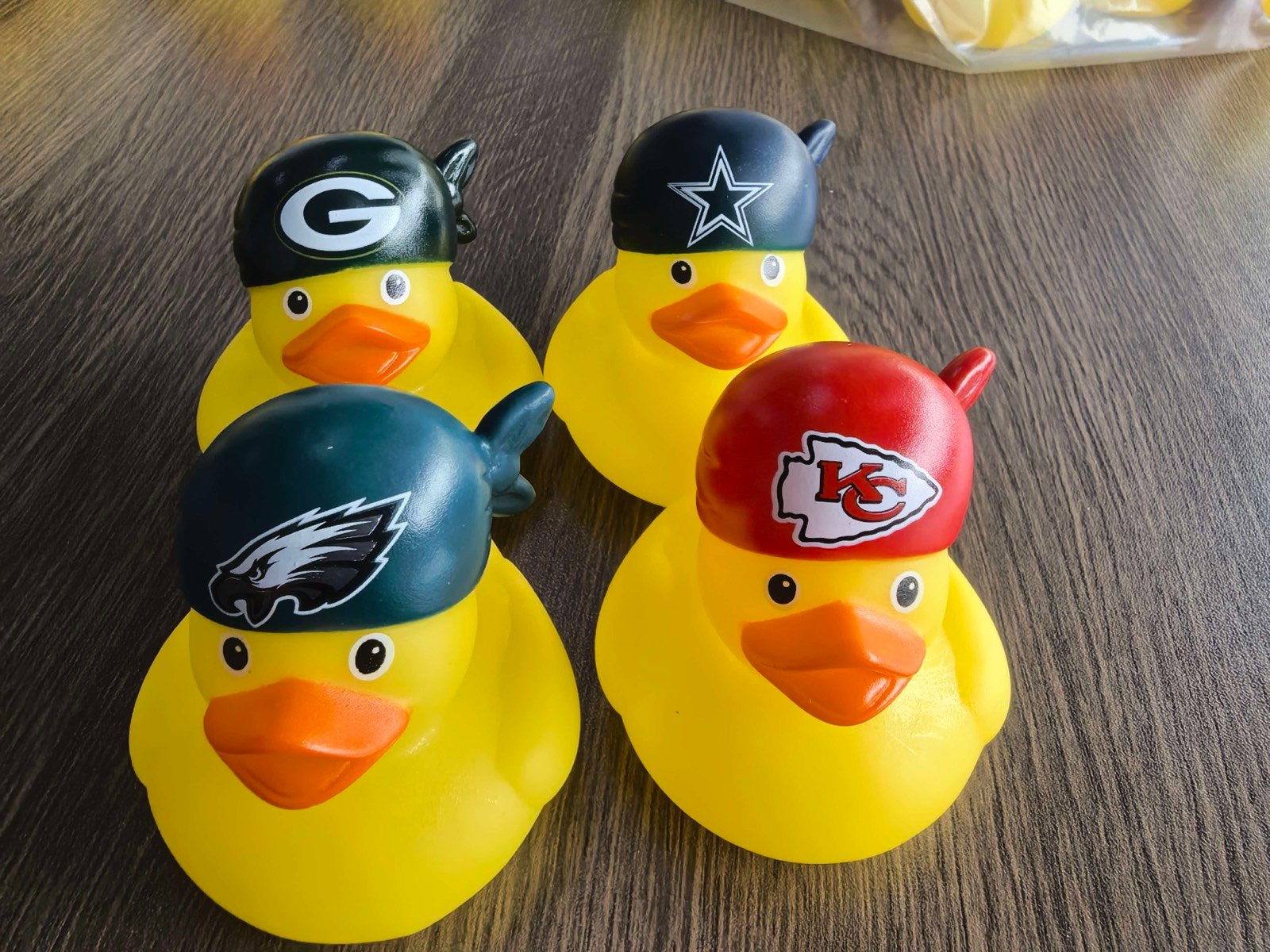
Custom molds allow operators to create exclusive duck designs that become part of their brand identity. A bowling alley chain, for example, might use a duck wearing a bowling shirt. A family entertainment center could create a mascot duck.
For operators not ready to invest in custom molds (typically $800-$1,500 per design), pad printing or UV printing on stock ducks offers a lower-cost alternative. Logo placement, team colors, and simple graphics can be applied at 300-unit minimums.
Wholesale Sourcing and Cost Breakdown
At scale (5,000+ units), standard 2-inch rubber ducks cost $0.15-$0.25 each FOB China. Custom colors add $0.03-$0.05 per unit. Custom molds amortize over the first production run — at 5,000 units, mold cost adds roughly $0.20 per duck to the first order, dropping to zero on reorders.
Shipping is economical: a 40-foot container holds approximately 500,000 2-inch ducks in retail poly bags. LCL shipments for smaller orders (5,000-20,000 units) add $0.02-$0.05 per unit depending on destination.
For additional reference, see the AMOA (Amusement & Music Operators Association).
Browse our full range of custom rubber ducks and request a quote for your next project.
Related Articles
- Rubber Duck Fundraiser Ideas
- Custom Rubber Duck Minimum Order Quantity
- Rubber Duck Material Safety Pvc Vs Vinyl
Frequently Asked Questions
What size rubber duck works best for claw machines?
Claw machine prize ducks should be 2-3 inches tall to fit standard gripper claws. Larger ducks (4+ inches) work better for ticket redemption counters where size has more visual impact.
What is the minimum order for custom arcade prize ducks?
Most manufacturers require 500-1000 units per design for custom molds. Stock designs with logo printing can start at 300 units. Lead time is typically 3-4 weeks for custom colors and 4-5 weeks for new molds.
Can arcade ducks be made with different weights?
Yes. Standard ducks are 25-35g. Heavier ducks (40-50g) feel more premium as prizes. Weight is adjusted by changing wall thickness or using denser PVC compound.
What safety standards apply to prize ducks?
In the US, CPSIA compliance is required for any product marketed to children under 12. This includes lead content limits (100ppm substrate, 90ppm paint) and phthalate restrictions (0.1% for 8 restricted phthalates). ASTM F963 toy safety testing is also recommended.
Ready to start your custom rubber duck project? Contact our team for samples, pricing, and production timelines.