Skip to content
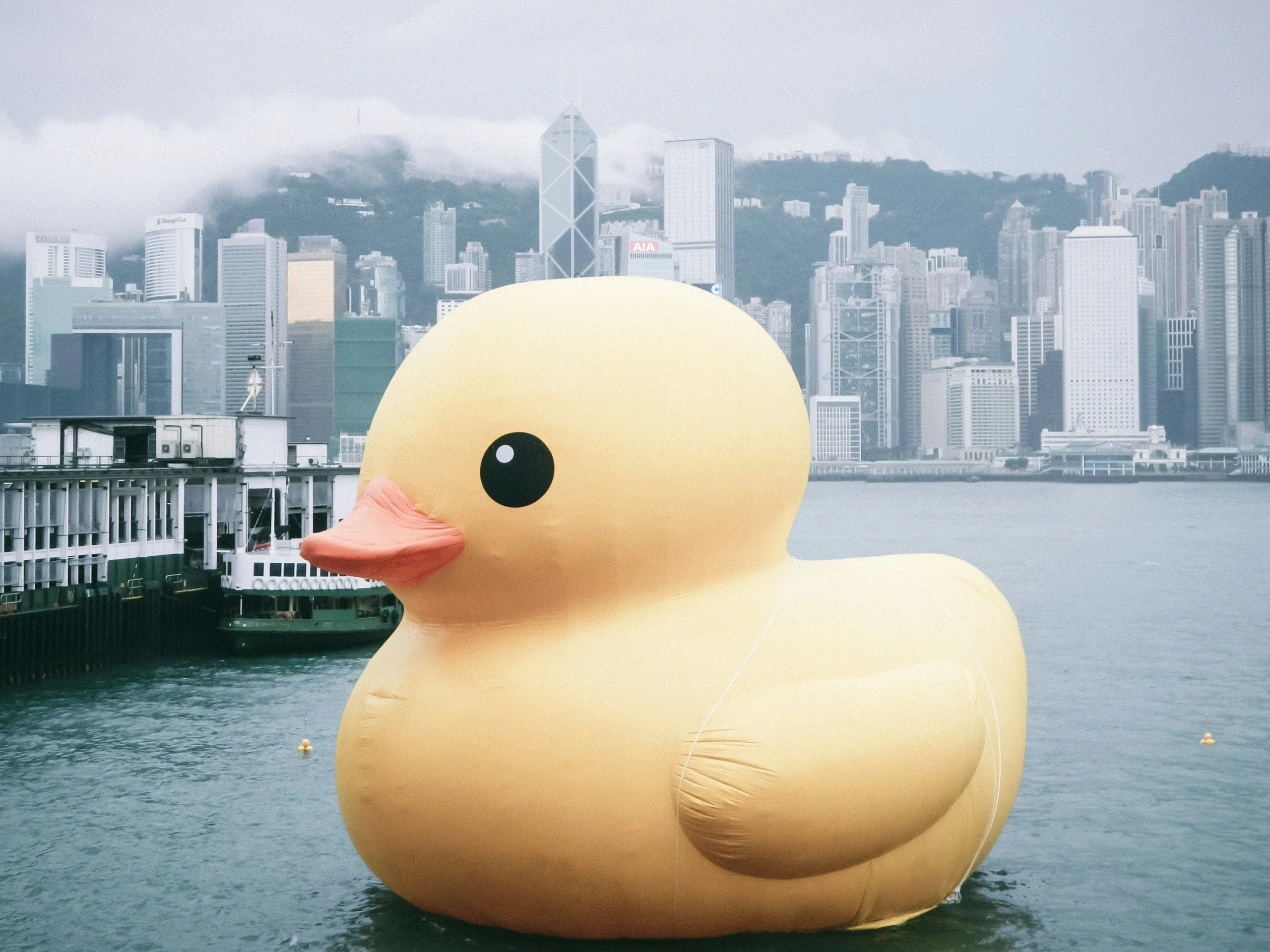
An event planner in Chicago nearly scrapped a waterfront activation last year because a large rubber duck arrived vacuum-compressed in a cardboard box. They thought the supplier shipped a dead product. That flat pack actually cut their freight volume by 60 percent. The actual disaster happened on site. The planner hadn’t budgeted for the extra 7 to 10 days factory engineers need to design internal PVC baffling, so they skipped that step entirely. Their centerpiece drooped on camera in a 15 km/h breeze because they brought a consumer blower instead of the required 1.5kW industrial unit.
You need to know if your activation requires a 9-inch solid giveaway or a 10-meter inflatable centerpiece, because those are two entirely different manufacturing processes. I pulled three years of factory test data on mold costs, material density, and shipping logistics to spell out exactly what you are buying. You will walk away knowing the real cost difference between rotational molding and heat-welded seam sealing, and why ignoring a 24-hour acclimation period will tear your PVC on deployment day.
Large Rubber Duck Size Classes
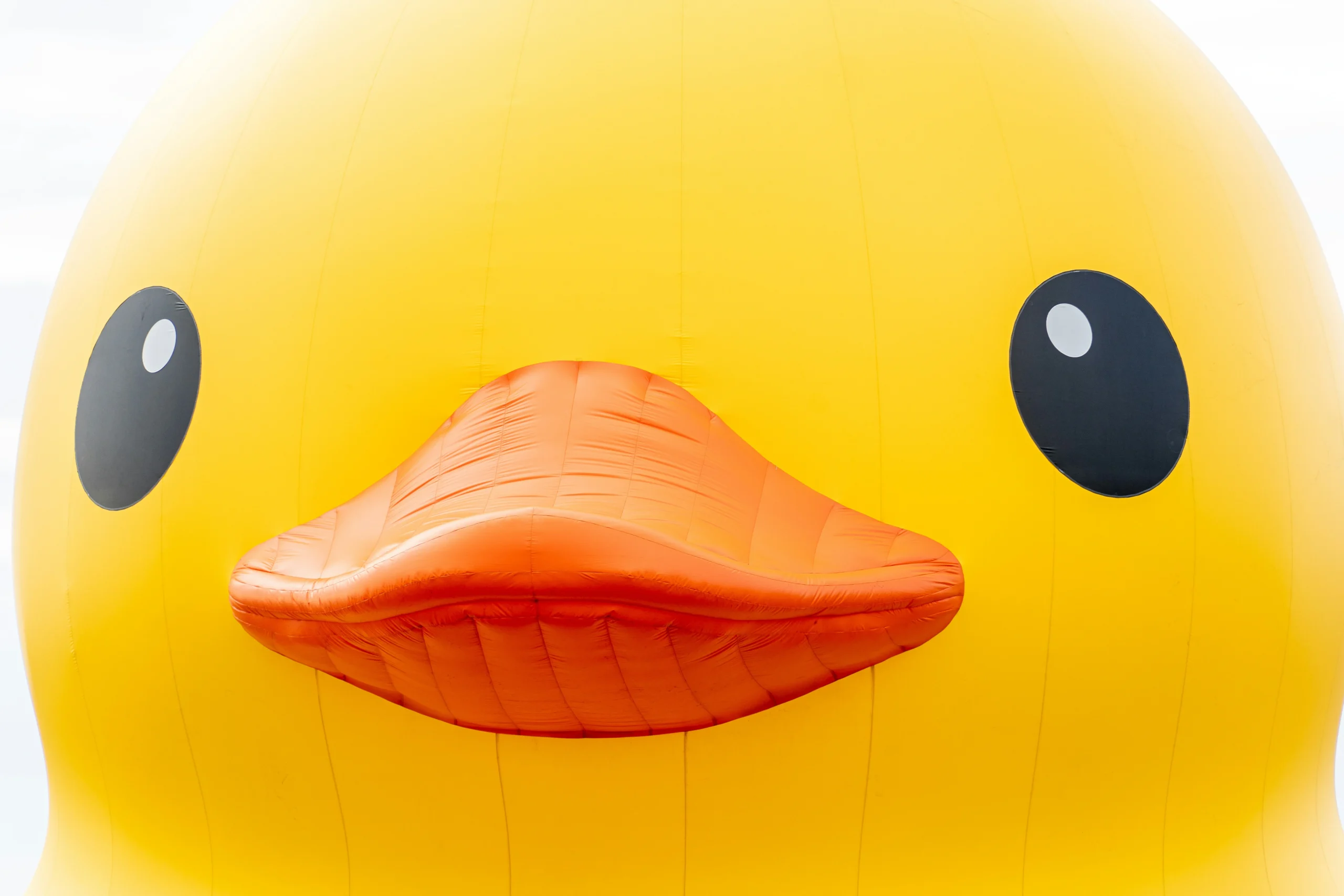
“Large” in B2B rubber duck procurement means two entirely different manufacturing processes — rotational molding for solid units versus heat-welded seam sealing for inflatables. Conflating them causes quote mismatches and event-day failures.
The Four B2B Size Classes
When an event planner searches for a “large rubber duck,” Google serves a mix of bath toy collectors and world record articles. On the factory floor, “large” is not a feeling — it is a millimeter specification tied to a specific production method. Here is how we categorize them internally.
- Mini (3″ / ~76mm): Standard bath toy scale, 2.0mm baseline wall thickness, roughly 25-30g per unit. Irrelevant for event installations but frequently ordered as add-on crowd giveaways alongside larger centerpieces.
- Standard (5-7″ / 127-178mm): The bulk promotional workhorse. Custom mold tooling at this scale runs approximately $1,200. Density is 0.85-0.95 g/cm³ with phthalate-free PVC meeting EN71-3 and ASTM F963 compliance.
- Jumbo Solid (9-11″ / 228-279mm): This is where the physics change. Our engineers found that jumbo solid ducks require +2mm wall thickness to prevent structural bending, increasing unit weight by roughly 40% compared to standard 5-inch ducks. Custom mold costs for jumbo solid ducks range from $3,500 to $8,000 due to multi-part rotational molding complexity.
- Giant Inflatable (2m-10m+): Constructed from 0.55mm PVC tarpaulin using heat-welded seam sealing — a completely different process from solid rotational molding. Units at 5 meters and above require continuous 1.5kW industrial blowers and internal PVC baffling to maintain shape in winds above 15 km/h. All sealed electric blower systems undergo 500V high-potential leak testing.
Why Millimeter Precision Prevents Quote Disasters
Most procurement briefs we receive state sizes in whole inches — “we need a 10-inch duck.” The problem is that a 254mm duck and a 279mm duck (roughly 10″ vs 11″) fall on opposite sides of a structural threshold. The 279mm unit requires that +2mm wall reinforcement, which adds approximately 40% to the unit weight. That weight difference directly alters your per-carton count, which shifts your freight quote, which blows out the budget line your client already signed off on.
We mandate millimeter-level specifications in every production order for this exact reason. A supplier quoting on “approximately 10 inches” is leaving enough variance to either under-spec the wall thickness or overcharge on shipping weight. Always request caliper verification photos from the factory before production sign-off.
There is a second timeline trap that catches event planners consistently. Standard factories quote 30-day lead times across the board, but oversized custom inflatables require an extra 7-10 days for structural engineering of the internal baffling system — a step most buyers never budget for. Missing those extra days means missing the extra 7-10 days.
| Size Class | Manufacturing Process | Technical Specifications | Logistics & Handling | Event Planner KPI Impact |
|---|---|---|---|---|
| Jumbo Solid (9-11 inches) | Rotational Molding | Phthalate-free PVC (EN71-3/ASTM F963), 0.85-0.95 g/cm³ density, +2mm wall thickness | Standard bulk freight; unit weight increases by ~40% compared to 5-inch ducks to prevent bending | Premium crowd giveaways maintaining strict brand consistency and structural integrity |
| Giant Inflatable (5 meters+) | Heat-Welded Seam Sealing | 0.55mm PVC tarpaulin, internal baffling, continuous 1.5kW industrial blower (500V leak tested) | Vacuum-compressed packing reduces freight volume by 60%; requires 24-48h acclimation to prevent tearing | High-impact visual centerpiece; maintains shape in 15+ km/h winds to protect social media impressions |
Solid PVC vs Inflatable Cost Specs
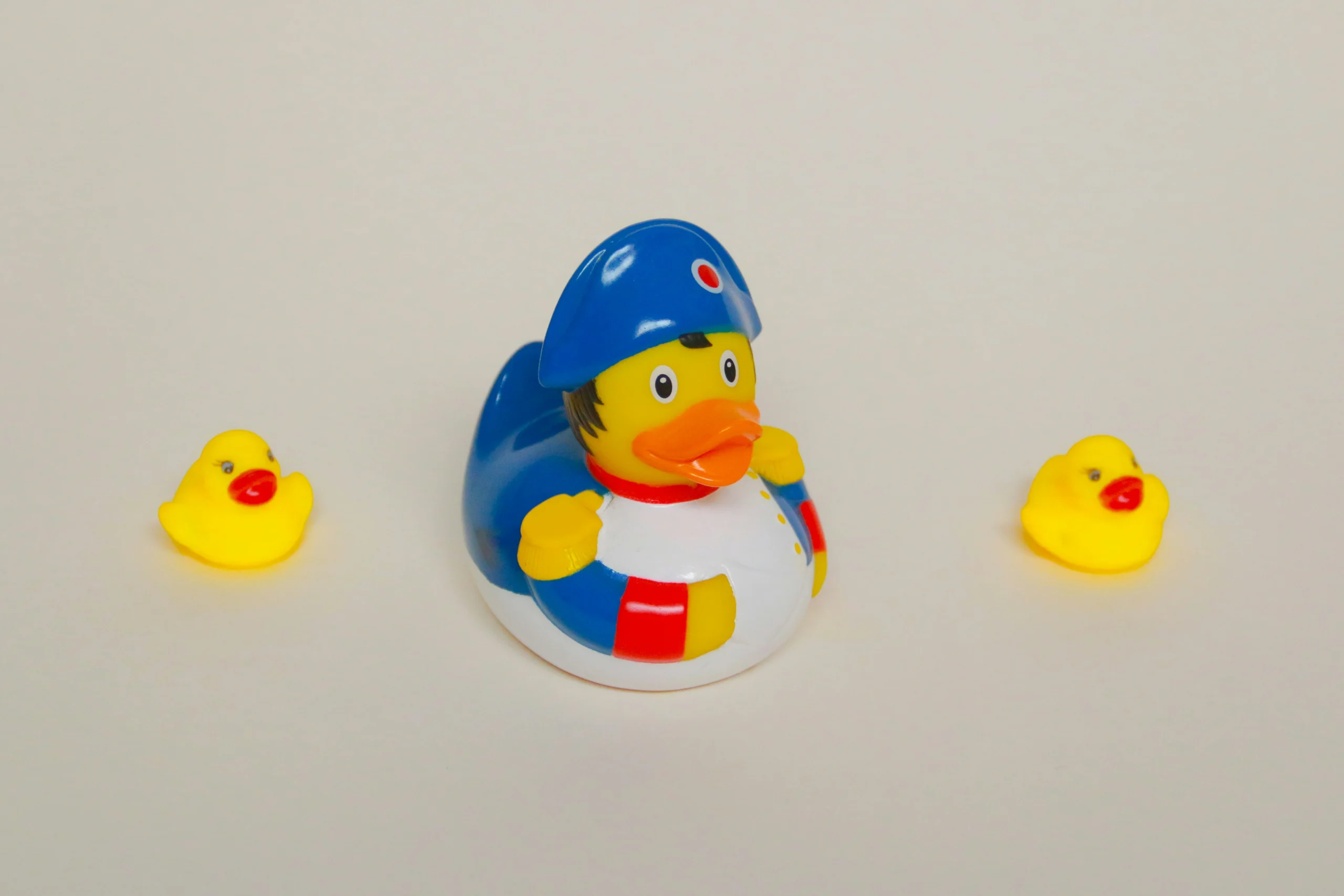
Solid PVC and inflatables are not size variants of the same product. They use entirely different manufacturing processes—rotational molding versus heat-welded seam sealing—and choosing the wrong format for your activation directly wastes budget and risks on-site structural failure.
Unit Weight, Thickness, Setup Time, and FOB Price Ranges
Most sourcing guides lump “large rubber ducks” into one category. That is factually wrong. A 9-inch solid PVC duck and a 5-meter inflatable share almost nothing in terms of production physics, compliance testing, or freight logistics. We run both lines, and the cost drivers diverge immediately at the material stage.
- Material Thickness: Jumbo solid ducks (9-11 inches) require a minimum +2mm wall thickness to prevent structural bending under their own weight. Commercial inflatables use 0.55mm PVC tarpaulin with internal baffling.
- Unit Weight: Solid ducks at 0.85-0.95 g/cm³ density weigh roughly 40% more than standard 5-inch ducks. A 10-inch solid unit averages 280-320g. A 5-meter inflatable shell weighs 45-60kg before the blower system is added.
- Setup Time On-Site: Solid ducks arrive deployment-ready—zero setup. Giant inflatables require 15-25 minutes for inflation and positioning, plus continuous power via a 1.5kW industrial blower once anchored.
- Custom Mold Cost: Giant solid ducks demand multi-part rotational molds ranging from $3,500 to $8,000. Standard-size molds run around $1,200. Inflatables use CNC-cut panel patterns instead of molds, eliminating this upfront cost entirely.
- FOB Price Range (MOQ 1000): Jumbo solid PVC ducks land between $1.80-$3.20/unit depending on print coverage. Giant inflatables (3-5 meters) range from $1,200-$3,500 per unit, with pricing driven by seam complexity and blower specifications.
Internal Steel Framing Requirements for Solid PVC Ducks Over 12 Inches
Here is a factory-floor reality that event planners almost never budget for: solid PVC ducks exceeding 12 inches cannot rely on hollow rotational molding alone. The wall thickness required to support a 12+ inch form without deformation would make the unit prohibitively heavy and create uneven cooling lines, ruining surface finish. Our engineers solved this by inserting an internal welded steel skeleton before the final PVC overmold.
This frame typically uses 3mm diameter galvanized steel wire for the vertical spine and wing supports, welded at junction points and coated with an anti-corrosion dip before insertion. The steel adds roughly 80-120g per unit depending on the pose complexity. Without this internal structure, a 12-inch duck placed outdoors in direct sunlight will gradually warp at the head and tail joints within 4-6 hours due to PVC softening at surface temperatures above 60°C. If a supplier quotes you a 12-inch solid duck with no mention of internal framing, request caliper verification photos at the neck joint—they are almost certainly cutting corners on structural integrity.
How Steel Framing Alters Logistics Costs
The steel skeleton changes your freight calculation in two ways. First, the added 80-120g per unit shifts your carton weight bracket. A standard export carton of 50 units moves from approximately 14kg to 18-20kg, which can push individual boxes over the 20kg manual-handling limit enforced by some European warehouses, forcing a repack at destination and adding $0.15-$0.30 per unit in handling fees.
Second, vacuum-compressed packing—the technique we use to reduce inflatable freight volume by 60%—does not apply to steel-framed solid units. The internal wire prevents compression. This means your per-cubic-meter shipping cost for steel-framed ducks runs roughly 35-45% higher than an equivalent volume of vacuum-packed inflatables. For a 20-foot container shipment, expect to fit approximately 30% fewer steel-framed solid units compared to standard hollow ducks. Factor this into your per-unit landed cost before committing to a 12-inch+ solid design for a high-volume event giveaway. If freight efficiency is critical and the duck serves as a visual centerpiece rather than a handheld item, the inflatable route almost always wins on total delivered cost.
| Specification | Solid PVC Jumbo | Giant Inflatable | Event Planner Impact |
|---|---|---|---|
| Material & Safety Compliance | Phthalate-free PVC, 0.85-0.95 g/cm³ density (EN71-3 / ASTM F963) | 0.55mm PVC tarpaulin, 500V high-potential leak tested blower systems | Eliminates safety and compliance liabilities for global brand activations. |
| Tooling & Engineering Cost | $3,500 – $8,000 custom mold (multi-part rotational molding complexity) | No hard tooling cost; requires +7-10 days for internal structural engineering | Solid demands higher upfront budget; Inflatable demands strict timeline padding to prevent late delivery. |
| Structural Durability | +2mm wall thickness (40% heavier than standard 5-inch ducks to prevent bending) | Internal PVC baffling + continuous 1.5kW industrial blowers | Solid prevents giveaway defects; Inflatable survives outdoor winds above 15 km/h without deflating on camera. |
| Freight Optimization | Standard bulk palletizing | Vacuum-compressed packing (reduces freight volume by 60%) | Inflatable slashes shipping costs by 40%, but requires a mandatory 24-48 hour acclimation period to prevent material tearing. |
| Activation ROI & KPI Value | Premium handheld crowd giveaway ensuring strict brand consistency | 2m-10m towering visual centerpiece installation | Solid drives direct crowd engagement; Inflatable maximizes social media photo impressions and event spectacle. |
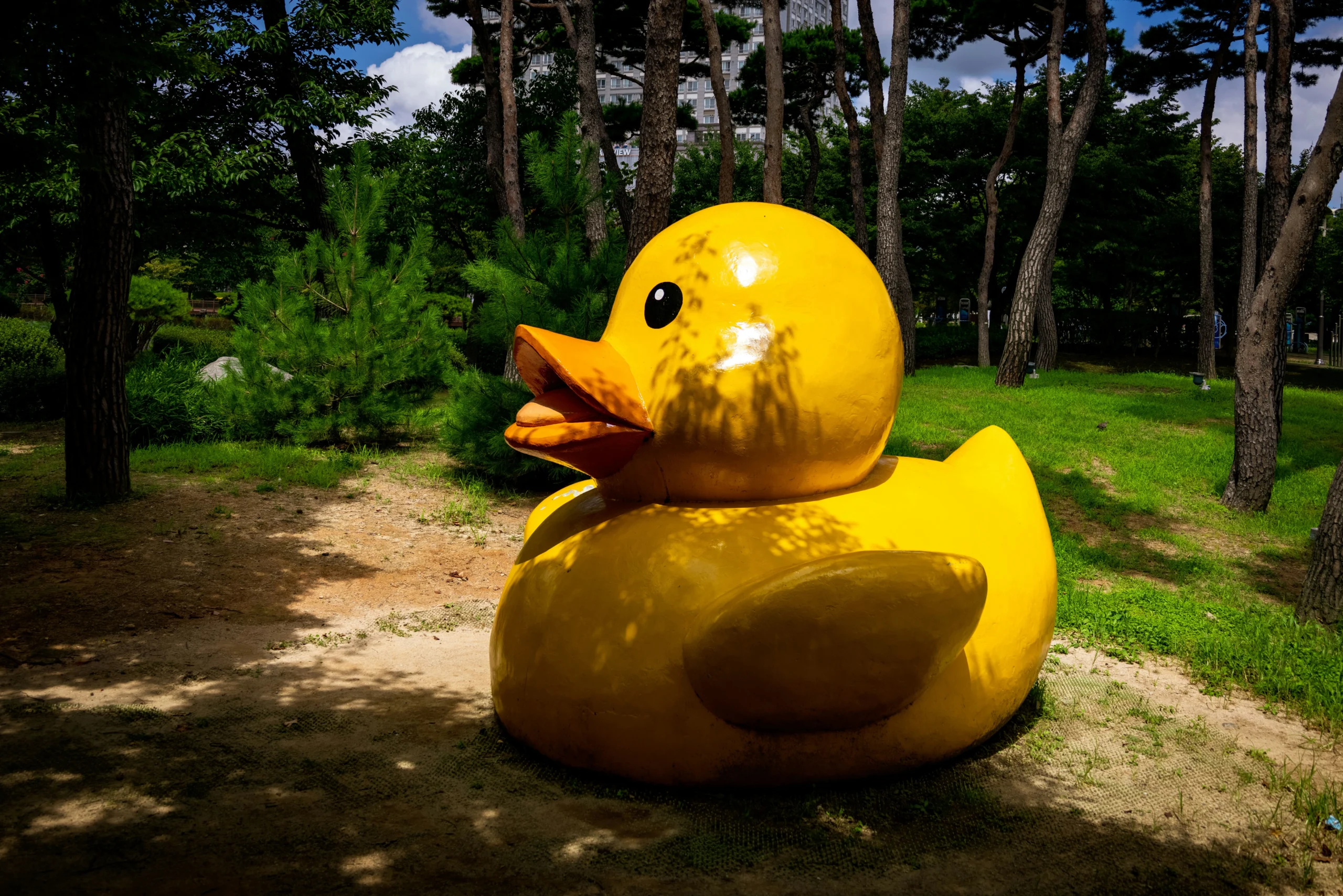
Mold Complexity & Cost Analysis
Mold cost is the line item that kills event budgets, not unit price. A $5,000 tooling fee on a single 1,000-unit run silently adds $5.00 to every duck.
Tooling Investment by Size Class
The SERP is flooded with consumer pricing for 3-inch bath ducks. Nobody is publishing actual B2B tooling brackets for oversized units. Here is what a custom large rubber duck MOQ 1000 run actually requires in mold investment, based on our production data from 5,000,000+ monthly units.
| Mold Type | Size Class | Tooling Cost | Engineering Driver |
|---|---|---|---|
| Standard Rotational | 5-inch solid PVC | $1,200 – $2,500 | Single-part cavity, 1.5mm wall standard |
| Custom Jumbo Rotational | 9-11 inch solid PVC | $3,500 – $8,000 | Multi-part cavity, +2mm wall thickness, 40% more raw material per cycle |
The jump from $2,500 to $3,500 is not arbitrary margin. Our engineers found that jumbo solid ducks (9-11 inches) require a minimum 2mm wall thickness to prevent structural bending under their own weight. That thicker wall forces a multi-part rotational mold design instead of a single-part pull, which directly drives the tooling cost up by 40-220%.
Mold Amortization for Event Planners
Event planners budget in total project cost, not per-unit tooling allocation. This is where budgets silently bleed. The table below shows the true per-unit tooling burden at different order volumes for a mid-range jumbo mold priced at $5,000.
| Order Volume | Mold Cost ($5,000) | Per-Unit Tooling Burden | Planner Reality Check |
|---|---|---|---|
| 1,000 units | $5,000 | +$5.00 / unit | Often exceeds the base unit cost itself |
| 3,000 units | $5,000 | +$1.67 / unit | Manageable, but still a visible line item |
| 5,000 units | $5,000 | +$1.00 / unit | Negligible impact on total project budget |
| 10,000 units | $5,000 | +$0.50 / unit | Effectively amortized — reusable asset |
The mold is a reusable asset. We store custom tooling for 24 months at no charge. If you are an agency sourcing for a recurring annual activation, that $5,000 mold pays for itself by the second order. The large rubber duck bulk order cost on repeat runs drops to pure unit price plus materials.
One-Off Events vs. Recurring Campaigns
This is the decision point where most event planners make the wrong call. For a single brand activation with no planned sequel, a $5,000 mold on a 1,000-unit order means you are paying $5.00 per duck before a single gram of PVC is injected. At that volume, the total project cost per unit often lands 30-40% higher than the client was quoted internally.
For recurring campaigns — annual conferences, seasonal pop-ups, multi-city roadshows — the math flips hard. On the second run of 3,000 units, your per-unit tooling burden collapses from $5.00 to $1.67. By year three, the mold is a sunk cost and your unit pricing sits below what any competitor can offer on a fresh tooling job. We have agency clients who amortized a custom giant rubber duck for events across four city activations in one quarter, driving the per-unit tooling cost below $0.40.
The practical rule: if you cannot commit to at least 3,000 units across a 12-month window, request a stock mold modification (logo pad print or decal) instead of a full custom sculpt. You sacrifice sculpt uniqueness, but you eliminate the tooling line item entirely and keep the large rubber duck bulk order cost within a defensible budget range for a single-event planner.
| Duck Size Class | Molding Process | Custom Mold Cost | Engineering Complexity | Procurement Insight |
|---|---|---|---|---|
| Standard (3-5 inches) | Standard Injection | $1,200 | Low (Single-part cavity) | Baseline cost for bulk promotional giveaways; fastest turnaround. |
| Jumbo Solid (9-11 inches) | Multi-part Rotational Molding | $3,500 – $8,000 | High (+2mm wall thickness) | Prevents structural bending; expect a 40% increase in unit weight versus standard sizes. |
| Giant Inflatable (2m-10m) | Heat-Welded Seam Sealing | $0 (Pattern/Engineering Fee) | High (Internal PVC baffling) | Requires 7-10 extra days for structural engineering; standard 30-day factory quotes will miss your event. |
| Full Event Activation | Dual-Process (Solid + Inflatable) | $4,700 – $8,000+ | Extreme | Consolidates suppliers to guarantee brand consistency between crowd giveaways and the visual centerpiece. |
Event Logistics & Installation Factors
A 5-meter inflatable duck ships at 1,800 kg dimensional weight but weighs 45 kg actual. If your logistics team doesn’t understand that gap, your freight budget is already broken.
Dimensional Weight: The Freight Trap Planners Never See Coming
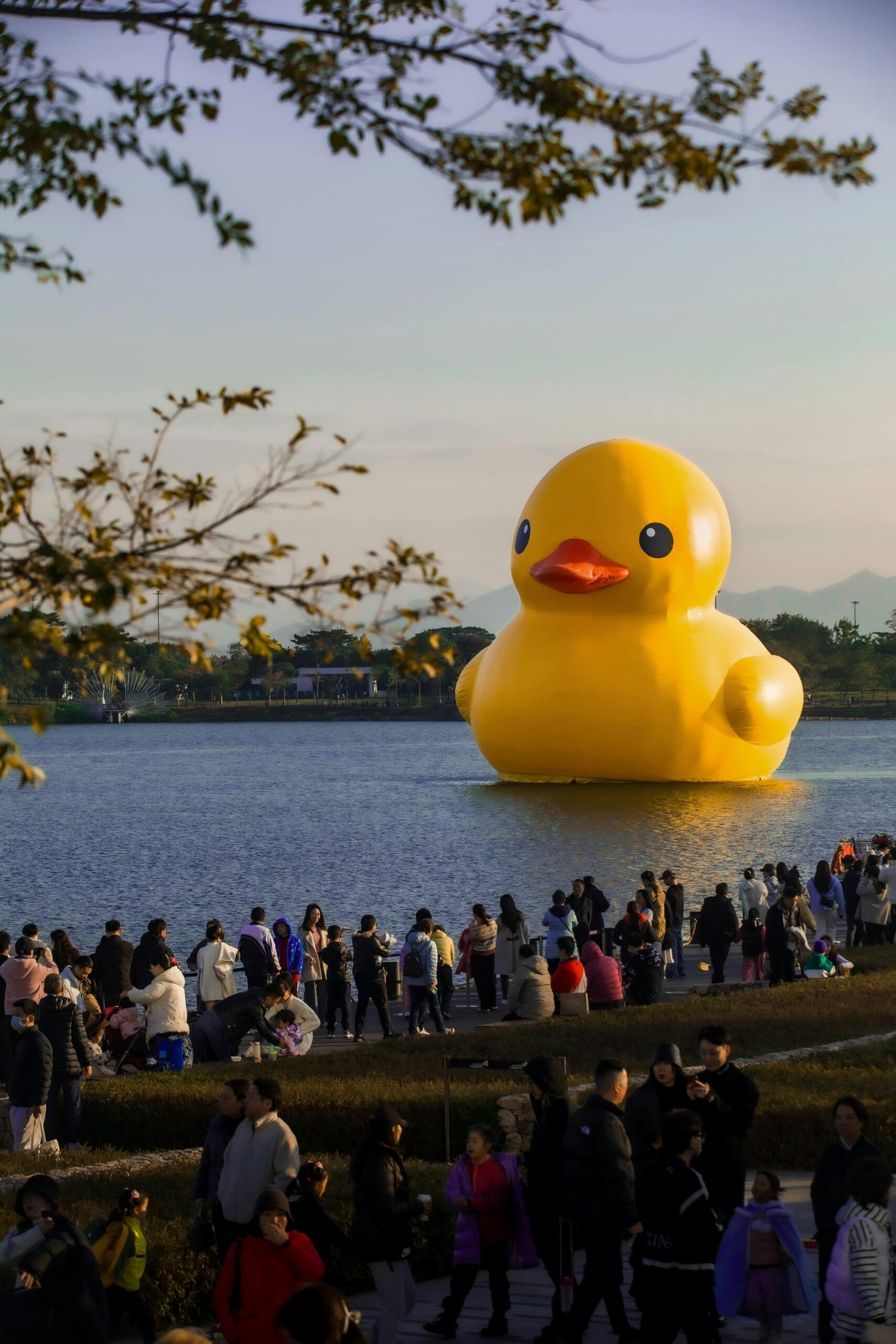
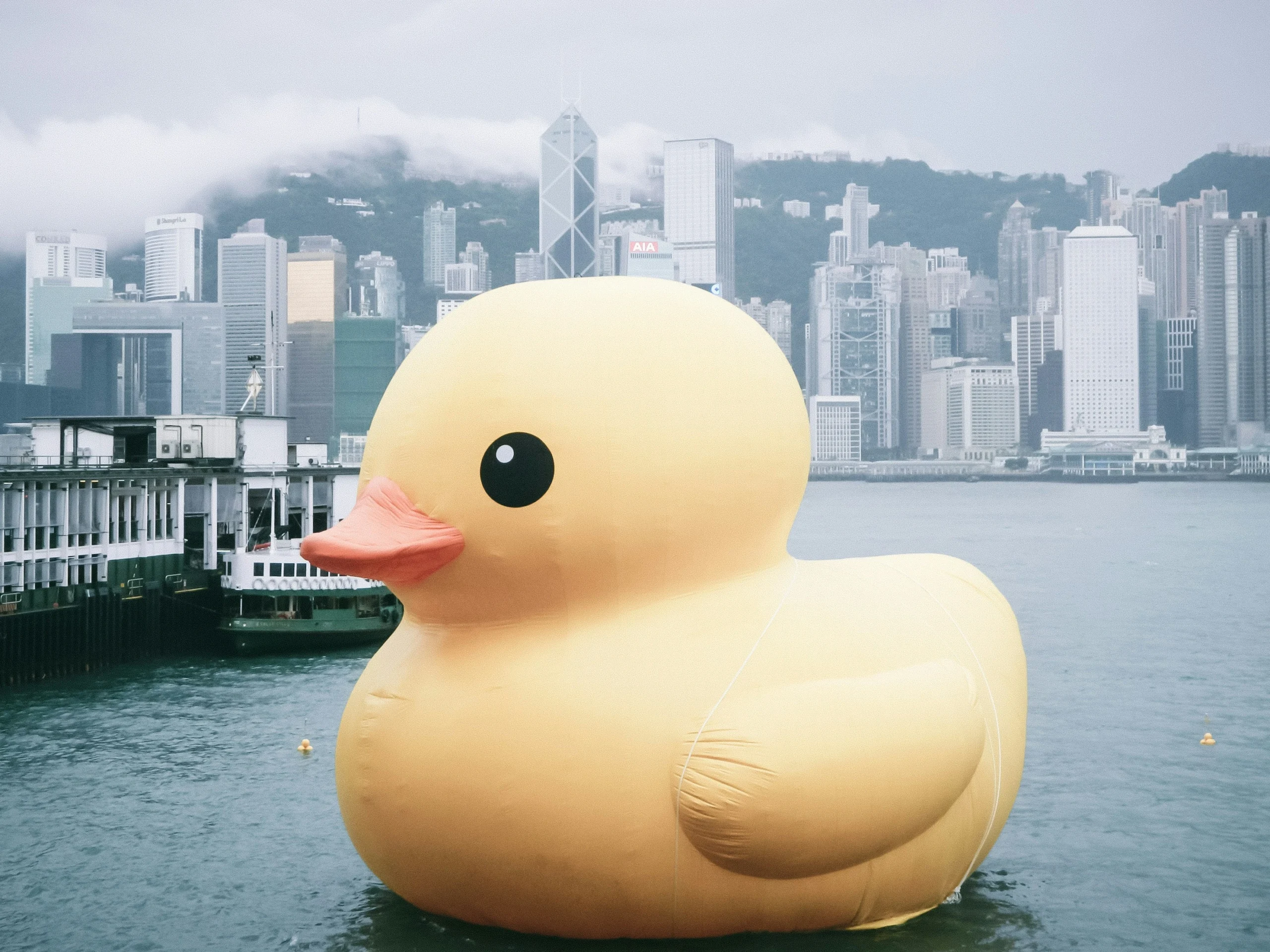
Most event planners budget freight based on actual weight. For oversized inflatables, that assumption destroys budgets. Air freight carriers calculate charges using dimensional weight (DIM weight), which factors in package volume. A 5-meter custom giant rubber duck for events packs down into roughly 4-6 cartons, but the combined cubic volume triggers a dimensional weight around 1,800 kg — while the actual 0.55mm PVC tarpaulin weight sits closer to 45 kg. You pay air rates on the higher figure.
Our logistics team uses vacuum-compressed packing for giant inflatables, which reduces freight volume by 60% compared to loose folding. This is not a defect. B2C guides incorrectly warn that “flattened ducks on arrival” are damaged goods. In B2B manufacturing, vacuum compression is a deliberate freight optimization that can save thousands on a single shipment. The trade-off: the PVC material needs a 24-48 hour acclimation period at room temperature before deployment. Unpack it and inflate immediately, and the cold-folded seams will tear under internal pressure.
Blower Requirements: Power Planning Planners Forget
Giant inflatables (5 meters and above) require continuous 1.5kW industrial blowers to maintain structural integrity. This is not a one-time inflation — the blower runs for the entire event duration. Our engineers specify internal PVC baffling inside all inflatables above 5m to distribute air pressure evenly and hold shape in winds above 15 km/h. Without baffling, the duck bill sags and the body deforms within 20 minutes of moderate gusts.
Every blower system we ship undergoes 500V high-potential leak testing for sealed electrical safety in outdoor environments. For event planners, the practical implication is direct: you need a dedicated 220V power source within 15 meters of the installation point, confirmed with the venue at least two weeks before load-in. Generator rental adds $200-400 per day depending on your market. Build that line item into the client budget upfront, not as a day-of emergency.
Anchor Point Engineering: Stopping the Deflation Disaster
A giant duck collapsing on camera is the event planner’s worst nightmare, and it almost always traces back to inadequate anchoring. Outdoor installations require engineered anchor systems — not sandbags tossed at the base. Our structural team calculates anchor loads based on the inflatable’s wind profile at the specific site. For a 5-meter duck, we specify a minimum of 6 ground anchor points using D-ring attachment points welded into the PVC base, each rated for 150 kg pull force.
- Concrete surfaces: Expansion bolts with heavy-duty carabiner clips rated to 150 kg per point
- Grass or soil: Earth screw anchors driven to a minimum 40 cm depth, with pull-testing on-site before rigging
- Hardstanding (tile/asphalt where drilling is prohibited): Water ballast barrels rigged to D-rings, minimum 25 kg per barrel
Standard factories ship inflatables with basic tie-down loops and zero engineering documentation. We include a site-specific anchor diagram with every oversized order. Skip the engineering, and a 20 km/h gust — well within normal weather variance — will drag a 5-meter duck across a plaza and straight into your client’s liability claim.
Why Brand-Restricted Suppliers Fail
A customs seizure 72 hours before your activation date doesn’t just kill the event — it sinks the $3,500 to $8,000 mold fee with zero recourse.
How “Brand-Restricted” OEM Factories Trap Buyers
Most event planners sourcing a custom giant rubber duck for events don’t realize that a significant portion of Chinese OEM rubber duck factories operate on dual-track production lines. By day, they produce legitimate promotional merchandise. Off the books, they run unlicensed knockoffs of copyrighted characters — Disney, Sanrio, Peppa Pig — using the same rotational molding equipment. The factory doesn’t tell you this. The risk only materializes when your container gets flagged.
We’ve seen this trap close on buyers who sourced jumbo solid ducks (9-11 inches) from factories offering suspiciously low unit prices — typically 30-40% below market. The factory recoups margin by mixing your legitimate order with infringing SKUs in the same shipping container. Customs doesn’t inspect individual cartons; they flag the entire bill of lading. Your compliant, phthalate-free PVC ducks get seized alongside the knockoffs.
IP-Infringing Promo Merch: The Real Financial Fallout
The consequences of importing IP-infringing promotional merchandise extend far beyond losing the shipment. For an event planner, the damage cascade looks like this:
- Total shipment forfeiture: U.S. Customs and Border Protection (CBP) does not return seized goods. Your entire bulk order — including compliant items — is destroyed or auctioned.
- Secondary supplier scramble: A standard 30-day production lead time plus 15-day ocean freight means you cannot replace a seized order in time for an immovable event date.
- Client contract liability: Most agency and planner contracts carry penalty clauses for failed deliverables. A $15,000 duck order seizure can trigger $50,000+ in downstream breach-of-contract damages.
- Future inspection flagging: CBP’s automated targeting system links your importer ID to the violation. Your next five shipments — even from different suppliers — face elevated inspection rates, adding 3-7 days to every future customs clearance.
We require a signed IP compliance declaration from every client and run internal design clearance checks before tooling begins. This adds 48 hours to the front end but eliminates the seizure vector entirely. Most budget-focused suppliers skip this step because it costs them deals with buyers who just want the cheapest price.
Customs Seizure Risks Specific to Live Events
Live event activations create a uniquely dangerous import scenario because the timeline is absolute. A trade show booth doesn’t reschedule. A city festival doesn’t wait. When an event planner orders a large rubber duck bulk order for a specific date, the logistics chain has zero slack. This is exactly where brand-restricted suppliers cause catastrophic failures.
Giant inflatables (5 meters and above) are particularly vulnerable because they require continuous 1.5kW industrial blower systems that must pass 500V high-potential leak testing. A factory cutting corners on electrical compliance to reduce costs will fail CBP’s mandatory safety spot checks. For sealed inflatables, customs inspectors can and will cut open heat-welded seam seals to verify internal PVC baffling and 0.55mm tarpaulin thickness claims. If the factory substituted thinner material, the duck is seized and your centerpiece installation is gone.
The practical safeguard is straightforward: demand a pre-shipment inspection (PSI) report from a third-party firm like SGS or Intertek, with the inspection performed at the factory before the container is sealed. Any legitimate custom rubber duck manufacturer will accommodate this. A supplier who resists or claims “it’s not necessary” is the clearest available signal that something in that container won’t survive customs scrutiny.
Conclusion
If your activation is outdoors, spec the heat-welded inflatable over the solid 11-inch duck. Period. Solid PVC units over 9 inches need thicker walls just to prevent bending, while a 5-meter inflatable with internal baffling drives ten times the photo impressions for a lower freight cost. Just budget that extra 7-10 days for structural engineering, or your centerpiece folds on camera.
Before you sign off on any giant inflatable quote, ask the supplier for the 500V high-potential leak testing report for their sealed blower systems. A cheap blower kills the event. Get that documentation, then compare it against your venue’s power restrictions.
Frequently Asked Questions
What does gifting a rubber duck mean?
In consumer culture, gifting a rubber duck symbolizes good luck, positivity, and playful energy. For brand marketers, however, it serves as a highly effective tactile anchor for campaign messaging. Distributing a custom rubber duck creates significantly higher social media shareability compared to standard promotional items like pens or tote bags. Ultimately, this translates to greater organic brand visibility and a higher return on your promotional investment.
What makes a rubber duck collectible?
While vintage models are historically recognized for their unique markings, B2B buyers can learn from their success in the collector market. This legacy highlights the critical importance of distinct intellectual property and bespoke branding in manufacturing. To make your custom OEM duck a true collectible rather than a disposable novelty, it requires a unique sculptural identifier. Our factory specializes in developing these custom molds at a 1,000-unit MOQ, ensuring your brand’s duck stands out.
What are key rubber duck facts?
Originally introduced in the 1800s as solid rubber chew toys, rubber ducks have evolved significantly into the hollow, floating promotional items we know today. The major manufacturing shift from hard rubber to modern injection-molded PVC completely revolutionized the industry. This advancement is exactly why our facilities can efficiently produce complex, large-scale custom shapes at a 1,000-unit MOQ. Consequently, global brands no longer face exorbitant tooling costs to bring highly detailed promotional concepts to life.
What is the rubber duck problem?
While software engineers use the term to describe a coding debugging method, B2B sourcing faces an entirely different rubber duck problem. This issue occurs when buyers mistakenly assume all rubber ducks are manufactured using identical structural specifications. For example, ordering a large promotional duck using the physical specs of a standard bath toy will result in bent necks and high defect rates. Our engineering team mitigates this by custom-calibrating the PVC wall thickness and weight distribution for every custom order.
Do rubber ducks offer good ROI?
While limited-edition models can appreciate in value for individual collectors, B2B buyers should evaluate worth through the lens of cost-per-impression. A strategically designed custom rubber duck acts as a powerful magnet for organic event photography and user-generated content. When compared to traditional paid digital ad clicks in experiential marketing, this organic reach often yields a significantly lower cost-per-impression. Backed by our monthly output of over 5,000,000 units, we ensure scalable quality that protects and maximizes your marketing ROI.
Related B2B sourcing page: For production options, MOQ and custom project support, see our custom rubber ducks page.