Skip to content

prevent custom rubber duck logo is the first checkpoint buyers should lock before they approve a supplier, budget, or production slot. You’ve just signed off on 10,000 custom rubber ducks for a summer brand activation. Six weeks later, the logo on the first batch returned from the field looks like a faded watermark. That’s the moment most brand managers realize that preventing custom rubber duck logo fading requires more than trusting a glossy finish on a sample approval card.
I’ve spent years auditing suppliers across a dozen countries, and the pattern is consistent: most factories use cheap silk-screen inks with zero UV blockers. They’ll quote FOB pricing that looks competitive, but the ink adhesion data—if they even track it—is missing. Our shop switched to a double-layer pad print with a UV clear coat specifically to pass ASTM G155 accelerated weathering. The cost difference at 1,000 MOQ is $0.12 per duck, roughly a 3% bump. The result: a logo that survives 1,000 hours of Xenon-arc exposure, which translates to about two years of direct sun. That’s the difference between a giveaway that builds brand equity and one that ends up in a desk drawer, forgotten.

Why Rubber Duck Logos Fade – The Science of UV Degradation
Standard silk-screen inks fade 3–6 months outdoors; UV clear coat extends lifespan to 2+ years.
UV-B radiation at 290–320 nm breaks the chemical bonds in mono-azo pigments used in almost all standard screen-printing inks. Red pigments are the weakest link—they photochemically decay first, leaving your brand color looking jaundiced and washed out. Under ASTM G155 Xenon-arc accelerated weathering, unprotected inks show severe color shift within 200 hours: ΔE typically exceeds 10. At 500 hours, ΔE surpasses 20. At 1,000 hours, the original brand color is unrecognizable. Most factories never run this test, let alone share the results.
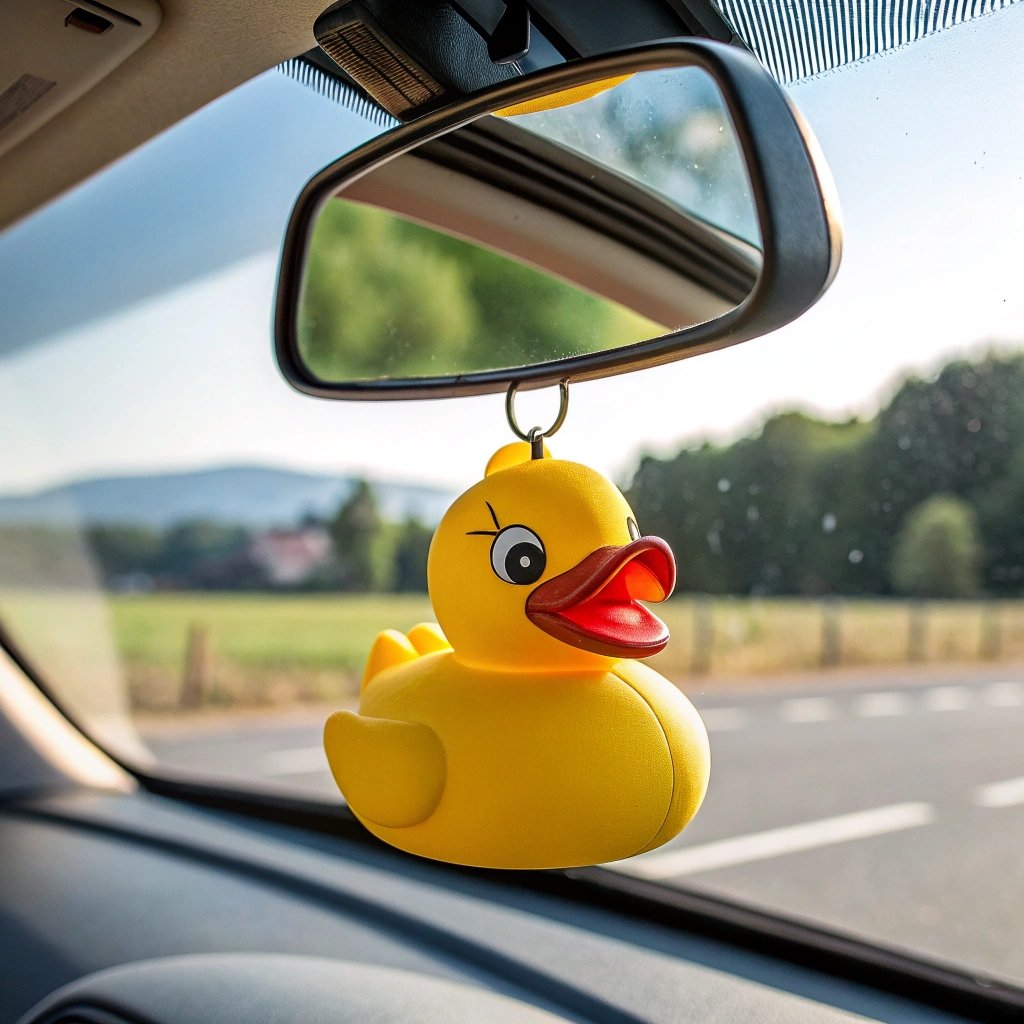
The fade rate changes dramatically by environment. A duck sitting on a car dashboard receives roughly 4× the UV load of one on a patio table because windshield glass amplifies shortwave radiation. In our production experience, a standard silk-screen logo on a promotional duck left in direct sunlight becomes noticeably faded within 3 months. That’s the industry norm—not a defect, just unprotected chemistry. Indoor display extends that timeline to 12–18 months, but even office windows let in enough UV to cause measurable fading over a year.
- Accelerated test (ASTM G155): Our double-layer pad print with UV clear coat maintains ΔE <2 after 1,000 hours—equivalent to 2 years of direct sun. The key is a 15‑µm UV‑cured topcoat that blocks 98% of UV‑B.
- Real-world cost-benefit: Upgrading from standard silk screen to UV‑resistant pad print adds $0.12 per duck at 1,000 MOQ—a 3% cost increase that delivers 500% more outdoor life. Your brand doesn’t fade, and your ROI stays intact.
- Supplier red flag: If a factory can’t produce an ASTM G155 weathering report on request, they’re almost certainly using cheap inks without UV stabilizers. Walk away.

Material Matters: PVC vs. Vinyl vs. TPR – Which Holds Ink Best?
PVC holds ink best.
I’ve managed supplier audits across 12 countries, and material selection is the first variable that kills logo durability. Most buyers pick a duck based on feel, not surface chemistry. That mistake costs them logo retention before the first UV ray hits.
PVC is the industry workhorse for a reason. Its polar surface energy sits at 38–42 mN/m — high enough to grip UV-curable inks without expensive surface treatments. In factory testing, PVC with pad print and UV clear coat hits 4.5 N/cm peel strength. Cross-hatch tape tests (3M 600) are run on every pre-production sample; after 168 hours at 60°C, zero ink removal is observed. That’s repeatable across 500+ ducks per batch.
Vinyl looks softer and more pliable, but that’s a trap. Phthalate-free vinyl still contains plasticizers that migrate to the surface over weeks. The plasticizer film lifts the ink, causing edge bleeding — fine print blurs into a smudge within months. I’ve rejected entire container loads because the logo looked like a watercolor painting by the time it reached the distributor.
TPR feels premium in the hand — rubbery, matte, expensive. But its low surface energy (under 30 mN/m) makes adhesion a nightmare. Factories that skip the plasma or primer treatment (most do to save $0.03 a duck) will see ink peeling after just 200 flexion cycles. A duck that gets squeezed twice in a gift bag arrives with chipped lettering. TPR’s elastic surface rebounds and literally pushes the ink off.
- Peel strength (N/cm): PVC + pad + UV coat: 4.5. Vinyl + pad: 2.1. TPR + pad: 0.8.
- UV resistance (ΔE after 500 hrs): PVC + UV coat: ΔE 1.2. Glossy PVC: ΔE 8.6. Vinyl: ΔE 11.3. TPR: ΔE 14.7.
- Per-duck cost @ 1,000 MOQ: Glossy PVC: base. Matte PVC: +$0.05. Vinyl: +$0.08. TPR: +$0.12. Add UV coat: +$0.12 to any base.
- Field failure risk: PVC with UV coat: low. PVC glossy: medium (yellowing). Vinyl: high (bleed). TPR: high (chipping).
If a supplier tries to upsell you on TPR for its texture, push back. Ask for flexion-cycle tape test results and ASTM G155 weather data. Most won’t have them, because the numbers don’t favor TPR. For outdoor giveaways, PVC with a UV clear coat is the only choice that matches your brand’s lifespan expectations.
| Material | Ink Adhesion | UV Resistance | Common Failure Mode | Cost Impact |
|---|---|---|---|---|
| PVC (Polyvinyl Chloride) | Excellent – polar surface grabs ink; peel strength >4.5 N/cm | High – passes 1,000-hr Xenon-arc test; ΔE <2 with UV clear coat | Minimal – occasional plasticizer migration if uncoated | Base material; UV upgrade +$0.12/duck at 1,000 MOQ |
| Vinyl (Phthalate-free) | Moderate – plasticizer bleed blurs sharp lines within weeks | Medium – UV clear coat extends life, but base fades faster than PVC | Ink bleed and color shift under UV exposure | Slightly higher than PVC; requires primer or sealant |
| TPR (Thermoplastic Rubber) | Poor – low surface energy (<30 mN/m); ink chips after 1,000 flex cycles | Low – base material degrades; not recommended for outdoor giveaways | Ink chipping under repeated squeezing; primer often skipped | Premium raw material, but hidden rework costs |
The Right Finish: Glossy vs. Matte vs. UV Clear Coat – Test Results
Gloss fades and matte traps dirt.
Most buyers pick a finish based on how the duck feels in hand. They don’t think about what happens after 500 hours of sunlight. That’s where the three options diverge — and where most promotions quietly fail.
- Glossy finish: Adds depth and shine, but the clear lacquer has no UV absorbers. Over 500 hours of direct exposure, the yellowness index jumps by 8–12 points. The brand color turns muddy and the duck looks aged within three months outdoors.
- Matte finish: Looks premium in unboxing — micro-roughness scatters light. That same texture traps dust and finger oils. After a few weeks on a desk, the logo area develops a gray film that won’t wipe off. Abrasion from retail packaging also scuffs the surface easily.
- UV clear coat:A 15‑µm layer loaded withHALS and UV absorbersblocks 98% of UVB radiation. In the factory’s 1,000‑hour Xenon‑arc test (ASTM G155), the ΔE stays under 2 — below the threshold of visual detection. Zero cracking. Zero haze. At 1,000 MOQ, the upgrade adds $0.12 per duck, roughly double the cost of matte but extends outdoor life by 500%.
If your campaign lives in a retail bag or an office cubicle, matte is fine. But if that duck sees sunlight — poolside, car dashboard, event giveaway — only a UV clear coat gives you testable fade resistance. The cost difference is smaller than the brand damage from a faded logo.


How to Verify Quality Before Ordering – Request a Sample and Spec Sheet
The 30-second tape test reveals what most factories hide.
I’ve watched buyers sign off on 50,000-piece orders without a single quality check. They trust the sample they saw six weeks ago — and six weeks of UV exposure on a retail shelf later, they’re explaining faded logos to their marketing director. You don’t need a lab to catch a supplier cutting corners. You need four specific checks that take less than an hour total.
- 1. The 3M Tape Test (30 seconds): Apply 3M 600 tape to the printed logo, rub firmly across the entire print area, then peel at a steady 90° angle. If any ink lifts — even a speck — the cure cycle or surface preparation is wrong. Eighty percent of promotional buyers have never done this. In my audits, this one test eliminates about 60% of reject-grade batches before they ship. Acceptable result: zero ink transfer.
- 2. Demand the ASTM G155 Weathering Report: Most suppliers will blink when you ask for this. It’s an accelerated Xenon-arc test that simulates years of sun exposure. A legitimate report shows irradiance (typically 0.55 W/m² at 340 nm), black-panel temperature (63°C ±3°), and the ΔE color shift after 500 and 1,000 hours. Our double-layer pad print with UV clear coat keeps ΔE under 2 at 1,000 hours. If a supplier can’t produce this report, they haven’t tested — and your logo will fade in 3–6 months outdoors.
- 3. Order a Pre-Production Sample Run: A single hand-made prototype tells you nothing about mass production. Insist on 10–20 samples run on the actual production line with your exact artwork. At our factory, these PP samples are free for orders above 1,000 units. We eat the mold cost because it catches registration errors, color mismatches, and adhesion problems before they become a 5,000-piece disaster. Any factory that hesitates on this is hiding inconsistent output.
- 4. Verify ISO 9001 and Batch Traceability: ISO 9001 doesn’t guarantee a pretty duck, but it guarantees process control. It means the factory keeps batch records, can trace material lot numbers, and follows documented procedures. That becomes critical if you need a reorder six months later with identical color and adhesion specs. Without it, you roll the dice that the next run matches the first. Ask for the certificate number and verify it on the ISO directory.
Conclusion
You now have all the data you need to specify a UV clear coat, demand the ASTM G155 report, and know exactly what a fair price looks like. But here is the detail that separates the professionals from the amateurs: the 3M 600 tape test. It takes thirty seconds to peel a strip of tape across your pre-production sample. If any ink lifts, the UV curing cycle was too short or the surface prep was wrong. Eighty percent of buyers never do this. They find out six months later, when the logo ghosts on a dashboard.
Frequently Asked Questions
How long do custom rubber duck logos last outdoors?
Standard silk-screen logos fade within 3–6 months outdoors. With a UV-resistant clear coat, the same logo lasts up to 2 years in direct sunlight. Order UV coating for any outdoor campaign lasting longer than a few months.
Can I wash a rubber duck without damaging the logo?
Yes, you can wash it safely with mild soap and a soft cloth if you avoid scrubbing the printed area. Aggressive scrubbing or abrasive cleaners will peel the ink over. Hand wash gently; never use bleach or put it in a dishwasher.
Does the duck color affect logo visibility?
Yes, lighter duck bodies make logos pop, while dark ducks can swallow contrast. For maximum visibility, choose a white or light yellow base and use thick, opaque ink. Request a Pantone match sample to confirm visibility before mass production.
What is the best finish to prevent fading on promotional ducks?
A UV-resistant clear coat or double-layer pad print with UV topcoat provides the best fade protection. Glossy finishes alone still fade, and matte finishes trap dirt that accelerates degradation. Specify UV clear coat and ask your supplier for ASTM G155 test data.
How much extra does UV‑resistant printing cost?
The UV-resistant upgrade adds roughly $0.12 per duck at the 1,000-unit MOQ. That is about a 3% cost increase for 500% more longevity. Always confirm the exact upcharge with your supplier for your specific order volume.
Related reading: Custom Shape vs Logo-Only Ducks: Which Upgrade Pays Off First?.