Skip to content
Minimum order quantity — MOQ — is the single most important number in a rubber duck purchase conversation. It determines your per-unit cost, your lead time, and whether the factory will open a custom mold for your design. For first-time buyers, MOQs can seem confusing: why does one supplier require 1,000 units while another insists on 50,000? The answer lies in the production setup, and understanding it helps you negotiate terms that match your budget.
The U.S. Consumer Product Safety Commission (CPSC) requires that all imported toys — including rubber ducks — meet safety standards regardless of order size. Whether you order 500 or 500,000, every unit must comply with the same regulations. This means the compliance cost (testing, certification) is spread across the entire order, which is one reason larger MOQs produce lower per-unit prices.

Why MOQs Exist
Every production run starts with setup: mixing the PVC compound in the right color, mounting the mold on the machine, calibrating the oven temperature, and running the first few pieces for quality approval. This setup takes 2–4 hours regardless of whether the run produces 500 or 50,000 ducks. The factory builds the MOQ around amortizing this setup cost.
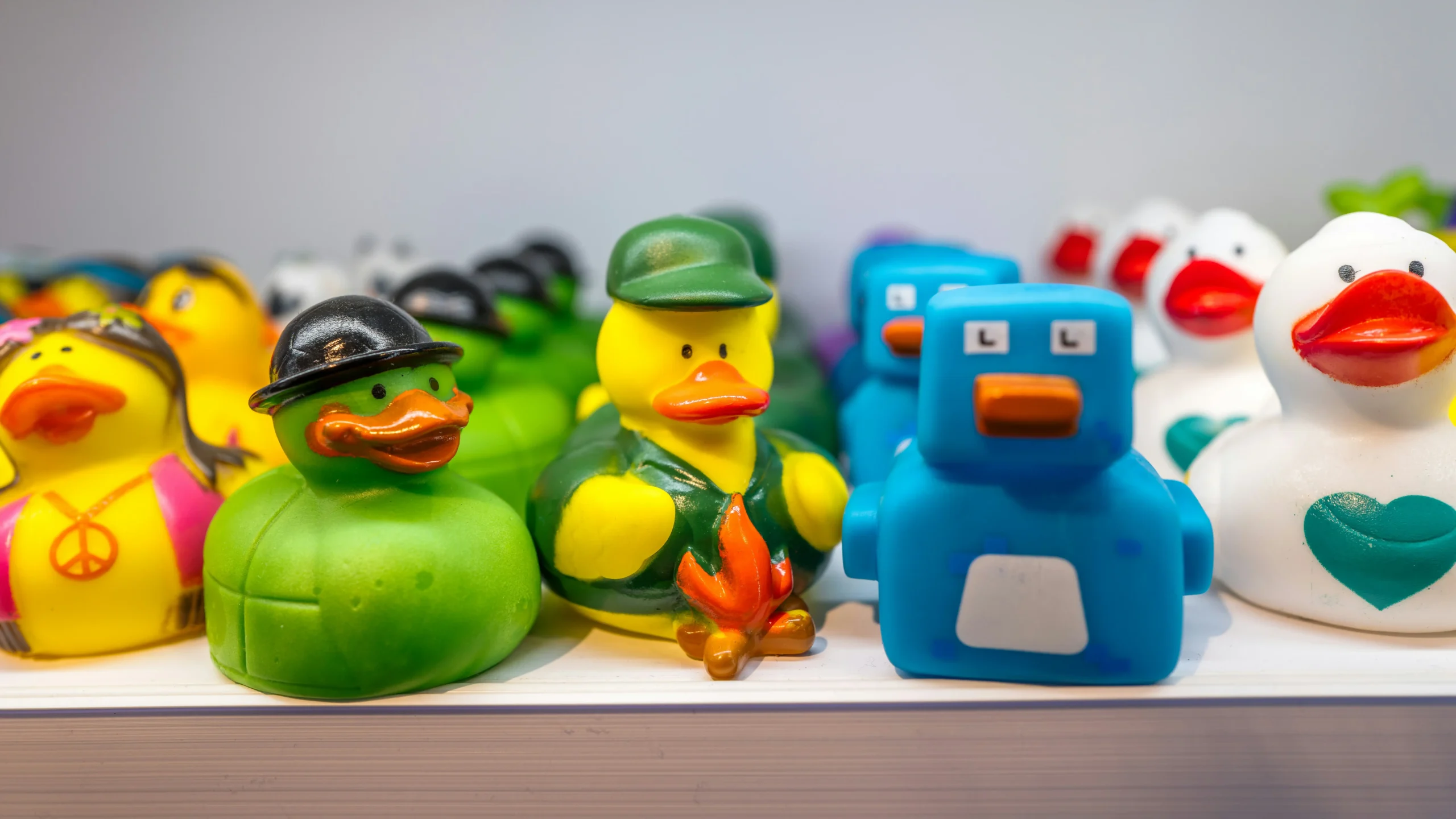
For a standard yellow duck with a one-color logo, the mold already exists, so setup is minimal — color mixing and machine calibration. This is why standard designs have low MOQs (500–1,000 units). For a fully custom duck shape, a new steel mold must be manufactured, which costs $800–$2,500 and takes 15–25 days. The factory sets a higher MOQ (5,000–10,000 units) to justify the mold investment.
MOQ Tiers Explained
Most rubber duck factories operate with three MOQ tiers:
Standard designs (500–1,000 units). The factory uses existing molds. You choose from available shapes and add your logo via screen printing or pad printing. Per-unit cost: $0.60–$1.20 depending on print complexity.

Semi-custom (3,000–5,000 units). The factory uses an existing body mold but customizes the accessories — a hat, glasses, a prop — to create a unique look. Per-unit cost: $0.45–$0.75. This tier is popular for promotional campaigns where the client wants a distinctive duck without paying for a full custom mold.
Fully custom (5,000–10,000+ units). A new steel mold is manufactured to your exact design. Per-unit cost after mold amortization: $0.30–$0.55. The mold cost is typically charged separately as a one-time fee. At 10,000 units, the mold cost adds roughly $0.10–$0.25 per duck.
How to Calculate the Right MOQ for Your Project
Start with your distribution plan. How many units do you need per event, per store location, or per quarter? If you exhibit at 10 trade shows per year with 3,000 attendees each, you need 30,000 ducks annually. Ordering in a single batch of 30,000 gives a better per-unit price than ordering 3,000 ten times.
The rubber duck product line at LZENGO offers flexible MOQs that scale with your needs — from 500 units for standard designs to 5,000+ for fully custom molds, with volume pricing that rewards larger commitments.
Negotiating MOQ Terms
First-time buyers often assume MOQs are fixed, but there is room to negotiate. If your total annual volume is high but your per-order quantity is low, ask for a blanket order: commit to 20,000 units over 12 months, delivered in four batches of 5,000. The factory gets the volume commitment it needs, and you get the per-unit pricing of a larger order without tying up capital in inventory.
Another approach: offer to accept the factory’s standard Pantone colors instead of a custom match. This eliminates the color-matching setup and can lower the MOQ by 30–50%.
Sample Orders and MOQ Waivers
Most factories offer sample orders below MOQ — typically 50–100 units — so the buyer can evaluate quality before committing to a full production run. Sample pricing is higher (often 2–3× the production price) because the setup cost is the same but spread over fewer units. Some factories waive the sample charge if you proceed with a full order within 30 days.
Summary
MOQs are driven by production setup costs, not arbitrary factory policy. Standard designs start at 500–1,000 units; custom molds require 5,000–10,000. Understanding the cost structure behind the MOQ helps you negotiate better terms, plan your inventory, and choose the right production tier for your project.