Skip to content

Most rubber duck buyers plan the unit price and let the rest of the invoice happen to them. The factory quotes $0.80 per duck, the committee multiplies by 1,000, and the budget says $800. Then freight arrives, customs adds duty, the broker sends a fee, and the real cost per duck ends up 20 to 40 percent above the number on the quote. That gap is the difference between a rubber duck landed cost and a rubber duck price, and it is where first-time importers lose their margins.
This guide walks through the seven costs that sit outside the unit price on a bulk duck order, with the numbers that matter for planning. It covers what each cost is, how it is charged, and where a buyer can control it.
| Cost | What it covers | How it is charged |
|---|---|---|
| Freight | Factory to port, ocean or air leg | Per CBM or per container |
| Customs duty | Import tax on declared value | Rate on HTS 9503.00.00 |
| Tariff surcharges | Section 301 actions on China goods | Percent added to duty |
| Brokerage | Entry filing and clearance | Flat fee per entry |
| Insurance | Marine cargo coverage in transit | Percent of declared value |
| Payment fees | Wire, FX spread, terms | Per transfer or percent |
| Final mile | Port to warehouse or door | Per shipment or per pallet |
Freight: The Volume Game
Freight is the biggest line item after the goods themselves, and it is priced by space, not by duck. Sea forwarders quote per cubic meter (CBM) or per container. A carton measuring 60 by 40 by 40 centimeters equals 0.096 CBM, and a 1,000-duck order typically fits well inside a shared less-than-container (LCL) shipment with other cargo. Air freight prices by chargeable weight, which is where duck weight matters: a 2-inch duck weighs roughly 15 grams and a 3-inch duck about 30 grams, so a 3-inch order is roughly twice as expensive to move by air at the same quantity.
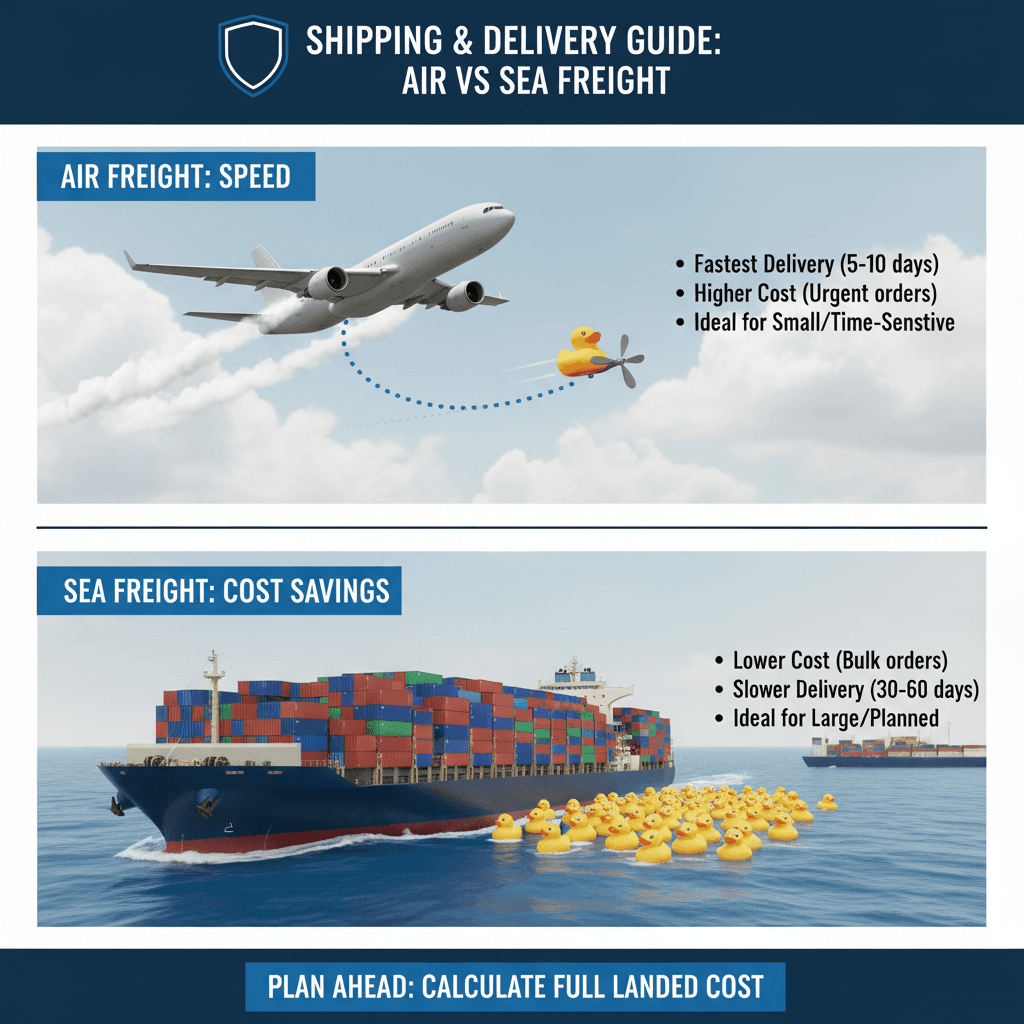
The choice between sea and air is a schedule trade, not a price debate. Sea freight from China to the U.S. West Coast runs roughly 15 to 25 days door to port, with container rates that swing by season. Air freight lands in 3 to 7 days at a multiple of the sea rate. For a campaign with a fixed event date, the question is whether the deadline justifies the air cost; for everything else, sea freight plus a two-week buffer is the default.
LZENGO’s global shipping support covers the factory-to-port leg, documentation, and FBA-bound routing, which removes the most common first-order mistakes: wrong shipping marks, missing documents, and cargo that arrives without a clear entry plan.

Customs Duty and the HS Code
Every duck crossing a border is classified, and the classification decides the duty. Toy ducks fall under HTS 9503.00.00 in the U.S. harmonized tariff schedule, the heading for toys and dolls. The general duty rate for the heading is free for most trading partners, which surprises buyers who assume every import pays a big tax. The surprise lives elsewhere: origin-specific duties and value-based taxes that change the math country by country.
EU and UK buyers classify the same product under CN code 9503, and value-added tax applies at the importing country’s rate. The practical rule for every market: look up the heading, then verify the rate for your origin country and your declared value. A broker does this in minutes; a buyer who guesses can overpay or, worse, under-declare and trigger an audit.
Duty is charged on the transaction value, which is the price you actually paid, not the retail value. Keep the factory invoice, the freight invoice, and the insurance certificate together, because customs and the broker both want to see them.
Section 301 and Country-Specific Tariffs
The classification tells you the base rate; the origin country tells you the rest. Goods of Chinese origin, which is where most custom duck production happens, have faced additional Section 301 tariff actions administered by USTR since 2018, with exclusion lists that change repeatedly. Toy imports have been swept into these actions more than once, and the combined rate a buyer pays in 2026 is not the rate a guide published in 2024 describes.
The operational rule is simple: before you lock a campaign budget, ask your customs broker for the current combined duty and tariff rate on HTS 9503.00.00 from your origin country, and ask them to reconfirm at shipment time. A rate change between quote and entry is rare but possible, and the difference lands on your invoice either way.
For buyers using DDP (delivered duty paid) terms, the supplier carries this risk, which is why DDP quotes run higher per unit. For FOB and CIF terms, the duty and tariff risk belongs to the buyer, and the landed-cost model needs a line for it.
Brokerage and Clearance Fees
Someone has to file the entry with customs, and that someone charges a fee. A customs broker typically charges a flat fee per entry, with a planning range of roughly $100 to $300 for a standard LCL entry depending on the port and the broker. On an $850 duck order, that fee can exceed 10 percent of the goods value, which is why small first orders feel expensive even when the unit price is right.
Consolidating shipments changes the arithmetic. A distributor that imports for five clients in one consolidated entry pays one brokerage fee instead of five, and the per-order cost collapses. The same logic applies to buying larger quantities against the 1,000-piece MOQ: one 5,000-duck order costs less per unit to clear than five 1,000-duck orders.
Some forwarders bundle brokerage into the freight quote; others invoice it separately. Ask which model the quote uses, because the difference can be $200 on a small shipment and the landed-cost comparison between suppliers is only honest when the fee structures match.
Insurance
Ocean cargo moves through weather, port congestion, and handling equipment, and the carrier’s liability covers a fraction of the goods value. Marine cargo insurance fills the gap, typically at a small fraction of the declared value, roughly 0.3 to 0.5 percent. On an $850 duck order, that is about $3 to $4. On a $50,000 container, it is $150 to $250, which is cheap relative to the risk of a damp, crushed, or delayed shipment.
Insurance is a line item buyers skip because it sounds optional, then regret once. The policy is written per shipment or per open cover, and the premium depends on the declared value and the transit route. Ask the forwarder for the quote in the same email as the freight rate, and include it in the landed-cost model even for small orders, because the cost is nearly invisible while the protection is real.
Payment and Currency Costs
International orders are paid in the factory’s currency or in U.S. dollars via wire transfer, and both routes carry fees. Bank wires typically add a flat fee per transfer, often $25 to $50, plus a foreign-exchange spread when the invoice is not in dollars. For a $850 order, those fees can add 5 to 10 percent if they are not planned.
Payment terms change the model too. T/T with a deposit and balance before shipment is standard in the industry; L/C adds bank confirmation costs; trade assurance platforms bundle escrow into the price. The cheapest payment method is the one that matches the order size, and for a first 1,000-duck order that is usually a wire with the fees confirmed in advance.
When comparing quotes, force the comparison onto one basis. The rubber duck quote comparison guide walks through the six fields that reveal the real price, and payment fees are one of them. A quote that lists FOB price, freight, and payment fees separately is a quote you can plan around.

Final-Mile Delivery and Warehousing
The freight quote usually ends at the port or the nearest hub, and the last leg to your warehouse or event is a separate cost. Port-to-door trucking, liftgate delivery, and warehousing for goods that arrive before the campaign date all add per-shipment or per-pallet charges. A pallet of duck cartons is light relative to its volume, which keeps trucking affordable but makes storage space the constraint.
For Amazon-bound orders, the final mile includes FBA prep: labeling, polybag requirements, and case-pack rules that differ from a normal wholesale shipment. LZENGO’s factory-direct pricing model and FBA support handle the prep side, which removes a layer of cost that surprises first-time sellers.
Plan the arrival date, not the ship date. Sea freight with a two-week buffer means the ducks sit somewhere for a few days, and warehousing that costs $40 per pallet per month is still cheaper than air freight on a deadline. The landed-cost model should include the holding cost, because the cheapest freight option is the one that lands on time.
The Landed Cost Formula in One Row
Landed cost per unit is the sum of eight numbers divided by the units you receive: FOB total, freight, customs duty, tariff surcharges, brokerage, insurance, payment fees, and final-mile delivery. The formula is simple; the discipline is writing every line down before you order. A worked example makes the model concrete, with each non-grounded figure labeled as a planning estimate.
Take a 1,000-duck order at $0.85 per unit, which is $850 FOB from the factory. Freight by sea, LCL to the U.S. West Coast: roughly $250 (estimate, seasonal). Brokerage and clearance: roughly $150 (estimate). Marine insurance at about 0.3 to 0.5 percent of value: about $4. Payment wire fees and FX: roughly $40 (estimate). Final-mile trucking from port to a local warehouse: roughly $150 (estimate). The subtotal lands near $1,444, or about $1.44 per unit, before duty and tariffs, which depend on origin and the current schedule. If the combined Section 301 surcharge at your entry date is, say, 25 percent (illustrative only; the real rate changes and your broker confirms it), the duty line adds about $212 and the unit lands near $1.66.
The model’s value is not the accuracy of the estimates; it is the structure. When a supplier quote looks cheap at $0.85 and a competitor’s DDP quote looks expensive at $1.30, the model shows whether the DDP quote is actually the better deal once freight, brokerage, and tariffs are added to the FOB price. The buyers who run this row before ordering are the ones who stop being surprised by final invoices.
Payment method is a separate line in the same budget, and the rubber duck payment terms guide compares T/T, L/C, PayPal, and escrow options.
Frequently Asked Questions
What is the landed cost of rubber ducks?
Landed cost is the FOB unit price plus freight, customs duty, tariff surcharges, brokerage and clearance fees, insurance, and final-mile delivery, expressed per unit. For a 1,000-duck order at roughly $0.85 per unit, those extras can add a meaningful share on top of the $850 base.
Which HS code covers rubber duck imports?
Toy ducks classify under HTS 9503.00.00 in the United States. Buyers in the EU and UK use the equivalent CN code 9503. The duty rate depends on origin country, so check the current schedule before pricing a campaign.
Do Chinese-origin ducks carry extra tariffs?
Yes. Chinese-origin goods face Section 301 tariff actions administered by USTR, and exclusion lists change over time. Confirm the combined rate with your customs broker before finalizing a landed-cost budget.
Should a 1,000-duck order go by sea or air?
Sea freight fits budget-driven bulk orders at roughly 15 to 25 days door to port from China to the U.S. West Coast. Air freight runs about 3 to 7 days at a higher rate, which makes sense only when a campaign deadline cannot move.
Final Thoughts
A rubber duck landed cost is the unit price plus seven line items, and most of those line items are controllable. Freight follows the schedule you pick, duty follows the classification and origin you declare, brokerage follows the consolidation you arrange, and final-mile follows the arrival date you plan. The buyers who treat the unit price as the whole story are the ones who see the real number after the invoice arrives.
Build the model before you place the order: unit price, freight, duty, tariffs, brokerage, insurance, payment fees, final mile. Ask the supplier for the FOB price, ask the broker for the current rate, and ask the forwarder for the schedule. When those three answers line up, the landed cost stops being a surprise and becomes a budget line you can defend.
For the weight bands and the freight math behind a duck order, see our rubber duck weight guide.