Skip to content

Every custom rubber duck order includes at least one design revision, and most include more. The question buyers should answer before signing a quote is not whether revisions will happen, but how many rounds to plan for and where the free rounds end. A brand that treats the mockup as a real checkpoint spends a few extra emails early. A brand that clicks approve and waits for the sample learns the same lessons later, when each change costs money and days.
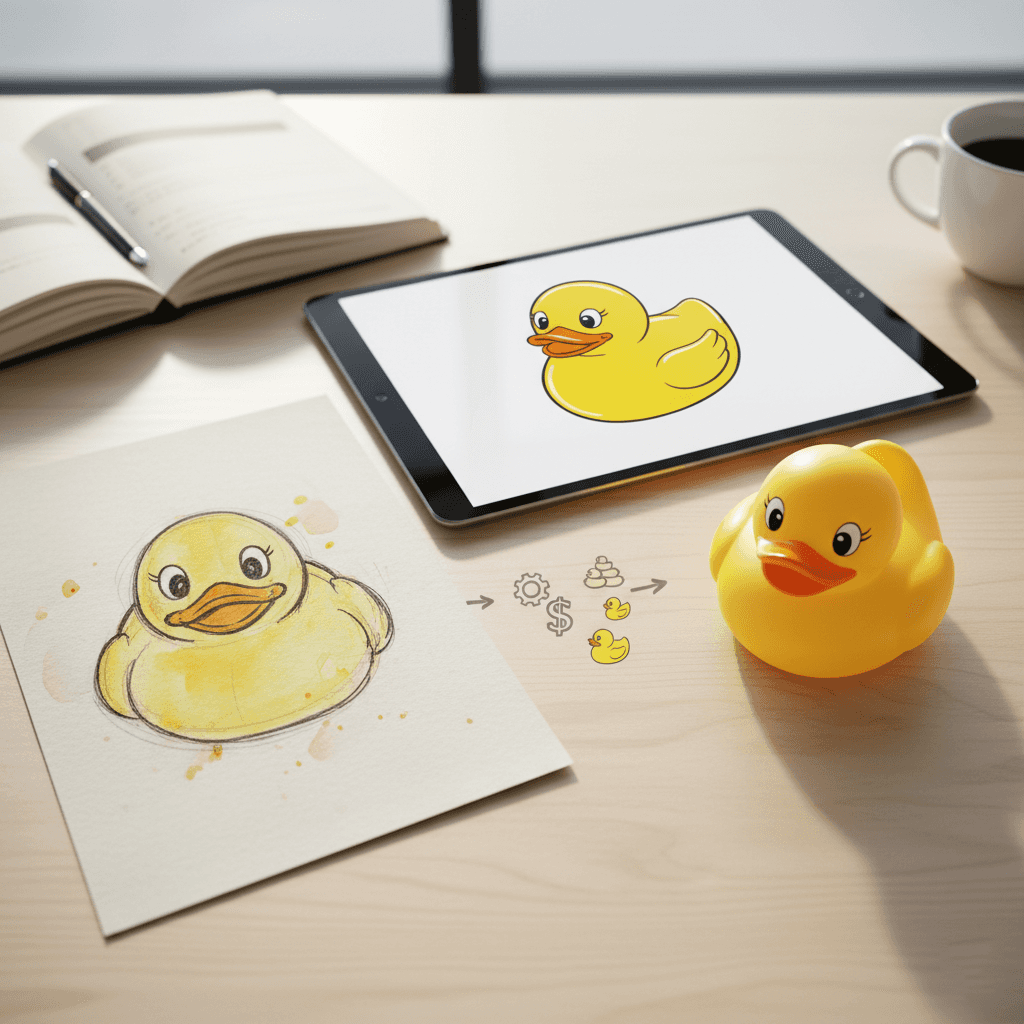
The revision map is simpler than it looks. There are three stages: the digital mockup, the physical sample, and production. Changes get more expensive at every step, and the factory’s job is to make the early stages cheap enough that buyers actually use them.
Where Revisions Happen in the Process
A custom duck order moves through three checkpoints, and each one accepts changes at a different price. The digital mockup arrives within 12 hours of artwork submission; this is the cheapest revision zone because nothing physical exists yet. The physical sample follows in 7 days, giving the buyer a real duck to squeeze, sniff, and compare against a Pantone swatch. Bulk production runs 15 to 25 days after sample approval, and at that point the design is frozen.
The structure exists to push changes left. Every detail that gets fixed at the mockup stage costs an email. Every detail that survives to the sample stage costs a re-mold or a reprint. Every detail that survives to production costs a full restart. Buyers who understand the three zones stop treating the mockup as a formality and start treating it as the cheapest insurance in the order.
LZENGO’s process is built around this map: the 12-hour mockup gives the committee time to review systematically, and the 7-day sample gives a physical check before the 15 to 25 day production slot is committed.
The Mockup Round: Where Changes Are Nearly Free
Plan for two mockup rounds as the default. Round one is the factory’s translation of your artwork onto the duck form: logo placement, Pantone colors, and size relationships. Round two is your response: the tweaks that always surface when a logo sits on a curved 3D body instead of a flat PDF. Brands that prepare properly rarely need round three; brands that rush the artwork routinely burn three or four.
The mockup stage catches the revision classes that are cheapest here. A logo placed too close to the neck will distort on the real mold, and the rubber duck mockup approval checklist walks through the seven details worth checking: Pantone match, logo placement on the curved surface, print method, size ratio, and color separation among them. Each check is free to run before tooling and expensive to run after.
One detail buyers skip: check the mockup against your actual brand swatch, not against the screen. Pantone 286C and a generic dark blue look close on a monitor and unmistakably different on a physical duck. The factory can mix custom resin colors, but only if the mismatch is flagged at the mockup stage, before material mixing starts.
What Changes Cost at Each Stage
The price of a change climbs as the order moves forward. At the mockup stage, a revision is a new render: near zero. At the sample stage, a revision means a new physical sample: real money and a few extra days, but still before the line commits. After tooling, a change hits the mold itself, and a custom duck mold runs about $500 as a one-time fee. After production starts, a body color change means restarting from material mixing, which halts the line entirely.
The asymmetry is the point. A color correction that costs $0 at the mockup and $500 at the mold stage and a production restart after that is a change that should never reach stage two. The same logic applies to print placement, size, and material. When a buyer says “we will fix it in the next round,” they are choosing the most expensive version of the fix.
This is also where the quote conversation matters. Ask the factory what a revision costs at each stage before you sign, and ask how many mockup rounds the base price includes. A supplier that bundles two mockup rounds and one sample round into the MOQ pricing is structurally aligned with a smooth approval; a supplier that prices every email is structurally aligned with your delays.
The Artwork Mistakes That Guarantee Revisions
Most revision rounds trace back to three artwork failures, all preventable. First, resolution: a logo exported from a website at 72 DPI prints soft and pixelated at duck scale. Factories need vector files (AI, PDF, EPS, CDR) or rasters at 300 DPI at print size, with fonts outlined so the factory does not substitute a missing font. The rubber duck artwork file requirements guide lists the accepted formats and the math behind the 300 DPI rule.
Second, size: the 30/50 rule caps logo width at 30mm on a standard 2.5-inch duck and 50mm on a 3.5-inch duck. Anything wider wraps around the side curvature and distorts, turning circles into ellipses and compressing text at the ends. Third, placement: the only distortion-free zones are the belly between 8 and 4 o’clock and the crown. Logos near the neck or tail always distort because those surfaces curve most tightly. These are geometric limits of the mold, not factory preferences, and no file tweaking fixes them.
The good news is the detail budget. Pad printing reproduces line work down to 0.3mm, so a well-prepared vector logo prints crisply within the print zone. The revision happens only when the artwork violates the rules above, which is why the submission checklist in the artwork guide is the cheapest document in the whole order.

Sample Revisions and Physical Reality
The physical sample is the first moment the design exists outside a screen, and it earns at least one revision round of its own. Color is the classic surprise: molded resin reads differently than a monitor render, and the sample is where a buyer compares the duck against the real Pantone swatch under real light. Print durability is the second: the sample reveals whether the ink holds or lifts, which is why factories apply corona or flame treatment plus a primer before pad printing. That pretreatment adds 24 hours to lead time and is the difference between a print that lasts and one that lifts within 30 days.
Budget one sample round as the default and treat a second as a signal. A first sample that misses color slightly is normal. A first sample that misses placement, material feel, and squeaker behavior together suggests the briefing was thin, and the fix is better artwork and a fuller spec, not another blind round.
When the sample passes, the design is frozen for production. From that point the 15 to 25 day production clock runs, and the factory’s capacity of 5 million ducks a month means the slot itself is rarely the constraint; the approved sample is.
Compliance Changes Trigger Re-Testing
One revision class is easy to overlook because it has nothing to do with looks: compliance. A material change, a colorant change, or a construction change can alter the product’s test profile, and children’s products sold in the United States must meet testing and certification requirements under CPSIA. The testing and labeling rules in 16 CFR Part 1107 describe when a material or design change requires re-testing, and a buyer who swaps from PVC to TPR mid-order should expect the certificate file to be revisited, not just the sample.
This is a hidden cost of late revisions, and it compounds the $500 mold math. A colorant change may be cosmetic, or it may change the phthalate or heavy-metal profile that the certificate covers. Ask the factory which elements of the design are covered by the existing test reports and which changes would trigger a new test cycle, and put that answer in the approval email.
LZENGO ships custom ducks with BSCI, GRS, REACH, and CPSIA documentation tested through Intertek, and the certificate scope is part of the order file. Buyers who confirm the scope before approving the sample avoid the surprise re-test invoice at the end of the project.
Budgeting Revisions in the Quote
The practical answer to “how many rounds” is two mockup rounds and one sample round, with the understanding that each unused round is a sign of preparation, not waste. Structure the budget around the three stages, and put the numbers in the quote: what a mockup revision costs, what a new sample costs, what a mold change costs, and what the test file covers. Suppliers who cannot answer those four questions in writing are asking you to buy their process blind.
For a first order from a custom rubber duck manufacturer, add one buffer round to the calendar even if the budget holds: a 12-hour mockup plus a revision response plus a 7-day sample plus a re-sample can stretch a two-week approval into three, and the production clock does not start until approval lands. Planning the buffer means the campaign date survives the process.
The revision budget is not a tax; it is the price of getting the design right while changes are still cheap. The buyers who spend the rounds early are the ones who never see the $500 mold change or the production restart.
The Reorder Revision: What Changes on Repeat Orders
Repeat orders follow a different revision logic, and buyers often overpay by treating them like first orders. When the artwork, the Pantone codes, and the mold are on file, a reorder needs no design rounds at all: the factory pulls the record, the buyer confirms quantity and ship date, and the production clock starts immediately. The revision budget for a reorder is zero unless the design actually changes.
The change cases are narrow and clear. A logo refresh, a new colorway, or a size change moves the order back into the revision process, but only for the affected elements: a colorway change touches the material mixing and the sample, while a logo refresh touches the print setup and the mockup. The unaffected parts of the file stay frozen, which is why reorder revisions cost a fraction of first-order revisions.

One warning: confirm the certificate file covers the reorder as well as the first run. If the reorder changes material or colorants, the testing rules in 16 CFR Part 1107 may require a refreshed test before the new batch ships, even when the mold is untouched. The reorder is cheap only when the file, not just the duck, carries over.
Frequently Asked Questions
How many revision rounds should I budget for a custom duck order?
Two digital mockup rounds and one physical sample round cover a normal order. Brands that prepare vector artwork, Pantone codes, and print-area limits up front rarely use the second mockup round.
Do mockup revisions cost extra?
Early digital mockup rounds are effectively free because LZENGO delivers the first mockup within 12 hours and revisions happen before tooling. Real costs appear once the mold is cut or production starts.
What artwork mistakes cause revision rounds?
Low-resolution rasters below 300 DPI, fonts that are not outlined, and logos wider than the 30mm limit on a 2.5-inch duck or 50mm on a 3.5-inch duck. Placement outside the belly zone also guarantees a revision.
Can I change the duck’s color after approval?
Before production starts, yes, because the change happens in the mockup or sample stage. After production starts, a body color change means restarting from material mixing, which halts the line and adds cost and days.
Final Thoughts
Revision rounds are not a failure of the process; they are the process. The mockup exists to be revised, the sample exists to be checked, and production exists to be frozen. The skill is spending the rounds where they are cheap: two on the 12-hour mockup, one on the 7-day sample, and none after tooling. That pattern keeps the $500 mold and the production line out of the change cycle.
Before you place the order, collect the artwork files, the Pantone codes, and the print-zone limits, and ask the factory to confirm the revision terms at each stage in writing. The answers decide whether your custom duck order costs two emails or two thousand dollars.