Skip to content
Mold Carving vs Printing: When to Carve Detail Into the Duck Tool
Every custom rubber duck starts with two decisions that shape the whole budget: how much detail goes into the mold itself, and how much goes on the surface as a print. Carving detail into the mold makes the duck “born with” that feature — a hat, a uniform, a logo that is raised rather than flat. Printing lays a graphic on a smooth surface. The choice is not purely technical; it decides the price, the minimum order, and how the duck reads at shelf distance.
This guide compares mold carving and printing so you can choose what fits your design. It also covers when the two work together and what each does to cost and lead time.

What mold carving actually is
Mold carving (or engraving) means cutting the feature into the steel or silicone tool so it appears three-dimensionally on the finished duck. A chef’s hat, a firefighter’s helmet, a sports jersey with a raised number — these are carved into the mold, so the detail is part of the duck’s shape, not a sticker on top. Our custom rubber duck process starts from 3D modeling and an open mold, which is where carved detail happens.
Carved detail is durable. It does not scratch off or fade, and it survives handling and washing better than a print. That makes it right for character ducks and collector items where the feature is part of the story.
What printing adds
Printing (pad printing or UV printing) lays a graphic onto the duck’s surface. It is ideal for a logo, a slogan, a fine illustration, or a multi-color design that would be far too expensive to carve. Pad printing deposits ink from a silicone pad; UV printing cures ink with UV light for a crisp result. For a team logo or a mascot with lots of fine detail, printing is usually the cheaper, sharper route.
The trade-off is durability and depth. A print sits on the surface, so it can scratch or wear over time, and it has no physical relief. For a duck meant to be a keepsake, that may be fine; for a collectible intended to last, carved detail often reads as more premium.
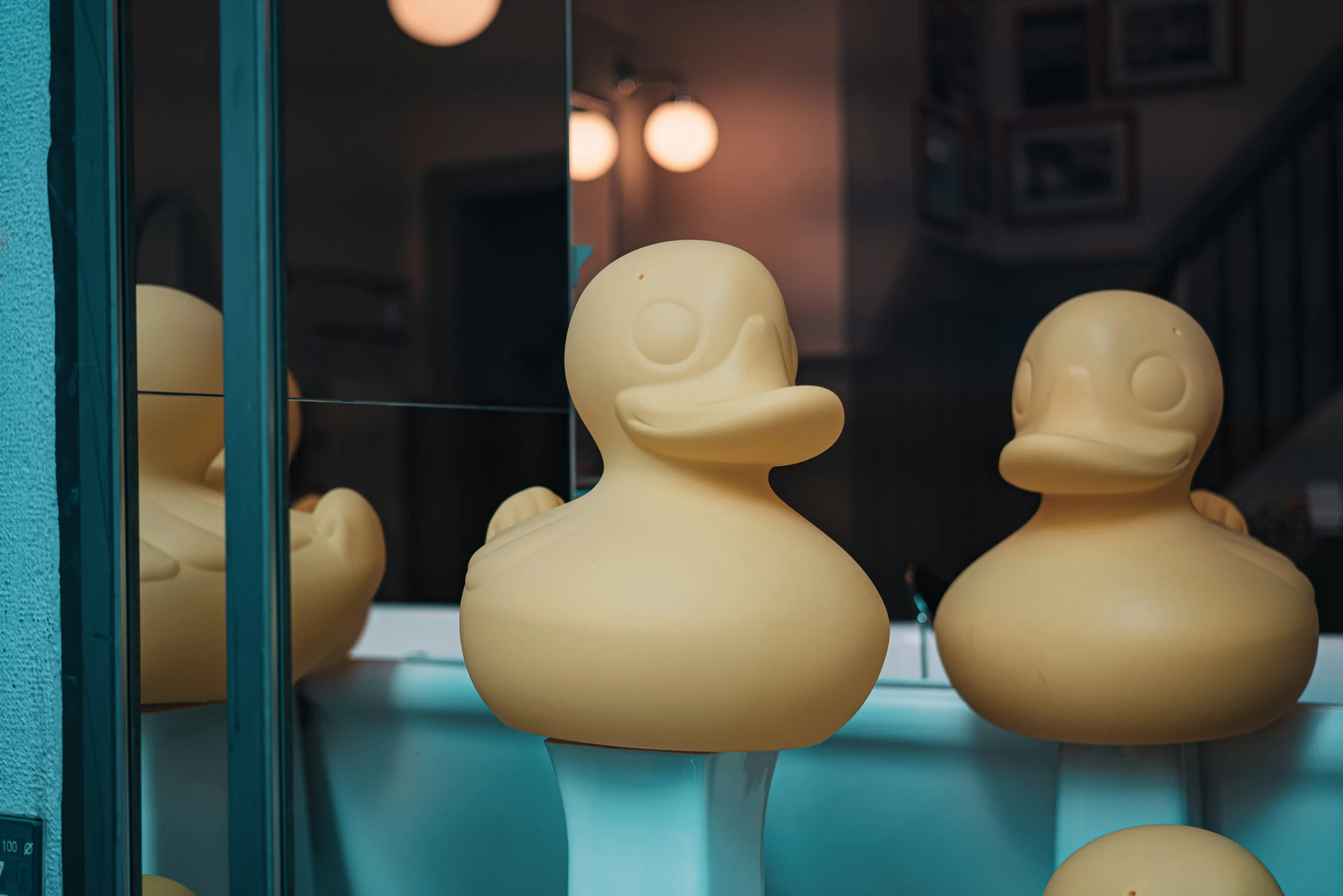
Mold carving vs printing: when to choose each
The decision comes down to what the detail needs to do for your brand. Use this quick rule of thumb.
Carve when the feature is part of the duck’s identity
A uniform, a hat, a shape – if the duck would not be that character without the feature, carve it. Carved detail also lets a duck “have” the detail in profile, not just head-on.
Print when the detail is a graphic or a multi-color logo
A colorful logo, a slogan, a fine mascot face – printing reproduces these sharply and across many colors at a far lower tooling cost than carving each color separately.
Combine both for maximum effect
The best character ducks carve the base shape (a hat, a jersey) and print the fine detail (the number, the emblem). This balances cost and impact.
If you want to understand how carving compares to a molded sample, our 3D-printed prototypes vs molded samples article covers the prototyping stage that comes first.

How carving affects cost, MOQ and time
Carved detail raises the tooling cost and the development time because the mold is more complex. Printing is usually included as a per-unit or per-color cost and does not change the tool much. A carved duck with raised detail may also push toward a higher effective MOQ because the more detailed a tool is, the more it favors a longer run to amortize the setup.
That is why we ask clients what the duck is doing. A giveaway or a low-cost promo is better served by a clean mold plus printing. A collector item or a character duck meant to sit on a shelf is a better fit for carved detail. Knowing the goal — adding a logo without losing detail is a common middle ground — keeps either route within budget.
Compliance and finishing
Whichever route you choose, the duck still needs to meet toy-adjacent safety standards. Our factory holds BSCI, GRS, REACH and CPSIA compliance (Intertek tested), and we support Pantone-matched colors with matte or gloss finishes so the final look matches your intent. The US Toy Industry Association is a useful reference for the standards a durable duck should meet.
Conclusion
Choose mold carving when you want the feature to be part of the duck — durable, visible in profile, premium. Choose printing when you want a sharp, multi-color graphic at lower tooling cost. Most winning ducks do both. Tell us the duck’s role, and we will recommend the right balance of carved detail and print, and quote the actual MOQ and timeline.

Related reading: AI in Custom Duck Design