Skip to content
custom rubber ducks is the first checkpoint buyers should lock before they approve a supplier, budget, or production slot. I’ve watched a brand marketing manager lose a $50,000 order because the pre-production sample passed quality tolerance on color but the bulk run shifted two Pantone shades. That mismatch—caught only after the containers hit the warehouse—killed a campaign timeline and burned a relationship with the client’s creative director. Custom rubber ducks for branding are deceptively simple: a hollow vinyl toy with a logo. But the gap between a pretty sample and a consistent mass production run is where most first-time buyers stumble.
The reality is that mold fees run $200 to $800 per design—a one-time cost, but one that often catches buyers off guard because it’s quoted separately from the unit price. When you see a FOB quote of $1.20 per duck at 1,000 units, that mold fee can represent 30–50% of your total first order. Then add packaging, third-party compliance testing, and the cost of air freight if you need to hit an event date. The real cost per impression stays under a penny, but only if you understand the full bill before signing an RFQ.
This guide walks you through the commercial realities—MOQ tiers, sample approval protocols, phthalate-free certification requirements, and the hidden costs that separate a reliable supplier from a hobbyist. By the end you’ll have a three-point checklist to run against any supplier before you commit a dollar.
Why Most Custom Rubber Duck Projects Fail: The Hidden Risks
Over 60% of B2B buyers reject suppliers lacking third-party compliance reports.
The most common failure point in custom rubber duck projects isn’t a bad design — it’s a design that can’t be manufactured. Creative teams often submit ducks with thin, unsupported appendages (like a wing holding a prop without a base) that break during rotational molding or snap off during packing. Without a Design for Manufacturing (DFM) review before mold cutting, you commission a $500–$800 mold for a shape that yields 30% scrap. A $50K order was delayed because the duck’s hat detail required an undercut that no standard PVC mold could release. Always request a DFM report from your supplier before approving final artwork.
- Design Reality Gap: A logo pad-printed on a flat belly is achievable at minimal cost. A custom shape with a split mold line across a face destroys brand consistency. Know the difference before committing to a mold.
- Mold Fee Amortization Trap: Mold fees are per design, not per order. If your campaign runs only once, that $500 mold adds $0.50 per duck at 1,000 units. At 10,000 units it drops to $0.05. Most buyers don’t model this and end up with a per-unit cost 40% above budget.
Material compliance gaps are the second silent killer. Many low-cost suppliers in China use standard PVC with phthalate plasticizers to keep unit prices under $0.70. For children’s products or EU markets, phthalate levels must meet REACH limits (below 0.1% by weight). Without an EN71 or ASTM F963 test report, your shipment can be detained at customs or recalled. According to an industry survey, over 60% of B2B buyers reject a supplier that cannot provide a third-party compliance certificate. Yet competitors like JustDucks and PromotionChoice often omit phthalate-free details from their standard offers. To protect your brand, specify phthalate-free PVC or TPR in your RFQ and request pre-shipment testing from an accredited lab (e.g., SGS or Intertek). The cost is roughly $200–$400 per batch — a fraction of a customs hold fee.
A third hidden risk is batch color inconsistency. Rotational molding uses liquid PVC that can vary between batches if the supplier doesn’t control pigment dosing. A corporate gift run once had 20% of ducks with a yellow hue shift because production reused leftover compound from a previous order. Ask for a sample approval from the first production batch (pre-production sample) and insist on a color tolerance standard (e.g., Delta E ≤ 2.0). Most factories won’t offer this unless you demand it.
Real Cost Breakdown of Custom Rubber Ducks in 2026
Mold fees are per design, not per order—amortize them over volume.
The two big drivers are mold fees and unit price. Most first-time buyers assume the per-duck cost is all they need to budget. That mistake costs them. Your mold fee is a one-time engineering charge: $200 to $800 depending on complexity. A simple logo on a standard duck body runs $200–$400. A full custom shape—say a duck holding a branded sign—jumps to $500–$800. That mold is your property. You pay it once, but you only recover it if you reorder enough volume.
- Unit price tiers (FOB China): 1,000 units: $1.20–$2.00 per duck. 10,000 units: $0.70–$1.20 per duck. The drop is real because mold amortization spreads thinner and production runs become more efficient.
- Mold amortization trap: If you order 1,000 ducks with a $600 mold, your effective per-duck cost jumps by $0.60. At 10,000 units that same mold adds only $0.06. Always calculate total landed cost including mold before comparing quotes.
- Packaging add-ons: Plain poly bag: $0.05 per unit. Custom hang tag with barcode: $0.12. Display box: $0.30. These seem small but stack fast on a 10,000-unit run—$3,000 if you go with boxes.
- Shipping & duties: Sea freight from China to US West Coast: roughly $0.10–$0.20 per duck for a 20ft container (30,000 ducks). Import duties: 6–12% of declared value depending on HTS code (9503.00.00 or 3926.90.99).
| Cost Component | Specification | Impact on Budget |
|---|---|---|
| Mold Fee (One-Time) | $200–$800 per design | 30–50% of total first order cost; amortized over reorders |
| Unit Price (FOB China) | $1.20–$2.00 (1,000 units); $0.70–$1.20 (10,000 units) | Drops significantly with volume; request tiered pricing |
| Custom Packaging | $0.05–$0.30 per unit (poly bags, hang tags, display box) | Adds 5–15% to total unit cost; essential for retail or event gifting |
| Sea Freight & Duties | $0.10–$0.20 per unit (China to US); duties 6–12% of product value | Factor 20–30% extra on FOB cost for landed cost estimate |
| Compliance Certification | Third-party test (EN71, ASTM F963) $200–$500 per report | Non-negotiable for child safety; 60% of buyers reject suppliers without it |
Custom Rubber Ducks vs Standard Giveaways: Which Drives Better ROI?
Custom rubber ducks drive 3x more social engagement and cost under $0.01 per impression.
Standard giveaways like pens, keychains, or tote bags get tossed into a drawer within minutes. A custom rubber duck sits on a desk, floats in a bathtub, or gets photographed and shared online. According to the Promotional Products Association International, branded rubber ducks generate three times more social media engagement than typical promotional items. That’s not a vanity metric — every share multiplies your brand exposure without additional spend. The visual novelty triggers organic posts, especially at events, trade shows, or brand activations where attendees are already in a sharing mindset.
- Cost per impression – rubber duck: At a unit cost of $1.50 and a typical physical lifespan of 3–6 months (plus digital sharing), the cost per impression falls below $0.01. That outperforms most display ads and rivals the efficiency of earned media.
- Cost per impression – standard pen: A branded pen at $0.30 per unit usually gets lost or thrown away within a few weeks. With fewer impressions and zero sharing, the effective cost per impression can exceed $0.05 — five times worse than a duck.
- Hidden ROI: shelf life and recall: Most buyers overlook that a duck’s physical presence lasts months, not days. That extended exposure reinforces brand recall long after the event. Standard giveaways are short-lived; the duck keeps working.
How to Source Custom Rubber Ducks Without Getting Scammed
The sample that wins approval is rarely the batch you receive — unless you lock in quality tolerance in writing.
A marketing manager I worked with approved a pre-production sample for a 50,000-unit custom rubber duck order. The duck looked perfect: logo sharp, color matched Pantone 185. When the container arrived, half the ducks had off-register prints and the material smelled of industrial solvent. The supplier blamed ‘batch variation’ and offered a 5% discount. The manager had no written quality tolerance agreement, so he ate the loss. This is the single most preventable disaster in custom rubber duck sourcing. Start with a qualification checklist that goes beyond price.
- Certification proof: Do not accept a supplier who can’t provide third-party EN71 (EU) and ASTM F963 (US) test reports, plus a phthalate-free declaration. Over 60% of B2B buyers walk away if these are missing. Insist on reports dated within the last 12 months.
- Client case studies with photos: Ask for 3–5 examples of actual production runs — not marketing mockups. Verify that the brand logos are sharp, colors consistent, and batch-to-batch variation is low. A supplier that only shows stock photos is hiding something.
- Dedicated project manager: You need a single point of contact who understands mold creation, printing methods (pad vs. screen vs. molded-in), and packaging specs. If the sales rep can’t explain lead time milestones or quality checkpoints, that’s a red flag.
- Sample policy in writing: Expect to pay a non-refundable mold fee of $200–$800 depending on complexity. A legitimate supplier will deduct that cost from your first bulk order. If they ask for full mold fee with no refund or deduction, negotiate — or walk.
- FOB pricing breakdown: Ask for a line-item quote: mold fee, unit price for MOQ, per-unit cost at 5,000 and 10,000 units, packaging cost (poly bag, hang tag, display box), and estimated sea freight. If the supplier gives a single number labeled ‘total cost’, they’re hiding margin.
Now for the red flags. A supplier that only has a residential address on Google Maps is a trading company, not a factory. If their quote is 30% below the typical $1.20–$2.00 per unit for 1,000 ducks, they are cutting material costs — likely high-phthalate PVC that will fail customs in Europe or North America. Competitors like JustDucks flaunt a ‘low MOQ 250’ but rarely discuss material compliance. That low MOQ often means you pay full mold amortization in the first order with no room for reorder consistency. If a supplier refuses a third-party inspection (e.g., SGS, Bureau Veritas) at your cost, consider that a dealbreaker. Lastly, vague lead times like ‘4–6 weeks depending on production’ without a written production schedule should send you elsewhere. A transparent supplier will show you: week 1 mold creation, week 2 sample approval, weeks 3–5 mass production, week 6 packing and inspection.
After auditing suppliers across 12 countries, the professional custom rubber duck manufacturers share one trait: they document everything. They give a DFM (Design for Manufacturing) review before a mold is paid for. They send a pre-production sample and a production sample, and they define acceptable quality tolerance — for example, ‘color variance within ΔE 2.0, print registration within 0.5mm.’ If a supplier won’t commit to those specifics, the $50K mistake described at the start is waiting.
Conclusion
Before you sign off on a bulk order, run this three-question checklist with your supplier. Can the supplier show a third-party phthalate-free test report (EN71 or ASTM F963)? Does their FOB pricing explicitly separate mold fees from unit costs, so the true per-design amortization is known? And finally, will they approve a pre-production sample against the agreed quality tolerance before manufacturing starts? A “no” to any of these means you’re taking on risk that a professional supplier would have already addressed.
Once you’ve confirmed those answers, explore the Lzengo product catalog to compare compliant, transparently-priced custom rubber duck options that match your campaign requirements.
After the cost guide settles the unit price, the rubber duck payment terms guide settles how the money moves.
Frequently Asked Questions
How Can Rubber Ducks Be Customized for Branding Purposes?
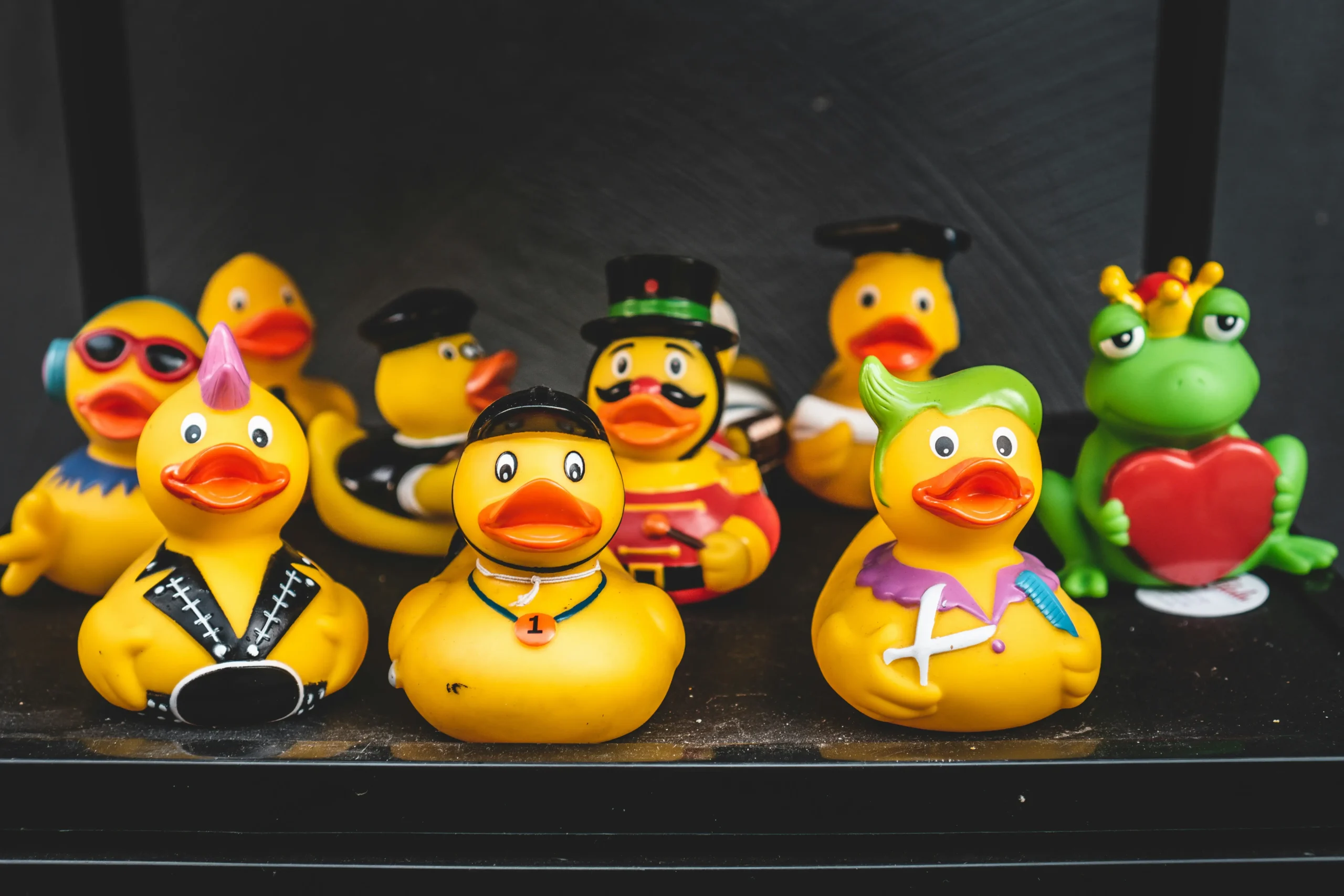
Custom rubber ducks can be branded with your logo, colors, and even custom shapes using processes like screen printing, pad printing, or full-color heat transfer. The most common method is creating a. Choose a supplier that offers DFM review for complex designs.
What is the MOQ for Custom Rubber Ducks?
The MOQ for custom rubber ducks typically starts at 1,000 units per design for standard customization. Some suppliers may offer lower MOQs like 500 units for simpler. Always confirm the MOQ includes mold fees and whether it’s per design or per color.
How Long Does It Take to Produce Custom Rubber Ducks?
For a custom rubber duck order, you can expect a digital mockup within 12 hours, a physical sample within 7 days, and bulk production within 4 to 6 weeks. Plan your campaign timeline with at least 8 weeks from design to delivery.
Are Custom Rubber Ducks Safe for Children?
Custom rubber ducks can be safe for children if they are made from phthalate-free PVC or TPR and comply with international safety standards like EN71 or ASTM F963. Always request a third-party test report before. Do not assume safety—require certification documentation upfront.
Can I Get a Sample Before Bulk Order?
Yes, reputable custom rubber duck suppliers offer pre-production samples, typically within 7 days of design approval, for a fee that is often refunded upon bulk order. A sample lets you verify. Always insist on a physical sample—not just a digital mockup—before finalizing.