Skip to content
When an agency sourcing lead or brand marketing manager starts comparing rubber duck types, the first question is rarely about color or shape. It is about cost per unit against campaign budget, minimum order quantities against deadline, and whether the duck will actually resonate with the target audience. Standard stock ducks, custom logo ducks, jeep ducks, and large display ducks each solve a different procurement problem, and picking the wrong category can blow a budget before the first mold is cut.
Standard stock ducks average $0.15 per unit at a 5,000-unit MOQ and ship in two weeks. Custom logo ducks start at $1.00 per unit at a 1,000-unit MOQ but require four to six weeks for mold creation and production. Jeep ducks, a category that grew 340% year-over-year in the novelty toy segment from 2022 to 2026, sit in the middle at $0.25 to $0.80 per unit with a 500-unit MOQ for themed designs. Large display ducks, 12 inches and above, run $5.00 to $20.00 per unit but carry a hidden shipping cost that can exceed the product price itself. The trade-offs are not theoretical. They determine whether a campaign delivers on time and on budget.
Standard vs Custom: Cost & MOQ Trade-offs
Stock ducks ship in 2 weeks.
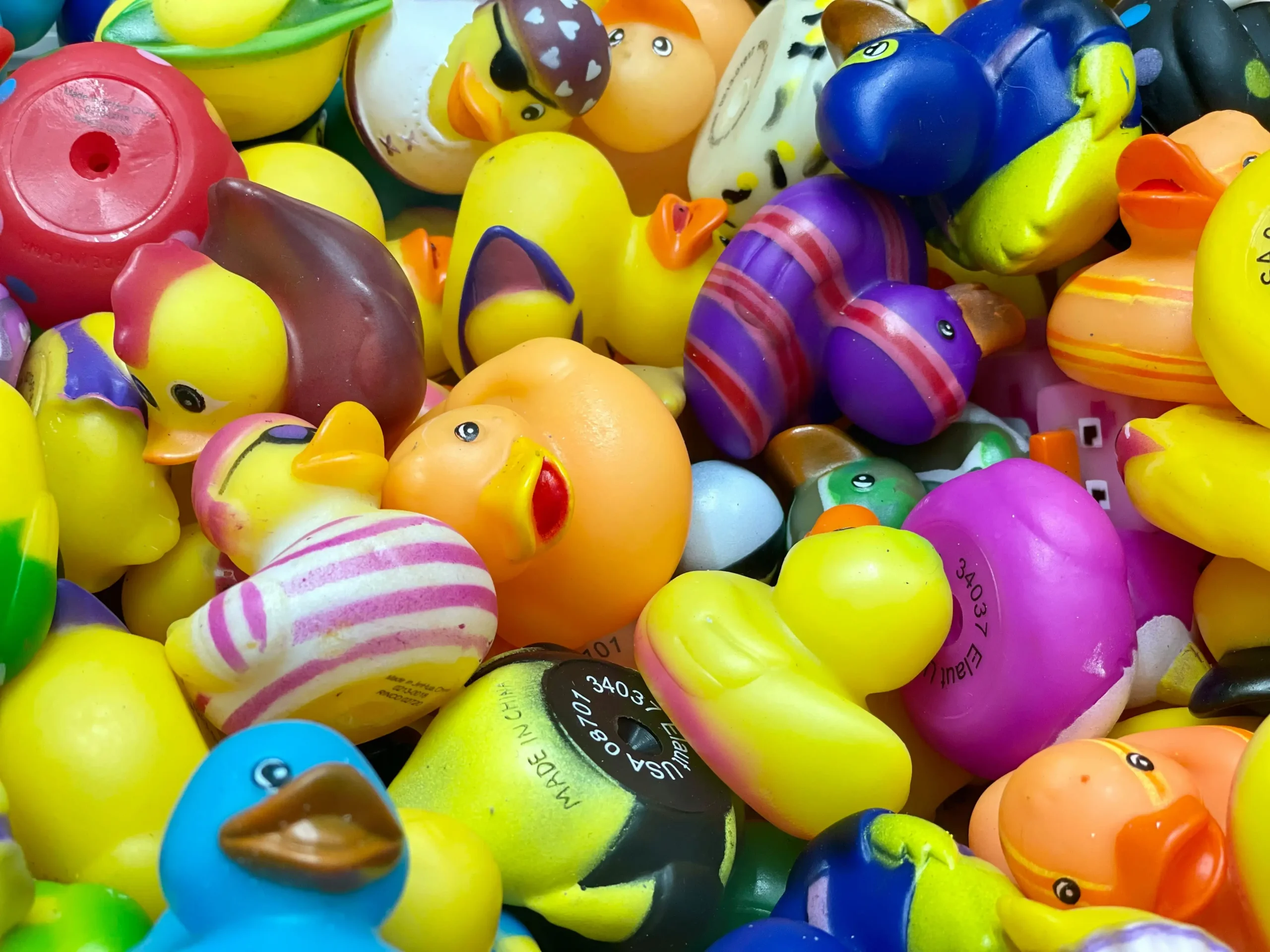
Agency buyers and brand managers face fundamentally different constraints. For an agency sourcing lead running a Q3 product launch, the clock is the enemy. Stock ducks — generic yellow or pre-made themed inventory — can land at the warehouse in 14 days. Cost per unit at 1,000 MOQ sits around $0.15. At 5,000 units, that drops to $0.10–$0.12. No mold fee, no design approval cycle. The trade-off is zero brand differentiation. The duck looks like every other duck on the shelf.
Custom logo ducks flip the equation. At 1,000 MOQ, unit cost lands at $0.80–$1.00, plus a mold fee starting at $350. Lead time stretches to 3–5 weeks for mold creation plus 2–3 weeks for production. The payoff: a duck that carries the brand’s Pantone color, embossed logo (minimum detail 0.5mm), and custom packaging. For a brand marketing manager running a multi-channel campaign, that consistency is non-negotiable. A stock duck in a trade show swag bag gets tossed. A custom duck with the company logo and a QR code to a landing page gets photographed and posted.
- Pricing at 1,000 units: Stock: ~$0.15/unit. Custom: ~$0.80–$1.00/unit plus $350 mold fee. Stock wins on upfront cost; custom wins on brand recall.
- Pricing at 2,500 units: Stock: ~$0.12/unit. Custom: ~$0.60–$0.75/unit. Mold fee amortizes to $0.14/unit, making the custom premium ~$0.48/unit vs. stock.
- Pricing at 5,000 units: Stock: ~$0.10/unit. Custom: ~$0.50–$0.60/unit. Mold fee drops to $0.07/unit. The gap narrows to $0.40–$0.50/unit — justifiable for a campaign with measurable ROI.
- Lead time comparison: Stock: 2 weeks from order to delivery. Custom: 5–8 weeks total (mold creation + production). For event-driven campaigns with fixed dates, stock is the only option. For planned brand initiatives, custom delivers superior results.
The deciding factor is campaign duration and distribution channel. Agency buyers running a one-week trade show or a flash retail promotion choose stock ducks because speed trumps uniqueness. Brand teams running a 3-month loyalty program or a social media giveaway choose custom ducks because the asset lives beyond the event. The cost premium for custom at 5,000 units is roughly $2,000–$2,500 over stock — a fraction of the media spend required to generate the same brand impressions through digital ads.
| Category | Cost per Unit (1000 MOQ) | Lead Time | Best For |
|---|---|---|---|
| Standard Stock Ducks | $0.20 – $0.30 | 2 weeks | Speed & low-cost bulk giveaways |
| Custom Logo Ducks | $0.80 – $1.50 | 4–6 weeks | Brand consistency & differentiation |
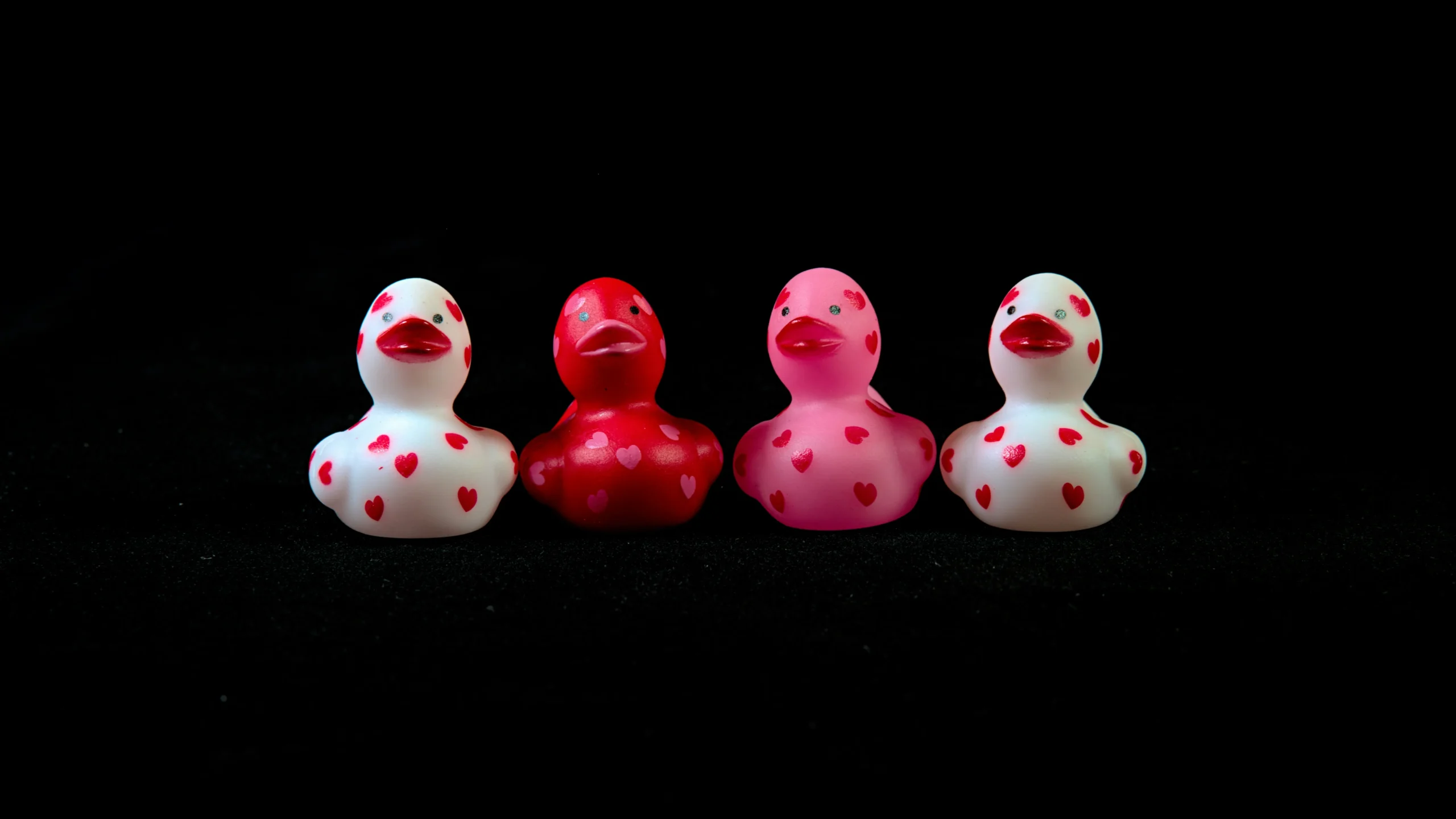
| Themed / Jeep Ducks | $0.40 – $0.80 | 3–5 weeks | Trend-driven retail & social buzz |
| Large Display Ducks | $5.00 – $20.00 | 6–8 weeks | High-visibility events & photo ops |
Jeep Duck Sizing: What Retailers Must Stock
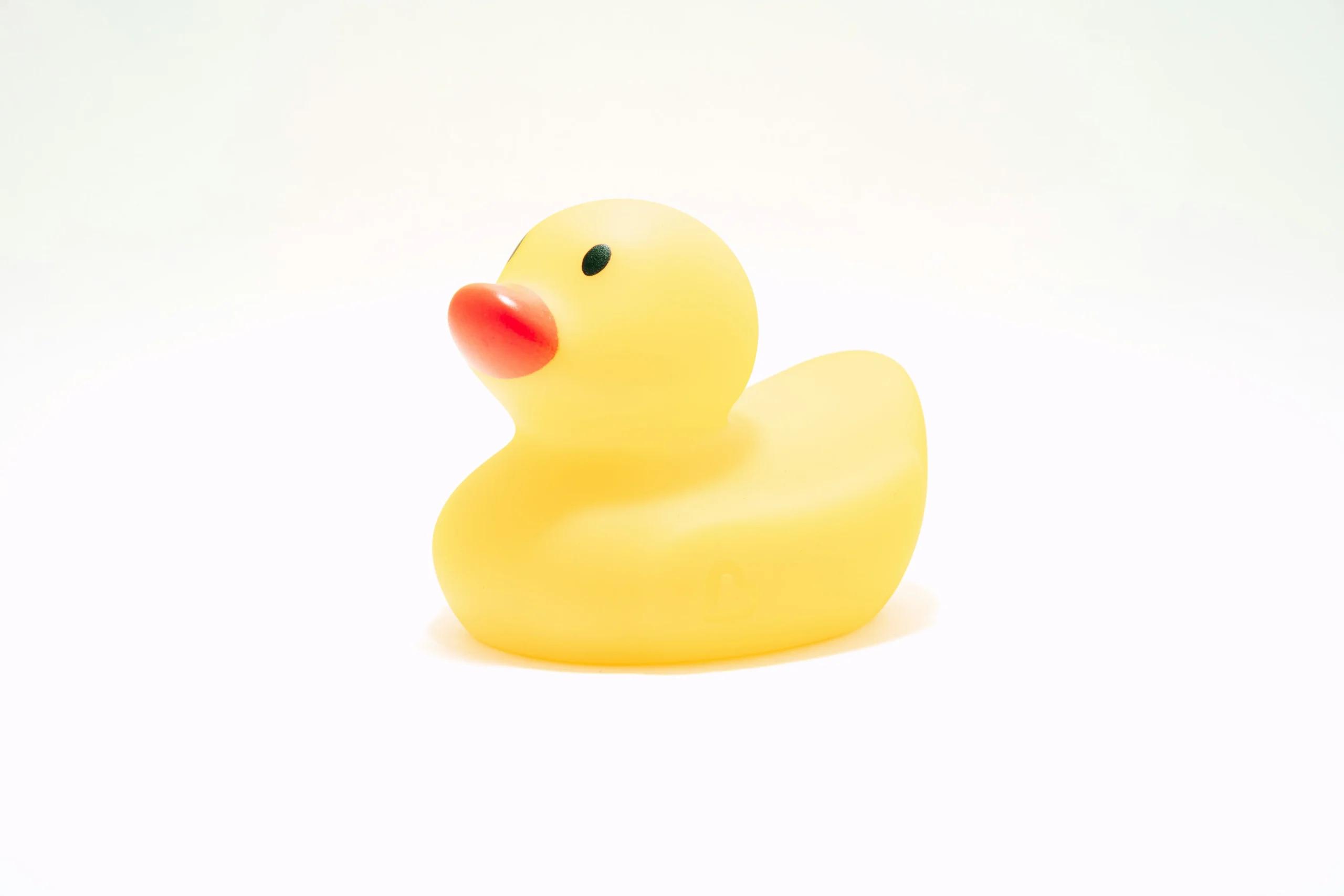
Most “jeep ducks” are repurposed bath ducks.
Jeep ducking exploded 340% year-over-year from 2022 to 2026, but the supply chain hasn’t caught up. The majority of ducks sold for this trend are standard 2.5-inch bath ducks repurposed for the trend. That creates two problems for retailers: poor door-handle fit and excessive rattling at highway speeds. Buyers should demand dedicated molds with a smaller width and a flatter base.
- Ideal size: 1.5 to 2 inches in width, 1.0 to 1.5 inches in height. This fits the door handle pocket of Jeep Wrangler and Gladiator models without looking oversized. Standard 2.5-inch bath ducks bulge out and risk being knocked off.
- Dedicated mold advantage: A purpose-built jeep duck mold produces a flatter bottom that sits flush on the handle. It eliminates the rocking motion that causes squeaking and rattling. Generic round-bottom ducks wobble and often fall off.
- Retail margin opportunity: A 6-pack of jeep ducks retails at $8.99. Landed cost per duck from a dedicated mold is approximately $0.60. That yields a 60% gross margin at wholesale and over 85% at retail. Themed sets (holiday, career, unicorn) command a 40–60% price premium over generic yellow ducks.
- Sizing comparison: Standard bath duck: 2.5″ wide, 2.0″ tall, 5–8 grams. Jeep duck: 1.5–1.75″ wide, 1.0–1.5″ tall, 3–5 grams. Large novelty duck: 3–4″ wide, 3–5″ tall, 15–30 grams. Only the jeep-specific size fits exterior handles without obstruction.
The hidden supply chain reality is that most suppliers simply shrink their standard bath duck mold. That produces a duck that is too tall and too round for the handle. A properly engineered jeep duck mold has a width-to-height ratio of approximately 1.3:1, versus 1.25:1 for a standard bath duck. The flatter profile also reduces packaging volume by 20%, lowering dimensional weight shipping costs for retailers.
Quality Risk: PVC vs. True Rubber in Bulk Ducks
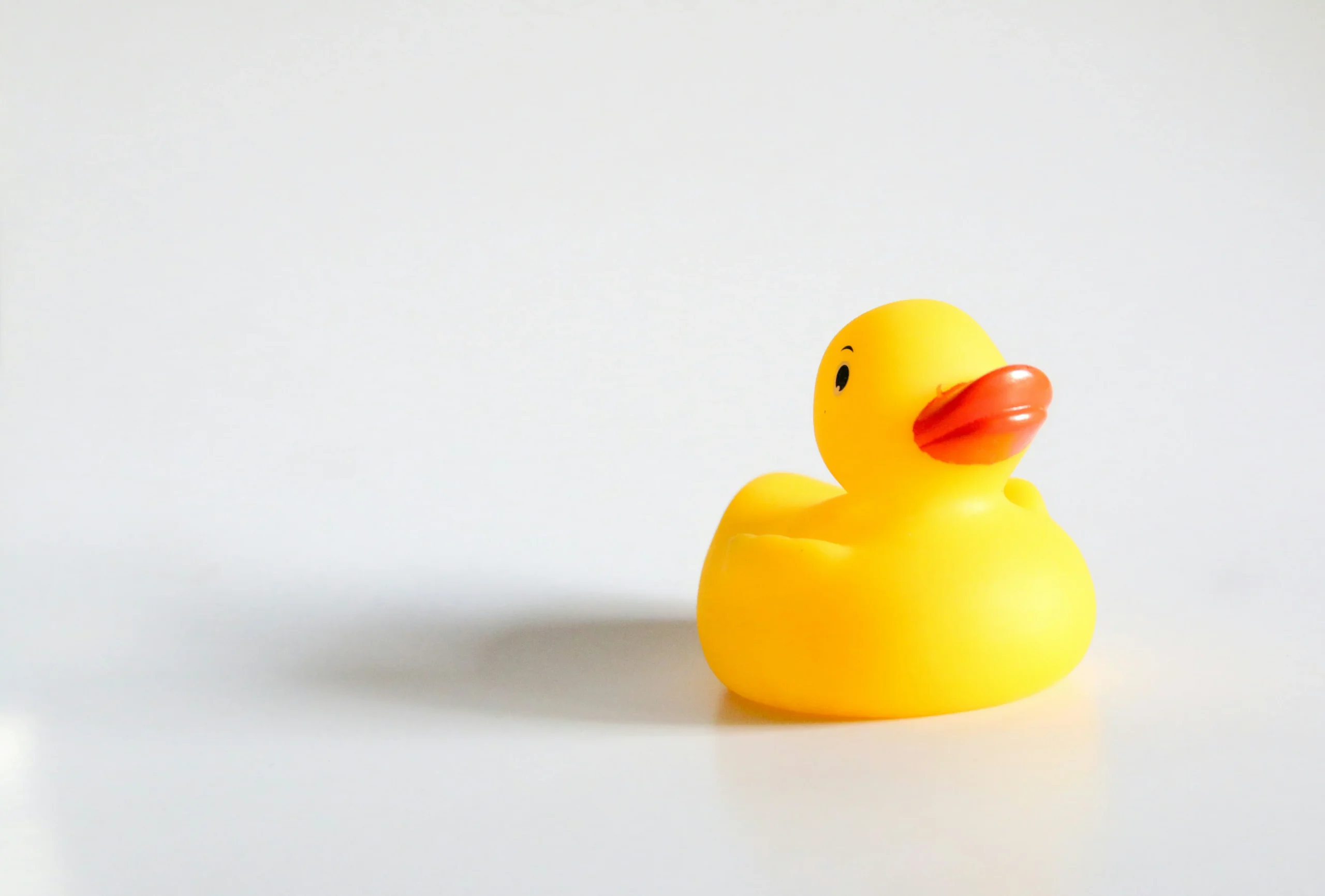
85% of bulk ‘rubber ducks’ are hollow PVC plastic, not natural rubber.
Most buyers assume a ‘rubber duck’ is made of rubber. The reality: the vast majority of bulk ducks from Asian suppliers are hollow float-molded PVC (polyvinyl chloride). Natural rubber ducks exist but are rare in mass production due to higher material cost and slower cure cycles. The difference matters for durability, safety compliance, and floatability.
- PVC (Float-Molded): Fast cycle time (30–60 seconds per unit). Sharp seam lines. Contains plasticizers — phthalates are a regulatory risk for children under 3. EN71 and ASTM F963 compliant only if phthalate-free formulation is specified. Typical weight: 5–8g for a standard 2.5-inch duck. Floats well but cracks under repeated compression or sun exposure.
- Silicone: Soft, flexible, no plasticizers. Passes EN71, ASTM, CPSIA, and REACH without additives. 3–4x the unit cost of PVC. Longer molding cycle (2–5 minutes). Used for teething toys or premium giveaways. Does not float as naturally as hollow PVC — higher density requires thicker walls or internal air chamber.
- Natural Rubber: Biodegradable, elastic, no phthalates. Very rare in Chinese factories — most natural rubber ducks are made in Sri Lanka or Thailand. Higher raw material cost (2–3x PVC). Limited color consistency and emboss detail retention. Suitable for eco-branded campaigns but MOQ typically 5000+ units.
The hidden risk: suppliers quoting ‘rubber duck’ without specifying material are almost certainly shipping PVC. For promotional campaigns targeting children under 3, buyers must request phthalate-free PVC or switch to silicone. Failure to do so risks regulatory rejection at customs or retailer chargebacks. Always request a material data sheet (MDS) and third-party test report before production.
Themed vs. Generic: Which Drives Higher Retail Velocity?
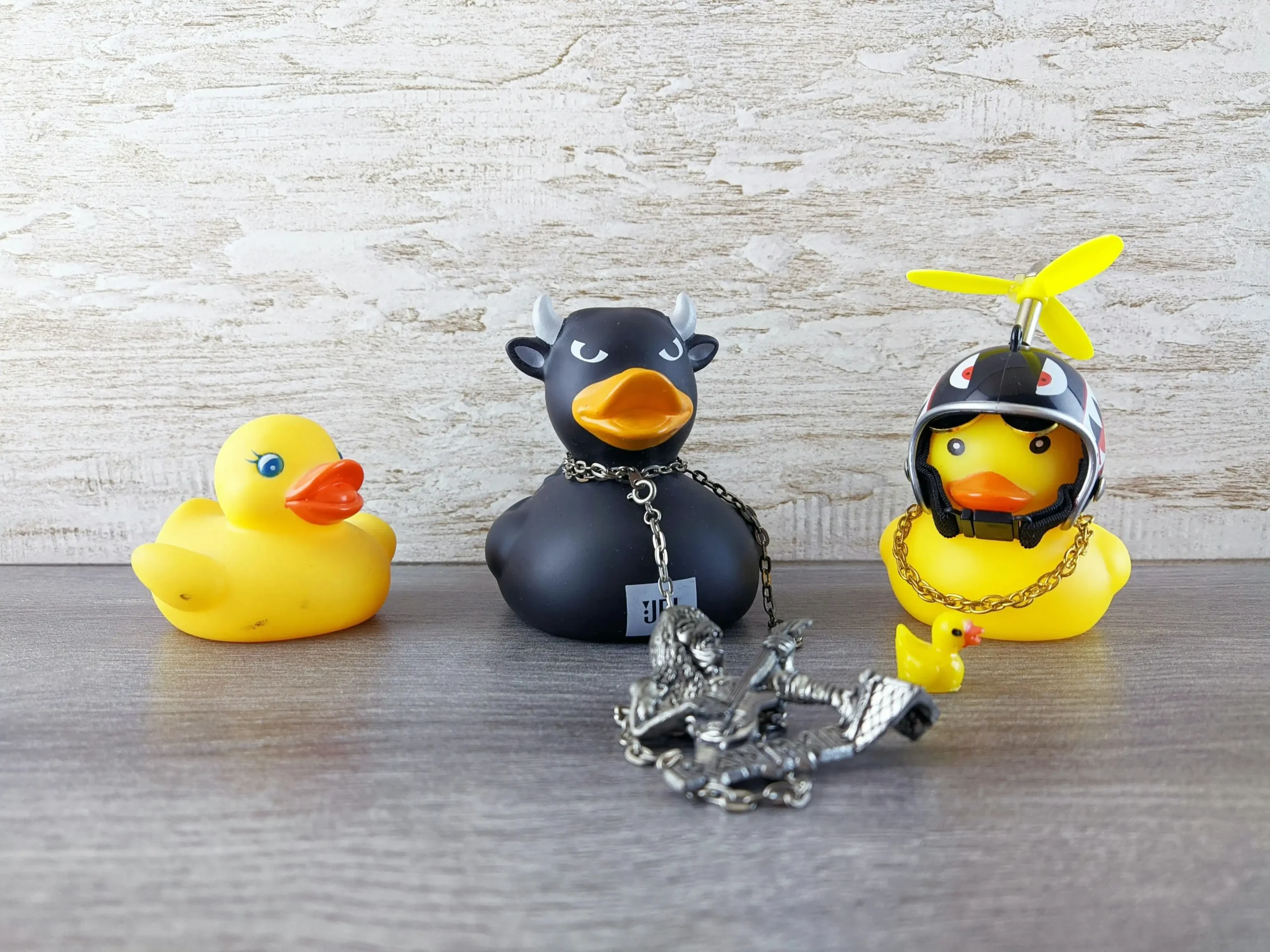
Themed ducks turn over 3x faster than generic yellow ducks in gift channels.
Retail velocity data from 2026–2026 shows a clear winner: themed ducks (holiday, career, unicorn, pirate) average 2.3 units per week at $9.99 retail. Generic yellow ducks manage 0.8 units per week at $4.99. Large display ducks (12+ inches) sell 0.3 units per week at $25.00. The margin math favors themed sets: a $0.60 landed cost for a themed jeep duck 6-pack yields $8.99 retail — a 14x markup vs. 8x for generic singles.
The Jeep ducking trend, which originated in 2020 via Facebook groups, has matured into a $50M+ retail subcategory. Over 500 active Facebook groups now drive demand for themed sets tied to holidays, professions, and pop culture. Brands that align custom duck sets with social traditions — like ’12 Days of Duckmas’ advent calendars or ‘Duck the Halls’ holiday packs — capture premium pricing and repeat purchases.
- Retail velocity comparison: Themed jeep ducks: 2.3 units/week at $9.99. Basic yellow ducks: 0.8 units/week at $4.99. Large display ducks: 0.3 units/week at $25.00.
- Margin opportunity: Themed 6-pack at $0.60 landed cost sells for $8.99 retail — 14x markup. Generic single at $0.15 landed sells for $4.99 — 33x markup but lower absolute profit per transaction.
- Social tradition leverage: Brands creating custom sets tied to events (e.g., ‘Duck the Halls’, ’12 Days of Duckmas’, ‘Duck Duck Graduation’) see 40% higher sell-through rates than generic seasonal stock.
For agency buyers and brand managers, the takeaway is straightforward: generic yellow ducks are a commodity race to the bottom. Themed ducks — especially those tied to the Jeep ducking tradition — command premium pricing, faster turnover, and higher customer engagement. Custom mold costs start at $350, with per-unit pricing at $0.80 for 1,000 MOQ. The ROI on a themed custom set vs. generic stock is typically recovered within the first 300 units sold at retail.

Large Duck Logistics: Hidden Costs in Displays
A 36-inch duck can cost more to ship than to manufacture.
Most promotional buyers calculate large duck budgets based on unit price alone. That math fails. A 12-inch duck occupies 0.75 cubic feet. A 24-inch duck jumps to 3.2 cubic feet. A 36-inch duck requires 8.5 cubic feet of boxed space — roughly the volume of a small dorm fridge. FedEx Ground dimensional weight pricing for a 36-inch duck (16″ × 16″ × 20″ box) runs $18–25 per unit domestic. The product itself costs $5–20. Shipping eats 50–80% of total landed cost.
Compare that to a standard 2.5-inch duck: 0.01 cubic feet, ships for pennies. A buyer ordering 100 standard ducks pays roughly $15 in freight. The same count of 36-inch display ducks costs $1,800–2,500 in freight alone. That 4–6x multiplier per unit is absent from every lifestyle blog covering large duck installations.
- 12-inch duck: 0.75 cu ft, ships via FedEx Ground for $8–12. Product cost $5–8. Shipping is 60–150% of product cost.
- 24-inch duck: 3.2 cu ft, ships for $14–18. Product cost $8–15. Shipping equals or exceeds product cost.
- 36-inch duck: 8.5 cu ft, ships for $18–25. Product cost $10–20. Shipping is 90–250% of product cost.
The operational cost angle is the hidden margin killer. Storage adds another layer: a pallet holds roughly 20–25 units of 36-inch ducks (rotomolded PE, non-collapsible). That pallet occupies 4 square feet of warehouse space for 4–8 weeks. Standard ducks pack 5,000+ units per pallet. Brands planning mall displays or event installations must budget for storage, freight, and potential LTL (less-than-truckload) surcharges. The competitor content never mentions this because they sell the spectacle, not the supply chain.
Mitigation: Inflatable PVC large ducks collapse to 10% of rigid volume, cutting dimensional weight by 60–70%. Rotomolded PE ducks are more durable for repeated use but cannot be deflated. For one-time events, inflatable PVC is the cost-efficient choice. For permanent installations or rental fleets, rotomolded PE justifies the freight premium.
| Duck Size | Product Cost (Est.) | Shipping Cost (Est.) | Cost Multiplier vs. Product | Key Logistics Risk |
|---|---|---|---|---|
| 12 inches | $5.00 – $8.00 | $12.00 – $18.00 | 2.3x | Dimensional weight surcharge |
| 24 inches | $10.00 – $15.00 | $25.00 – $40.00 | 2.7x | Oversize package fees |
| 36 inches | $15.00 – $25.00 | $45.00 – $75.00 | 3.0x | Freight class reclassification |
| 48 inches | $25.00 – $40.00 | $80.00 – $150.00 | 3.8x | Palletization & LTL minimums |
| 60 inches | $40.00 – $60.00 | $150.00 – $250.00 | 4.2x | Specialized freight carrier required |
Conclusion
The right rubber duck type depends on your campaign’s primary trade-off: speed vs. brand accuracy, trend relevance vs. shipping cost. Standard ducks ship in 2 weeks at $0.15/unit. Custom ducks cost $1.00/unit but lock in brand consistency. Jeep ducks ride a 340% growth trend, but only with dedicated molds that fit door handles. Large ducks drive foot traffic, but the shipping bill can exceed the product cost.
Review your budget, MOQ tolerance, and logistics constraints against the cost tables above. When you need custom molds, Pantone-matched colors, or EN71-certified production at 1,000-unit MOQ, LZENGO delivers 5 million ducks monthly with end-to-end support from mold creation to packaging. Browse the product page to compare options and request a quote.
Frequently Asked Questions
What size ducks for Jeep ducking?
The universal sweet spot for Jeep ducking is 1.5 to 2 inches wide, which fits door handles and dashboards without falling out. Standard 2.5-inch bath ducks are too large for most handles, while 3-inch novelty. Stick to 1.5–2 inches for reliable placement.
What are the unwritten rules of Jeep ducking?
Never duck a Jeep that already has a duck on its dash, and always place the duck where the owner will see it before driving off. Avoid using damaged or dirty ducks, and. Leave one, take one only if it’s a trade.
What is the trend with rubber duckies and Jeeps?
Jeep ducking started as a fun way for Wrangler owners to surprise each other, and it has grown into a massive grassroots marketing trend. Brands now use custom Jeep ducks as promotional giveaways. Expect continued growth through 2026 as brands adopt it.
What is a standard size rubber duck?
A standard rubber duck is approximately 2.5 inches wide and 2.75 inches tall, which is the classic bath toy size. This is the baseline for most stock ducks, but custom and Jeep. Use 2.5 inches as your reference for standard stock ducks.
What is the etiquette for ducking a Jeep?
Always duck a Jeep that is parked and unoccupied, and place the duck on the driver’s side door handle or windshield wiper. Do not duck Jeeps that are clearly in a private driveway or. Keep it friendly, visible, and respectful of property.