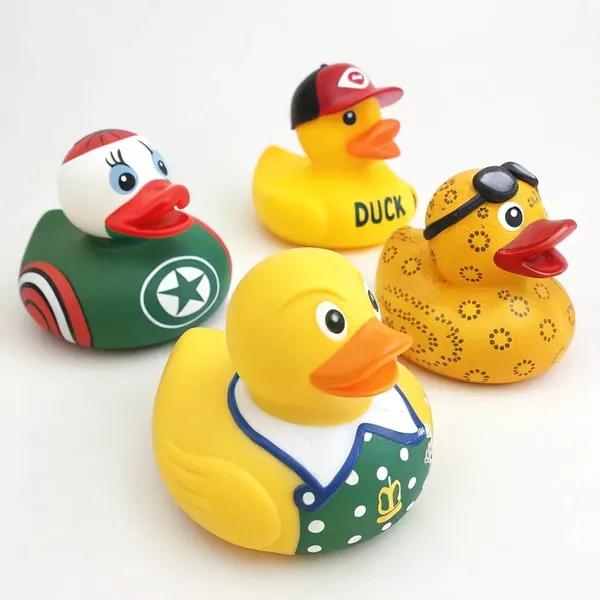
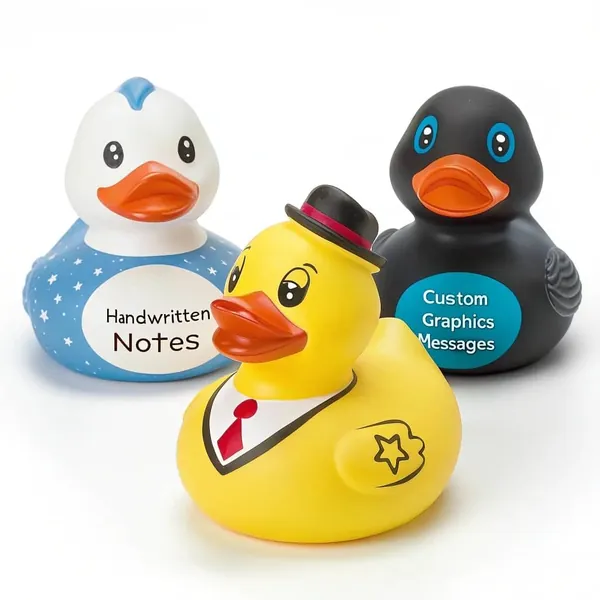
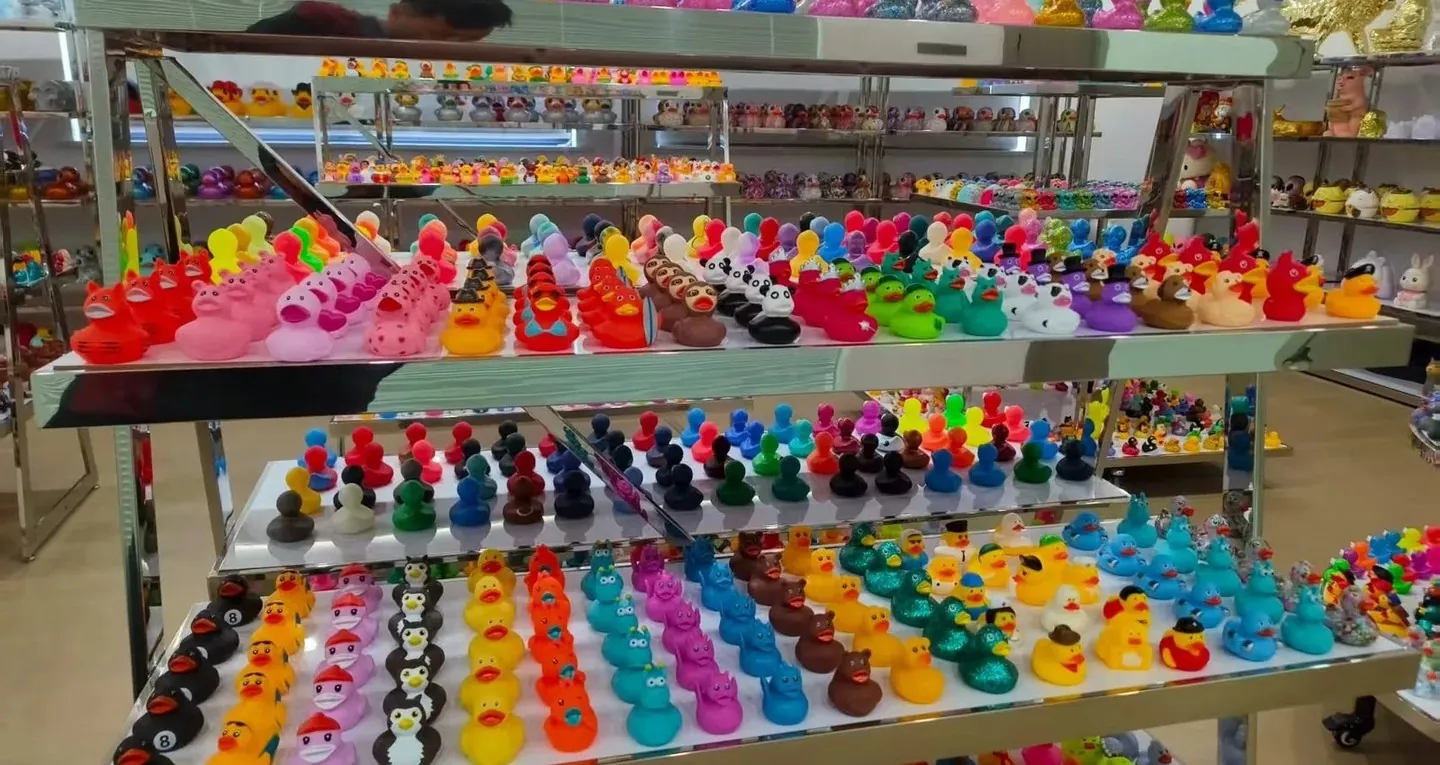
A system-wide opening duck belongs on one body, because a franchise cannot personalise its way to a consistent brand. A single location can put anything it likes on a duck; many locations have to look like one company by the hundredth opening. That constraint is a tooling and packing decision, and it is what the personalisation routes on this page are measured against.
A franchise giveaway is one body with many store marks, because the hundredth opening has to look like the first.
In short: A franchise grand opening duck is one body, one base design and a variable store mark, packed by location and handed over in a format the store can run without a designer. The body carries the brand, the print or the card carries the store, and the carton carries the location label. When those three are separated correctly, a hundred openings look like one campaign instead of a hundred local orders.
A Grand Opening Is a Brand Test, Not a Party
An opening day is the first time a neighbourhood meets the brand, and the giveaway is the object that goes home with them. That makes the duck a brand test rather than a party favour: it will sit on a desk or a dashboard for months, and every one of those months is a small advertisement for the store that gave it away. A duck that looks improvised is a brand that looks improvised, and the impression it leaves is not repaired by the ribbon.
The practical consequence is a split between what is fixed and what is local. The brand mark, the body, the size and the pack are fixed across the system, because those are what make the duck recognisable. The store name, the store number, the city and the opening date are local, because those are what make the duck a keepsake of that day. A specification that does not draw that line ends up with one store printing a slogan across the chest and another printing nothing at all.
Why the Duck Outlasts the Ribbon
A ribbon is cut once and thrown away. A duck goes home, gets put on a desk, gets photographed and gets kept, and that is the whole reason a duck is worth giving at an opening. The object carries the store's name into places the store cannot buy: a kitchen shelf, a car dashboard, a child's bath, a colleague's monitor.
That long life sets the requirement. The print has to survive handling and light, the body has to survive being squeezed and dropped, and the mark has to stay legible after the opening week. A giveaway that fades in a month is a giveaway that quietly stops working, and the logo fading note covers what makes a mark fade and how the route is chosen.
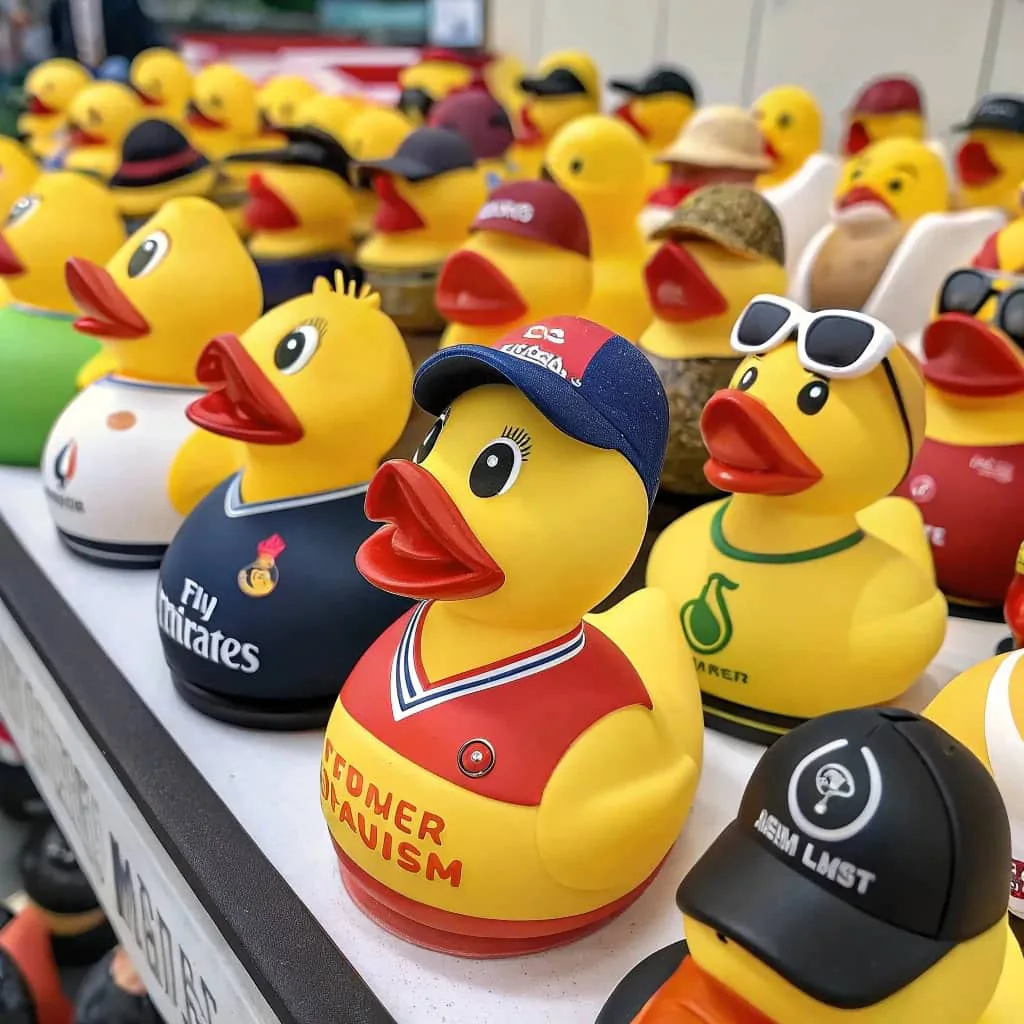
The duck also has to be worth keeping. A plain body with a small logo reads as a promotional leftover, and a body with a design that fits the brand reads as a souvenir. The difference is not the print area. It is whether the design was made for the duck or pulled from a folder of logo files.
One Design or Fourteen: Personalisation Without a New Tool
A franchise system usually wants the same duck with the store name on it, and the first question is how that name gets there. There are four routes, and only one of them touches the tool.
| Route | Tool change | What it can carry | Where it fits |
|---|---|---|---|
| Moulded base mark | A tool change | One fixed brand mark on every duck | A system that wants one mark and no local text |
| Pad print | No tool change, a print plate | A short store name or number | Most openings, on a flat body area |
| UV print | No tool change, a print file | Fine text, small logos, several colours | Stores with longer names and detailed marks |
| Printed card | No tool change, a card file | The store details, the date, the address | Any opening where the duck stays generic |
The base mark is the most economical place to personalise because it is made once and repeats on every duck, and it is also the least flexible, because changing it means changing the tool. The mould carving note covers where a carved mark belongs and where a printed one does, and the printing process note covers how pad and UV print differ on a curved body.
The practical split for a rollout is the base mark for the brand, a print for the store, and a card for anything that changes per opening, such as the date or the address. That keeps the tool fixed, the print short and the card simple to reprint for the next location.
Packing by Location Is Where a System Order Fails
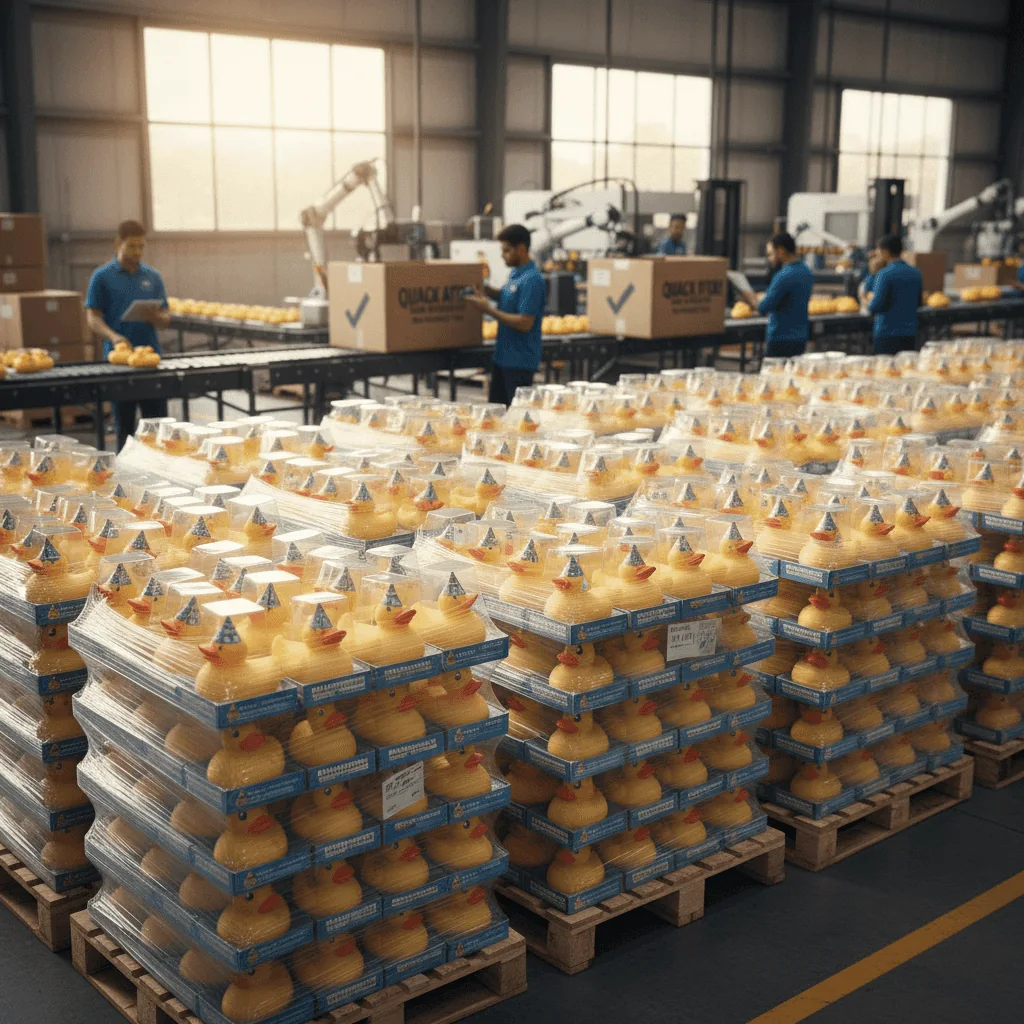
A system order is one order and many deliveries, and the packing is where it usually breaks. A carton that mixes four stores means somebody at the distribution point has to open it and sort it, and the first store to run out is the store whose stock went to the wrong location. Packing by store is not a courtesy. It is the only way a hundred-opening rollout can be received without a sorting bench.
The pack has to be readable at a glance. A carton marked with the store, the quantity and the opening date can be handed to a store manager without a lookup, and a carton marked with only a style number cannot. The packaging layout note covers how the carton and the inner pack are built, and the bulk order note covers how a mixed order is assembled.
There is also a count per store, and it needs to be a real count rather than an average. A flagship opening and a small-format store do not hand out the same number of ducks, and a system that ships the same carton to both will over-supply one and run short at the other. The count belongs on the store line, not in a footnote.
The Handover Has Three Formats
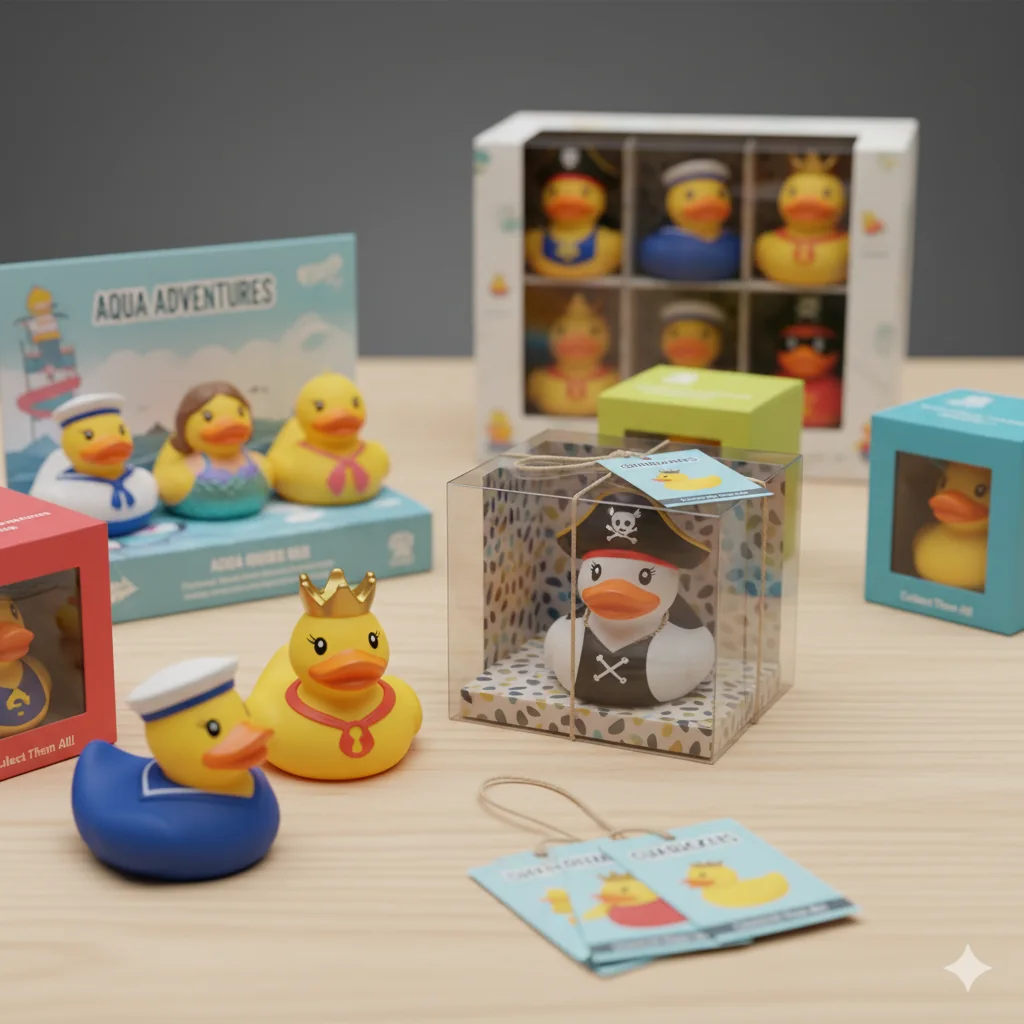
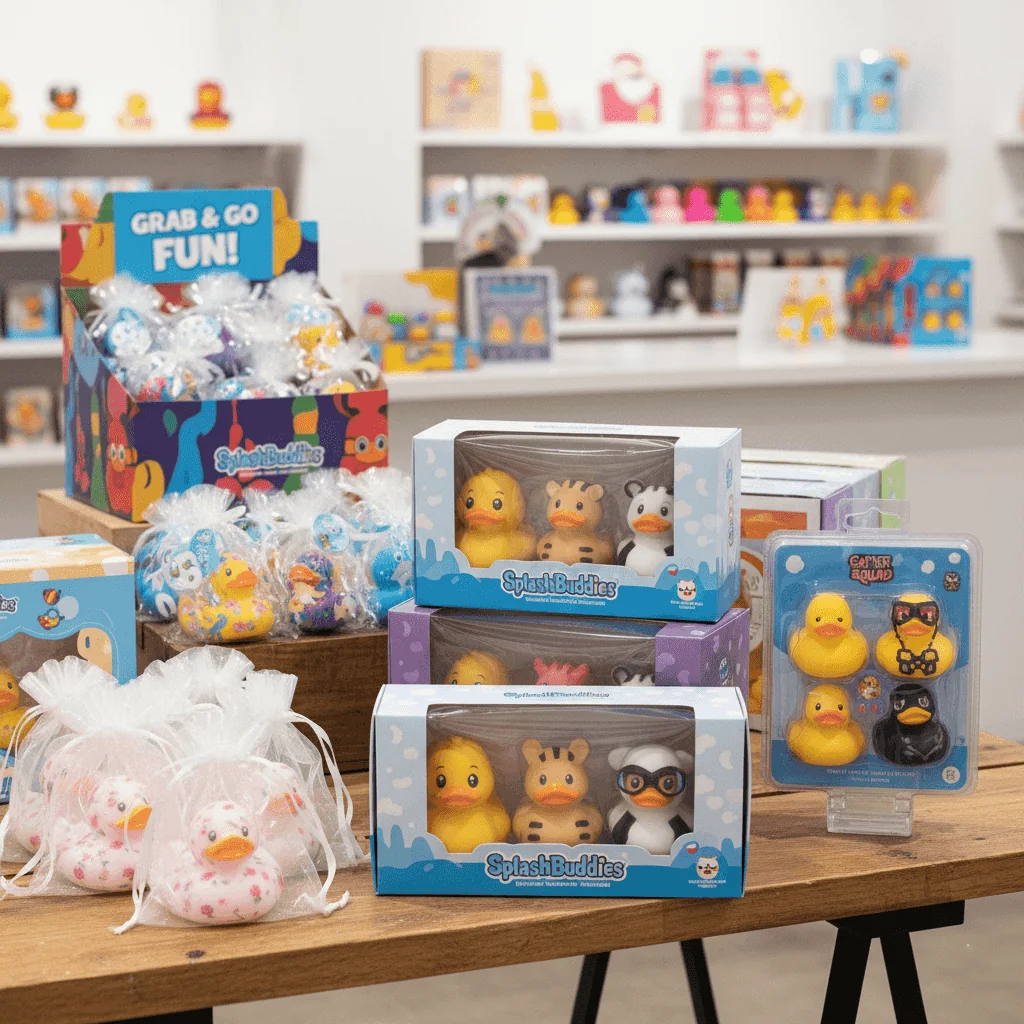
A franchise opening tends to use one of three formats, and each one asks something different of the duck and the pack. The door handout is the simplest: a duck handed to each visitor as they come in, usually with a card. The counter drop is the second: a duck given with a purchase, or to the first visitors of the day, which creates a queue and a reason to come early. The social drop is the third: a duck left in a public place with a tag that sends the finder to the store's account, which turns one duck into a post.
Each format sets a different requirement. A door handout needs a fast unpack and a card the staff can hand over without instructions. A counter drop needs a numbered or dated mark, because the duck is the proof that the visitor came early. A social drop needs a tag with the account and a clear rule, and the hang tag page covers the card that carries it.
The format also decides who is allowed to hand the duck to a child. A door handout puts a duck in the hands of every visitor, including families with toddlers, so the parts and the marks on the duck have to hold up to that. A counter drop with a purchase is easier to control and easier to explain. Writing the format into the store sheet is what stops one location inventing a water game and another handing out ducks from a box at the till.
The File a Family Audience Needs
A grand opening attracts families, and a duck in a child's hand is a toy, whether the store calls it a giveaway or a souvenir. The parts are the first question. An eye, a hat or a squeaker that can be pulled free turns the duck into a small part, and for a product intended for children under three the test is physical: no toy or other children's article subject to the rule shall be small enough to fit entirely within the cylinder shown in the regulation, when tested by its procedure (16 CFR 1501.4).
The marks are the second question, and a system order makes them harder rather than easier, because a hundred stores means a hundred batches and no single batch number covers them. The CPSC tracking label guidance explains that permanent distinguishing marks have to be affixed to the product and its packaging, to the extent practicable, and may use a code the consumer can ask about, which is why the store line and the batch line belong in the same record.
Age grading is the third question. An opening is often planned for adults and attended by children, and the duck's grade has to match the younger of the two. The age grading guide covers how the grade is set, and the safety label guide covers what the pack carries. A franchise that treats the file as a formality is one complaint away from a system-level problem.
Four questions settle a system order before the store list is final:
- Which mark is fixed on the body, and which mark changes per store?
- Does the store mark fit the print area, or does it need a card instead?
- Is every carton packed and labelled by location with its own count?
- Which handover format, and what does it add to the safety file?
Frequently Asked Questions
Should every franchise location get the same duck?
The same body, the same brand mark and the same pack, with the store name or number as the local variable. That keeps the system recognisable while giving each opening a keepsake that names the location. One location with a different body breaks the campaign.
Can a store name be printed without a new mould?
Yes. A store name or number is a print job on a flat area of the body, so it does not touch the tool. A moulded mark is only needed when the mark is part of the body itself and repeats unchanged on every duck, which is the brand mark rather than the store.
How should a system order be packed for many stores?
By location, with the store, the count and the opening date on each carton. A mixed carton forces the receiving point to sort it, and a system with no sorting bench will send the wrong stock to the wrong opening. The inner pack should follow the same line as the carton.
Do franchise giveaway ducks need toy safety testing?
A duck handed to a child is a toy, and a family audience makes that likely at any opening. The parts, the age grade and the marks belong in the file before the first carton ships, and one shared file across the system is easier to hold than a hundred local checks.
Final Note: The Rollout Sheet
- Fix the body, the brand mark and the pack across the system.
- Put the store name or number on a print, and the date and address on a card.
- Pack and label by location, with a real count per store.
- Choose the handover format and write it into the store sheet.
- Hold one safety file and one batch record that covers the whole rollout.
A franchise opening is a party for one day and a brand impression for years, and the duck is the part that leaves the building. One body, many marks, packed by location: that is the whole specification, and it is the difference between a system-wide campaign and a hundred separate orders that happen to share a logo.
Key takeaways
- An opening duck is a brand test because it goes home and stays, covered under the opening as a brand test.
- The duck outlasts the ribbon, so the print has to survive handling and light, covered under why the duck lasts.
- The base mark is fixed and the store mark is variable, covered under personalisation routes.
- A system order fails at packing unless each carton carries the store and the count, covered under packing by location.
- A duck handed to a family is a toy, so the file has to cover parts, marks and age, covered under the family audience file.