Skip to content
Rubber ducks and babies are a combination parents ask about constantly, and the answer is not a simple yes or no — it is an age grading. The duck itself is not inherently dangerous; the risks sit in the details: small parts that break off, the squeaker that can be extracted, the material’s chemical safety, and the age of the child holding it. This guide explains how age grading works for rubber ducks, what the safety standards actually test, and how buyers and parents can verify a duck is appropriate for a baby or toddler.
Why Age Grading Exists for Toys
Age grading is the toy industry’s way of matching product attributes to developmental stage. The core rule: anything intended for children under 3 must pass small-parts testing — no part small enough to be swallowed or choked on, which means no detachable squeaker, no eyes or accessories that pull off, no small pieces at all. A duck with a removable squeaker is therefore not a toy for under-3s by definition; a solid molded duck with no detachable parts is. The second rule is the labeling: toys for under-3s are marked with the age grade and the safety standard they meet, and toys that cannot meet small-parts requirements are marked “not for children under 3.” The third rule is material safety: the toy must comply with the heavy-metals and phthalate limits of the destination market. The ASTM F963 standard — the U.S. consumer safety specification for toy safety — is the framework that bundles these requirements, and it is the standard cited in CPSIA compliance documentation for toys sold in the United States.
What the Standards Test: Small Parts, Squeakers, and Chemistry
For a rubber duck, three tests decide the grade. Small parts: the duck is dropped and pulled with defined forces to simulate a child’s use, and any part that separates and fits the small-parts cylinder fails. The squeaker is the classic failure — it is a separate part, and even when firmly seated it is a choke risk if a child bites it loose. Solid ducks without accessories pass; duck-with-squeaker products fail for under-3 unless the squeaker is molded as one piece into the body. Chemistry: the material is tested for heavy metals (lead, cadmium, mercury, barium, among others) and phthalates, with limits set by the destination market’s rules — CPSIA in the U.S., REACH annex limits in the EU. Labeling and documentation: the compliant product carries the age grade, the standard reference, and — for importers — the test report trail from the manufacturer. LZENGO’s certified programs carry BSCI social compliance, GRS recycled-content certification, and REACH/CPSIA testing through Intertek, with test reports available to buyers; the rubber duck safety testing guide explains how to read those reports.
The Age-by-Age Answer
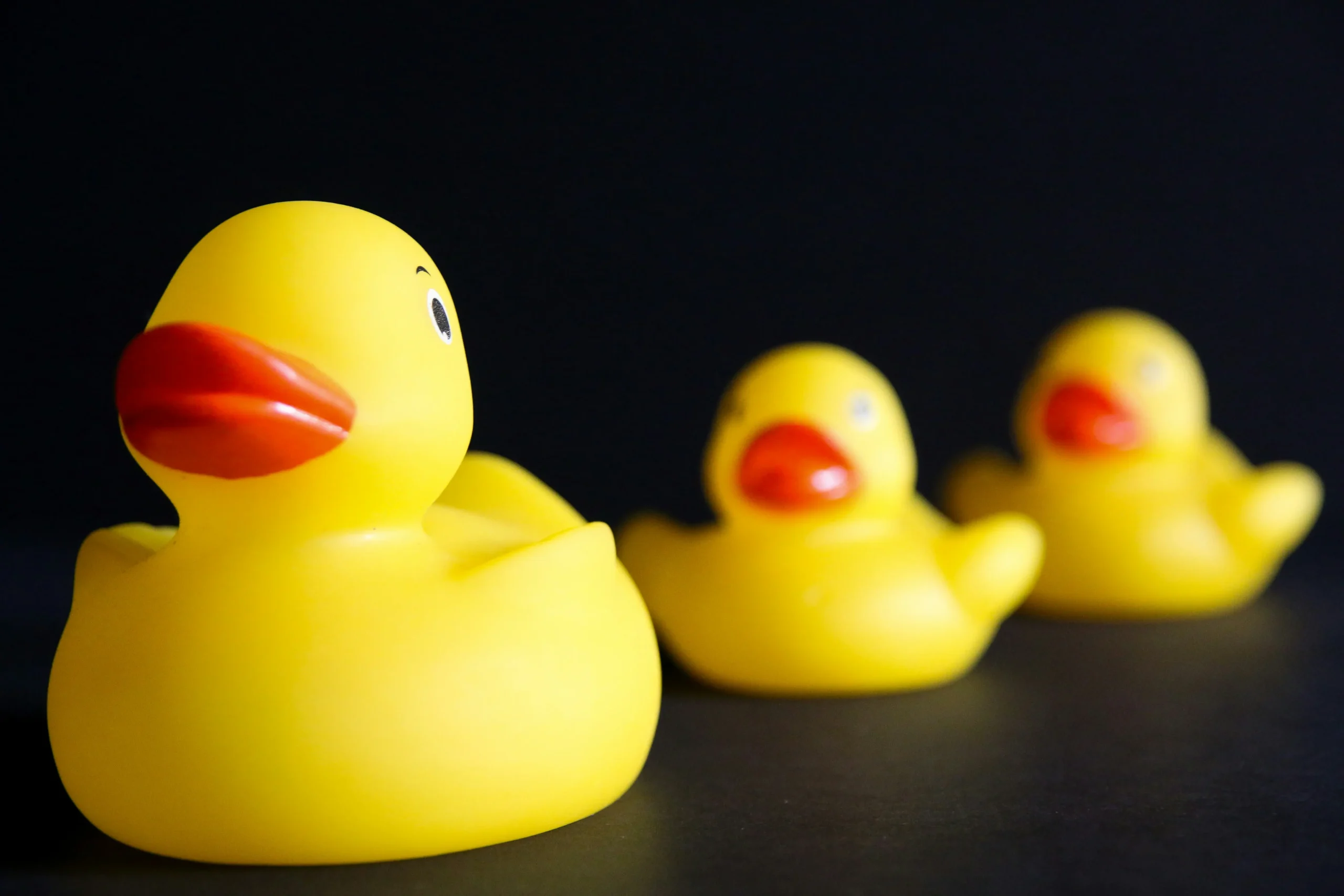
Under 6 months: no rubber duck as a toy — the mouthing phase makes any small-part risk unacceptable, and the product is not developmentally meaningful yet (bath ducks are used by caregivers, not played with by infants). 6–12 months: a solid, squeaker-free molded duck is acceptable as a supervised bath toy — the material is soft, the shape is graspable, and the bath context suits it; the duck must be tested for under-3 compliance. 12–24 months: the same solid duck remains the right choice; squeaker ducks are still out because the biting phase can extract the squeaker. 2–3 years and up: squeaker ducks become acceptable under supervision, and by 3+ the small-parts risk drops out of the under-3 frame entirely. The practical buyer rule: for any program serving babies and toddlers, spec the solid no-squeaker duck with under-3 testing documentation; keep squeaker ducks for the 3+ market. For the sourcing side, the baby product sourcing guide covers how buyers verify these specs with suppliers.
How Buyers Verify a Duck Is Safe for Babies
Verification is a document exercise with three layers. The test report: request the CPSIA/ASTM F963 test report (or the destination market’s equivalent) naming the product and the test date — the report must cover the specific duck SKU, not a “similar” product, and must be current. The age-grade label: confirm the product’s labeling matches its testing — a duck with under-3 testing should carry the 0+ or 3+ age mark correctly (products tested for under-3 may carry 0+; products that fail small-parts carry 3+ and must not be marketed to babies). The supplier’s compliance position: BSCI for social compliance and GRS for recycled content are separate from toy safety — a supplier can be GRS-certified and still lack toy safety testing; ask for the toy-specific documentation explicitly. For private-label programs, the buyer’s name goes on the product and the compliance responsibility follows the documentation trail — the safety testing guide lists the exact documents to request before the PO.
The Bottom Line for Parents and Brands
For parents: buy ducks marked for the child’s age, prefer solid squeaker-free ducks for under-3s, and check the label for the standard reference. For brands: if the duck is intended for babies and toddlers, spec the solid construction, request the under-3 test documentation per SKU, and keep the marketing consistent with the age grade — marketing a 3+ product as a baby toy is both a compliance and a trust failure. The duck itself is a fine toy; the age grading is the safety mechanism that makes it fine. The custom rubber ducks page covers the construction options (squeaker vs solid, matte vs gloss) that determine which age grade a product earns, and the FAQ answers the most common compliance questions from buyers.
FAQ
Are rubber ducks safe for babies?
Solid, squeaker-free ducks tested to the under-3 standard are safe for supervised bath play from about 6 months; ducks with detachable squeakers are not suitable for under-3s.
What makes a duck unsafe for a toddler?
The removable squeaker and any small detachable parts are the choke risks; material chemistry (heavy metals, phthalates) is the second layer, covered by ASTM F963/CPSIA testing.
Can a duck with a squeaker be sold for babies?
Only if the squeaker is molded as one piece and the product passes small-parts testing; a seated squeaker that a child can bite loose fails the under-3 requirement.
What documents prove a duck is baby-safe?
A current ASTM F963/CPSIA test report naming the specific SKU, the correct age-grade labeling, and the supplier’s toy-specific compliance documentation.
Age grading is the safety mechanism: match the duck to the child, request the SKU-specific test documentation, and keep the marketing consistent with the grade. Related reading: safety testing guide and the private label baby-safe duck programs.