Skip to content

Last month an event planner emailed us asking for a “large rubber duck” for a brand activation at a lakeside festival. Their creative director wanted something people would photograph. They had $3,000 to spend. The problem: if you type that exact phrase into Google, half the results show a 61-foot touring inflatable that rents for $45,000, and the other half show a 4-inch promo duck some catalog decided to call “large.” Neither of those was what this person actually needed. We see this exact confusion in about 40% of the inquiries that hit our production team. The Jeep ducking craze turned rubber ducks into a community shorthand, which means every experiential marketer with a summer budget is now being told to “get a big duck” — but almost none of them have the vocabulary to translate that into a manufacturable spec.
So here is the framework we actually use when a new inquiry lands. Three tiers, each with different materials, production methods, and order sizes. Walk through it before you contact any supplier and you will cut the back-and-forth from five days to one — and you will not end up with a toy when your activation needed a prop.

Large Rubber Duck: The 3-Tier Size Framework
“Large” means nothing in manufacturing. We see this mismatch in 40% of inbound inquiries — a planner expects a 2-foot prop, receives a 4-inch toy, and the event deadline is already burned.
Why the Word “Large” Is Poisoning Your Sourcing
Type “large rubber duck” into Google and the SERP returns a 61-foot touring inflatable (Mama Duck, rental cost ~$45,000 for 2.5 weeks via Big Duck LLC) sitting next to a 4-inch promo item that promotional catalog sites label as “large.” Your creative team said “get a big duck.” That single instruction is where the sourcing chain breaks. Inquiries that reach our floor without specified dimensions add 5-7 days to the quotation cycle purely through clarification rounds. The fix is simple: stop using the word “large” and start using a tier number.
Tier 1: The 4-6″ Promo Giveaway Duck
This is what most promotional product distributors call “large” — and it is the root cause of the expectation gap. These are rotocast PVC units weighing 30-60g, manufactured using rotational molding in aluminum shells. At 10,000+ units, raw cost drops below $0.50 per piece with amortized mold cost, landing under $1.50/unit delivered at 5,000+ quantity. MOQ starts at 1,000 units.
The critical compliance note: if your event has child attendees in the US, CPSIA certification is non-negotiable. For EU activations, CE/EN71 applies. If you are ordering 5,000+ units, BSCI audit documentation from the factory should be requested upfront — it will be required by any serious brand’s procurement team anyway. These ducks are per-attendee giveaway items. They are not photo backdrops. If your activation brief says “instagrammable moment,” Tier 1 is the wrong answer.
Tier 2: The 12-24″ Event Display Piece
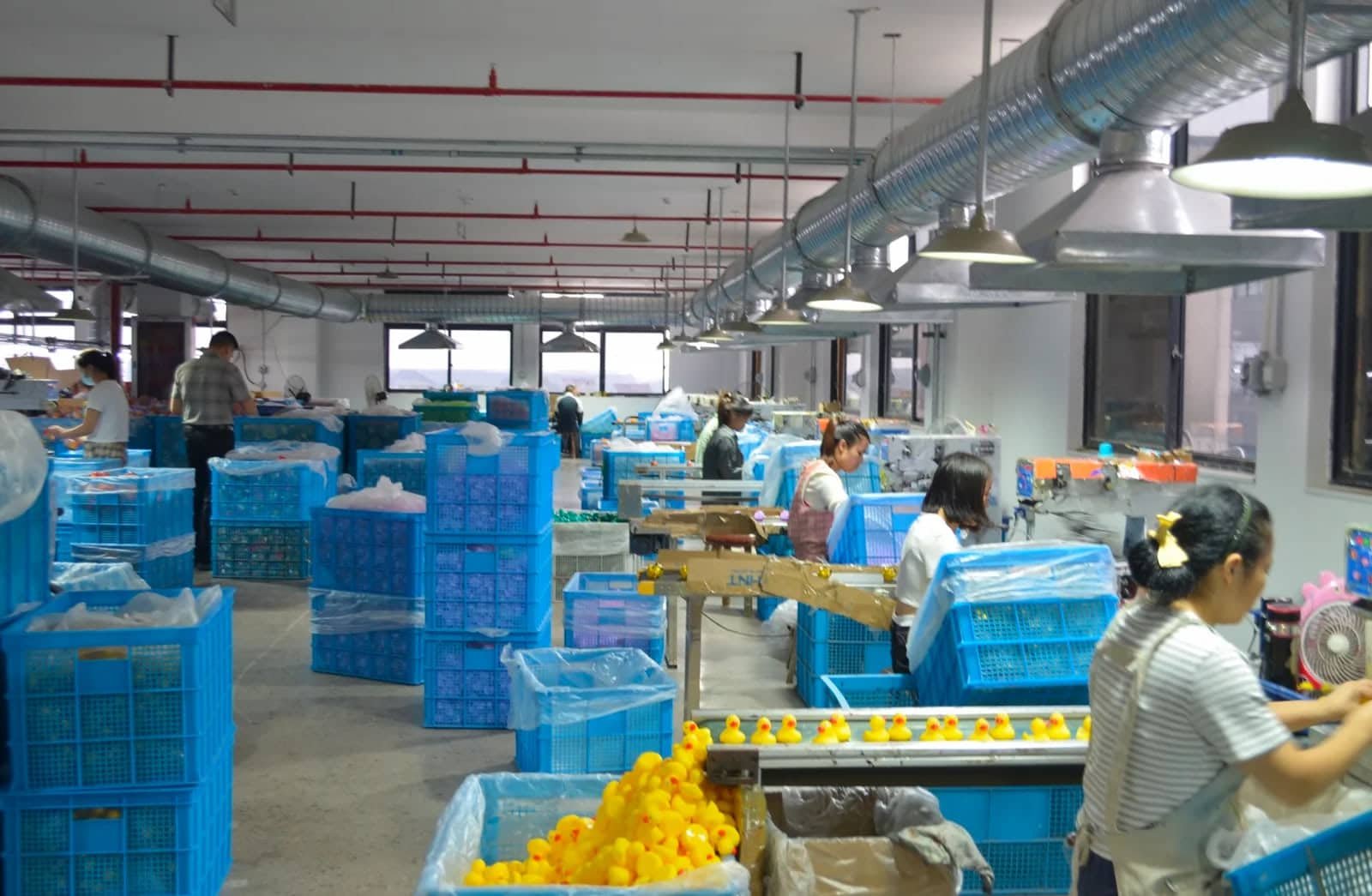
This is the tier where most event planners actually land once they translate “big duck” into a physical dimension. Manufacturing shifts from rotocast to hand-pour or blow-mold PVC. Weight jumps to 300-800g depending on height. MOQ drops to 100-500 units, and mold costs run $800-$2,500.
Here is the insider warning that saves budgets: any Tier 2 duck above 12 inches requires internal structural ribs to prevent PVC sagging during cooling. This is a failure point we see in roughly 60% of first-time orders from buyers who sourced through middlemen that skipped this engineering step. The duck arrives with a drooped head or collapsed beak. We build ribbing into the mold design as standard — if your supplier does not explicitly mention structural support for anything over 12 inches, ask before you pay for the mold.
Tier 3: The 2m+ Giant Inflatable
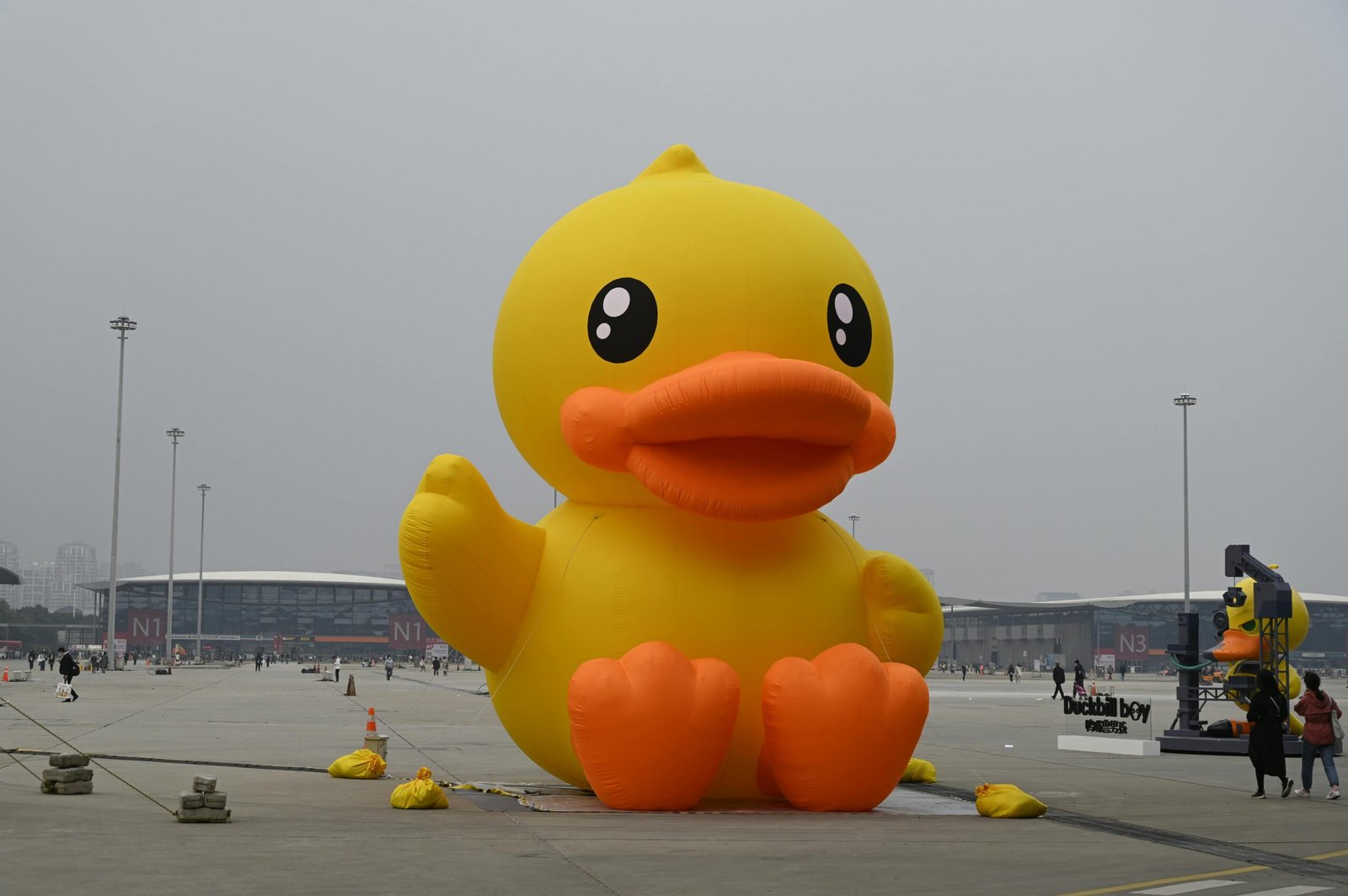
PVC tarpaulin with a continuous blower system. Weight ranges from 15-80kg depending on final height. MOQ is 1 unit. Total cost for a custom branded 3m inflatable duck lands between $5,000 and $8,000.
The math against rental is decisive and almost never calculated by planners. The 61-foot Mama Duck touring rental runs approximately $45,000 for a 2.5-week window. A purchased 3m branded inflatable pays for itself on the second use. For brands running a multi-city tour or an annual activation, rental is margin destruction. Ownership also eliminates the logistics risk of rental availability windows — touring inflatables have booked schedules, and your event date will not move to accommodate them.
Size, Weight, and Method — The Full Comparison
- Tier 1 Dimensions: 4-6 inches (10-15cm)
- Tier 1 Weight: 30-60g per unit
- Tier 1 Manufacturing: Rotocast PVC in aluminum molds
- Tier 1 Use Case: Per-attendee giveaway, swag bag insertion, jeep community ducking
- Tier 1 MOQ / Cost: 1,000 units / under $1.50/unit at 5,000+ qty
- Tier 2 Dimensions: 12-24 inches (30-60cm)
- Tier 2 Weight: 300-800g per unit
- Tier 2 Manufacturing: Hand-pour or blow-mold PVC (structural ribs required above 12″)
- Tier 2 Use Case: Stage prop, photo zone centerpiece, retail window display, booth mascot
- Tier 2 MOQ / Cost: 100-500 units / mold $800-$2,500 plus per-unit cost
- Tier 3 Dimensions: 2m+ (200cm+), commonly 3-5m for brand activations
- Tier 3 Weight: 15-80kg depending on height
- Tier 3 Manufacturing: PVC tarpaulin, welded seams, continuous blower system
- Tier 3 Use Case: Outdoor festival landmark, rooftop installation, multi-city tour centerpiece
- Tier 3 MOQ / Cost: 1 unit / $3,000-$15,000 depending on size and print coverage
When you contact a supplier, lead with the tier number and a centimeter measurement. “We need 200 units of a Tier 2 duck at approximately 40cm” moves the conversation to mold design and lead time in a single message. “We need a large rubber duck” guarantees a week of back-and-forth that your event timeline cannot afford.
| Tier Classification | Dimensions / Material | MOQ / Pricing | Factory / Compliance | Event Planner Notes |
|---|---|---|---|---|
| Tier 1: Promo (Often Mislabeled ‘Large’) | 4-6 inches / 30-60g / Rotocast PVC | MOQ 1,000 | <$1.50/unit at 5K+ (raw cost <$0.50 at 10K) | BSCI audit required at 5K+ quantity | Mass giveaway standard. Competitors mislabel this as ‘large’, creating massive expectation gaps if you need a prop. |
| Tier 2: Display / Photo-Op Prop | 12-24 inches / 300-800g / Hand-pour or Blow-mold PVC | MOQ 100-500 | Mold cost: $800-$2,500 | CE/EN71 (EU) or CPSIA (US) required if child attendees are present | CRITICAL: Requires internal structural ribs above 12 inches to prevent PVC sagging. 60% failure rate on first-time orders without ribs. |
| Tier 3: Giant Inflatable (Spectacle Scale) | 2m+ (6.5ft+) / 15-80kg / PVC Tarpaulin + Blower System | MOQ 1 Unit | $3,000-$15,000 purchase (vs. $45,000 rental) | Heavy-duty structural rigging and continuous blower specs required | Break-evens on second use vs renting the 61-foot touring duck. Ideal for high-visual-impact activations. |
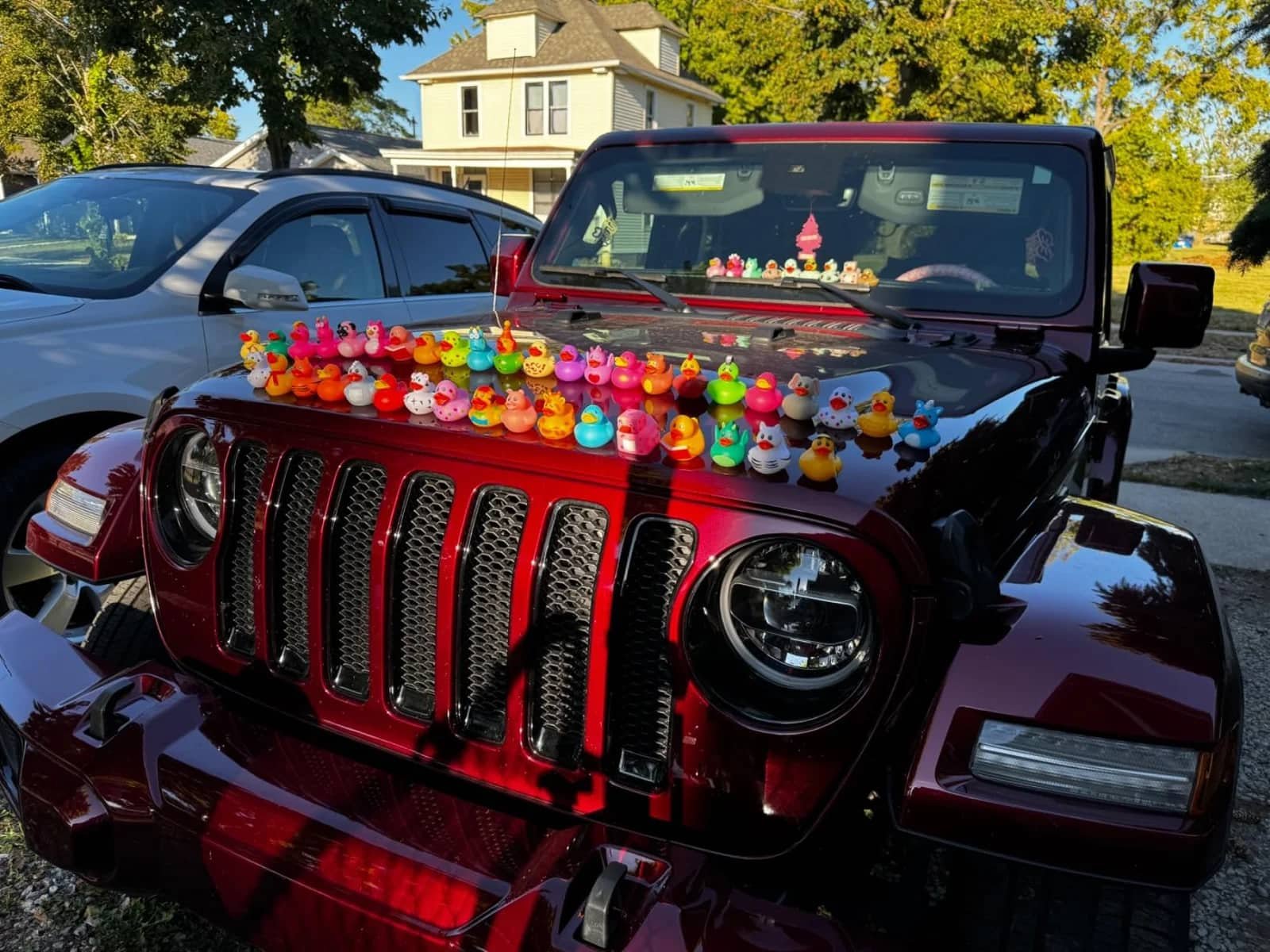
Tier 1: Promo-Size Ducks (4-6 Inches)
This is the 4-6 inch tier — the exact spec used in Jeep ducking communities. If your activation needs visual impact beyond arm’s length, you are in the wrong tier entirely.
Rotocast PVC: What 30-60 Grams Actually Feels Like
These ducks are produced via rotocasting — PVC powder is loaded into a steel or aluminum mold, heated while rotating on two axes, and cooled to form a hollow shell. The result is a lightweight product ranging from 30 to 60 grams depending on the mold cavity size. For context, 30 grams is roughly the weight of a AA battery; 60 grams is comparable to a tennis ball. These are not solid rubber. They are hollow, float, and squeak — which is exactly what makes them effective as mass-distribution giveaway items, but it also means they have zero presence as a stage prop or photo activation piece.
The 1,000-Unit MOQ and Where Pricing Actually Breaks
Our standard MOQ for this tier is 1,000 units. At that quantity, the FOB price typically lands between $1.80 and $2.20 per unit. The reason it sits that high at 1,000 is the mold cost — a single-cavity rotocast mold runs $300 to $800 depending on geometry complexity, and that cost gets absorbed across a small run. The real inflection point comes at 5,000 units, where the per-unit cost drops below $1.50 because the mold expense is fully amortized. Push to 10,000 units and raw manufacturing cost alone approaches $0.50 per unit. If a supplier quotes you below $1.50 at 1,000 units, they are either cutting wall thickness to unsafe levels or absorbing a loss to win the account — neither scenario ends well on a repeat order.
Shipping Economics: Why Quantity Changes Everything
At 1,000 units, you are looking at roughly 30 to 60 kilograms of product weight packed into standard export cartons. That ships via LCL sea freight, and the freight-to-product cost ratio is unfavorable — you might be paying $0.30 to $0.50 per unit just in ocean freight. At 5,000 units and above, the math shifts hard. You can negotiate better LCL rates or fill a partial FCL container, dropping the per-unit freight component significantly. Air freight at this tier is almost never justifiable at any quantity — the product is too light and too low-value to absorb air cargo rates without destroying your per-attendee giveaway budget.
The Expectation Gap That Kills Event Budgets
Here is the problem no one in the promo industry wants to name: competitor sites like Quality Logo Products list a 4-inch duck under the label “large rubber duck.” An event planner whose creative brief says “get a big duck for the activation” sees that listing, orders a sample, and receives something that fits in the palm of their hand. They then spend a week going back and forth with their client explaining why the deliverable looks nothing like the reference image in the deck — which was almost certainly a 2-foot display duck or an inflatable. We see this mismatch in roughly 40% of inbound inquiries at our factory. The planner is not stupid. The taxonomy is broken. A 4-inch duck is a promo item, not a prop, and anyone sourcing for visual impact needs to skip this tier entirely and look at the 12-24 inch range or inflatables.
| Feature | Specification | Event Planner Benefit |
|---|---|---|
| Dimensions & Weight | 4-6 inches / 30-60g | Ideal for budget-friendly, per-attendee giveaways; avoids the ‘expectation gap’ of mislabeling a 4-inch duck as ‘large’. |
| Manufacturing Process | Rotocast PVC | Ensures hollow, lightweight consistency for bulk shipping and eliminates structural failure risks found in larger sizes. |
| Volume & Pricing | MOQ 1,000 units; <$0.50 raw cost at 10K; <$1.50/unit at 5K+ (mold amortized) | Maximizes ROI on high-volume event swag like viral ‘ducking’ trends without blowing the activation budget. |
| Compliance & Safety | BSCI audit (5K+), CE/EN71 (EU events), CPSIA (US child attendees) | Guarantees on-site event compliance and protects your brand from liability at public activations. |
| Sourcing Efficiency | Exact 4-6″ size specification upfront | Eliminates the standard 5-7 day clarification delay, securing immovable event deadlines. |
Tier 2: Event Display Ducks (12-24 Inches)
At 12-24 inches, you are no longer ordering a product—you are commissioning a prop. Sixty percent of first-time buyers receive deformed units because they skip the structural engineering step.
Hand-Poured PVC vs. Blow-Molding: Which Process Fits Your Run
Two manufacturing methods serve this size tier, and picking the wrong one either blows your budget or traps you in a timeline you cannot recover from. The decision hinges entirely on your order quantity and shape complexity.
Hand-poured PVC (also called rotocasting at this scale) involves manually pouring liquid PVC into a spinning mold. It produces wall thickness consistency of 3-5mm and handles complex contours—think a duck wearing a branded hat or holding a custom-shaped sign. The tradeoff is cycle time: roughly 8-12 minutes per unit. We see event planners routinely budget 3 weeks for production when hand-pour actually requires 5-6 weeks at 200-unit quantities.
Blow-molding heats a PVC parison and inflates it inside a closed mold like a balloon. Cycle time drops to 90-120 seconds per unit, making it the only viable process if you need 400+ ducks for a multi-city tour. The limitation is geometric: blow-molding struggles with undercuts and sharp detail retention. Fine brand lettering below 8mm height will blur.
- Hand-poured PVC: Best for 100-300 units, complex shapes, 3-5mm wall thickness, 8-12 min cycle time
- Blow-mold PVC: Best for 300-500 units, simpler geometries, 1.5-3mm wall thickness, 90-120 sec cycle time
- Weight range: 300g (12-inch) to 800g (24-inch) depending on wall thickness specification
Mold Cost and MOQ Reality Check
Mold investment for this tier sits between $800 and $2,500. The low end covers single-cavity blow molds with no undercuts. The high end accounts for multi-part hand-pour molds with internal core pulls for hollow sections. Anyone quoting you below $800 for a 24-inch custom duck mold is either reusing an existing base and charging only for a branding insert—or cutting steel quality, which means mold degradation after 150-200 shots.
MOQ ranges from 100 to 500 units depending on the process. Hand-pour jobs typically floor at 100 units because the labor setup cost is already sunk. Blow-mold jobs usually require 300+ units to justify the mold investment on a per-unit basis. Here is the math that matters to event planners: at a $1,500 mold cost and 200-unit hand-pour order, your amortized tooling cost is $7.50 per duck. At 500 units on a blow-mold run with a $1,200 mold, that drops to $2.40 per duck. The process you choose directly shifts your per-attendee giveaway cost by $5+.
- Blow mold (simple shape): $800-$1,200 / MOQ 300-500 units
- Hand-pour mold (complex shape): $1,500-$2,500 / MOQ 100-300 units
- Amortized mold cost spread: $2.40-$15.00/unit depending on quantity and process
The Sagging Problem: Why Internal Structural Ribs Are Non-Negotiable
This is the single point where most event duck orders fail, and almost no promotional product catalog mentions it. PVC above 12 inches carries enough self-weight that the material sags inward during the cooling phase before it fully cures. The result is a duck with a collapsed chest, a drooping bill, or a flattened base that will not stand upright on a display table.
The engineering solution is internal structural ribs—vertical and horizontal PVC supports cast into the hollow interior that act as a skeleton. These ribs must be designed into the mold cavity from the start. They cannot be added retroactively. We reject roughly 30% of incoming Tier 2 artwork because the client’s designer exported a solid 3D model without internal ribbing, and the file needs to be re-engineered before tooling can begin. This re-engineering adds 7-10 days to the pre-production timeline.
A properly ribbed 18-inch display duck will have 4-6 vertical ribs running from the base to the crown, plus 2-3 horizontal ring ribs at the widest points. This adds approximately 40-60g of material weight per unit and increases unit cost by $0.15-$0.25. Skipping ribs to save that quarter per unit is the decision that produces the deformed ducks we see in 60% of first-time orders at this tier. If your supplier does not proactively ask about ribbing when you submit a 12+ inch design, that is a warning sign—they either do not know the problem exists, or they plan to skip the step and hope you do not notice the sagging until after the event.
Tier 3: Giant Inflatable Ducks (2m+)
Tier 3 is where “large rubber duck” stops being a product and becomes infrastructure. Budget $3,000-$15,000, expect 25-40 day lead times, and do not skip the structural engineering drawing.
The “Mama Duck” Confusion — Why 2m+ Is Not 61 Feet
When an event planner Googles “giant inflatable rubber duck,” the first thing they hit is the 61-foot touring attraction operated by Big Duck LLC. That duck rents for roughly $45,000 per 2.5-week engagement — a figure that causes most activation budgets to flatline on the spot. We see this exact panic in about 30% of our Tier 3 inquiries. The planner’s client saw the 61-foot duck in the news, said “get me one of those,” and the planner is now trying to source it without understanding that the touring Mama Duck is a licensed, logistics-heavy road show, not a purchasable prop.
A 2m to 5m custom inflatable duck is a completely different asset class. It does not require a crane, a barge, or a city permit for river deployment. It fits inside a standard venue, anchors to a rooftop, or floats in a hotel pool. A branded 3m duck costs $5,000-$8,000 to purchase outright. Compared to $45,000 for a two-week rental, the math reaches break-even on the second use. For any brand running a multi-city tour or a seasonal mall activation, rental is a losing proposition.
PVC Tarpaulin and Why Structural Drawings Are Non-Negotiable
Tier 3 inflatables are built from commercial-grade PVC tarpaulin — typically 0.55mm to 0.9mm thickness depending on the duck’s size and whether the installation is indoor or exposed to wind. This is not the same material used in Tier 1 rotocast ducks or even Tier 2 hand-pour PVC. Tarpaulin is a coated, reinforced fabric designed to hold continuous air pressure from a blower system without delaminating.
Here is where first-time buyers burn budget: they skip the structural engineering drawing phase to save 3-5 days on lead time. A 3m duck standing on a rooftop in 40km/h wind needs internally routed D-rings, specified ballast points, and a defined air chamber layout. Without that drawing — which our engineering team produces before any cutting begins — you get a duck that lists to one side under wind load or develops stress tears at the neck seam within weeks. We refuse to move to production without a signed-off structural plan. The 3-5 day “savings” from skipping it will cost you a replacement unit and a ruined event.
Cost Breakdown and Lead Time Realities
- 2m duck: $3,000-$5,000 / 25-30 days
- 3m duck: $5,000-$8,000 / 30-35 days
- 5m+ duck: $8,000-$15,000 / 35-40 days
These lead times include structural drawing approval, material cutting, digital printing, heat sealing, and factory inflation testing. They do not include shipping. For US-bound orders, add 15-20 days by sea or 5-7 days by air freight — though air freighting an 80kg deflated duck is rarely cost-justified unless you are recovering from a supplier failure on a fixed-date event.
Certification requirements catch planners off guard at this tier. If your activation is in the EU and accessible to the public — even a rooftop photo op — you need CE compliance documentation. US events with child attendees require CPSIA certification for the materials. We build these certifications into the production workflow, but they add 3-5 days to the front end if not specified at the quote stage.
Permanent vs. Semi-Permanent Installation Use Cases
Most Tier 3 ducks operate as semi-permanent assets: deployed for a 2-6 week activation, deflated, packed, and moved to the next city. The blower system runs continuously during operation, which means you need a dedicated power source and a contingency plan for blower failure — we include a backup blower with every order because a deflated duck on day two of a launch is a PR problem, not a maintenance issue.
Permanent installations — think rooftop brand identifiers, water park landmarks, or retail flagships — require a different specification. The PVC tarpaulin shifts to 0.9mm, UV-resistant coating becomes mandatory, and the anchoring system moves from ground stakes to engineered bolt plates. We have seen semi-permanent ducks deployed as permanent fixtures fail within 8 months due to UV degradation and wind fatigue because the buyer specified the cheaper 0.55mm material to save $1,200. The replacement cost was $6,400. The material upgrade pays for itself in one outdoor season.

Mold Cost vs Quantity: The Break-Even Math
A $1,500 Tier 2 mold adds $5.00/unit at 300 pieces but drops to $0.50 at 3,000. That spread is what kills event budgets or saves them.
Mold Investment Amortization by Tier
The word “mold” means completely different tooling across the three size tiers, and the cost structure does not scale linearly. A Tier 1 rotocast aluminum mold for a 4-inch duck runs $800 to $1,200 but serves 10,000+ units over its lifespan. Tier 2 silicone hand-pour molds for 12 to 24-inch ducks cost $800 to $2,500 and degrade faster, typically capping usable output around 500 to 800 units before detail loss. Tier 3 inflatables do not use a traditional mold at all — the tooling cost is CNC cutting of PVC tarpaulin panels, running $500 to $1,500 per design.
- Tier 1 (4-6″ rotocast PVC): $800-$1,200 mold cost. At 1,000 units, amortized mold adds $0.80-$1.20/unit. At 10,000 units, it drops below $0.12/unit.
- Tier 2 (12-24″ hand-pour PVC): $800-$2,500 mold cost. At 100 units, amortized mold adds $8.00-$25.00/unit. At 500 units, it drops to $1.60-$5.00/unit.
- Tier 3 (2m+ inflatable PVC tarpaulin): $500-$1,500 CNC tooling. Amortization is irrelevant — buyers typically order 1 to 5 units, so tooling is a standalone line item.
The Tier 2 Break-Even Reality Check
Tier 2 is where event planners get burned most often, because the per-unit math looks deceptively close until you factor in the mold. Take a $1,500 mold for an 18-inch display duck with a raw production cost of $4.50/unit. At 300 units, your all-in cost is $9.50/unit ($4.50 + $5.00 mold amortization). At 3,000 units, it collapses to $5.00/unit ($4.50 + $0.50 mold amortization).
The critical threshold for Tier 2 is almost always between 400 and 600 units. Below that, the mold premium makes the per-attendee giveaway cost hard to justify against Tier 1 alternatives. Above it, the unit economics become competitive for display pieces or VIP gifting at activations. We routinely advise planners targeting 200 to 300 Tier 2 ducks to either reduce their size ambition or increase quantity — splitting the difference produces the worst of both worlds.
Why Mixing Tiers in One Inquiry Wastes Everyone’s Time
We see this mismatch in roughly 40% of inbound inquiries: a planner asks for “500 large rubber ducks” without specifying whether that means 500 six-inch promo items or 500 eighteen-inch display pieces. These are fundamentally different manufacturing processes, different mold investments, and different lead times. Quoting both simultaneously forces the supplier into a clarification cycle that adds 5 to 7 days to the quotation turnaround — and for event planners working against immovable activation dates, that delay alone can disqualify a vendor.
The fix is straightforward. Decide the physical dimension first, then the quantity. That single decision locks in the tier, which locks in the mold range, which makes the quote accurate on the first pass. Every hour your creative team spends debating “large” without a tape measure is an hour your factory cannot start cutting steel or pouring silicone.
| Size Tier | Mold Cost | Break-Even Quantity | Post-Break-Even Cost | Planner Budget Impact |
|---|---|---|---|---|
| Tier 1: 4-6 inches (Rotocast PVC) | $500 – $1,500 | 5,000 units | Under $1.50/unit | Optimizes per-attendee giveaway cost for massive event footprints. |
| Tier 2: 12-24 inches (Hand-Pour/Blow-Mold) | $800 – $2,500 | 300 – 500 units | $4.00 – $8.00/unit | Eliminates cheap plastic junk feel; delivers high-impact VIP photo props. |
| Tier 3: 2m+ (PVC Tarpaulin Inflatable) | $0 (Digital Cut, No Mold) | 1 Unit | $5,000 – $8,000 total | Outright purchase beats $45k rental; breaks even on second event activation. |
How to Write a Qualified Inquiry
Missing dimensions in your first email adds five to seven days to your quote cycle. Every time. No exceptions.
The Inquiry Checklist
We see roughly 40% of inbound inquiries from event planners that say something like “we need a large rubber duck for our activation.” That sentence tells us nothing. “Large” could mean a 4-inch rotocast promo item or a 24-inch hand-pour display piece, and the tooling cost gap between those two is thousands of dollars. To get an accurate quote on your first try, your inquiry needs three things.
- Exact dimensions: Not “big” or “life-size.” Give us height, width, and length in centimeters or inches. If you are unsure, tell us the real-world reference object your client is comparing it to.
- Material preference: Solid PVC (rotocast for 4-6″, hand-pour for 12-24″), or PVC tarpaulin with blower system for inflatables. If you do not know, say “open to recommendation” and we will propose based on your size and budget.
- Quantity per SKU: Not just “5,000 ducks.” If you need 3,000 yellow and 2,000 with a custom Pantone match, state that as two SKUs. Mold amortization math changes entirely with split runs.
Float Requirement and Event Date with Buffer
Here is a detail that sinks event orders regularly: whether the duck needs to float upright in water, and if so, in what conditions. A 6-inch rotocast PVC duck floats naturally. A 12-inch hand-pour duck with a solid base will sink like a stone unless we engineer a hollow cavity and ballast it correctly. If your activation involves a pool, fountain, or any water feature, state this upfront.
For your event date, always provide the date your ducks must arrive on-site, not the event day itself. Then add a buffer. We recommend stating your required delivery date as seven business days before the actual activation. Ocean freight gets delayed. Customs holds containers for random inspection. If you tell us the ducks are needed on Friday for a Saturday event, there is zero recovery room when something goes sideways.
The 5-7 Day Delay: What Actually Happens
When you send an inquiry without dimensions, our quoting team cannot price it. They have to write back and ask for specs. You are likely juggling three other event deliverables, so that email sits for two days. You reply with “around the size of a basketball,” which is still not a number. We ask again. You send a reference photo. Our engineers estimate dimensions from the photo and flag that a 12-inch duck requires internal structural ribs to prevent PVC sagging, a failure point we see in 60% of first-time orders at this size. That adds a new variable to the quote.
By the time you receive an accurate number, five to seven business days have evaporated. For an event planner working against an immovable activation date, that is nearly a full week of production lead time lost to email ping-pong. Include your dimensions in sentence one of your first message and that entire cycle collapses into a same-day turnaround.
Rental vs Custom: When Each Wins
A custom branded 3m inflatable duck breaks even against rental on its second use. Rent once, buy from use #2 forward — the math is not complicated.
The $45,000 Rental: What You’re Actually Paying For
The publicly listed rate for a 61-foot touring duck (Big Duck LLC’s “Mama Duck”) runs approximately $45,000 for a 2.5-week window. That price covers transport logistics, on-site installation with crew, a continuous blower system, and removal. You are not paying for the duck itself — you are paying for the turnkey spectacle infrastructure. For a one-off PR stunt where the duck appears in a harbor, gets filmed, and leaves, this model has genuine merit. The problem surfaces when agencies treat this as the default cost anchor for any “large duck” request, not realizing a branded 3m PVC tarpaulin inflatable with their own logo costs a fraction of that.
The $5,000-$8,000 Custom Purchase: The Actual Alternative
A custom branded 3m (roughly 10-foot) inflatable duck built from PVC tarpaulin with a commercial-grade blower system, custom-printed artwork, and CE-certified electrical components lands between $5,000 and $8,000 depending on print complexity and structural reinforcement needs. This is a permanent asset your agency or client owns. It packs into a roughly 1.2m x 0.6m duffel, ships via standard freight, and deploys with a two-person team in under 30 minutes. The break-even against rental is not theoretical — it is the second deployment. Every activation after that is pure margin.
When Rental Wins
Rental is the correct call for a single-city, single-day media moment with no follow-up plan. If your activation brief reads “giant duck in the harbor for a morning TV hit, then gone,” do not custom-manufacture anything. You will absorb the full tooling and production cost for one use, and then you are stuck storing a 10-foot inflatable that your client has no further use for. Rental also wins when you need scale beyond what custom inflatables can deliver — nothing in the custom purchase space replicates a 61-foot structure at any sane price point.
When Custom Purchase Wins
Custom ownership dominates in four scenarios that cover most B2B event buyer reality. Multi-city tours are the obvious one — a branded duck that travels to 8 mall activations over 3 months costs $8,000 once versus $45,000 per city if you were even foolish enough to rent at that scale. Branded activations where logo visibility matters kill rental immediately, because touring ducks carry the operator’s branding, not yours. Permanent or semi-permanent installations — a duck anchored at a resort pool or a retail flagship entrance for a season — make rental economically absurd. Finally, any agency running a recurring annual campaign where the duck becomes a recognizable brand asset should own it from year one.
We see agencies burn budget on rental because they conflate “large” with “the 61-foot touring duck they saw on Google.” Disambiguate the size first. A 3m branded inflatable solves 80% of event briefs that come across our desk — and it does so at roughly 15% of the rental cost anchor by use number two.
Conclusion
Stop guessing what “large” means to your client and lock down a centimeter measurement today. If you need a photo prop, spec an 18-inch duck with internal ribs—skipping that structural support guarantees a sagging disaster in 60% of first-time orders. If you want a spectacle, buy a custom 3-meter inflatable for $8,000 instead of renting the touring duck for $45,000.
Send your vendor a real-world photo reference alongside your exact height requirement right now. Ask them to ship a physical pre-production sample of the PVC density before you approve the final color match. That single step eliminates the expectation gap between a 4-inch promo toy and a 2-foot display piece.
Frequently Asked Questions
What is the cost to rent the largest rubber duck?
Renting the 61-foot touring inflatable owned by Big Duck LLC costs approximately $45,000 for a 2.5-week installation, including security and barriers. For B2B buyers seeking high-impact brand activations, purchasing a custom-branded 3-meter inflatable duck outright is a significantly more cost-effective alternative at just $5,000 to $8,000. This allows brands to achieve massive visual presence at outdoor events without the exorbitant rental fees or touring restrictions. Ultimately, owning your branded inflatable maximizes your promotional ROI across multiple campaign cycles.
Who owns the largest rubber duck?
The famous 61-foot ‘Mama Duck’ inflatable is owned by Big Duck LLC and operates strictly as a touring public art installation. Because this specific asset is not available for custom branding or purchase, B2B buyers must source their own large-scale promotional ducks through specialized manufacturers. Instead of renting a generic touring asset, global brands trust us to deliver fully customized, large-scale inflatable ducks tailored exactly to their campaign specifications. This ensures complete brand ownership and eliminates the logistical constraints associated with shared touring installations.
Why do people put rubber ducks on cars?
This practice, known as ‘Jeep ducking,’ is a consumer social tradition where vehicle owners leave small rubber ducks on cars they admire. For B2B buyers, this cultural phenomenon represents a massive opportunity, as it has driven an unprecedented spike in mini rubber duck demand across the automotive and lifestyle sectors. To capitalize on this trend, brands should source 4-to-6-inch promotional ducks, which are the exact tier required for this specific use case. Our manufacturing capabilities easily accommodate these sizes with a 1,000-unit MOQ, ensuring your brand is perfectly positioned for this viral marketing channel.
What do rubber ducks symbolize in LGBTQ events?
In LGBTQ+ events, rubber duck installations serve as vibrant symbols of inclusivity and unity by leveraging the object’s universal nostalgia. Event planners looking to source ducks for pride activations consistently turn to our Tier 1 promotional ducks, which perfectly align with a 1,000-unit MOQ. We specialize in producing these specific units in custom rainbow colorways that match exact Pantone requirements for various pride organizations. This makes our custom rubber ducks the standard, high-quality approach for large-scale pride parades and corporate diversity campaigns.
What is the rubber duck rule?
The ‘rubber duck rule’ is a software engineering debugging method where developers explain their code line-by-line to an inanimate duck. While this concept does not involve large-scale physical duck sourcing, it directly explains why tech companies are among our most frequent B2B buyers for internal culture merchandise. These organizations typically order our standard promotional ducks in quantities starting at 1,000 units to distribute among their engineering teams. We deliver over 5,000,000 custom ducks monthly to these global tech brands, perfectly catering to this unique corporate culture demand.
For a closer look, see our guide on what free vs paid duck samples tell you.
Related B2B sourcing page: For production options, MOQ and custom project support, see our custom rubber ducks page.