Skip to content
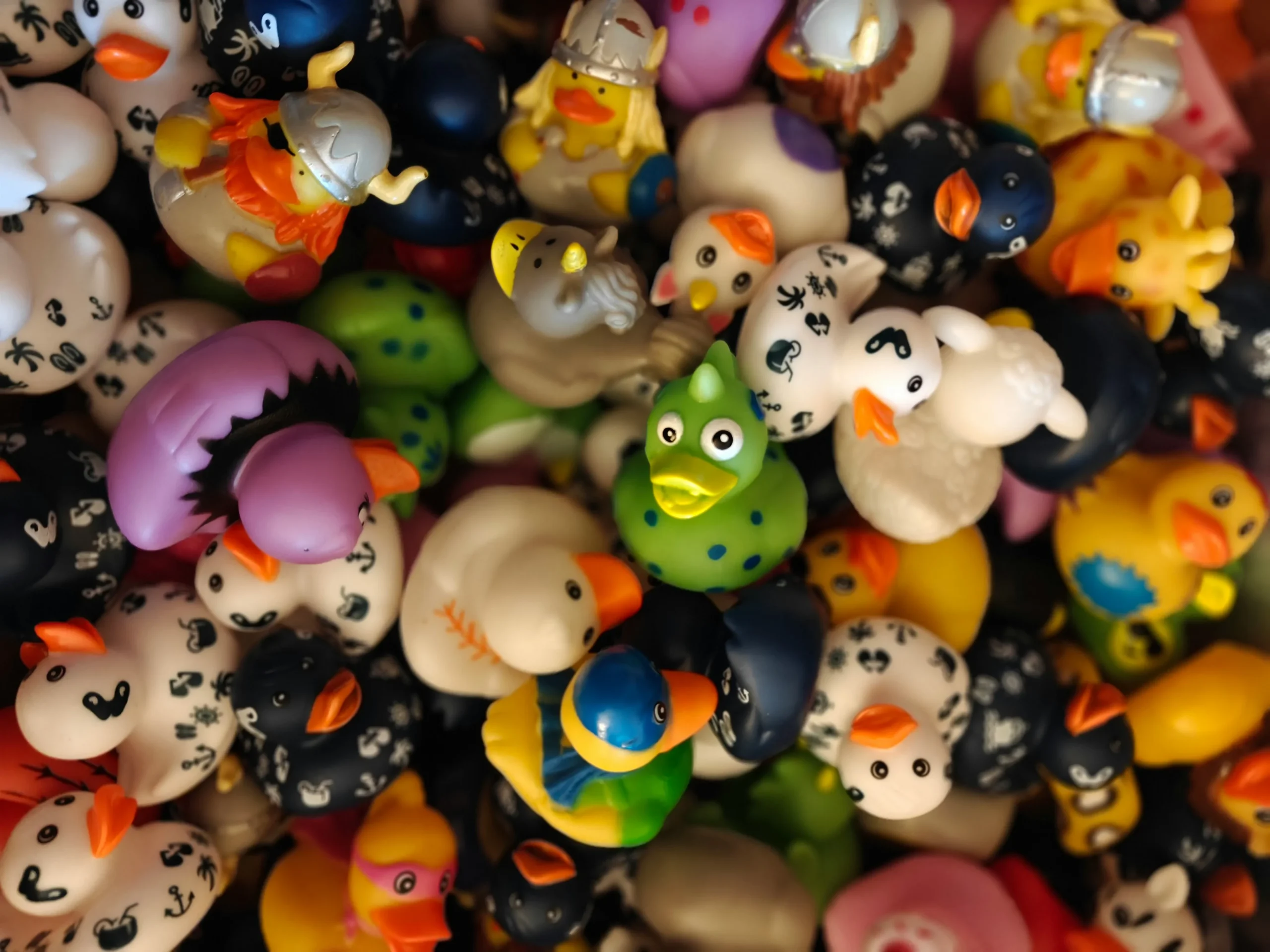
Two ducks can look identical on a sample table and behave completely differently after a month of bath nights. One has colour moulded through the plastic; the other has a decorated surface. In a showroom the difference is invisible, and in a bathroom it decides whether the duck still looks new at Christmas.
For a buyer, this is a specification question rather than a manufacturing detail. It affects cost, it affects the test evidence the factory can supply, and it affects how the product is described on the packaging.

The Two Routes Colour Takes
Moulded colour starts as masterbatch, a concentrated colour compound blended into the plastic before the duck is formed. The colour is part of the material from the inside out, so scratches do not reveal a different colour underneath and immersion has nothing to lift away.
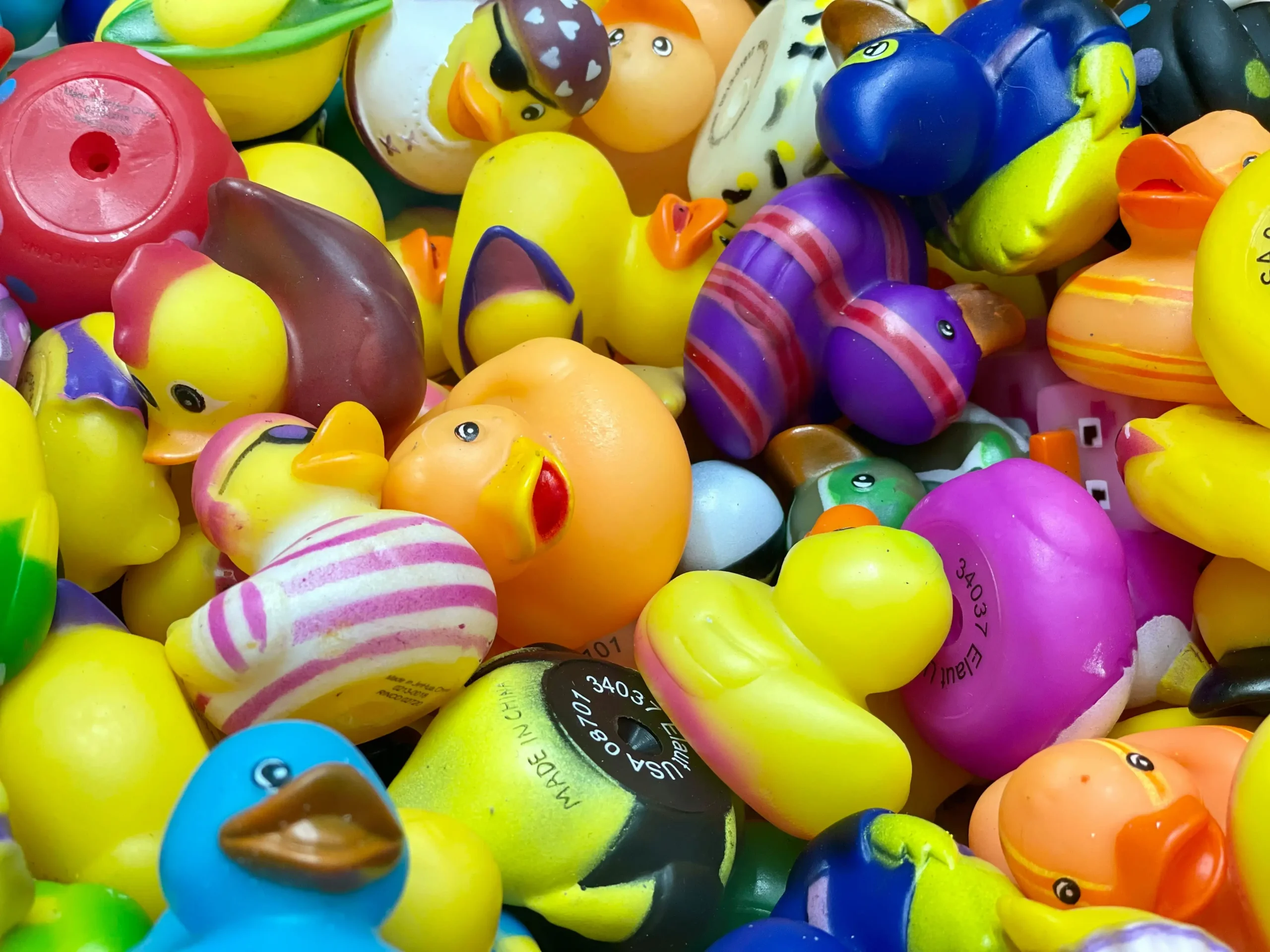
Surface decoration applies colour afterwards. Depending on the design it may be sprayed through a mask, pad printed, or hand finished for fine detail. This route makes possible effects that moulding cannot produce efficiently, including gradients, multi-colour faces and small logos, and it is the reason most character ducks have printed features rather than moulded ones.
The trade-off is a layer. A surface film can be abraded by bath toys rubbing together, by a child’s grip, or by the bleach and abrasive cleaners that bathroom surfaces attract. Colour inside the plastic has no layer to lose, which is why hand-painted detail is usually specified as an addition to a moulded base colour rather than as the only colour on the duck.
What Actually Chips, Fades or Lifts
Three failure modes appear on decorated ducks. Abrasion removes the decoration where it is touched most, usually the beak, eyes or the top of the head. Adhesion failure lifts the film at edges where the surface was not perfectly prepared. And light exposure fades the decoration before it fades the moulded body, producing a duck whose base colour and printed features drift apart.
Moulded colour is not immune to the third problem, but it behaves better because the pigment is protected within the material and because UV stabilisers added with the masterbatch slow the change. The practical difference is that a moulded duck fades evenly, while a decorated one fades unevenly.
Construction also plays a part. A solid duck sinks and holds less water against its surface than a hollow one, which changes how much time the decoration spends wet. That is worth knowing when the intended use is a bath rather than a shelf.

The Compliance Question Behind the Decoration
Where a duck is a children’s article, the decoration is not only a durability question. Surface coatings on children’s products must satisfy requirements for hazardous substances, and in the United States those requirements sit in eCFR Title 16 Part 1500, hazardous substances and children’s articles, alongside the toy safety rules that apply to the age grade the product is sold for.
The evidence a buyer should ask for is a test report covering the decorated article as supplied, not a report for the base plastic alone. A factory that moulds its own colour can often provide the masterbatch declaration quickly; a factory that decorates afterwards needs the ink or paint system documented as well.
Age grading follows the decoration too. A duck with small applied parts or a printed feature intended for an older child is a different compliance case from a simple bath toy. The specification should name the age grade, the decoration method and the test report that covers both, so the file matches the product on the shelf.
Cost, MOQ and Decoration Choice
Moulded colour carries a one-time cost for the masterbatch and a small per-unit material cost. Surface decoration adds a process step: masking or printing equipment, setup time per colourway, and a per-unit cost that rises with the number of colours. On a simple single-colour duck, moulding almost always wins on total cost.
Decoration earns its place when the design needs something moulding cannot give: a printed face inside a moulded body, a two-colour logo, or fine detail that would be expensive to cut into a tool. In those cases the decoration is the design, and the durability conversation becomes about specifying it properly rather than avoiding it.
A middle route is common in promotional work: a moulded base colour with a single printed element such as a logo or a brand name. That keeps most of the duck colour-fast while allowing the branding to change between campaigns without a new tool. Our custom rubber duck programme quotes moulded and decorated options side by side so the trade-off is visible before a tool is cut.
A Buyer Checklist for Decoration
Five points settle the specification. Name the decoration method for each colour on the duck. Confirm which colours are moulded and which are applied. Request a test report covering the article as supplied, including the decoration. State the age grade and the intended use, bath or display. And ask for a wear sample if the duck will be used in water.
A wear sample is a simple and underused control. Take production units and subject them to repeated immersion and rubbing for a short period, then compare against a retained reference. It is not a laboratory test, but it reveals adhesion problems long before a customer does.
Finally, describe the product accurately on the packaging. A duck whose colour is fully moulded can be described differently from one with a decorated surface, and honest description protects the brand if a customer has an expectation about fading. Buyers who want the factory to recommend a route can send the artwork and the intended use, and we will price both.
FAQ
Does painted colour come off a rubber duck in water?
It can. Surface decoration is a layer and repeated immersion, rubbing and cleaning can abrade it, particularly at the beak and eyes. Moulded colour has no layer to lose.
Which is cheaper, moulded colour or decoration?
Moulded colour is cheaper for a simple single-colour duck. Decoration adds setup and per-unit cost that rises with the number of colours, but it enables effects moulding cannot produce.
What test report should I ask for?
One covering the article as supplied, including any decoration, together with the requirements associated with the age grade the duck is sold for.
Can I combine both methods?
Yes, and it is the most common approach: a moulded base colour with a printed logo or feature. It keeps most of the duck colour-fast while allowing the branding to change.
How can I check decoration durability before ordering?
Ask for a wear sample: immerse and rub production units, then compare against a retained reference. Adhesion problems show up early.
Video: Plastic Toy Surface Spraying Process in a Toy Factory
If a duck design has printed features, send the artwork and the intended use. Our custom duck team will price the moulded and decorated routes separately and tell you which one fits the bath.
Related reading: Multi-Colour Rubber Ducks: How Colour Is Split in the Mould