Skip to content
The Material Debate Every B2B Buyer Needs to Understand Clearly
“Can you make biodegradable rubber ducks?” It is one of the most common questions landing in manufacturer inboxes this year. The short answer is: not yet in any commercially viable way. The longer answer involves understanding what biodegradable actually means for PVC, what recycled alternatives exist today, and how to make a sourcing decision that satisfies both sustainability goals and production realities.
This comparison cuts through the green marketing noise. You will see the actual performance data, the certification options, and the honest trade-offs between recycled PVC and the biodegradable options that are entering the market.

What “Biodegradable Rubber Ducks” Actually Means — And What It Does Not
The term “biodegradable” suggests a material that breaks down naturally in the environment. For rubber ducks, the reality is more complicated. Traditional ducks are made from PVC (polyvinyl chloride), a petroleum-based plastic that does not biodegrade. It photodegrades — meaning UV light eventually causes it to become brittle and fragment into microplastics — but this process takes decades, not months.
Several companies have developed PVC blends with biodegradable additives. These additives (often starch-based or organic compounds) accelerate fragmentation under specific conditions: industrial composting facilities with sustained temperatures above 58°C and high microbial activity. In a landfill or ocean, these same ducks degrade at rates barely faster than conventional PVC.
This distinction matters enormously for B2B buyers. If your marketing claims “biodegradable ducks” but the product only breaks down in industrial composting facilities that most municipalities do not operate, you face a credibility gap that savvy customers will expose.
Recycled PVC: The Sustainable Option That Works Today
Recycled PVC (rPVC) is a proven, commercially available material for rubber duck production. Here is how it works: post-industrial PVC waste — offcuts from manufacturing, unused compound from color changeovers, and selected post-consumer PVC products — gets collected, sorted, cleaned, and reprocessed into pellets that can be remolded into new ducks.
The EPA’s recycling guidelines classify PVC as a Category 3 plastic (#3), which has lower curbside recycling acceptance than PET or HDPE. But industrial PVC recycling is well-established. The GRS-certified recycled rubber ducks available through LZENGO use post-industrial PVC that meets Global Recycled Standard verification requirements.
Key properties of recycled PVC for duck manufacturing:
- Structural integrity: rPVC retains 85-95% of virgin PVC’s tensile strength when processed correctly. For rubber ducks — which are hollow, thin-walled objects — this is more than adequate.
- Color consistency: Recycled PVC can be Pantone-matched, though very light pastel shades may show slight variation from batch to batch. Dark and mid-range colors are indistinguishable from virgin PVC.
- Safety compliance: rPVC can meet CPSIA, REACH, and EN71 safety standards, provided the source material is certified contaminant-free. Phthalate-free and BPA-free formulations are available in both virgin and recycled grades.
Head-to-Head Comparison: Recycled PVC vs Biodegradable Blends
Here is how the two material paths compare across the criteria that matter for B2B purchasing decisions:
Cost per unit: Recycled PVC carries a 5-15% cost premium over virgin PVC. Biodegradable blends carry a 30-60% premium due to expensive additive packages and lower production throughput. For a 1,000-unit order, the difference is roughly $0.10-$0.20/unit for rPVC versus $0.40-$0.80/unit for biodegradable blends.
MOQ availability: Recycled PVC ducks can be ordered at standard MOQs (1,000 units). Biodegradable blends often require 5,000-10,000 unit minimums because the additive suppliers operate at smaller scale and need dedicated production runs.
Certification: rPVC can be GRS-certified, providing third-party verification of recycled content. Biodegradable claims require ASTM D6400 or EN 13432 certification, but these only certify industrial compostability — not home compostability or marine degradation.
Shelf life: Recycled PVC ducks have the same 5-10 year shelf life as virgin PVC. Biodegradable blends have a rated shelf life of 12-24 months before additive degradation begins affecting surface quality. For products stored in warehouses or displayed on retail shelves, this is a significant limitation.
Printability: Both materials accept pad printing and UV printing. But biodegradable blends can show slight surface tackiness in humid conditions, which affects ink adhesion. Additional primer coats may be needed, adding $0.05-$0.10 per unit.
The Environmental Impact: What the Data Actually Shows
Choosing between recycled and biodegradable is not as simple as “biodegradable = better.” The environmental impact depends on the full lifecycle:
Carbon footprint: Recycled PVC reduces carbon emissions by 50-70% compared to virgin PVC, because it eliminates the energy-intensive vinyl polymerization step. Biodegradable blends typically use virgin PVC as the base polymer with additives — meaning the carbon footprint is actually higher than rPVC, despite the “green” marketing.
Waste diversion: rPVC directly diverts industrial waste from landfills. Each ton of recycled PVC keeps approximately 1.4 tons of CO2-equivalent emissions out of the atmosphere. Biodegradable blends do not divert existing waste — they create new material that happens to break down faster under very specific conditions.
End-of-life reality: Most rubber ducks end up in household waste, not industrial composting facilities. In a standard landfill, neither rPVC nor biodegradable blends will meaningfully decompose. The real environmental benefit of rPVC comes from avoiding virgin material extraction, not from post-use degradation.
When Biodegradable Blends Make Sense
Despite the limitations, biodegradable blends serve specific use cases:
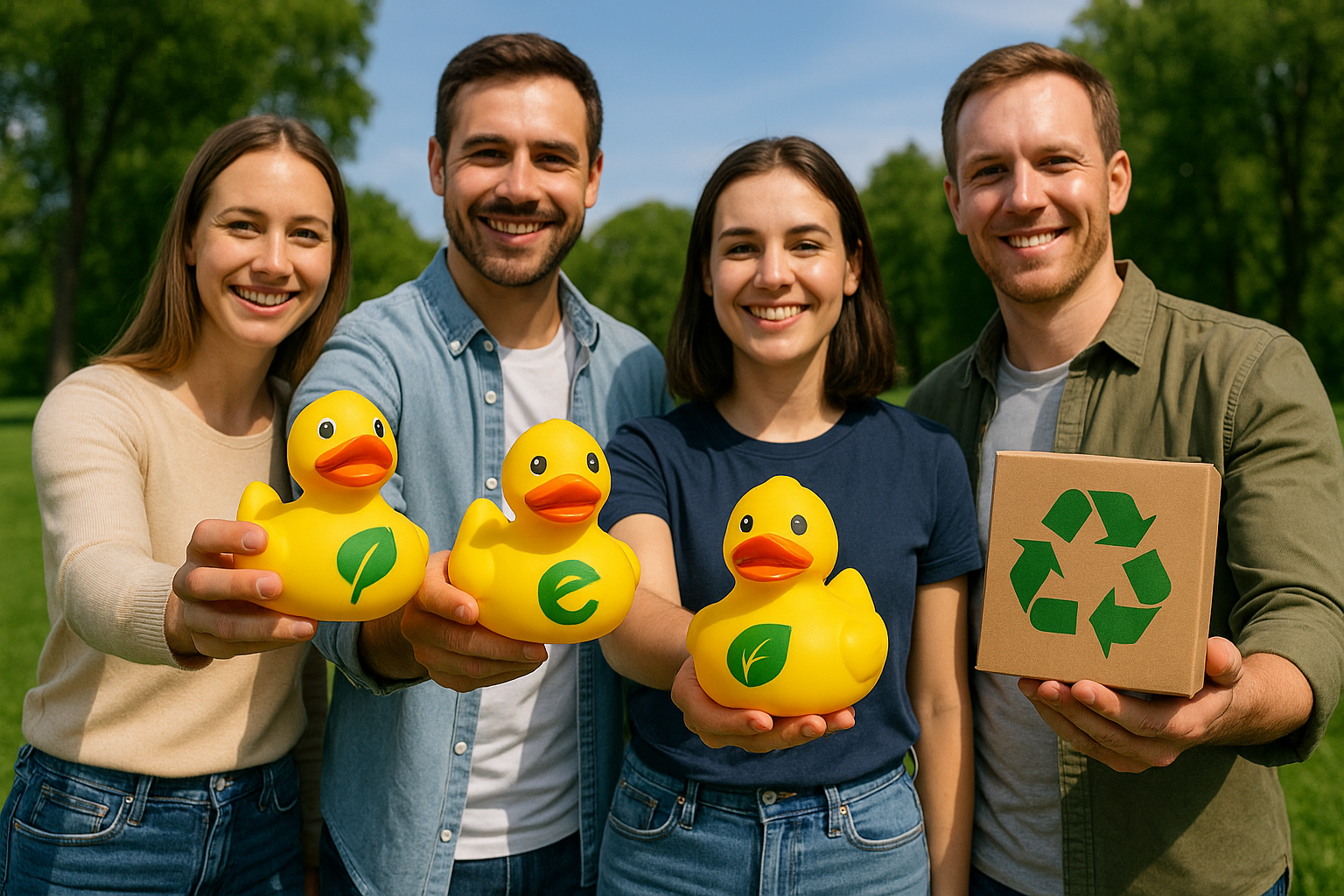
- Single-use event giveaways: If ducks will be distributed at an outdoor festival or beach event where collection for composting is organized, biodegradable blends prevent permanent litter.
- Educational campaigns: Environmental organizations using ducks as teaching tools may value the biodegradable narrative, provided they explain the industrial composting requirement honestly.
- Short-lifecycle promotions: If the duck is designed for a seasonal campaign (3-6 months) and will likely be discarded, the biodegradable option reduces long-term persistence in waste streams.
When Recycled PVC Is the Better Choice
For the majority of B2B buyers, recycled PVC delivers stronger sustainability credentials at lower cost:
- Corporate branding programs: Ducks that need to last 2-5 years on desks and shelves require the durability of rPVC or virgin PVC.
- Retail products: Shelf life, color consistency, and printability all favor rPVC for retail-packaged ducks.
- Jeep Ducking community: The jeep rubber duck market demands weather resistance and long-term color retention — properties where rPVC outperforms biodegradable blends.
- Amazon FBA and e-commerce: Products stored in fulfillment centers for months need stable materials. Biodegradable additives begin degrading in warehouse conditions.
How to Source Sustainable Rubber Ducks: A Buyer’s Checklist
Whether you choose recycled or biodegradable, verify these points before placing an order:
- Request the material safety data sheet (MSDS) for the specific compound being used.
- Confirm third-party certification: GRS for recycled content, ASTM D6400 or EN 13432 for biodegradable claims.
- Ask for test samples produced in the actual material — not just catalog photos from virgin PVC runs.
- Verify that the product line you are ordering supports your chosen material at your required volume.
- Understand the end-of-life pathway. If you claim “biodegradable,” understand exactly where and how the product will biodegrade.
The Honest Bottom Line
True biodegradable rubber ducks — ones that break down safely in home compost or natural environments within a reasonable timeframe — do not yet exist at commercial scale. What exists today is recycled PVC (a proven, certifiable, lower-carbon material) and biodegradable blends (a niche option that works under controlled conditions but costs more and performs worse in most B2B applications).
For most buyers, the smart move is to specify GRS-certified recycled PVC. You get verifiable sustainability, full safety compliance, production-ready availability, and a cost structure that does not punish you for choosing the responsible option. The biodegradable path will mature. It is not there yet.
Frequently Asked Questions
Are biodegradable rubber ducks real?
Biodegradable PVC blends exist, but they only break down in industrial composting facilities (58°C+, high microbial activity). They do not meaningfully degrade in landfills, oceans, or home compost bins. True biodegradable ducks for natural environments are not yet commercially available.
Is recycled PVC safe for rubber ducks?
Yes. GRS-certified recycled PVC meets CPSIA, REACH, and EN71 safety standards when sourced from certified contaminant-free material. Phthalate-free and BPA-free formulations are available in both virgin and recycled grades.
How much more expensive is biodegradable vs recycled PVC?
Biodegradable blends cost 30-60% more than virgin PVC. Recycled PVC costs 5-15% more than virgin PVC. For a 1,000-unit order, the per-unit difference is roughly $0.10-$0.20 for rPVC versus $0.40-$0.80 for biodegradable blends.
Can recycled PVC match Pantone colors?
Yes, with a minor caveat. Dark and mid-range colors are indistinguishable from virgin PVC. Very light pastel shades may show slight batch-to-batch variation in recycled material.
Buyers deciding between hollow and solid constructions can follow the feel, float, and pricing comparison in our guide to hollow vs solid rubber duck comparison guide.