Skip to content
The terms "phthalate-free" and "BPA-free" appear on rubber duck packaging, product listings, and supplier marketing materials with increasing frequency. They have become shorthand for safety, quality, and regulatory compliance. But for procurement professionals and brand managers ordering custom rubber ducks at scale, these labels need to mean something specific and verifiable. Vague claims about chemical safety do not satisfy compliance officers, and they certainly do not protect against liability if a product reaches a child and fails a post-market audit.
This article dissects what phthalate free rubber ducks and BPA-free rubber ducks actually are, the regulatory framework behind each claim, the material science that determines whether a duck can make these claims honestly, and how buyers should verify the labels before committing to a production order. The goal is to replace marketing language with technical precision so that every purchasing decision is grounded in facts rather than assumptions.
What Phthalates Are and Why They Matter in Rubber Ducks
Phthalates are a family of ester chemicals used primarily as plasticizers, meaning they are added to rigid polymers like PVC to make them soft and flexible. Without plasticizers, PVC is a hard, brittle material suitable for pipes and window frames. With phthalate plasticizers, PVC becomes the soft, squeezable material that has been the standard for rubber duck manufacturing for decades.
The concern with phthalates is not the material itself but the potential for certain phthalate compounds to act as endocrine disruptors. Research has shown that some phthalates can interfere with hormonal systems, particularly in developing children whose metabolic systems are still maturing. This led to regulatory action in multiple jurisdictions, most significantly in the United States through CPSIA Section 108, which permanently banned eight specific phthalates at concentrations above 0.1% in children's toys and child care articles.
The eight restricted phthalates are: DEHP (diethylhexyl phthalate), DBP (dibutyl phthalate), BBP (benzyl butyl phthalate), DINP (diisononyl phthalate), DIBP (diisobutyl phthalate), DPENP (di-pentyl phthalate), DHEXP (di-hexyl phthalate), and DCHP (dicyclohexyl phthalate). The first three are permanently banned; the remaining five were restricted following a 2017 rulemaking by the CPSC that expanded the original 2008 interim prohibitions.
What "Phthalate-Free" Actually Means on a Label
Here is the critical distinction that most marketing materials gloss over: "phthalate-free" does not mean zero phthalates. It means that each of the eight restricted phthalates is present at a concentration below 0.1% by weight in any accessible component of the product. This is the regulatory threshold, and it is the standard that testing laboratories use when issuing compliance certificates.
The CPSC Phthalates Enterprise Guide explains that the 0.1% limit applies to each individual phthalate, not to the total phthalate content. This means a product could theoretically contain 0.09% of each of the eight restricted phthalates (totaling 0.72% phthalate content) and still be labeled as phthalate-free. While this scenario is unlikely in practice, it illustrates why the label is a compliance indicator rather than an absolute purity claim.
For buyers, the practical implication is that "phthalate-free" is a meaningful safety claim when backed by test data. A product that meets the 0.1% threshold per phthalate is safe for children's use and compliant with U.S. federal law. But the label alone, without supporting documentation, is just a marketing statement. The rubber duck safety testing guide explains how to request and verify the test documentation that substantiates the claim.

What BPA Is and How It Differs from Phthalates
BPA (bisphenol A) is an entirely different chemical from phthalates. It is a monomer used in the production of polycarbonate plastics and epoxy resins. Polycarbonate is a hard, transparent plastic used in water bottles, food containers, and some plastic toys. Epoxy resins containing BPA are used in can linings and surface coatings. BPA is not used as a plasticizer; it is a structural component of the polymer itself.
The key difference is that BPA is relevant to products made from polycarbonate or epoxy resin, while phthalates are relevant to products made from flexible PVC. A rubber duck made from PVC may contain phthalates but will not contain BPA. A rubber duck made from polycarbonate may contain BPA but will not contain phthalates. And a rubber duck made from TPR (thermoplastic rubber) or silicone will contain neither, because neither chemical family is used in those materials.
This is why the material composition guide is essential reading for buyers. The base material determines which chemical concerns are relevant. If a supplier tells you their duck is "BPA-free" but it is made from PVC, that claim is technically true but potentially misleading, because the more significant chemical concern for PVC is phthalate content, not BPA.
Material-by-Material Breakdown: Which Ducks Can Make Which Claims
The three primary materials used in custom rubber duck manufacturing each have a different chemical profile, and understanding this profile determines which safety claims are meaningful.
PVC (polyvinyl chloride) is the traditional rubber duck material. It is soft, flexible, inexpensive, and takes color well. However, rigid PVC requires plasticizers to achieve the soft texture associated with rubber ducks, and those plasticizers are typically phthalates. A PVC duck can be manufactured to meet the phthalate-free threshold by using alternative (non-restricted) plasticizers such as DOTP (dioctyl terephthalate) or DINCH (diisononyl cyclohexane-1,2-dicarboxylate). These alternatives provide the same flexibility without the endocrine disruption concerns. A PVC duck using non-phthalate plasticizers can legitimately be labeled both phthalate-free and BPA-free.
TPR (thermoplastic rubber) is a blend of rubber and plastic polymers that achieves flexibility without chemical plasticizers. TPR does not require phthalates to be soft, and it does not contain BPA because it is not a polycarbonate material. A TPR duck can legitimately claim both phthalate-free and BPA-free status as an inherent property of the material, not as a result of special formulation.
Silicone is the highest-performance material. Medical-grade and food-grade silicone is inherently free of both phthalates and BPA. It is also more expensive than PVC or TPR, which is why silicone ducks are typically specified for healthcare, infant, or premium brand applications. The PVC vs TPR vs silicone comparison provides detailed performance and cost differences between these three options.
How to Verify Compliance Claims: The Documentation Chain
Any supplier can print "phthalate-free" or "BPA-free" on a product page. The question is whether the claim is backed by testing. Here is the documentation chain that transforms a marketing label into a verifiable compliance fact.
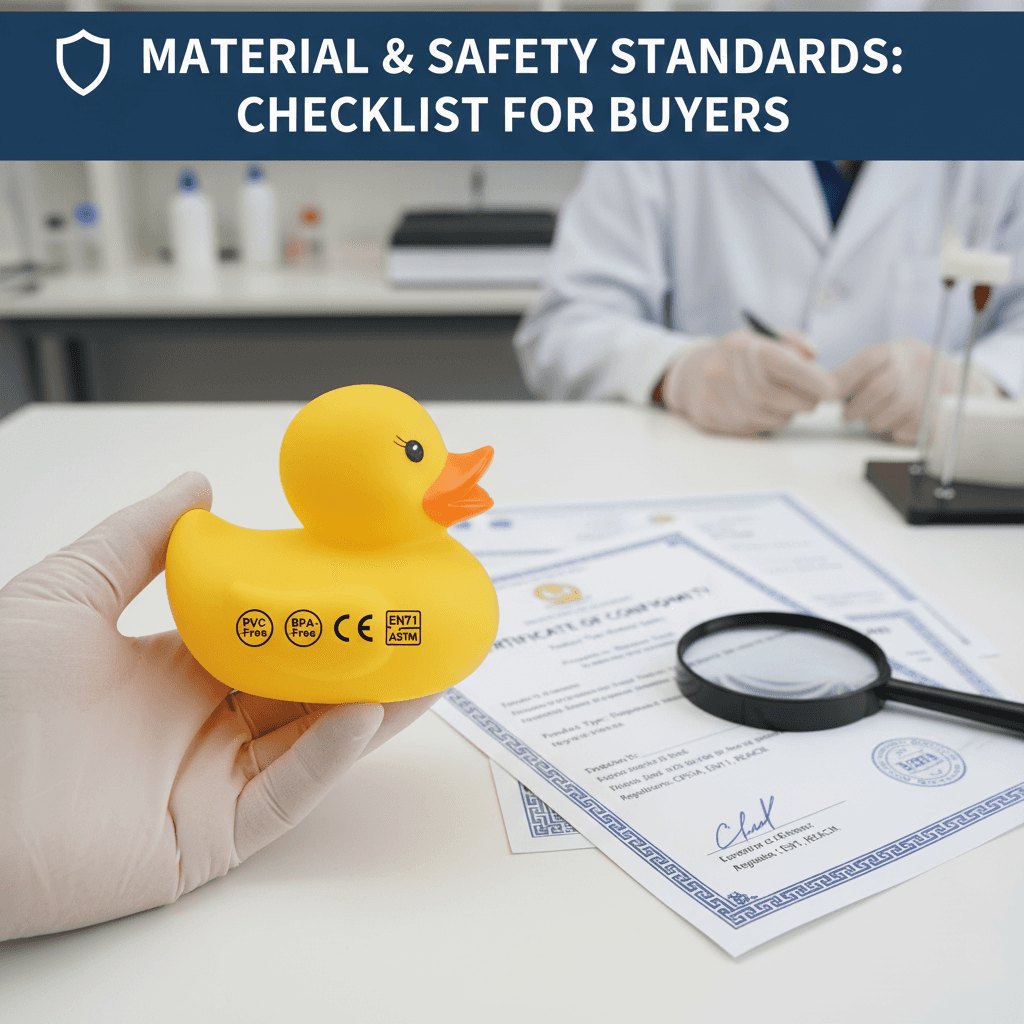
Step one is the test report. The duck should be tested by a CPSC-accepted third-party laboratory such as SGS, Bureau Veritas, Intertek, or TUV Rheinland. The test method for phthalates is typically CPSC-CH-E1001 (for PVC components) or ASTM F2902 (for textile components). The test report should show the concentration of each of the eight restricted phthalates individually, not just a total phthalate number. Each restricted phthalate should read below 0.1% (1,000 ppm).
Step two is the Children's Product Certificate (CPC). The CPC is the manufacturer's or importer's formal certification that the product complies with all applicable children's product safety rules. It must reference the test report, identify the testing laboratory (including its CPSC acceptance number), and list each regulation the product meets. For phthalate compliance, the CPC should reference CPSIA Section 108 and 16 CFR 1307.
Step three is the material safety data sheet (MSDS or SDS). While the SDS does not replace testing, it provides transparency about the chemical composition of the raw material compound. A supplier willing to share their SDS is demonstrating confidence in their material formulation. An SDS that lists no restricted phthalates and no BPA is consistent with the test report and CPC.
Regional Variations: Beyond U.S. Federal Requirements
If your rubber ducks will be sold or distributed in markets outside the United States, the phthalate and BPA landscape becomes more complex. The European Union's REACH regulation restricts phthalates under Annex XVII (Entry 51), and the restriction covers four phthalates (DEHP, DBP, BBP, DIBP) at 0.1% in toys and childcare articles. The EU list is shorter than the U.S. CPSIA list (four versus eight phthalates), but REACH also includes broader SVHC (Substances of Very High Concern) obligations that may capture additional phthalates.
California's Proposition 65 maintains its own list of phthalates and BPA as reproductive toxicants, requiring warning labels on products containing these chemicals above safe harbor levels. Even if a product meets federal CPSIA standards, Proposition 65 may impose additional labeling requirements for products sold in California.
For buyers sourcing eco-friendly rubber ducks for international distribution, the safest approach is to specify compliance with the most stringent standard in each chemical category. If the CPSIA list of eight phthalates is more restrictive than the EU list of four, test to the CPSIA standard. If California's Proposition 65 safe harbor levels for BPA are more stringent than any federal standard, test to that threshold. This multi-standard approach eliminates the risk of a product being compliant in one market but non-compliant in another.
Red Flags: When "Free" Labels Are Misleading
Not all phthalate-free and BPA-free claims are created equal. Here are the specific red flags that indicate a label may be more marketing than substance.
First, a supplier who claims "phthalate-free" but cannot produce a test report is making an unverified claim. The label means nothing without the analytical data to support it. Second, a supplier who tests only for total phthalate content (a single aggregate number) rather than individual phthalate compounds may be hiding the fact that some restricted phthalates are present above 0.1% even though the total reads below a threshold. Third, a supplier who offers "BPA-free" PVC ducks without mentioning phthalate testing may be drawing attention away from the more relevant chemical concern for PVC material.
Fourth, a supplier who references "FDA-approved" or "FDA-compliant" as evidence of phthalate or BPA safety is using imprecise language. The FDA does not "approve" rubber ducks. The FDA regulates food contact materials, and a food-contact-compliant material is not automatically compliant with CPSIA toy safety requirements. These are separate regulatory frameworks with different standards and different testing protocols.
Fifth, be cautious of "phthalate-free" claims on PVC ducks where the supplier has not disclosed what alternative plasticizer is being used. Some alternative plasticizers have their own safety questions that have not been as thoroughly studied as the restricted phthalates. A responsible supplier will disclose the alternative plasticizer (DOTP, DINCH, or similar) and provide test data for both the restricted phthalates and the alternative compound.
Recycled content is a separate claim from phthalate-free and BPA-free labels; the GRS recycled ducks guide keeps the two verification paths distinct.
Practical Sourcing Checklist for Chemical Compliance
When requesting quotes for custom rubber ducks, include the following chemical compliance requirements in your specification to ensure that the phthalate-free and BPA-free claims you receive are verifiable and defensible. Require a CPC referencing CPSIA Section 108 and 16 CFR 1307 for phthalate compliance. Require individual phthalate test results (not just total phthalate) from a CPSC-accepted laboratory. Require BPA test results if the duck will be marketed as BPA-free. Require disclosure of the base material (PVC, TPR, or silicone) and, for PVC ducks, disclosure of the plasticizer system used. If the ducks will be distributed in the EU, require REACH Annex XVII compliance testing in addition to CPSIA testing. And finally, require that the CPC, test reports, and SDS be provided before production begins, not after delivery.
This documentation chain is not optional. It is the difference between a marketing label and a defensible compliance position. The supplier RFQ guide includes a compliance documentation checklist that can be copied directly into your procurement specifications.
Related: sustainable duck material options
Buyers structuring the compliance file for a custom duck order can follow the label placement and wording rules in our guide to toy safety label placement guide for custom ducks.