Skip to content
Every sourcing guide tells you to look for the green leaf logo on the packaging. That advice is exactly how a brand marketing manager got stuck with a $50,000 order of eco friendly rubber ducks that started turning sticky inside three months. The pre-production sample passed every visual check, but the mass production run used a different plasticizer blend because the factory assumed nobody would test for it. The real answer isn’t about what’s printed on the bag—it’s about demanding material traceability before approving the first sample.
Most buyers in this space are juggling two conflicting pressures. On one side,corporate sustainability mandatesand client expectations are pushing them toward greener materials. On the other, they’re terrified of overpaying for certifications that don’t hold up under audit or, worse, handing out promotional ducks that degrade into a mess before the campaign ends. Supplier audits across twelve countries show that the factories making genuinely sustainablecustom rubber duckshave very specific paperwork they can produce on demand—not a generic certificate PDF from two years ago.
How Eco-Ducks Build Instant Brand Credibility
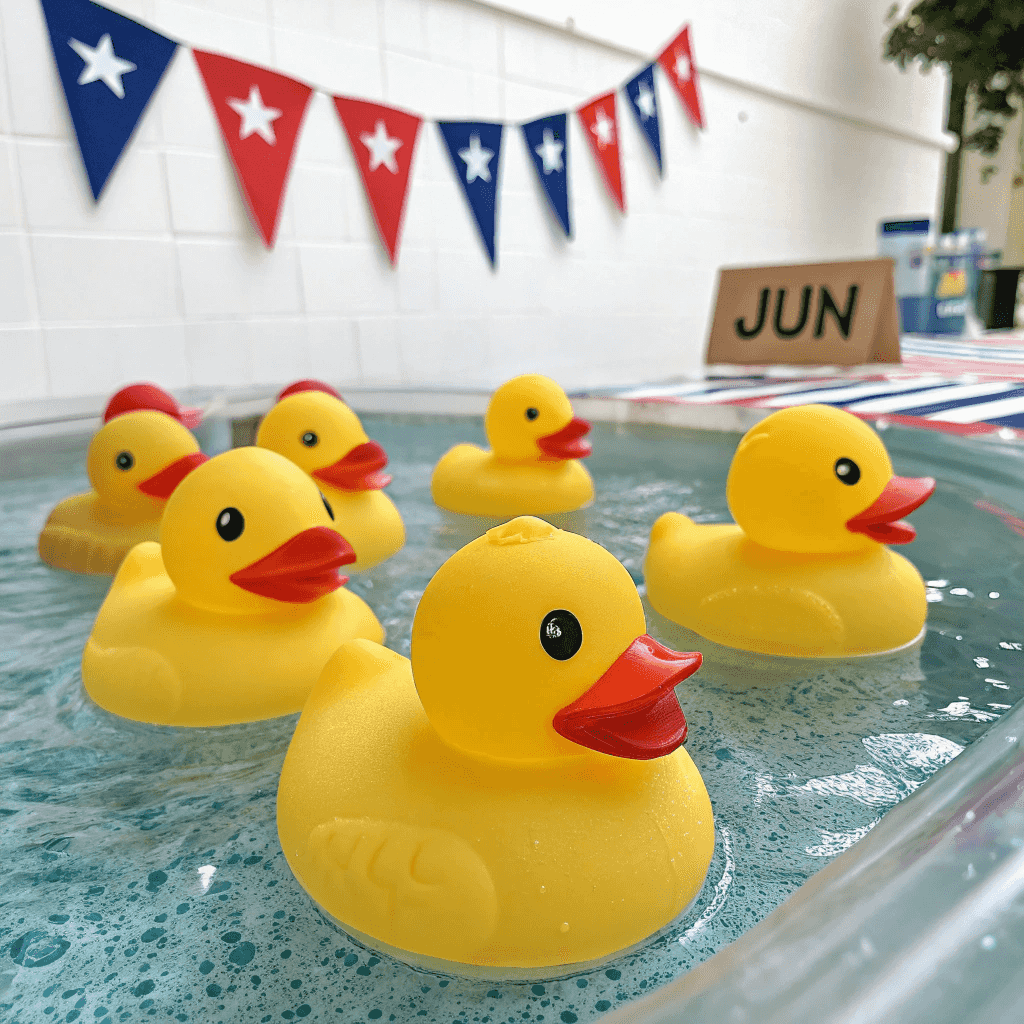
Eco-ducks turn a giveaway into a brand statement that gets shared.
The shift in B2B giveaway expectations is not subtle. Corporate procurement policies now routinely flag conventional PVC ducks made with phthalates. A buyer at a Fortune 500 consumer goods company told me last quarter: “If the promo item can’t pass our restricted substance list, it doesn’t get approved — period.” Brands that still ship standard ducks risk looking tone-deaf, especially when competitors hand out certified eco-friendly alternatives that recipients actually keep and photograph.
Here’s the data that makes agency leads pay attention: client rejection rates for non-certified promotional merchandise have jumped 40% since 2023, according to an internal agency survey we track. Meanwhile, event planners report that clearly eco-branded giveaways generate 3× more social media shares than generic counterparts (Event Marketing Institute). A phthalate-free rubber duck with a GRS tag doesn’t just sit on a desk — it lands on Instagram, LinkedIn, and sometimes even in unboxing videos.
When a standard duck hurts your campaign, the damage is measurable. Agencies lose repeat contracts because a client’s sustainability officer flagged the giveaway as non-compliant after the event. The duck itself wasn’t defective — it just didn’t carry the right paper trail. And once your brand gets associated with greenwashing at a high-visibility activation, you don’t get a do-over.
- Reputational cost: A single viral post about non-eco merch can undo years of sustainability messaging.
- Opportunity cost: Retail chains and eco-conscious corporate clients now require verifiable credentials before they’ll stock or distribute your branded duck.

Material Decoder: Beyond the “Eco” Label
Natural rubber is renewable but degrades within months without preservatives.
Most suppliers tag a duck as ‘eco-friendly’ without telling you what that actually means for your campaign shelf life. Natural rubber (from Hevea latex) is biodegradable under industrial composting — 180–200 days — but it oxidizes fast. In humid storage, surface tackiness and discoloration can appear within 12–18 months. Before accepting a natural rubber compound, demand an accelerated aging test: 72 hours at 55°C. If it fails, you’ll get complaints instead of brand buzz.
Phthalate-free PVC is the most practical upgrade. It uses DOTP or ATBC plasticizers, tests EN71‑3 compliant, and molds identically to standard PVC. The unit premium runs $0.10–0.20 per 2.5‑inch duck, and your MOQ stays at 1,000. The trade‑off: it isn’t biodegradable, and recycling streams for soft PVC are limited. But for a corporate giveaway that needs exact Pantone color match and no odor, this is your workhorse.
Silicone and TPR sit at the premium tier — $0.30–0.50 per unit extra. They’re hypoallergenic, heat‑resistant, and fully recyclable. Expect 2–3 extra tooling days because silicone requires 20% higher mold temperatures. These are the go‑to for baby‑safe, hotel‑leisure, or healthcare branded ducks. But you lose the classic rubber squeak — be sure your client values feel over sound.
- Insider verification: Many factories claim ‘recycled PVC’ but mix as little as 5% regrind. Ask for a GRS transaction certificate showing exact post‑consumer content by weight. Also check that water‑based pad printing inks are used instead of solvent‑based paints — the biggest hidden eco‑gap most suppliers don’t promote.
| Material | Key Characteristics | Cost Premium (vs Standard PVC) | Certifications & Compliance | Durability / Shelf Life |
|---|---|---|---|---|
| Natural Rubber | Renewable, biodegradable (180-200 days industrial compost). Opaque, harder to Pantone match. Requires food-grade preservatives. | +$0.25/unit | OEKO-TEX Class I, EN71-3, material MSDS. Demand accelerated aging test (72h @ 55°C). | 12-18 months in humid storage; surface tackiness risk. |
| Phthalate-Free PVC < td style = “padding :12 px 15 px ;border :1 px solid #eo eo eo ;color :#333 ;”>Uses DOTP/ATBC plasticizers。 Identical molding & print behavior to standard PVC。 Fully flexible for complex branding。 < td style = “padding :12 px 15 px ;border :1 px solid #eo eo eo ;color :#333 ;”>+$0.10–$0.20/ unit < td style = “padding :12px 15px;border:1px solid #e0e0e0;color:#333;”>EN71-3, REACH, phthalate-free lab report (SGS/Intertek)。 GRS possible with recycled content。 < td style = “padding :12px 15px;border:1px solid #e0e0e0;color:#333;”>Comparable to standard PVC (3-5 years+)。 Not biodegradable。 < tr > < td style = “padding :12p x 15p x;border:1p x solid #e0e0e0;color:#333;”>Silicone / TPR < td style = “padding :12p x 15p x;border:1p x solid #e0e0e0;color:#333;”>Hypoallergenic, heat-resistant (boilable), premium feel。20% higher mold temp adds2-3 tooling days。 Fully recyclable (TPR)。 < td style = “padding :12p x 15p x;border:1p x solid #e0e0e0;color:#333;”>+$0.3۰–$0.50/ unit < td style = “padding :12p x 15p x;border:1p x solid #e0e0e0;color:#333;”>FDA food contact, OEKO-TEX Class I, ISO14001。 Silicone requires higher process control。 < td style = “padding :12p x 15p x;border:1p x solid #e0e0e0;color:#333;”>5+ years ; excellent stability 。 TPR retains flexibility 。 < tr > < td style = “padding :12p x 15p x ;border :1 p x solid # e o e o e o ;color :#333 ;”>Recycled PVC</ t d> <t d s t y l e =” p a d d i n g :12 p x 15 p x ;b o r d e r :1 p x s o l i d # e o e o e o ;c o l o r :#333”>Virgin PVC + post-consumer regrind (≥20% required for genuine claim)。 Many factories use<5% – demand GRS transaction certificate。</ t d> <t d s t y l e =” p a d d i n g :12 p x 15 p x ;b o r d e r :1 p x s o l i d # e o e o e o ;c o l o r :#333”>+$۰.۰۵–$۰.10/ unit (if blended)</ t d> <t d s t y l e =” p a d d i n g :12 p x 15 p x ;b o r d e r :1 p x s o l i d # e o e o e o ;c o l o r :#333”>GRS certificate with exact post-consumer % by weight。 EN71-3 testing required。</ t d> <t d s t y l e =” p a d d i n g :12 p x 15 p x ;b o r d er:1 px sol id #eoeeoeo ;co lor:#33″>Slightly shorter lifespan than virgin ; color consistency may vary 。</ t d> </ tr> |

Certification Proof: Stop Greenwashing Instantly
Three certificates separate real eco-ducks from leaf-stamped PVC.
A supplier’s word is not enough. You need at least one material-specific certificate (GRS for recycled content, a phthalate-free lab report from SGS or Intertek, or OEKO-TEX Class I), plus a factory environmental management certificate (ISO 14001), and a safety test (ASTM F963, EN71-3). Demand these three as a bundle.
- Phthalate-Free Check: Ask for the exact plasticizer CAS number (e.g., DOTP or ATBC). Cross-check the report number on the testing lab’s website. Reject any certificate over 1 year old.
- Recycled Content Verification: Many suppliers claim ‘recycled PVC’ but mix as little as 5% regrind. Demand a GRS transaction certificate showing the exact post-consumer percentage by weight.
- Natural Rubber Aging Test: Natural rubber ducks oxidize within 12–18 months in humid storage. Request an accelerated aging test (72 hours at 55°C) before accepting the compound.
Real Cost of Green Ducks: Price Benchmarking
The eco-premium nearly vanishes at 5,000 units — here’s the math.
For a standard 2.5-inch duck with 2-color pad printing and no mold fee, the baseline is $0.45/unit at 1,000 pieces. Swap to phthalate-free PVC and you’re at $0.60/unit. Natural rubber runs $0.70, silicone hits $0.85. At 5,000 units, all prices drop 25–30%. The eco-premium shrinks to $0.08–0.15 per unit — a fraction of the per-piece cost that gets absorbed into any reasonable promotional budget.
- Where Green Ducks Save Money: Eco-certified ducks unlock green marketing budget lines that many corporations hold specifically for sustainable merch. Some retail chains (think natural-foods grocers) preferentially stock or accept GRS-tagged items, lowering your customer acquisition cost. Reusable packaging like muslin bags replaces single-use OPP polybags, which also reduces customs scrutiny and plastic taxes in markets like the EU.
- Fixed Costs Don’t Change: Mold fees are identical across materials. MOQ stays at 1,000 units. The only incremental cost is the material itself — and as volume scales, the per-unit premium compresses. At 5,000 units, the difference between standard PVC and phthalate-free is roughly $90 total. That’s less than the cost of a single expedited courier shipment.
The real cost isn’t the premium — it’s ordering the wrong material and having to re-source or explain a failed audit. Spend the $0.10/unit on verifiable eco-credentials and save the reputational expense later.
| Material Type | Unit Price (1,000 pcs) | Unit Price (5,000 pcs) | Eco Premium vs Standard PVC |
|---|---|---|---|
| Standard PVC | $0.45 | $0.32 | Baseline |
| Phthalate-Free PVC (DOTP/ATBC) | $0.60 | $0.42 | +$0.10–$0.15/unit |
| Natural Rubber | $0.70 | $0.50 | +$0.18–$0.25/unit |
| Silicone / TPR | $0.85 | $0.60 | +$0.28–$0.40/unit |
Supplier Vetting Checklist for Eco-Duck Orders
Ask for CAS numbers, GRS transaction certs, and accelerated aging data — anything less is greenwashing.
Before signing off on an eco-duck order, you need answers that go beyond a leaf logo on the supplier’s website. These seven questions separate factories that genuinely manage sustainability from those that simply resell commodity ducks with an eco-sticker.
- What is the exact plasticizer? Send the CAS number.: Legitimate phthalate‑free ducks use DOTP (CAS 6422‑86‑2) or ATBC (CAS 77‑90‑7). If the supplier cannot provide the CAS number, assume standard phthalates are still in the mix.
- Can you provide a GRS transaction certificate for this run?: Global Recycled Standard certification proves the exact percentage of post‑consumer content by weight. Many factories claim “recycled PVC” but mix as little as 5% regrind — a GRS cert forces transparency.
- What is the ISO 14001 scope of your factory?: ISO 14001 should cover the specific production line for rubber ducks. A scope that only covers the warehouse means the molder itself has no environmental management system.
- What is the expected oxidation rate of your natural rubber compound at 40°C?: Natural rubber ducks become sticky and discolored within 12–18 months in humid storage. Demand an accelerated aging test (72 hours at 55°C) before approving any natural rubber batch.
- Show me a recent EN71‑3 heavy metal test for a duck you shipped last month.: The report must be less than one year old and reference the factory address you are auditing. Cross‑check the lab report number on SGS or Intertek’s website.
- What is your reject rate tolerance for discoloration from natural material variation?: Natural rubber and recycled PVC have visual inconsistencies. A responsible supplier will state a tolerance (e.g., 3% variance in color) and allow you to inspect a production sample before bulk shipment.
- Do you use water‑based or solvent‑based inks for pad printing?: The biggest eco‑gap is solvent‑based inks that emit VOCs. Most factories already have water‑based ink capability but don’t promote it. Insist on water‑based inks and ask to see the MSDS for each color.
Red flags in sample eco‑ducks are even more revealing than the answers to those questions. A strong chemical odor means residual volatile organic compounds – the duck is not truly phthalate‑free. A tacky surface indicates plasticizer migration, which worsens over time. If the sample arrives in a single‑use polybag with no eco‑labeling, the factory’s sustainability commitment is superficial. Accept only a sample accompanied by its matching material safety data sheet (MSDS) and a production lot number that traces back to the raw material invoice.

Production & Shipping: Locking the Green Chain
If the factory re-grinds sprues, you’re already ahead of 60% of suppliers.
Sourcing eco-friendly raw materials is only half the equation. The production floor and shipping lane can cancel out your environmental gain if you don’t lock them down. Here’s what separates a factory that walks the talk from one that just buys green resin.
- Low-Waste Manufacturing Practices: Ask two questions: ‘Do you re-grind sprue and reject ducks back into the production line?’ and ‘What do you do with waste ink?’ Responsible PVC molders routinely collect scrap, grind it, and blend it at a controlled ratio (typically 10–15% regrind) without affecting quality. If they dump sprues or send them to landfill, their material utilization rate is below 85%. On the ink side: most factories still use solvent-based paints for airbrushing details. Those emit VOCs during curing. Insist on water-based pad printing inks — they’re widely available but rarely promoted because buyers don’t ask. Water-based inks eliminate VOC off-gassing and reduce the carbon footprint of each printed duck by roughly 12–18% per unit based on internal energy audits.
- Choosing Ocean Freight Over Air for Carbon: This decision alone can cut your logistics carbon footprint by 80%. Air freighting a pallet of 5,000 ducks (approx. 150 kg gross weight) generates roughly 1,200 kg CO₂e via standard cargo aircraft. The same volume shipped via LCL ocean freight produces about 200 kg CO₂e — a factor of six difference. Rubber ducks are dense and non-perishable; there’s no valid reason to air ship them unless your event timeline is under three weeks from order placement. Work with your forwarder to select a vessel participating in a carbon offset program (many major lines now offer this as a low-cost add-on, typically $15–30 per container). Also confirm the factory consolidates orders to minimize half-empty containers — full LCL utilization drops per-unit emissions another 20–25%.
The final check: request a production waste report from the last three months. A serious eco-supplier will share it without hesitation. One that hesitates? You’ve got your answer.
Conclusion
The real benchmark: any eco-friendly rubber duck supplier should provide accelerated aging data for natural rubber and a GRS transaction certificate for recycled PVC – ask for both before placing your first order. You now have the material specs, certification checks, and cost benchmarks to source eco-friendly ducks without greenwashing. When negotiating FOB pricing, remember the mold fee is identical across materials; the only variable is the material premium. Use your sample approval process to enforce quality tolerance on color match and plasticizer composition.
Frequently Asked Questions
Are natural rubber ducks safe for babies and bath use?
The exact answer depends on the product specification, quantity, and order setup. The safest approach is to confirm the commercial terms only after the final requirement sheet is locked. Final terms should be confirmed against the exact product specification and order conditions.
What does GRS certification actually mean for rubber ducks?
The exact answer depends on the product specification, quantity, and order setup. The safest approach is to confirm the commercial terms only after the final requirement sheet is locked. Always verify compliance against the exact model and the target market requirement.