Skip to content
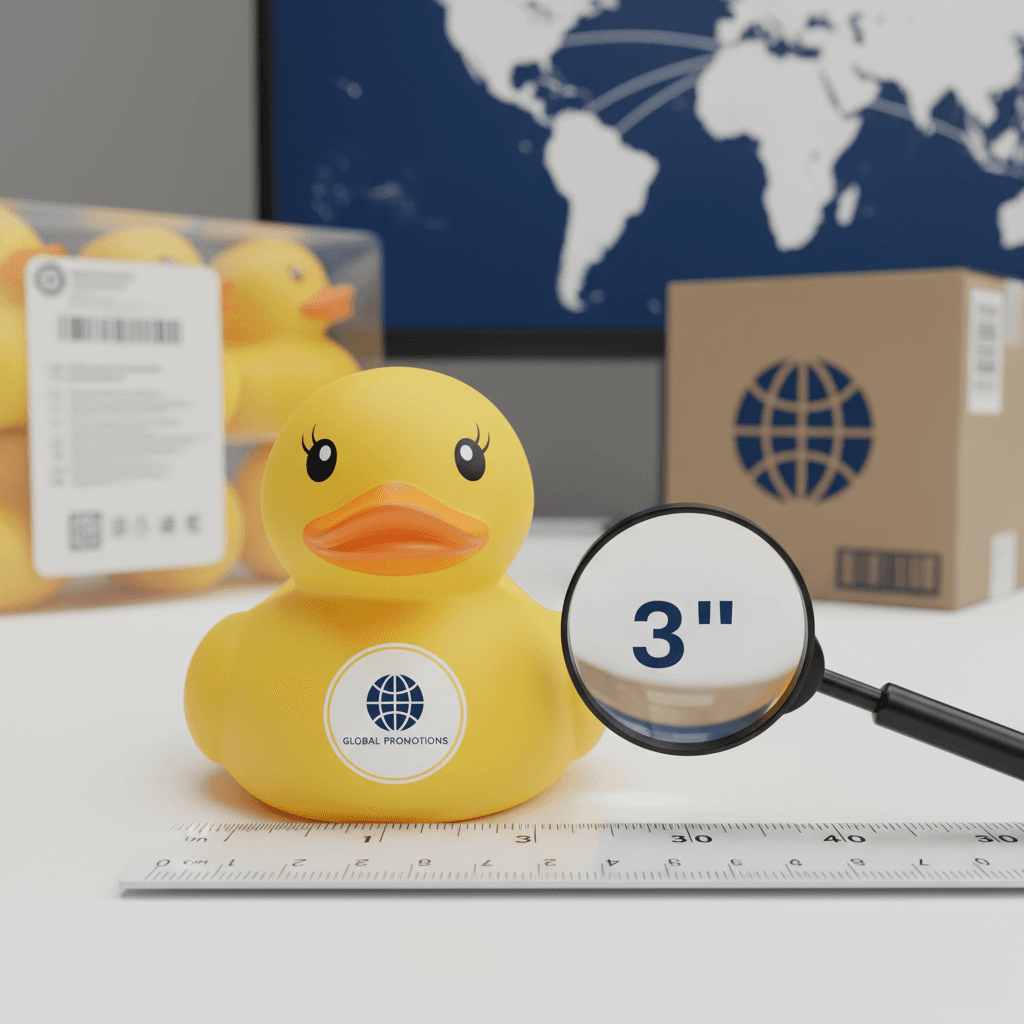
A gift shop buyer in Portland ordered five hundred large rubber duck units last spring, expecting standard toy margins. The freight quote killed the project. A jumbo 10-inch unit weighs around 200 grams, which means you are shipping air and eating your gross margin on the cubic meter calculation before the box even hits your dock.
We pulled three years of production data on 8 to 12-inch vinyl pieces to see where independent retailers actually make their money. The answer is surprisingly simple. You have to position the item as local decor rather than a child’s toy to justify a five-times markup, and you must force your supplier to add bottom-weight ballast so the piece actually floats upright in a storefront water tank instead of tipping over on its face.

Defining Large vs. Giant
A 12-inch retail duck and a 5-meter event prop share a name but belong to entirely different supply chains. Conflating the two destroys your margin model.
Retail “Large” vs. Event “Giant”: Two Different Businesses
When buyers search for a “large rubber duck,” they are typically looking for shelf-ready inventory in the 6 to 12-inch range. These are solid or hollow PVC units weighing 150 to 250 grams, compliant with EN71 and ASTM F963, and designed to be sold individually at retail. Your freight is calculated in CBM based on this specific weight-to-volume ratio.
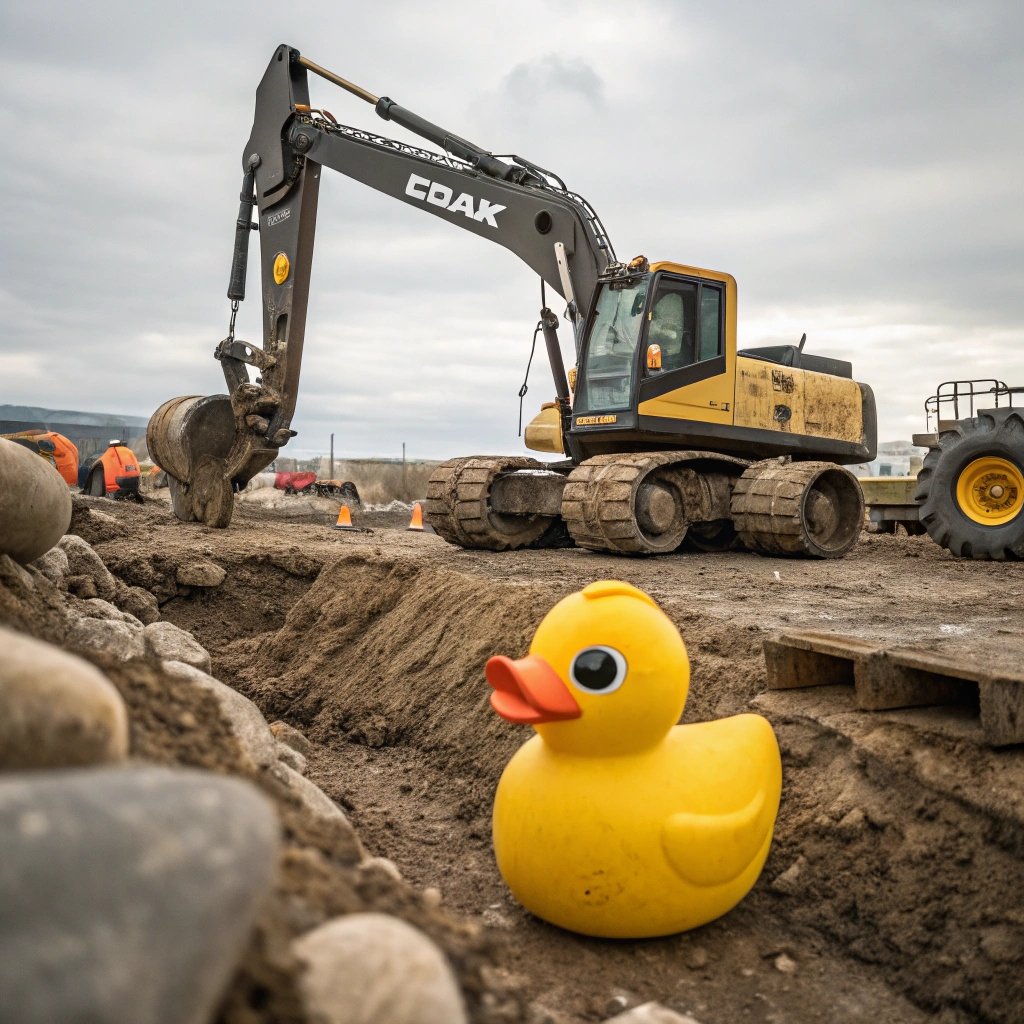
Event “giant” ducks start at 5 meters and are strictly display-only inflatables. To put the commercial difference in perspective, renting a competitor’s “Mama Duck” event installation costs approximately $45,000 including logistics. You are not competing with that spectacle; you are sourcing a high-margin, turnkey gift item that fits in a standard shipping carton.
Shelf-Ready Jumbos vs. Display-Only Inflatables
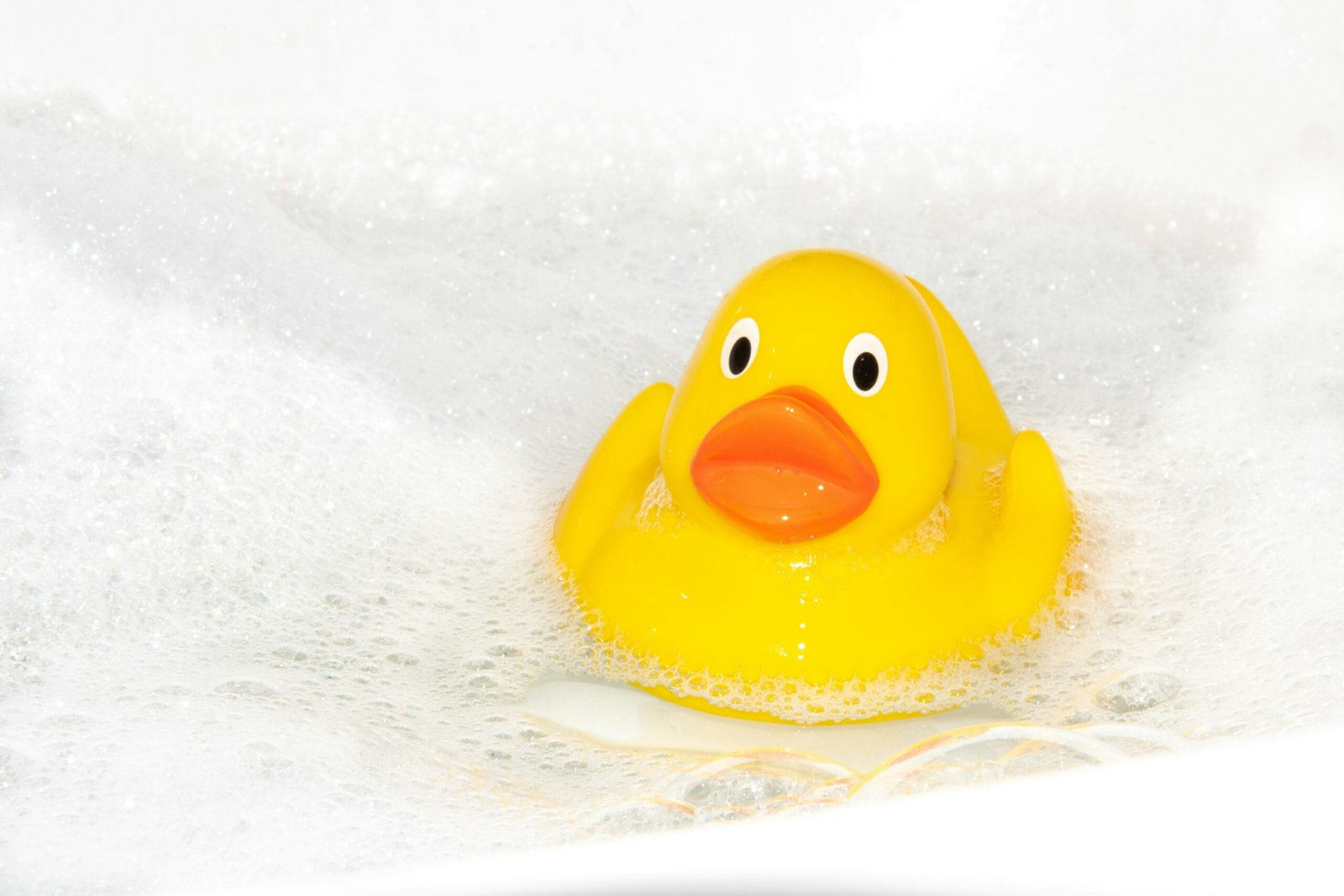
The critical distinction for gift shop buyers is end-use functionality. A shelf-ready 8-inch or 10-inch jumbo duck must float upright in a bathtub demo. This requires specific engineering that most suppliers overlook. Our engineers solve the “floater” challenge by incorporating a weighted ballast inside the mold during production, preventing the air pocket in the head from tipping the unit. Inflatable props do not face this physics problem because they are anchored to the ground and never touch water.
For your inventory strategy, the shelf-ready jumbo is where the actual margin lives. While standard 3-inch ducks are perceived as cheap giveaways, an unbranded 10-inch or 12-inch duck functions as a local art canvas. We manufacture these as premium retail sculptures rather than toys, allowing gift shops to command price points 5x higher than standard SKUs. When you source wholesale large rubber ducks for a gift shop, you are buying perceived value, not just cubic volume. If your goal is to buy large rubber ducks at the 10-inch scale, ensure your custom jumbo rubber duck manufacturer can guarantee the upright float test before you commit to a 1000-unit MOQ. Bulk oversized rubber ducks for retail only generate ROI if they survive the customer’s first bathtub test.
Retail Margin Analysis
The per-unit gross margin on a jumbo rubber duck is 3-5x that of a standard duck. The real constraint is not profitability — it is whether your freight-to-margin ratio survives the CBM penalty of shipping hollow, oversized PVC.
Unit Economics: Standard vs. Jumbo
A standard 3-inch duck weighs 30-50g and ships efficiently at roughly 8,000-10,000 units per cubic meter. A jumbo duck at 10-12 inches weighs 150-250g, and you are looking at roughly 1,200-1,800 units per CBM. That is a 5-7x density penalty, and it directly erodes per-unit margin if your retail price does not compensate. The FOB cost for a standard custom duck runs $0.40-$0.80, while a jumbo lands between $1.80-$3.50 depending on mold complexity and whether you need the internal ballast we engineer to prevent tipping in water.
- Standard Duck (3-inch): FOB $0.40-$0.80 | Retail $3-$5 | Gross Margin ~$2.50-$4.20 per unit
- Jumbo Duck (10-inch): FOB $1.80-$3.50 | Retail $14-$22 | Gross Margin ~$11-$19 per unit
- Jumbo Duck (12-inch): FOB $2.80-$4.20 | Retail $18-$25 | Gross Margin ~$14-$21 per unit
- Mold Amortization: $500-$1,500 one-time fee spread across 1,000-unit MOQ adds $0.50-$1.50 to first-run unit cost only
The raw margin multiple is significant, but here is the nuance most buyers miss: freight for jumbo ducks can add $0.80-$1.60 per unit on sea freight alone, depending on destination port. You must model your landed cost before committing to a size. We routinely run CBM calculations for gift shop buyers before production starts, because a $19 margin that becomes $17.50 after freight still outperforms a standard duck by 4x — but you need to know that number before you place the PO.
Price Point Uplift: The $10-$25 Window
The shift from a $3-$5 standard duck to a $10-$25 jumbo is not a linear markup. It is a category repositioning. At 8 inches and above, the product stops competing with bath toys and starts competing with desk decor, shelf sculptures, and gift items. Gift shop buyers we work with consistently report that jumbo ducks placed at eye level near the register outperform standard ducks in the impulse bin by a wide margin, precisely because the perceived value justifies the price without the customer needing to think about it.
The $10 floor is critical. Below $10, consumers mentally categorize the item as a novelty toy and start benchmarking against Amazon bulk pricing. Above $10 — and especially in the $15-$22 range — the comparison set shifts to other gift items like scented candles, ceramic mugs, and small art pieces. This is where the margin opportunity actually lives. We have seen gift shop partners price a 10-inch custom duck at $19.99 with minimal price resistance, because the physical presence of the product on the shelf does the selling.
Impact on Basket Size
Standard ducks are typically single-unit, throw-in purchases. A customer grabs one, adds it to a $40 basket, and moves on. Jumbo ducks behave differently. Our retail partners report two consistent patterns with oversized stock. First, the average transaction value increases by $12-$18 when a jumbo duck is in the basket, because the item itself anchors a higher spend tier. Second, jumbo ducks drive secondary purchases — customers buying a 12-inch duck as a gift will frequently add a standard duck as a “bonus” for a child at home, effectively doubling the units moved in a single transaction.
The strategic implication for inventory planning is straightforward: jumbo ducks should not replace your standard duck assortment. They should sit alongside it as a premium anchor SKU. One jumbo model at $19.99 next to a wall of $4.99 standard ducks makes the standard ducks look like an even better deal, while the jumbo captures the margin you cannot access at the lower price point. The two tiers reinforce each other in a way that a single-size strategy never will.

Customization for Large Models
A 10-inch rubber duck is not a scaled-up toy. It is a curved PVC canvas where print resolution, perceived value, and retail margin scale non-linearly with surface area.
The Canvas Effect: Why Surface Area Changes the Product Category
A standard 3-inch duck has roughly 45 square centimeters of printable surface. A 10-inch jumbo duck has over 600. That 13x multiplier in surface area does something most buyers underestimate: it shifts the product out of the “novelty toy” category and into “sculptural decor” in the mind of the retail shopper. For gift shop owners, this is the single most important distinction because it dictates your shelf placement and your price point.
We have seen independent gift shops position unbranded 10-inch and 12-inch ducks on entrance-level display tables the same way they would display a ceramic figurine or a art print. The buyer is not purchasing a bath toy; they are purchasing a conversation piece. This perceived value shift is what allows you to retail a bulk oversized rubber duck at 4 to 5 times the per-unit margin of a standard duck, even after absorbing the higher FOB cost and increased CBM freight.
High-Resolution Pad Printing on Curved PVC
Here is where most suppliers cut corners on large models. Pad printing on a curved, non-porous PVC surface at 8 to 12 inches introduces a physics problem that does not exist on small ducks: the silicone pad must deform significantly more to maintain contact across a larger arc, which causes image stretch and edge blur if the machine is not calibrated correctly. We run large-format pad printing at 80-90 Shore A hardness silicone cups with a delayed snap-off to compensate for this stretch, which preserves line clarity on logos wider than 60mm.
For artwork with gradients or photographic detail, standard 4-color pad printing will fail on a 10-inch duck. The correct method is digital UV flatbed printing applied in segments, then cured under a 395nm LED tunnel. This achieves photographic resolution but adds approximately 8-12 seconds per unit to the production cycle. If your supplier quotes a “complex logo” large duck at the same unit price as a single-color print, they are almost certainly using a lower-resolution transfer method that will visibly degrade after 6 months of UV exposure.
The Cost Structure: Why Large Ducks Are Not Just “More Material”
The raw PVC cost increase is straightforward: a jumbo duck at 150-250g uses 3 to 5 times the vinyl of a standard 30-50g duck. But material is only 15-20% of the FOB price. The real cost drivers on large models are the mold engineering, the floatation balancing, and the production cycle time. Custom mold fees for 8 to 12 inch ducks range from $500 to $1,500 depending on undercut complexity, and this is amortized across your MOQ of 1,000 units.
The hidden cost that surprises first-time buyers is the floatation engineering. A hollow duck of that size traps significant air volume in the head cavity, causing it to list sideways or capsize in water. We solve this by molding an internal weighted ballast pocket in the base during the rotational molding phase, which adds roughly 4-6 seconds to the demolding cycle per unit. If you are sourcing from a factory that does not discuss bottom-weighting with you upfront, test their samples in water before committing to a production run. A large duck that does not float upright is unsellable as a gift shop display item.
The freight math is the final variable. A 10-inch duck in individual polybag packaging yields roughly 800-1,000 units per cubic meter, compared to 6,000-8,000 for standard ducks. Your per-unit ocean freight cost increases by 6 to 8 times. When you combine higher FOB, higher freight, and mold amortization, the landed cost of a custom jumbo rubber duck is typically 3.5 to 5 times that of a standard unit. The commercial justification is simple: if your retail price point reflects the “sculpture, not toy” positioning, your gross margin per unit will still outperform the standard duck by a significant multiple.

Material Durability Specs
Material specification is the dividing line between a premium retail product and a warehouse full of returns. For large-format ducks, the physics change entirely.
PVC vs. Vinyl Density for Jumbo Formats
In manufacturing terms, “vinyl” is polyvinyl chloride (PVC). The distinction that actually matters for large rubber ducks is the compound density. Standard 3-4 inch ducks weighing 30-50g can be produced using PVC with a density around 1.30 g/cm³. When you scale to an 8-12 inch jumbo duck at 150-250g, that same compound produces a shell that flexes too much under its own weight.
We formulate our jumbo-grade PVC at 1.40-1.45 g/cm³. The higher resin-to-plasticizer ratio produces a noticeably stiffer finished product that holds its shape on a retail shelf. If a supplier cannot provide a specific density grade for their compound, they are running standard mix and the large ducks will deform in transit. Request a density data sheet before committing to a production run.
Wall Thickness: The 1.5mm Minimum
Standard duck wall thickness sits around 0.8-1.0mm. At that gauge, an 10-inch duck will develop a visible “lean” within weeks of shelf display and will dent under the pressure of bulk packing. We enforce a 1.5mm minimum wall thickness across all jumbo models (8 inch, 10 inch, 12 inch), with some structural points like the base and neck reaching 2.0mm.
Here is the hard truth about wall thickness and your margin: a supplier quoting 40% below market on bulk oversized rubber ducks for retail is almost certainly running thinner walls. Thinner walls mean less material per unit, which lowers both cost and freight weight. The savings vanish the moment your gift shop customers start returning ducks that arrived caved in. Always request caliper verification photos from the first article inspection before greenlighting mass production.
The Upright Floating Problem
This is the spec that almost no competitor discusses openly, and it is the single most common failure point for gift shop displays. A large hollow duck has significant air volume in the head cavity. Without counterbalance, the duck floats top-heavy and tips sideways in water. For a gift shop owner running a water demonstration to drive impulse purchases, a sideways duck is an unsellable duck.
Our engineers solve this by molding a solid PVC ballast into the lowest point of the base cavity during the rotomolding cycle. This shifts the center of gravity below the waterline. The ballast material is the same non-phthalate PVC compound used in the shell, so it maintains full EN71 Part 1, 2, 3 and ASTM F963 compliance without introducing foreign materials that could trigger a lab failure. If you are sourcing custom jumbo rubber ducks from a manufacturer and they do not proactively address buoyancy tuning in their technical drawing review, your water demos will fail at retail.
| Feature | Specification | Compliance | Retail Benefit |
|---|---|---|---|
| Base Compound | Non-phthalate PVC / Vinyl | EN71 Part 1, 2, 3 & ASTM F963 | Guarantees safety compliance, eliminating stock rejection risks for gift shops. |
| Floating Stability | Internal Molded Weighted Ballast | N/A | Prevents tipping in water; perfect for in-store visual merchandising and water demos. |
| Exterior Finish | Pad Print (4-color) or Digital UV | EN71 Compliant Inks | Scuff-resistant artwork preserves premium ‘decor’ perceived value and high margins. |
| Jumbo Wall Density | Optimized thickness for 150-250g weights | Drop-Test Verified | Withstands high-volume freight handling, reducing shipping damage and return rates. |

Logistics for Oversized Items
A 10-inch jumbo duck consumes roughly 20x the shipping volume of a 3-inch standard duck. If you calculate margin on FOB price alone, you are flying blind on landed cost.
Shipping Volume Impact Per Unit
Rubber ducks are hollow PVC—freight cost scales with volume, not weight. We pack roughly 250 standard 3-inch ducks into a 0.08 CBM carton. A 10-inch jumbo duck requires individual polybagging and fits approximately 25 units per 0.15 CBM carton. That shifts per-unit volume from 0.00032 CBM to 0.006 CBM.
At a 1000-unit MOQ, your standard duck order occupies 0.32 CBM—small enough to route as LCL (Less than Container Load) without penalties. The same quantity of 10-inch ducks occupies 6 CBM. That is not a trivial upsell; it fundamentally changes your shipping lane strategy.
Freight Cost Comparison: 10-Inch vs. 3-Inch Ducks
Using current LCL ocean freight rates from Shenzhen to Los Angeles (approximately $40/CBM), the math is blunt:
- 3-inch ducks (1000 units): 0.32 CBM × $40 = $12.80 total, or $0.013 per unit landed freight
- 10-inch ducks (1000 units): 6 CBM × $40 = $240 total, or $0.24 per unit landed freight
That is an 18x multiplier on freight cost per unit. For a gift shop targeting a $15–$25 retail price on jumbo ducks, $0.24 per unit in ocean freight is manageable. But if your retail ceiling is $8, freight alone consumes 3% of your shelf price before factoring in duties, last-mile delivery, and Amazon FBA inbound fees.
Air freight compounds the problem severely. At roughly $6–$8/kg, a 200g jumbo duck costs $1.20–$1.60 just to fly—often exceeding the FOB manufacturing cost of the unit itself. We routinely advise against air freight on anything over 8 inches unless the order is event-critical with a hard deadline.
FOB vs. DDP: Where Oversized Ducks Expose the Gap
FOB (Free on Board) quotes from our factory give you the manufacturing cost plus local handling to port. You then control the ocean leg, customs brokerage, and drayage. For standard ducks, the difference between a FOB and DDP (Delivered Duty Paid) quote is usually predictable—DDP adds a fixed $0.05–$0.08 per unit.
For bulk oversized rubber ducks, that predictability collapses. A DDP quote on 6 CBM of 10-inch ducks requires the supplier to estimate destination port fees, customs classification (HS code 9503.00 for toys), and last-mile freight—all of which fluctuate. Most factories build a 15–25% risk premium into their DDP quotes for oversized items to cover rate volatility.
Our recommendation for gift shop buyers ordering jumbo ducks: negotiate FOB, then engage your own freight forwarder. You will typically save $0.10–$0.15 per unit on a 1000-piece jumbo duck order compared to accepting a factory DDP quote. More importantly, you retain control over transit time—critical when seasonal inventory windows are tight.
| Logistics Factor | Standard Specification | Jumbo Specification | Strategic Benefit |
|---|---|---|---|
| Unit Weight | 30g – 50g | 150g – 250g | Higher weight-to-value ratio reduces shipping cost as a percentage of retail price. |
| Carton CBM Efficiency | High volume, low density | Dense, structured packing | Bypasses the high-volume/low-value shipping trap that erodes standard toy margins. |
| Export Packaging | Bulk polybag only | Individual polybag or color box | Color boxes prevent transit deformation, lowering return rates and protecting ROAS. |
| Product Classification | Toy / Cheap giveaway | Premium decor / Sculpture | Justifies FOB sea freight costs via 5x higher retail price points and faster inventory turnover. |
| Customs Compliance | Often uncertified | EN71 (1,2,3) & ASTM F963 | Eliminates border delays and inventory write-offs from failed safety compliance. |
Safety & Certification
One failed CPSIA lab report can pull your Amazon listing in 48 hours. EU customs will impound containers lacking a valid EN71 certificate. Treat compliance as inventory insurance.
EN71, ASTM F963, and CPSIA — What Each Standard Actually Tests
For non-phthalate PVC and vinyl ducks entering retail channels, three certification frameworks govern compliance. Understanding what each one physically tests — rather than treating them as a checkbox — prevents costly batch rejections at the lab stage.
EN71 Part 1 covers mechanical and physical properties. For a jumbo 10-inch duck, this means drop testing from 1.4 meters onto a steel plate and checking for sharp edges or rupture points that expose the internal air cavity. Part 2 addresses flammability — PVC self-extinguishes quickly, so this is rarely a failure point unless surface printing inks contain flammable solvents. Part 3 is the heavy metal migration test, where a solvent extract of the PVC surface is analyzed for lead, cadmium, and barium leaching. We test against all three parts on every production batch, not just the first run.
ASTM F963 is the US equivalent and largely mirrors EN71 but adds stricter torque and tension tests for any attached components. If your large duck design includes a molded hat or scarf, ASTM requires that component withstand 2.0 inch-pounds of torque and 15 pounds of tension for 10 seconds without detaching.
CPSIA (Consumer Product Safety Improvement Act) applies specifically to products sold in the United States and targets two things: total lead content must not exceed 100 ppm in any accessible component, and eight specific phthalates (DEHP, DBP, BBP, DINP, DIDP, DNOP, DNHP, DIBP) must each be below 0.1% by mass. Because our material base is non-phthalate PVC, the phthalate clause is inherently satisfied, but we still run third-party GC-MS testing on every batch to provide the certificate your customs broker will demand.
The Detachable Parts Trap on Large Models
Here is the mistake that catches gift shop buyers off guard: assuming a large duck automatically bypasses choking hazard regulations. The duck body at 8 to 12 inches is well outside the small parts threshold. The problem is the accessories.
If a custom jumbo rubber duck features a detachable bow, a removable sun hat, or a separate branded tag attached by a short cord, each of those individual components must pass the small parts cylinder test (1.25 inches diameter by 2.25 inches deep). If any detached accessory fits completely inside that cylinder, the entire product — regardless of the duck’s body size — must carry a choking hazard warning label under both ASTM F963 and 16 CFR 1500.51.
We handle this at the engineering stage by designing all molded accessories with a minimum 2-inch base footprint that prevents cylinder entry, or by integrating them into the main body mold so they cannot be removed without destructive force. If your brand design calls for a detachable element, our engineers will flag the dimension risk before tooling begins and propose a tethered or integrated alternative. This prevents the scenario where you receive 5,000 units that pass initial inspection but fail at the retailer’s compliance audit because someone pulled off a hat and dropped it into a test cylinder.
Conclusion
Skip the celebrity licenses. An unbranded large rubber duck positioned as local art sells for five times the standard toy price. You eat slightly higher freight costs on the 150-250g weight, but your gross margin easily absorbs the difference.
Demand a physical sample and test it in water. Most competitors’ hollow ducks tip over because they skip the internal ballast step. If it doesn’t float upright, reject the batch.
Frequently Asked Questions
What does it mean if someone puts a rubber duck on your car door handle?
It is a friendly nod, a spontaneous compliment, or a way to brighten someone’s day. The duck might sit on a mirror, door handle, or dashboard, often with messages like ‘Nice Jeep!’
How much does the world’s largest rubber duck cost?
Rental for a giant event duck (like ‘Mama Duck’) is roughly $45,000, including the duck rental, security, entertainment, and logistics.
What do rubber ducks mean in LGBTQ?
Installations encourage dialogue around inclusivity, unity, and resilience. The rubber duck is used as a universally nostalgic object to symbolize solidarity.
What does a rubber ducky symbolize?
Rubber ducks symbolize good luck, positivity, and playful energy. They are often associated with childhood nostalgia and stress relief.
What is the rubber duck rule?
In business and problem-solving, the ‘Rubber Ducking’ technique involves explaining a problem line-by-line to an inanimate object (like a rubber duck) to find the solution, often used in coding.
Related B2B sourcing page: For production options, MOQ and custom project support, see our bulk rubber ducks page.