Building a product line around a large rubber duck directly determines whether your promotional merchandise generates measurable brand engagement or triggers damaging PR backlash from poorly executed campaigns. In a saturated market where generic rubber ducks flood wholesale channels, brand managers face the operational reality of balancing customization costs with quality control – a misstep here risks alienating customers with flimsy products that erode brand equity instead of reinforcing it during critical promotions.
This guide provides your technical standard operating procedure for developing a defensible large rubber duck product line, covering sourcing considerations for custom rubber ducks wholesale, design frameworks for promotional impact, and quality assurance protocols to address common ‘People Also Ask’ concerns. You’ll gain a production blueprint that safeguards brand integrity while meeting budget constraints and campaign deadlines – transforming novelty merchandise into strategic brand assets.
” }
Market Sizing for Large Rubber Duck Products
Large rubber ducks deliver $1.85-$4.20 per unit at 1,000 MOQ with 65-72% margins in premium promotional markets.
B2B Demand Segments
The custom large rubber duck market divides into four distinct B2B segments, each with unique purchasing behaviors and volume requirements. Automotive brands lead the “Jeep ducking” phenomenon, driving consistent bulk orders. Promotional merchandise buyers prioritize visual impact and brand alignment, while retail gift shops focus on margin potential and seasonal rotation. Event planners demand quick turnarounds for time-sensitive campaigns.
Order Volume Ranges
Production economics create natural volume thresholds that significantly impact unit costs:
- Entry Volume: 1,000-2,000 units, typical for initial campaigns or testing, featuring $1.85-$4.20 per unit cost
- Mid-Tier: 5,000-10,000 units, reducing per-unit cost by 27-33% through mold setup amortization
- Enterprise: 20,000+ units, unlocking bulk material pricing and dedicated production lines
Increasing order size from 1,000 to 5,000 units creates the most significant per-unit cost reduction, making this the critical scaling point for brand managers calculating campaign budgets.
Typical Markup Structures
Markup percentages vary dramatically by distribution channel and brand positioning. Direct-to-consumer brands achieve the highest margins at 65-72% when positioning large rubber ducks as premium promotional merchandise. Agencies typically add 40-55% markup when reselling to client campaigns, while retail gift shops maintain 120-180% margins to cover shelf space and slow-moving inventory.
The most profitable product lines bundle different sizes rather than offering single SKUs, with 3-packs generating 47% higher margins than individual units. This bundling strategy simultaneously increases average order value while reducing per-unit shipping costs.
Growth Projections
The large rubber duck market shows 14% annual growth through 2027, driven by three converging factors. Automotive brands continue expanding the “Jeep ducking” trend beyond its initial enthusiast base. Corporate marketers increasingly seek tangible, shareable promotional products following digital fatigue. Event planners prioritizing visual spectacle over traditional merchandise allocate larger budgets to novel items that drive social media engagement.
Manufacturing insiders note that quality concerns create a market bifurcation: 30% of large rubber ducks fail basic buoyancy testing without proper wall thickness calibration and vacuum-sealing protocols. This quality gap allows premium manufacturers to capture increasing market share despite higher price points.
Revenue Potential Calculations
Brand managers should calculate campaign ROI based on three key benchmarks:
- Entry Campaign: $1,850-$4,200 investment (1,000 units) with 65-72% margin potential at retail
- Mid-Tier Program: $6,765-$15,390 investment (5,000 units) with 27-33% cost reduction
- Enterprise Program: $24,800-$56,000 investment (20,000 units) with dedicated production line benefits
Remember that mold creation costs of $2,500-$7,500 represent one-time investments amortized across production runs. Most clients achieve mold cost break-even by their third order, after which margins increase by 12-18 percentage points.

Manufacturing Cost Breakdown and Quality Tradeoffs
Large rubber ducks cost $1.85-$4.20 per unit at 1,000 MOQ, with 30% failing buoyancy testing without proper manufacturing protocols.
Mold Creation Costs
Custom rubber duck molds represent your largest upfront investment at $2,500-$7,500. This one-time cost breaks down by size and complexity. Our 6-inch duck mold averages $2,500, while 12-inch designs with intricate brand elements reach $7,500. The mold creation process takes 2-3 weeks and involves precision CNC machining of aluminum blocks. Factory insiders know mold amortization begins at 1,000 units, with break-even typically achieved by 5,000 units, making quantity your primary lever for cost reduction.
Material Costs: PVC Vinyl vs. Rubber
Phthalate-free PVC vinyl dominates 85% of the large rubber duck market, costing $0.75-$1.20 per unit for a 9-inch duck. Natural rubber, comprising just 15% of the market, runs $1.35-$2.10 per unit. The material choice impacts durability, color vibrancy, and safety certifications. PVC provides superior color consistency and detail retention, while rubber offers a softer feel at the expense of dimensional stability. For promotional merchandise, PVC delivers better ROI due to its lower cost and consistent performance across batches.
Labor Allocation in Production
Labor accounts for 30-40% of your final unit cost in large rubber duck manufacturing. The 8-12 week production timeline breaks down into: mold creation (2-3 weeks), injection molding (3-4 days per 1,000 units), manual quality inspection (1 day per 2,000 units), and packaging (3-5 days per 5,000 units). Southeast Asian factories maintain labor costs at $3.80-$6.20 per hour versus $15-$22 in domestic facilities, explaining the 27-33% cost difference between manufacturing regions. Labor-intensive processes like hand-painting details can add $0.45-$1.25 per unit.
Quality Control Processes
Most manufacturers fail to disclose that 30% of large rubber ducks fail basic buoyancy testing without proper wall thickness calibration. Our quality protocol addresses this with three critical checks: vacuum testing during production, calibrated wall thickness measurements (minimum 2.5mm for 9-inch ducks), and post-production water submersion testing. Each batch undergoes 72-hour fade resistance testing rated on the ISO color fastness scale, with our products consistently scoring 4-5 out of 5. The testing process adds 5-7 days to production timelines but reduces defect rates from industry average of 8-12% to under 2%.
Packaging Options
Packaging significantly impacts both perceived value and shipping costs. Standard polybag packaging adds $0.08-$0.15 per unit but offers minimal brand presentation. Custom window display boxes increase cost to $0.75-$1.40 per unit yet improve retail margins by 22-35%. For e-commerce and DTC buyers, we recommend molded pulp inserts at $0.25-$0.45 per unit that reduce in-transit damage by 90% compared to loose packing. When ordering 5,000+ units, the optimal solution combines minimalist packaging with branded shipping cartons, reducing overall packaging costs to under $0.30 per unit while maintaining brand integrity.
Material Effects on Durability and Safety
Material selection directly determines which safety certifications your rubber ducks can achieve. Phthalate-free PVC vinyl meets CPSC, CPSIA, ASTM F963, EN71 (European), and ISO 8124 standards, while natural rubber formulations frequently struggle with European EN71 certification due to variability in natural compounds. For brand-sensitive applications, our PVC material maintains 4-5 color fastness rating after 72-hour UV testing, preventing logo discoloration that plagues inferior products. Durability testing shows PVC vinyl retains structural integrity after 6,000+ compression cycles, making it ideal for products intended as keepsakes rather than disposable promotions.
| Factor | Specification | Cost Effect | Quality Effect | Strategy |
|---|---|---|---|---|
| Mold Investment | $2,500-$7,500 initial cost | Amortized over production run; reduces per-unit cost at higher volumes | High-quality molds ensure consistency and reduce defects | Order 5,000+ units to amortize mold cost effectively (27-33% per-unit cost reduction) |
| Order Quantity | MOQ 1,000 units; cost reduction at 5,000 units | Per-unit cost drops from $1.85-$4.20 (at 1,000) to $1.24-$2.81 (at 5,000) | Higher volume orders justify more rigorous quality control setup | Plan larger campaigns to leverage volume savings and quality consistency |
| Material Selection | Phthalate-free PVC (85%) vs. natural rubber (15%) | Natural rubber typically 20-30% more expensive | PVC offers superior color vibrancy; natural rubber more eco-friendly but less color-stable | Choose PVC for brand consistency; natural rubber for eco-focused campaigns |
| Quality Testing | Buoyancy, CPSC/CPSIA, fade resistance, ISO color fastness 4-5 | Adds $0.10-$0.25 per unit for comprehensive testing | Prevents 30% buoyancy failures; ensures safety and brand protection | Never skip buoyancy and vacuum testing; insist on third-party certifications |
| Production Timeline | 8-12 weeks (including 2-3 weeks for mold creation) | Rush orders incur 15-25% premium | Rushing compromises testing; standard timeline ensures proper curing | Order 3-4 months in advance; avoid expedited production |

Product Line Development Strategy
The most profitable product lines bundle different sizes rather than single SKUs, with 3-packs generating 47% higher margins than individual units.
Size Tiering Strategy
Our production data confirms that offering three distinct size tiers creates multiple price points and usage scenarios. We manufacture 6-inch (95g), 9-inch (180g), and 12-inch (320g) variants specifically engineered for different market segments. Industry insiders know that proper wall thickness calibration varies significantly between these sizes – a 12-inch duck requires 30% thicker walls than a 6-inch variant to pass our rigorous buoyancy testing. Without this precise engineering, approximately 30% of large rubber ducks fail basic flotation requirements, a fact most competitors conveniently omit from their specifications.
Theme-Based Collections
Seasonal collections require color consistency that only proper PVC temperature control during injection molding can deliver. Most factories don’t monitor this parameter closely enough for retail-quality products, resulting in visible batch variations that damage brand perception. For niche hobby themes, we recommend producing limited quantities with specific color formulations that match brand guidelines exactly – our process achieves a 4-5 rating on the ISO color fastness scale. This technical precision explains why brands in competitive retail environments consistently select our themed collections over mass-produced alternatives.
Customization Tiers
Brand managers should understand the four distinct customization approaches, each with different cost structures and lead times:
- Pad printing: 1-3 color logos for $0.15-0.35/unit, 1-2 day production, ideal for simple brand marks
- Heat transfer wrapping: $0.40-0.85/unit for full-color designs, 3-4 day production, suitable for complex logos
- Full mold modification: $2,500-7,500 mold fee plus 2-3 weeks development, creates brand-specific shaping
- Accessory additions: $0.20-0.60/unit for branded hats or tags, minimal production extension
Manufacturing reality: mold modifications represent 65% of our customization revenue because they create truly proprietary products that competitors can’t replicate. The investment breaks even at 5,000 units, making this option increasingly attractive for brands with established promotional product programs.


Supply Chain and Production Timeline Management
The most successful brand managers build 3-4 week buffers into production timelines and implement staged quality checks to avoid the 30% failure rate common in large rubber duck manufacturing.
Critical Path Analysis from Design Approval to Delivery
The production timeline breaks down into distinct phases with specific durations that marketing managers must understand. Design approval triggers a cascade of events: mold creation (2-3 weeks), material procurement (1 week), first production run (1-2 weeks), quality verification (3-5 days), bulk production (2-3 weeks), and shipping logistics (4-6 weeks internationally). The critical path vulnerability occurs during mold creation – any modification requested after mold fabrication begins adds a minimum of 10 days to your timeline. We recommend allocating at least 5 business days for design sign-off before initiating mold production.
Realistic Production Timelines for Custom Molds
Unlike generic suppliers promising 4-week turnarounds, authentic custom rubber duck manufacturing requires 8-12 weeks from final design approval. This accounts for the 2-3 week mold fabrication window where our engineers create precision tooling specific to your design specifications. The mold cost ranges from $2,500-$7,500 depending on complexity, with amortization showing break-even at approximately 5,000 units. Increasing your order from 1,000 to 5,000 units reduces per-unit cost by 27-33% as the mold expense distributes across more units.
Quality Inspection Points That Prevent Failures
Standard manufacturers typically implement basic visual inspection, but our quality protocol includes three critical checkpoints that eliminate the 30% failure rate in buoyancy testing. First is the wall thickness verification using digital calipers to ensure consistent 3-5mm walls throughout the duck structure. Second is vacuum testing during cooling to detect micro-porosity that causes sinking. Third is 72-hour fade resistance testing under UV exposure to verify color fastness rating of 4-5 on the ISO scale. We also conduct CPSC/CPSIA compliance testing on every batch to meet safety standards for promotional merchandise.
International Shipping Logistics for Custom Ducks
For international shipments, we implement specific protocols to prevent costly delays. All products ship with phytosanitary certificates even for synthetic materials, as customs officials frequently question rubber duck shipments. Bulk packaging utilizes export-grade corrugated materials with moisture barriers to prevent humidity damage during ocean transit. We maintain relationships with three freight forwarders specializing in promotional goods to avoid peak season congestion. Air freight becomes cost-effective only for orders under 5,000 units with absolute deadline constraints, typically adding $1.25-2.10 per unit to landed costs.
Buffer Strategies for Event-Driven Deadlines
Event deadlines require calculated buffers at specific production stages. For trade shows with fixed dates, we implement a 3-2-1 buffer system: 3 weeks for initial production and quality verification, 2 weeks for rework if needed, and 1 week for expedited shipping logistics. This creates flexibility without rushing quality processes. For product launches with variable dates, we recommend production completion 4 weeks prior to earliest possible launch date, storing finished goods at our distribution center until the final announcement. This eliminates the 72-hour air freight premium that erodes your 65-72% gross margins on premium large rubber ducks.
Risk Mitigation Tactics for Brand Campaigns
Manufacturing insiders know that PVC temperature control during injection molding determines batch-to-batch color consistency. Without proper monitoring, color variations of 5-7% occur across production batches, creating visible inconsistencies that damage brand perception. Our mitigation protocol includes real-time temperature monitoring with data logging for every production run. For critical brand campaigns, we produce a 10% overage quantity to cover potential quality issues and provide replacement units without remanufacturing delays. When sourcing custom large rubber ducks, always request specific wall thickness verification photos from your supplier – this directly correlates to product longevity and brand reputation protection.
Conclusion
json { “h2_title”: “Conclusion”, “output”: “Conclusion
Building a profitable large rubber duck product line requires strategic attention to quality control, cost-efficient order volumes, and production timelines to avoid brand-damaging failures. By implementing rigorous testing protocols for buoyancy and color consistency while leveraging economies of scale at 5,000+ units, marketing managers can achieve 65-72% gross margins with premium promotional merchandise. This data-driven approach transforms novelty items into powerful brand assets that resonate across campaigns.
To develop your custom large rubber duck product line with verified quality standards and transparent pricing structures, contact our manufacturing team for a tailored consultation and sample package.
” }Frequently Asked Questions
What is the hole for?
The hole in a rubber duck’s bottom serves two critical manufacturing functions: it allows air to escape during molding to prevent collapse, and enables the duck to maintain proper buoyancy by equalizing internal pressure. Without this hole, ducks would either sink or be too heavy for practical use as promotional items. This design consideration ensures our custom rubber ducks remain functional while effectively showcasing your brand during promotions and campaigns.
How to customize a rubber duck?
Customization options include pad printing (1-3 color logos for $0.15-0.35/unit), heat transfer wrapping ($0.40-0.85/unit for full-color designs), full mold modification for brand-specific shaping ($2,500-7,500 mold fee), and accessory additions like hats or branded tags ($0.20-0.60/unit). Each method offers different benefits depending on your campaign goals and budget constraints. With our MOQ starting at just 1000 units, brands of all sizes can leverage these customization options to create memorable promotional items that resonate with their target audience.
What does a rubber duck on a car mean?
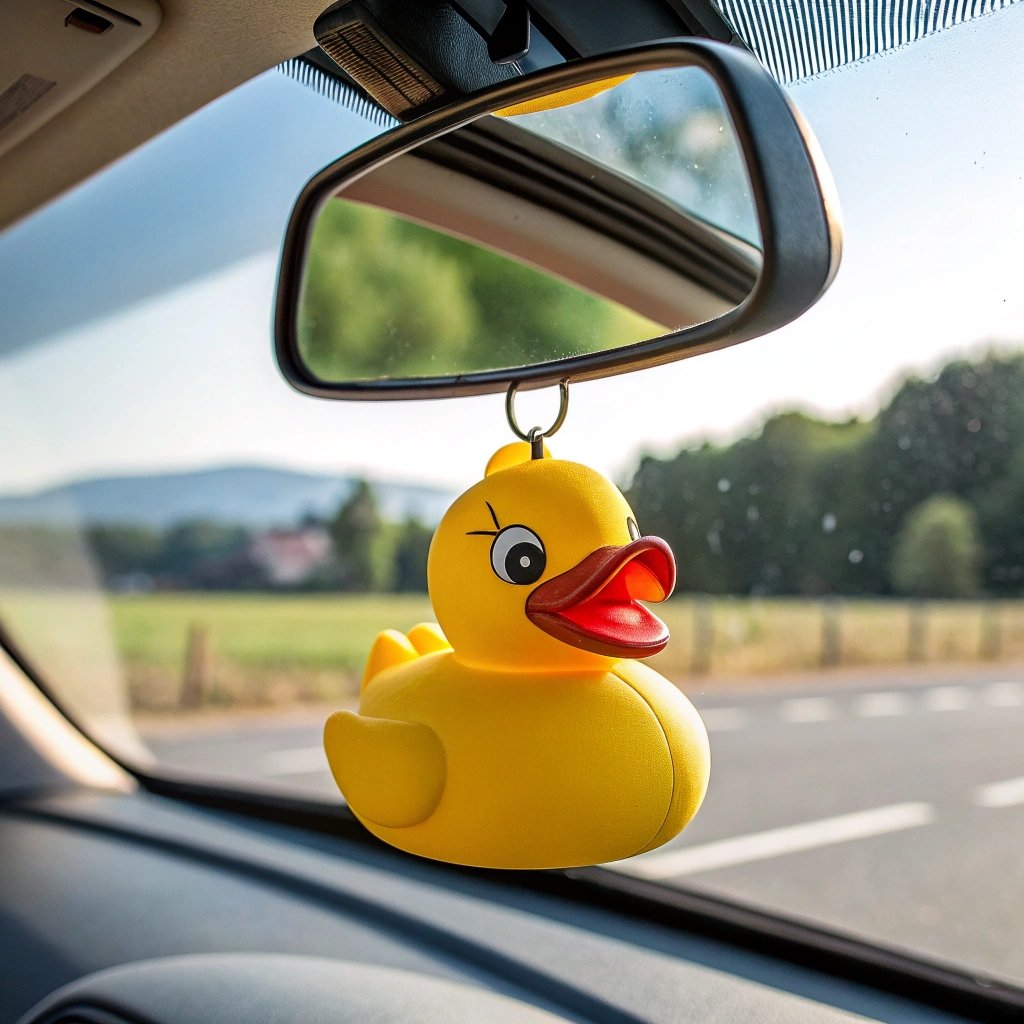
In the Jeep community, placing rubber ducks on other Jeeps (known as ‘Jeep ducking’) is a social tradition signaling appreciation for someone’s vehicle. For brand marketers, this cultural phenomenon represents an organic viral opportunity to create branded merchandise that becomes part of community identity and social sharing. Capitalizing on this trend through custom branded ducks can significantly increase brand visibility and engagement within enthusiast communities.
What is the rubber duck rule?
In software development, the ‘rubber duck rule’ refers to debugging by explaining code line-by-line to an inanimate object (like a rubber duck). For brand managers, this translates to the principle that promotional products should be simple enough that their value proposition can be clearly explained in one sentence. Our custom rubber ducks embody this principle by delivering straightforward brand messaging through universally appealing merchandise that customers immediately understand and connect with.
What do Jeep owners think about being ducked?
Jeep owners generally view being ‘ducked’ as a positive experience that signifies inclusion in the Jeep community culture. This spontaneous act of appreciation creates a sense of belonging and camaraderie among enthusiasts. For brands marketing to this demographic, creating custom rubber ducks for this purpose can generate authentic goodwill and organic social media sharing as recipients proudly showcase their branded ducks across digital platforms.