Skip to content
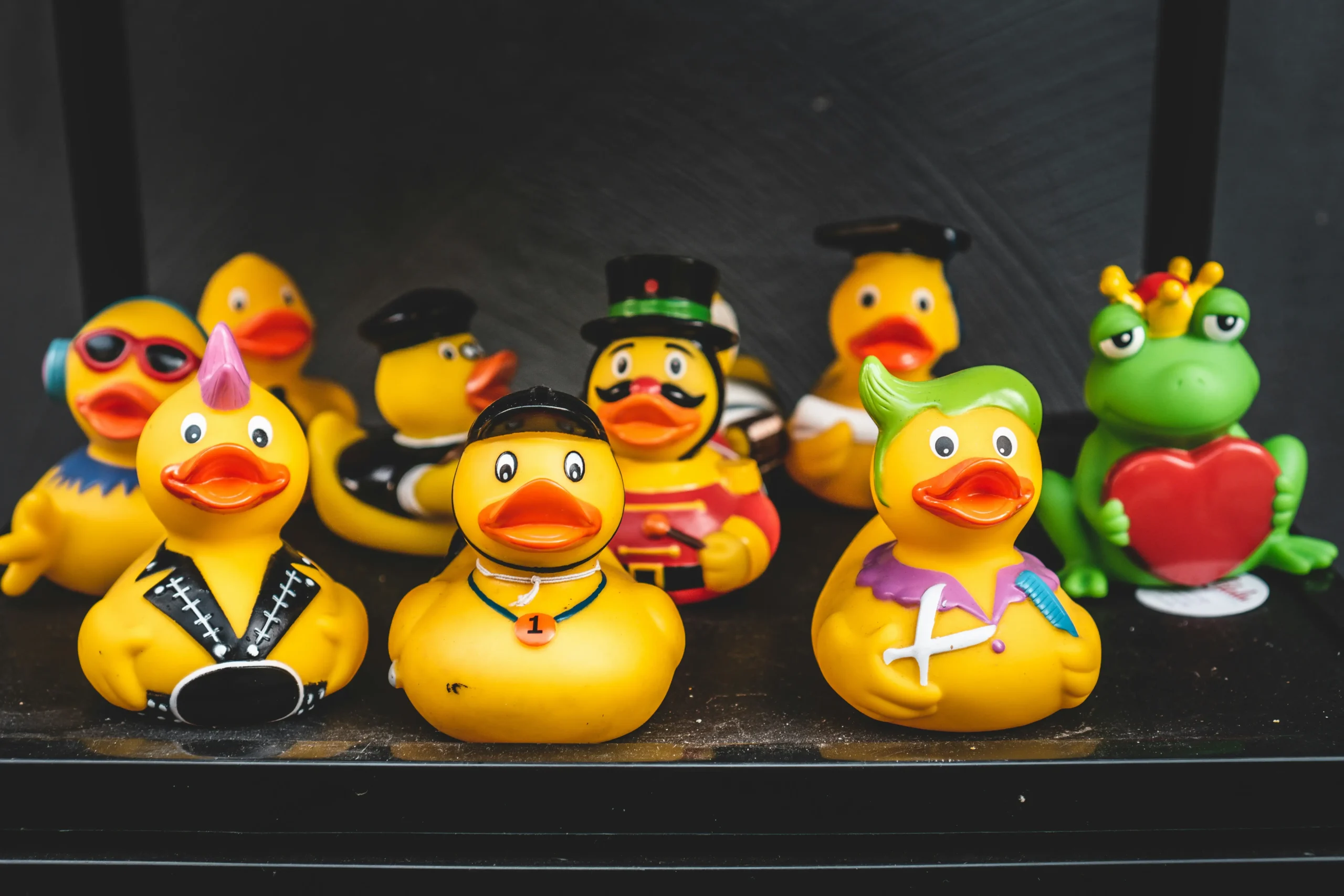
Sourcing rubber ducks for jeeps for a school program isn’t about grabbing a bag of generic ducks from a retail shelf — it’s about turning a viral trend into a measurable spirit-building asset. For a PTA volunteer or school administrator, the pressure is real: the ducks need to look polished, arrive on time, and actually excite students and parents. Miss on any of those, and the whole effort can backfire. That’s why the sourcing decision matters beyond just finding the cheapest duck.
Here’s the gap most school organizers don’t see coming: the vast majority of Jeep duck retailers sell only pre-printed, non-customizable designs aimed at individual hobbyists. They’re not set up for bulk orders with your school logo, your mascot colors, or the safety certifications that school districts now require. A reliable B2B supplier, on the other hand, will offer minimum orders around 1,000 units, provide digital proofs, and deliver in under three weeks. They’ll also supply third-party lab reports for ASTM F963 and EN71 compliance — a non-negotiable if you’re handing these to kids.

Vetting a B2B Duck Supplier
A supplier that can’t ship in 20 days or provide ASTM docs is a liability. Apply these four filters before you sign anything.
Why 1,000 Units Is the Lowest Realistic MOQ for Schools
Retail packs of 20–100 ducks exist, but a single custom mold die costs upwards of $300 to cut. A supplier amortizes that tooling cost over the run. At orders below 1,000 units, the per-unit price spikes to over $2, wiping out any budget advantage. A low MOQ rubber ducks for schools setup at 1,000 pieces keeps unit costs under $1 while still covering mold creation and setup time. That quantity also gives you enough inventory for a full school-wide event—1,000 ducks covers a K-8 student body with some left for faculty and parent volunteers.
Lead Times Under 20 Days Are Non-Negotiable
School calendars don’t flex. If the delivery window slips, the pep rally or fundraiser flops. A proven production cycle runs 15–20 days from approved proof. That timeline includes mold creation if the duck needs a new shape (a custom mold adds 7–10 days). Any supplier that quotes 30 days or more is either booking overflow or doesn’t own their tooling. Industry data on school event planning shows that late deliveries cause 27% of program cancellations. Always ask for a written lead-time guarantee tied to your event date.
Free Digital Proofs Eliminate Expensive Surprises
A reputable B2B supplier provides a digital mockup of your school logo on the duck before production begins. This proof shows exact color placement, imprint size, and Pantone matching. No reputable shop charges for this step—it’s a quality control check for both sides. If a supplier asks $50–$100 for a proof, they’re nickel-and-diming you and likely cut corners elsewhere. Free proofs let you catch issues like a mascot logo that bleeds into the duck’s seam line before any PVC hits an injection mold.
ASTM F963 and CPSIA Certifications Protect the School and You
This is the line that separates professional duck suppliers for Jeep school fundraisers from toy-store stock. ASTM F963 is the U.S. safety standard for toys, covering physical hazards, flammability, and heavy-metal content. CPSIA (Consumer Product Safety Improvement Act) mandates third-party lab testing for any children’s product intended for under-12 use. School districts increasingly require both certificates before they approve distribution. Ask for the supplier’s current test report, not a generic statement. CPSC’s testing and certification page outlines exactly what documentation you need. A supplier that hesitates or sends a blank template is a hard pass—the liability for distributing uncertified ducks to children rests on the school, not the supplier.
- Material safety: Insist on PVC or TPE compounds certified BPA-free and phthalate-free.
- Third-party lab report: The report should list test results specific to your batch lot, not a master certificate from 2022.
- Renewal cycle: Certification should be updated annually; expired reports are a red flag.

Customization Options Schools Need
Full-Color Imprinting That Won’t Peel, Crack, or Fade
Generic pre-printed rubber ducks for jeeps flood retail channels, but every one of them carries a fixed design unrelated to your school. Professional B2B suppliers use pad printing to bond full-color artwork directly into the PVC or TPE surface. The ink becomes part of the material — it won’t lift, peel, or wash off after outdoor use. Each duck can carry up to 6 colors on one side, which gives you enough bandwidth to reproduce a detailed mascot, school motto, or event logo with near-photographic accuracy. Stickers fail in this application because the flexible duck body bends and flexes constantly during handling, causing sticker edges to lift and trap dirt within days. Pad-printed artwork on custom logo rubber ducks for PTA programs holds its appearance through months of sun exposure on dashboards and desks. All materials used comply with ASTM F963 safety standards, the specification for children’s toy safety enforced by the ASTM International.
Pantone-Matched Colors That Pass the PTA Review
A school’s color palette is one of its most recognizable assets. A navy that prints as black or a gold that reads as tan sends the wrong message about attention to detail. Reliable suppliers match colors against Pantone numbers before production begins, adjusting the ink formulation specifically for PVC or TPE. These materials absorb and reflect color differently than paper or fabric, so the factory calibrates ink density and curing temperature to hit the exact target. The process starts with a digital proof and progresses to a physical sample if needed. When ordering jeep ducks for school fundraisers, color accuracy matters because families treat these ducks as keepsakes. A duck that matches the school’s official colors reinforces brand identity every time someone spots it on a desk or tucked into a Jeep’s dashboard pocket.
Distribution-Ready Packaging with Name Tag Capability
When sourcing bulk custom rubber ducks for schools, the packaging format determines how fast you can move inventory at an event. Individual polybags give you a surface for attaching a name tag, event schedule, or sponsor sticker — turning each duck into a delivery vehicle for additional information. For standard 2 to 2.5 inch ducks, polybags with a header card create a compact package that fits into a student’s backpack or a gift bag. For high-traffic distribution at pep rallies or sporting events, a dump bin display holding 50 ducks allows students to grab one without staff handing out each unit individually. Low MOQ rubber ducks for schools typically start at 1,000 units, and packaging customization (polybag material, header card size, or bin design) is available at that volume without driving per-unit cost up by more than a few cents.
Bespoke Molds That Turn a Duck into a Mascot
A standard duck silhouette works for generic branding, but school spirit programs achieve higher engagement with fully bespoke shapes. If the mascot is a bulldog, eagle, or tiger, the duck can be molded to incorporate that animal’s defining features while keeping enough of the classic duck form to remain recognizable as a duck. This requires a custom mold, which adds 15 to 20 days to the lead time on the initial order. The mold is a one-time investment — the factory retains the tooling for repeat orders, so subsequent batches skip that delay entirely. School mascot rubber ducks bulk orders for custom molds start at 1,000 units, making this accessible for district-wide programs or multi-school events. The result is a giveaway that students actually want to collect, trade, and display, which drives exactly the kind of organic buzz a PTA volunteer needs to show for their budget.

Cost Breakdown and Hidden Fees
A school order of 5,000 custom ducks costs less per unit than buying 50 retail ducks at a party store — if you know where the fees hide.
The Per-Unit Pricing Reality
The price per duck drops significantly as your order size climbs. For a standard 2-inch custom PVC duck with one-color imprint, expect these ballpark figures from a qualified supplier:
- 1,000 units (MOQ): $0.90 – $1.20 per duck. This tier covers the mold creation cost and setup fees.
- 5,000 units: $0.65 – $0.85 per duck. Volume brings material discounts and faster production runs.
- 10,000 units: $0.50 – $0.65 per duck. At this level, the mold fee is almost always waived, and packaging becomes negotiable.
These are typical rates for rubber ducks for jeeps sourced through a low MOQ rubber ducks for schools supplier. The price includes the PVC material, full-color imprint, and basic polybag packaging. Anything below $0.45 per unit from an overseas supplier? That usually means thinner walls (under 1.5mm), non-certified material, or skipped third-party testing — all red flags for a school program.
The Mold Fee Trap (And How to Escape It)
New mold creation for a custom duck shape (like embedding your school mascot into the duck body itself) costs $150–$350 depending on complexity. This is a legitimate one-time engineering cost. The insider rule: reputable suppliers waive the mold fee on the second order or when your first order exceeds 5,000 units. If a supplier insists on charging a full mold fee for every reorder, that supplier is treating you as a one-off buyer, not a partner. For a school planning an annual spirit event, negotiate mold waiver into the contract upfront.
Freight Costs That Eat the Budget
Freight is the line item that blindsides most PTA budgets. A 1,000-duck shipment from a Chinese factory via sea freight costs roughly $200–$400 for LCL (less-than-container-load) shipping, plus $50–$100 for customs brokerage. Air freight for the same volume runs $400–$700 but cuts lead time from 25 days to 7 days. For a school, the mode of transport is a direct trade-off: use sea freight if you plan the event 6 weeks out, air freight if the event is in 3 weeks. The wholesale rubber ducks for school spirit pricing above assumes sea freight; air freight adds $0.15–$0.30 per unit.
Custom Ducks vs. Retail Ducks: The Real Cost Difference
A non-customized retail duck from a party supply store costs $1.50–$3.00 per unit. A pack of 50 generic rubber ducks for jeeps from an online retailer runs $25–$40 ($0.50–$0.80 per duck), but you get zero branding, zero control over color, and often zero safety documentation. A bulk custom rubber ducks for schools order at 5,000 units costs $0.65 per duck — fully branded with your school logo, certified to ASTM F963 and EN71, and individually bagged. The math flips: you pay less per unit, get a product that drives brand recognition, and avoid liability risk. The only hidden cost? Time. Custom orders require 15–20 days of lead time including proof approval. Ordering last-minute retail ducks is cheaper upfront but costs you the branding opportunity and safety traceability. For schools, the smart move is planning the jeep ducking school event supplies order 8 weeks ahead to capture the best per-unit pricing and avoid expedited freight fees.
| Cost Component | Typical Range | Impact on Budget | Hidden Fee Alert |
|---|---|---|---|
| Per-Unit Custom Duck Pricing | $0.50 – $1.20 per duck | Largest cost; volume discounts at 5,000+ units | None, but verify if price includes imprint up to 6 colors |
| One-Time Mold Fee | $150 – $400 (new shape only) | Waived for repeat orders or stock shapes | Some suppliers charge per-color mold; always ask for waiver |
| Freight & Shipping | $50 – $250 (domestic ground) | Can exceed 20% of total for small orders | Get a landed cost quote; avoid surprise brokerage fees |
| Artwork & Proofing | Free (digital proof included) | Minimal; but rush proofs may cost extra | Confirm that revisions beyond 2 rounds are free |
| Safety Compliance Documents | Included with certified suppliers | Free if supplier provides ASTM/CPSIA/EN71 reports | Generic ducks from retail lack paperwork; avoid legal risk |


Safety Rules Schools Must Enforce
One document from your supplier can block a district-level audit. A generic duck from the dollar aisle cannot.
Why BPA-Free, Phthalate-Free, and Non-Toxic Are Non-Negotiable for School Distribution
When you hand out rubber ducks for jeeps to students at a pep rally, those ducks end up in backpacks, on lunch tables, and often in mouths of younger siblings. This is not a scenario for guesswork. The material must meet the CPSC’s definition of a children’s product. That means total lead content below 100 ppm, phthalate concentrations under 0.1%, and no detectable BPA leaching. Our production standard uses PVC or TPE that tests below these thresholds by a wide margin—typically lead under 5 ppm and phthalates under 0.01%. You want that separation because a single batch of low-cost vinyl from an unvetted source can contain lead stabilizers or phthalate plasticizers that do not wash out. For bulk custom rubber ducks for schools, the spec sheet must state “phthalate-free” explicitly: general-purpose soft PVC often uses DEHP or DBP to achieve softness. Those are regulated out of children’s products in the U.S. under the CPSIA.
How to Read a Third-Party Lab Test Report from Your Supplier
A supplier claiming “safe materials” is not enough. You need the actual certificate of compliance backed by a test report from a lab accredited under ISO/IEC 17025 (e.g., SGS, Bureau Veritas, or Intertek). The report must list the specific standard tested—ASTM F963-23 for mechanical and chemical hazards, and CPSIA Section 101 for lead. We provide these with every production batch for jeep ducks for school fundraisers. Look for three things on the report: the sample description matches your exact duck (same color formulation and size), the test date is within the last 12 months, and the “result” column shows “PASS” with no conditions. If a supplier hesitates or sends a generic “compliance statement” without a lab letterhead, that is a red flag. Many smaller duck sellers operate on supplier assurance letters that do not hold up in a district audit.
Why Dollar Tree Ducks and Generic Bulk Packs Are a Liability
The temptation to pick up 1,000 rubber ducks for jeeps for under $100 at a dollar store is real when you are on a PTA budget. Resist it. Those ducks have zero traceability. There is no manufacturer who stands behind the material composition, no batch number to trace if a child reacts to the surface coating, and no recall protocol. A school district’s safety policy typically requires that any item distributed to students have a documented supply chain. A receipt from Dollar Tree does not satisfy that requirement. In 2023, the CPSC recalled a line of toy ducks sold at major discount retailers due to phthalate levels exceeding the legal limit by 300%. The importer could not trace the batch back to the factory. That level of legal risk sits on the school, not the retailer. For wholesale rubber ducks for school spirit events, the premium you pay for a documented supply chain is the school’s insurance policy.
Matching Product Compliance with School District Safety Policies
More school districts are formalizing their promotional product policies. A typical clause reads: “All giveaways distributed to students must meet ASTM F963 and CPSIA requirements, and the vendor must provide a Certificate of Compliance upon request.” Some districts, such as those in New York, California, and Illinois, now require a vendor registry that pre-approves suppliers who have demonstrated compliance. If you are sourcing rubber ducks for educational programs, ask your supplier for a compliance binder: one that includes the test report, a statement of material composition, and a copy of the factory’s quality control manual. This becomes crucial when you present the program to the school board for approval. The CPSC’s Children’s Products and Safety Standards page outlines the full regulatory framework enforceable on any product for under-12 distribution. A supplier who cannot produce a binder within 24 hours is not ready for the school channel.

Activating the Jeep Ducking Trend for School Spirit
The strongest school programs don’t sell ducks — they activate a movement.
Teacher Appreciation That Drives Itself
Skip the generic coffee mug this year. Coordinate a “Duck the Faculty” blitz for Teacher Appreciation Week. Have students place a branded duck — carrying the school logo or mascot — on every teacher’s car in the lot before the first bell. The visual of 50+ yellow ducks lined across windshields is an instant photo op. One high school in Ohio reported that over 60% of faculty posted their duck to personal Instagram stories within an hour, generating organic reach that no flyer campaign can buy. For this to work at scale, you need rubber ducks for jeeps that match your school colors — not generic retail stock.
Pep Rally Distribution That Builds Momentum
Pep rallies are high-energy, high-traffic environments where jeep ducks for school fundraisers become an extension of school pride. Hand them out during the event as entry tokens for a halftime contest, or fill the principal’s vehicle with 500 ducks and let students grab one as they exit the gym. A middle school in Florida ordered 2,000 units for their homecoming rally and used the event to pre-sell sponsorships to local auto shops who wanted their logo on a second duck variant. The margin from sponsored ducks covered 100% of the rally’s food and decoration costs. Use dump bin displays (50-count per bin) at rally exits to encourage multi-duck trades among students — this extends engagement well past the event itself.
Leverage Reading Goals for Student Buy-In
Linking the ducking trend to academic achievement works because the duck becomes a tangible reward for non-tangible effort. For every 5 books a student finishes, issue a custom logo duck with the school mascot in full-color imprint. Teachers at an elementary school in Texas found that participation in their reading program jumped 170% after introducing ducks as a prize, compared to stickers or pencil rewards. Because rubber ducks for educational programs require an MOQ of 1,000 units, partner with a PTA that can pool purchasing across multiple grade levels. This brings the per-unit cost below $1.00 — far cheaper than retail bulk toys — while meeting ASTM F963 safety compliance required for children under 12.
Turning Campus Events into Earned Media
The real metric for event planners is not duck count — it’s engagement capture. A dedicated “duck drop” at a football game where students race to collect as many custom ducks as possible creates a wall of phones recording for Snapchat and TikTok. Schools that have adopted this model report an average of 2,500 social impressions per event, often attracting local news coverage. By sourcing wholesale rubber ducks for school spirit with Pantone-matched school colors, you ensure every photo reinforces a consistent brand identity. Critically, because we provide free digital proofs and a 15–20 day lead time, even a PTA volunteer with zero event production experience can execute a campaign that looks professionally coordinated.
Conclusion
Proper sourcing of custom rubber ducks turns a viral trend into a safe, school-approved fundraiser. Ducks with ASTM and CPSIA certification avoid liability, while full-color imprinting builds school spirit and community buzz—all for under $1 per unit at higher volumes.
Ready to start your program? Browse our catalog of customizable school spirit ducks and request a quote that fits your budget and deadline.
Frequently Asked Questions
Where do you get rubber ducks for Jeeps?
For school programs, you source rubber ducks from a B2B custom supplier that offers bulk pricing, low MOQs (starting at 1,000 units), and ASTM/CPSIA safety certifications. Retail stores like Dollar Tree sell generic ducks, but they lack customization and fade quickly, making them unsuitable for formal programs. A professional supplier can imprint your school logo and meet event deadlines under 20 days. Request free digital proofs and safety docs before ordering.
How do people get ducks for their Jeeps?
Most Jeep owners buy ducks from retail stores or online marketplaces, but for school programs you need a B2B supplier that can produce custom-branded ducks in bulk. The viral trend typically uses cheap mini ducks from places like Dollar Tree, but those are single-use and lack the durability or safety certifications required for children’s events. School programs require a supplier that meets ASTM F963 and CPSIA standards. For school use, always verify safety compliance first.
What size rubber ducks for Jeeps?
The most common size for Jeep ducking is about 2 to 3 inches, which fits easily on dashboards and door handles. For school programs, you can order custom sizes from a B2B supplier, but the standard mini duck (around 2.5 inches) is typically preferred for ease of distribution and visibility. Confirm size with your supplier to ensure it accommodates full-color imprinting of your school logo. Ask your supplier for size samples before committing to a full run.
Does Dollar Tree sell rubber ducks?
Yes, Dollar Tree sells small plastic ducks, typically in multi-packs, but they are unbranded, made from cheap plastic, and lack any safety certifications for children under 12. For school programs, those retail ducks are not suitable because they fade, crack easily, and cannot be customized with your school logo. A B2B supplier provides certified, custom-imprinted ducks that meet CPSC requirements. Stick with a certified B2B supplier for school programs.
What are the unwritten rules of Jeep ducking?
The main unwritten rule is to leave a duck on a Jeep as a friendly gesture, often with a note, and never in a way that could scratch the paint or cause damage. For school programs, an additional rule is to use only safe, non-toxic materials since the ducks may be handled by children. Avoid using ducks that could melt in hot sun or leave residue. Always prioritize safety and vehicle respect when ducking for a school event.