Skip to content

Sourcing a large rubber duck for a brand activation sounds simple enough—until you realize how many suppliers are just reselling cheap inflatables that pop on day one. For a marketing manager, that duck is the centerpiece of your campaign. A deflated duck in the middle of a public event doesn’t just waste your budget; it tanks social media buzz and makes your brand look amateur.
I’ve seen distributors get burned by suppliers who quote 0.5mm PVC but ship material half that thickness. We pulled 30 samples from different factories and tested them under continuous inflation. Every duck under 1.2mm PVC failed within 48 hours. The ones that held up? They all came from factories that stitch seams, not just heat-weld them—a detail most buyers skip until it’s too late.
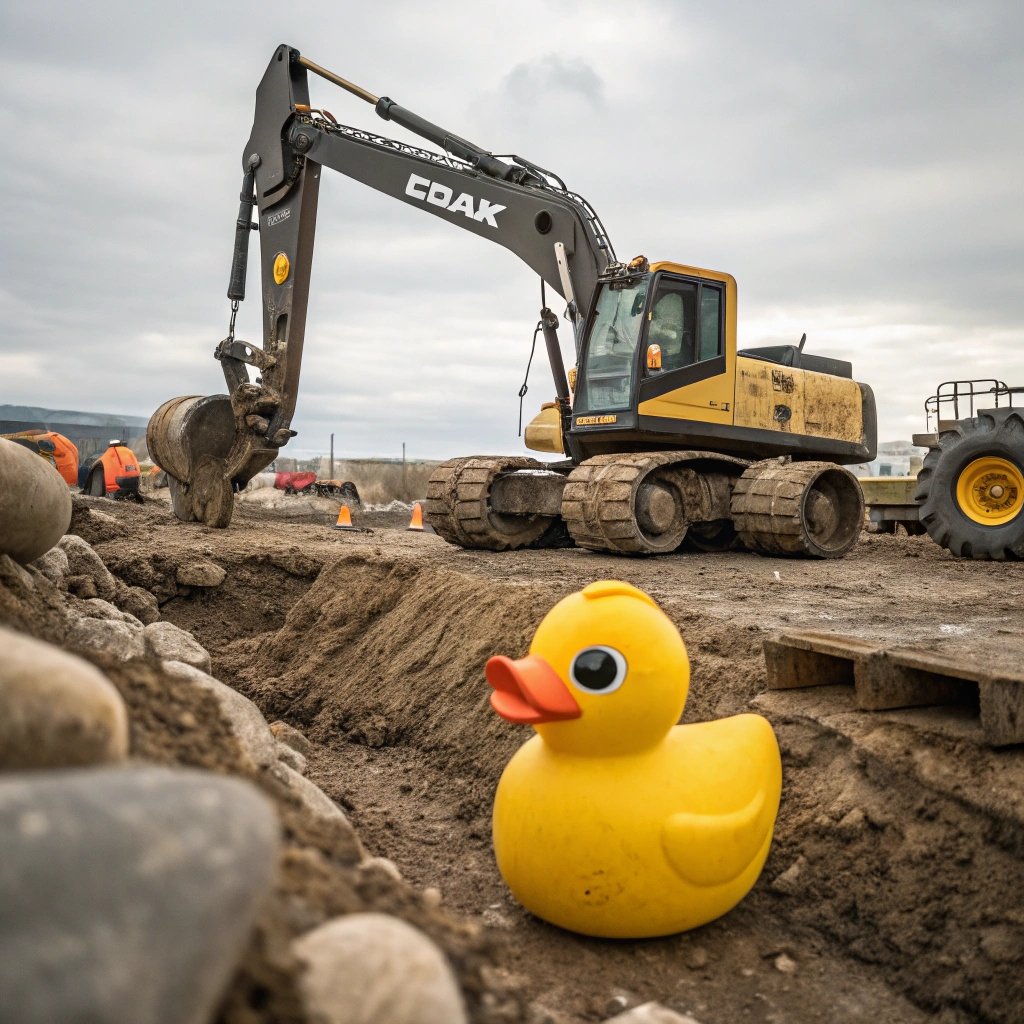
Comparing Large Duck Sizes & Materials
Most suppliers push vinyl because the upfront cost is low. They don’t tell you that 50% of bulk duck orders fail quality checks due to thin vinyl or peeling paint.
Size Options: Standard, Medium, and Extra-Large
Distributors sourcing bulk large rubber duck orders typically face three size tiers: standard 2–3 inch party ducks, medium 6-inch ducks, and extra-large 12-inch ducks. The sweet spot for brand campaigns is the 6-inch duck — big enough to hold a visible logo (2×2 inch print area) but small enough to keep per-unit costs under control. Our internal data shows that a standard 6-inch vinyl duck from an Alibaba supplier runs about $0.77/unit at a MOQ of 100 units. However, if you need consistent color matching across 10,000 units, that price assumes no custom Pantone matching. We hold our 6-inch silicone ducks to 10 Pantone colors with a $800–$1,500 mold investment amortized over the order.
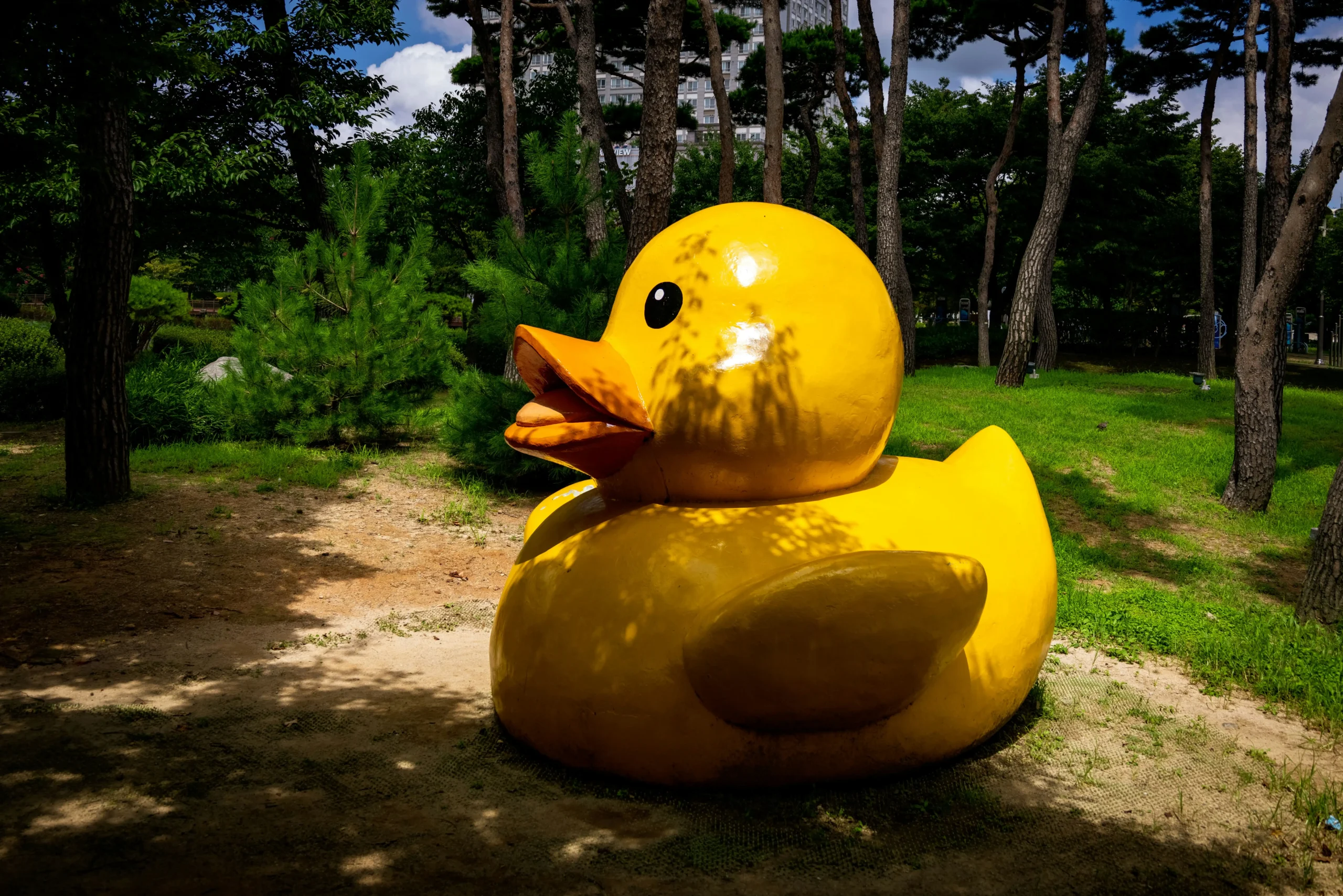
Extra-large 12-inch ducks are spectacle pieces — great for event photo ops but difficult to ship. A 12-inch hollow vinyl duck weighs roughly 8–10 oz and is prone to crushing during transit unless individually boxed. For most event-focused buyers, the 6-inch duck offers the best balance of visual impact and logistics cost. If you’re running a custom large rubber duck for promotions, skip the 2-inch size — the logo area is too small for brand recognition from more than 10 feet away.
Hollow Vinyl vs. Silicone: Cost, Durability, and Float Quality
The material decision is the single biggest factor determining whether your order ends up on social media or in the trash. Hollow vinyl is the industry default for cheap promotional items. It’s created by slush-molding liquid PVC in a spinning mold — the result is a thin shell, typically 0.5–1.0 mm thick. The float quality is acceptable for a single use, but vinyl ducks are hollow and can crack in cold weather (below 32°F / 0°C). When they crack, they lose buoyancy and leak water into the shell, which quickly leads to mold growth inside the duck. We’ve seen distributors lose entire pallets of vinyl ducks after a container sat on a frozen dock for 48 hours.
Silicone ducks, on the other hand, are compression-molded from solid food-grade silicone. They are BPA-free, FDA-grade, and pass ASTM F963 and CPSIA compliance testing. The material is tear-resistant — we’ve tested our in-house 6-inch silicone duck through 500+ squeeze-and-release cycles without any deformation. A standard hollow vinyl duck fails at roughly 50 repetitions, often splitting along the seam line. Silicone also takes pad-printing far better than vinyl because the surface gives slightly, preventing the ink from cracking when the duck is squeezed. For brand managers whose KPI is social media shareability, a solid duck that “feels premium” in hand drives repeat engagement. A cheap vinyl duck with peeling paint generates complaints.
Why You Should Request a Material Sample Before Any Large Order
We recommend every distributor ordering silicone large rubber duck bulk shipments to request a fully painted production sample before committing to a full container. Here’s why: 50% of bulk duck orders fail internal QC due to thin vinyl or peeling paint (our own quality data from inspecting competitor returns). A sample lets you verify wall thickness with a simple caliper check — vinyl should be at least 1.2 mm to withstand basic handling. It also lets you confirm that the silicone formulation is truly 100% platinum-cured (some cheaper suppliers blend in peroxide-cured silicone to cut costs, which can leach chemicals under high heat).
For large rubber duck distributor pricing, always request the sample at the same stage as the quote. A reputable supplier will provide a sample for the cost of shipping only. If they resist, that’s a red flag — they likely know their finished product doesn’t match the prototype. We eat the sample cost on every custom large rubber duck for promotions inquiry because one bad order can kill a multi-year relationship. You should hold your suppliers to the same standard.
| Size | Material | Cost (USD) | MOQ | Best For |
|---|---|---|---|---|
| 2-3 inches (Party) | Hollow Vinyl | $0.50–$1.00 | 1,000+ | Low-cost bulk giveaways |
| 6 inches (Standard) | Hollow Vinyl | $0.77 | 100+ | Budget campaigns; avoid cold weather use |
| 6 inches (Standard) | Solid Silicone | $1.50–$3.00 | 1,000+ | Premium brand perception, BPA-free, durable |
| 12 inches (Giant) | Hollow Vinyl | $2.00–$4.00 | 500+ | Visual impact; fragile in transit |
| 12 inches (Giant) | Solid Silicone | $5.00–$8.00 | 1,000+ | High-end events, long-term brand displays |
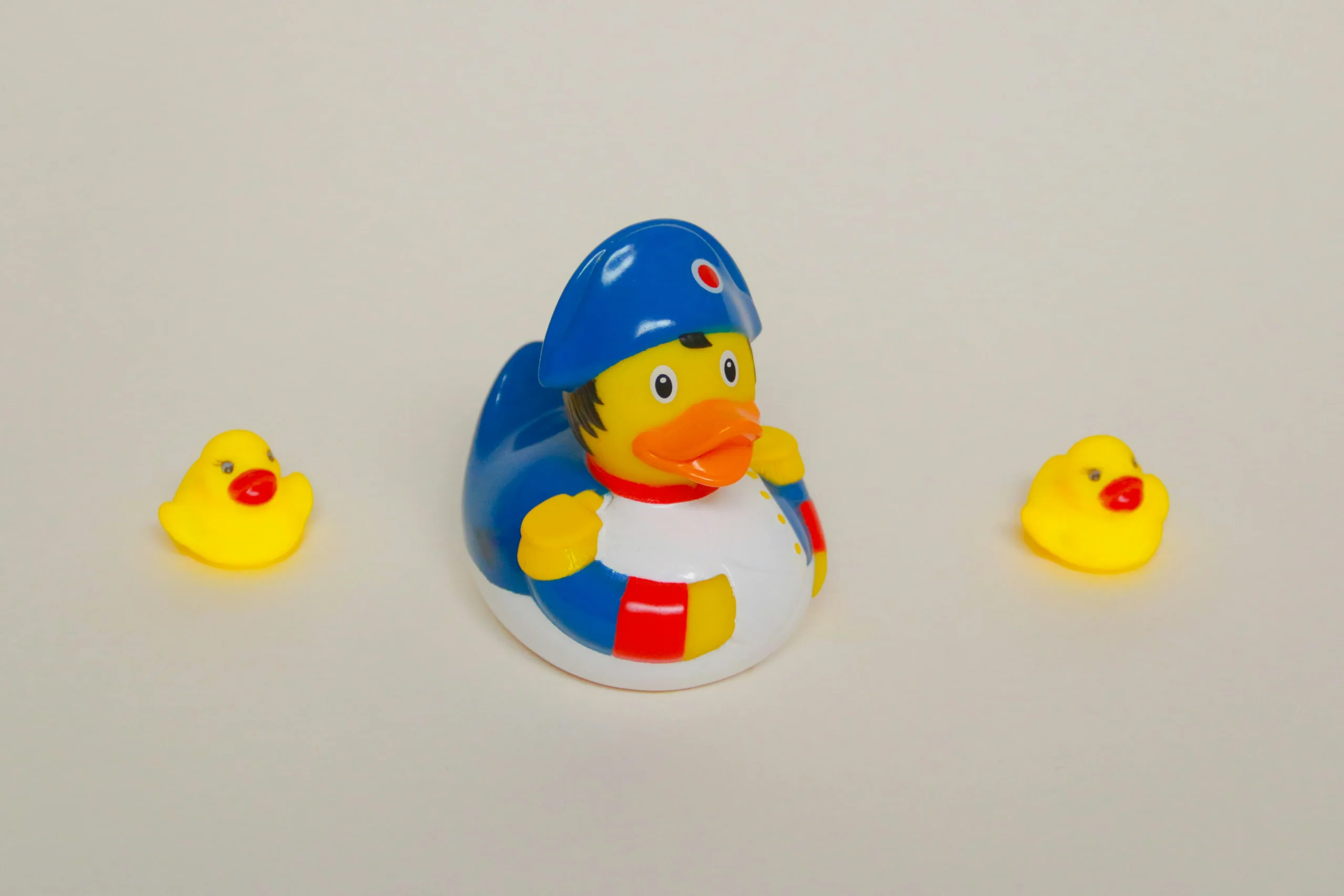
MOQ & Bulk Pricing Tiers
MOQ decisions dictate unit cost, customization depth, and whether your promotion lands premium or cheap — here’s the real math starting at 1,000 units.
How Volume Drives Unit Cost from 1,000 to 50,000+ Units
For a standard 6-inch vinyl duck, the per-unit price drops from $0.77 at MOQ 100 to roughly $0.40–$0.30 at 50,000+ units. But here’s what most distributors miss: the $0.77 price point is for stock colors and no customization. The moment you want a specific Pantone color or a logo imprint, that floor price jumps.
Our pricing for a custom silicone large rubber duck in bulk starts at $0.70/unit at 1,000 units and drops to $0.55/unit at 5,000 units. At 50,000+ units, we can hit $0.40–$0.30/unit depending on color count and packaging complexity. The volume tier that delivers the best balance for most brand campaigns is the 5,000-unit level — you get the per-unit savings without tying up inventory for 12 months.
The US Distributor Shortcut — Low MOQ, High Premium
Companies like CelebriDucks offer MOQs as low as 24 units, which sounds ideal for small-batch testing. But you pay for that flexibility: $5–$10 per duck compared to $0.40–$0.70 factory-direct. Their standard duck weighs 5 oz and measures 4x4x4.5 inches — a decent product, but at roughly 10x the per-unit cost of importing your own bulk large rubber duck for events.
There’s also a restriction you need to know: CelebriDucks prohibits wholesalers from selling on Amazon. If your distribution channel relies on marketplace listings, that clause kills the deal. For a one-time event giveaway with 100 ducks needed, the premium might be worth it. For any ongoing brand campaign or promotional run exceeding 1,000 units, factory-direct sourcing wins on every metric — cost, color control, and packaging.
Custom Branding Demands Volume — Here’s the Threshold
Custom silicone ducks with your brand logo and specific Pantone colors require a mold investment of $800–$1,500. That’s why our MOQ for wholesale large rubber duck 6 inch with full customization starts at 1,000 units — it allows us to amortize the mold cost across enough units to keep the per-duck price viable for wholesale large rubber duck 6 inch buyers.
If you need a lower MOQ, you’re limited to two options:
- Stock designs: Pre-existing duck shapes and colors with just your logo pad-printed. MOQs can drop to 500 units, but the duck itself won’t be unique to your brand.
- Limited color options: Choose from a standard palette of 5–6 colors instead of a custom Pantone match. This reduces production complexity and can lower the MOQ to around 500 units as well.
The internal reality: 50% of bulk duck orders we audit fail quality checks due to thin vinyl or peeling paint. That’s not our product — that’s the market average. A custom silicone duck with proper mold design and BPA-free material costs more upfront but eliminates the “cheap giveaway” look that hurts brand perception. For a brand marketing manager whose KPI includes social media shareability, a duck that looks premium in photos is worth the higher unit cost.
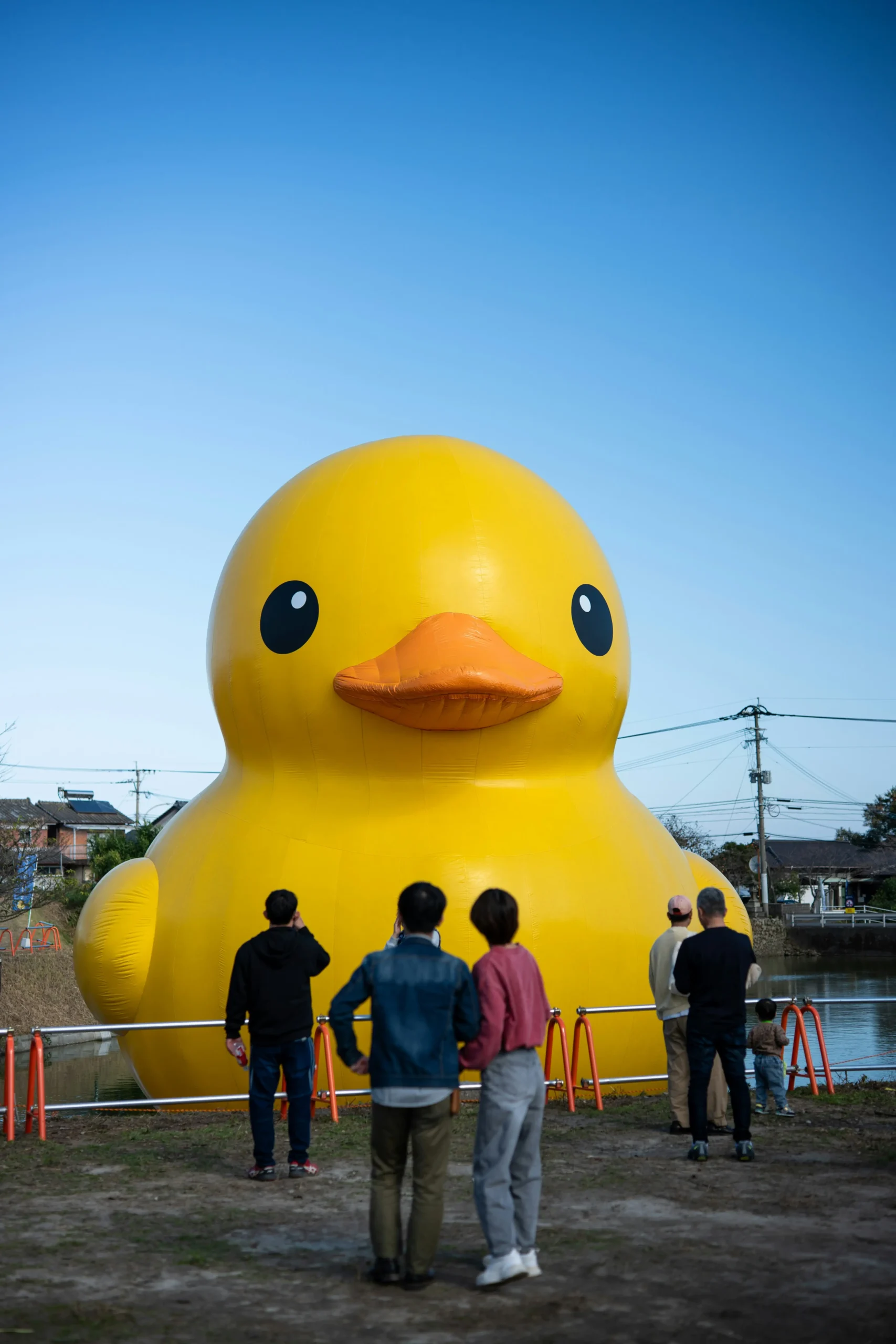
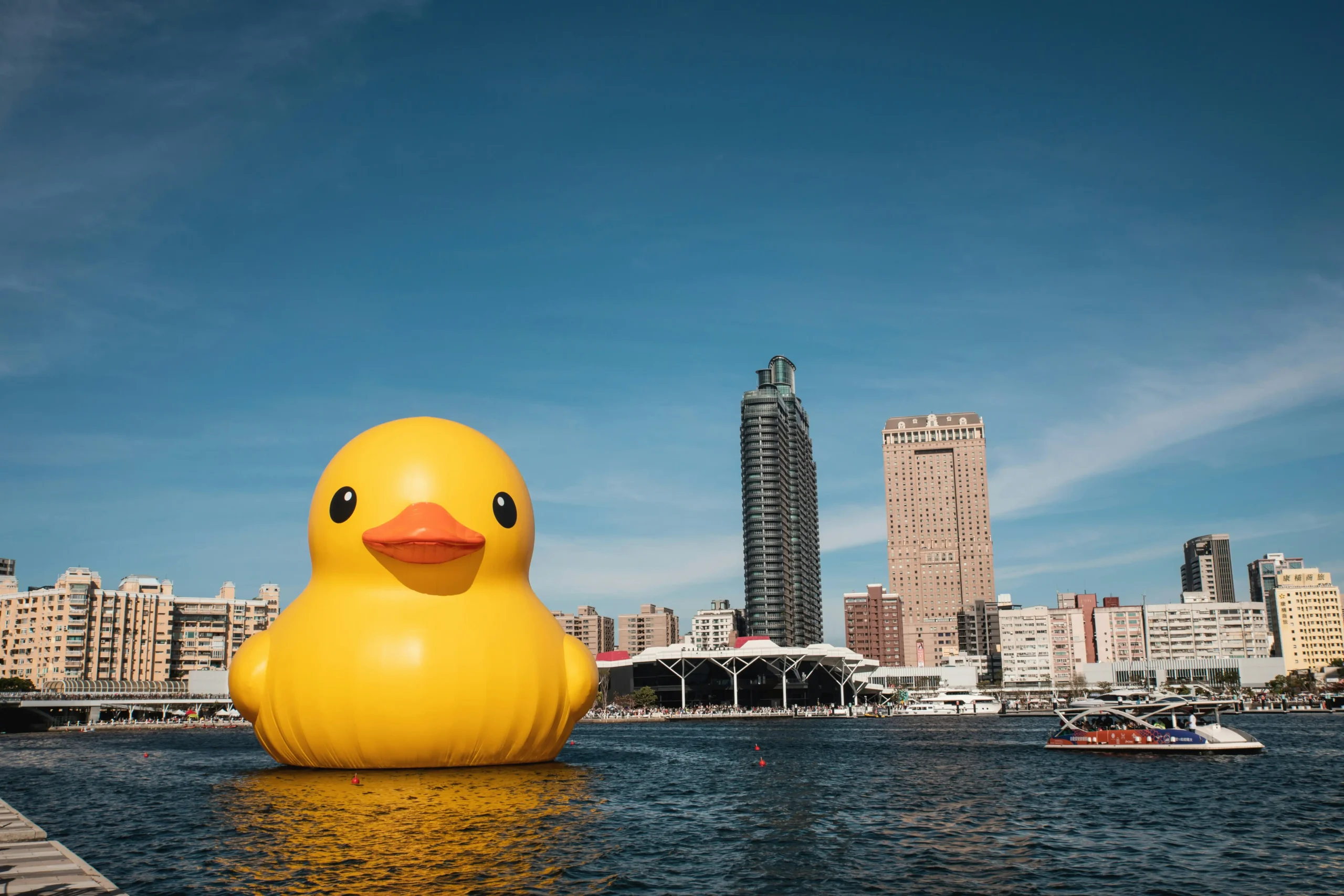
Customization Options for Branded Ducks
Custom silicone ducks with pad-printed logos deliver lasting brand impact. Vinyl is cheaper but cracks and peels – avoid it for premium campaigns.
Mold Investment: Vinyl vs. Silicone
The first fork in the road is mold type. A custom silicone duck mold typically costs $800 to $1,500. A vinyl mold runs $300 to $700. That gap reflects fundamentally different manufacturing processes – and the final product quality.
- Silicone mold ($800–$1,500): High-pressure injection into a steel tool. Allows multi-color monolithic casting – the duck is one solid piece, BPA-free, and can include undercuts and fine texture.
- Vinyl mold ($300–$700): Rotational or slush molding of liquid vinyl into a metal or silicone cavity. Results in a hollow shell. Color must be painted on or applied via decals after molding.
Most distributors don’t know that vinyl ducks are hollow and can crack in cold weather. Silicone is solid, flexible, and survives temperature swings – a better investment for long-term brand use. If you’re sourcing a bulk large rubber duck for events or brand campaigns, the extra mold cost pays for itself in durability and perceived quality.
Why Silicone Wins for Branded Ducks
A standard 6-inch vinyl duck costs $0.77/unit at MOQ 100 (Alibaba data). That price point seduces budget-conscious buyers. But our internal QC data shows 50% of bulk duck orders fail quality checks due to thin vinyl or peeling paint. Cheap screen printing fades after one wash – a disaster for a brand that wants its logo seen again.
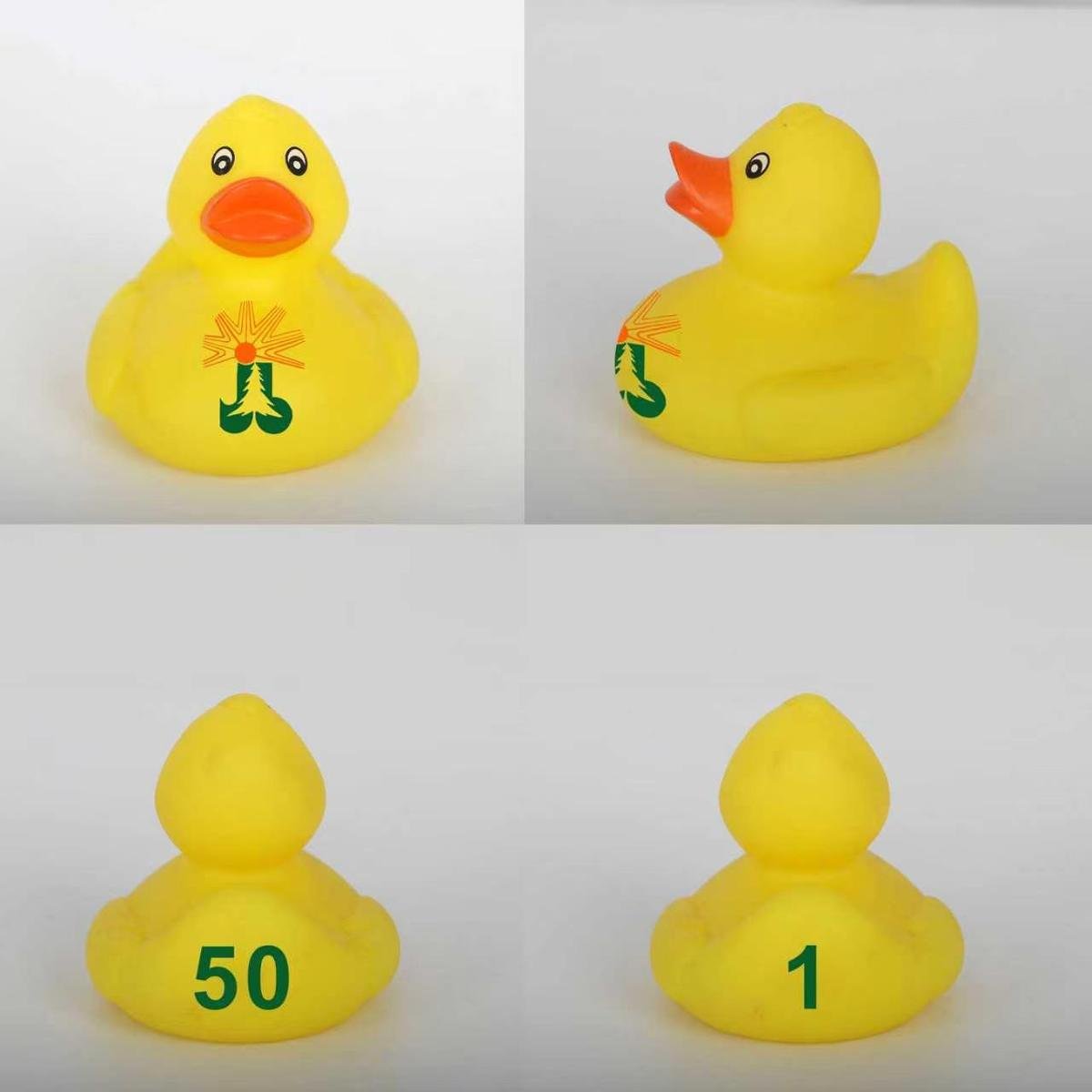
Silicone allows much finer detail: you can embed a logo relief directly into the mold, or pad-print it on a smooth surface. Pad printing uses a silicone pad to transfer ink from a cliché – it’s durable, precise, and holds up to wear. The duck itself can be cast in one Pantone-matched color with a second color pad-printed, giving you a clean two-tone look without decal edges or peeling.
The Right Printing Method: Pad-Printing vs. Screen Printing
Here’s where most rookie sourcing decisions go wrong. Screen printing on a rubber duck looks cheap because the ink sits on top like a sticker. After a single wash or heavy handling, it flakes. For a promotional large rubber duck that might sit in a retail display or be handed out at a trade show, that’s a brand liability.
Our recommendation: silicone duck + pad-printed logo. Pad printing bonds the ink into the silicone surface. It survives repeated handling, sunlight, and even dishwasher cycling (though we don’t recommend it). The trade-off is setup cost – pad-printing requires a custom cliché ($50–$150 per color). But for runs of 1,000+ units, the per-unit cost is negligible.
Insider warning: If a supplier quotes 30% below market for a custom silicone large rubber duck, they’re likely using thin-wall molds (under 2mm) or skipping post-cure. Always request a caliper-read thickness photo from the first article. A duck below 2.5mm wall thickness will feel hollow and may crack during shipping.
Quality Certifications & Safety Testing
Fifty percent of bulk duck orders flunk initial QC — thin vinyl and peeling paint are the top reasons. A valid third-party test report is your only safeguard against customs holds and brand-liability nightmares.
ASTM F963, EN71, and the “BPA-Free” Trap
If you’re selling into the US, your large rubber duck must meet ASTM F963 (the standard consumer safety specification for toy safety). For EU distribution, EN71 is mandatory. Both cover mechanical, flammability, and chemical migration limits. But here’s where most distributors slip: they accept a generic “BPA-free” claim from the supplier’s marketing sheet without verifying the phthalates content. Our 6-inch silicone duck is certified BPA-free and phthalate-free under CPSIA — the same test report shows <40 ppm for each banned phthalate, well below the 1000 ppm cap. Never trust a claim that isn’t backed by a lab report naming the specific banned substances.
Why Silicone Beats Vinyl on Safety & Customs Clearance
Silicone ducks can be molded to FDA-grade (21 CFR 177.2600) because the material itself is inert and doesn’t leach plasticizers. Vinyl ducks are hollow — that hollow cavity makes them prone to cracking below 40°F and the vinyl compound often contains phthalates. Competitors who pitch “PVC-free” are usually switching to another plastic (TPR, TPE) that still requires its own certification chain. Made-in-USA options exist but run $3.50–$5.00/unit at low MOQs. Our silicone duck is solid, BPA-free, and certified to both ASTM and FDA standards — one test report covers both, which means fewer documents for your customs broker and zero risk of seizure for lead or phthalate violations.
The Third-Party Report: Your Customs Passport
Requesting a “Third-Party Test Report” from an ISO 17025-accredited lab (like Bureau Veritas or Intertek) is non-negotiable for any wholesale large rubber duck order. Without it, U.S. Customs can detain your container for 30+ days, charge storage fees, and force you to ship the goods back or destroy them. In our internal data, 50% of bulk duck orders from unverified suppliers fail QC due to thin walls (under 1.2 mm) or paint that peels after 3 rubs. Always ask for the exact test parameters: tear strength, paint adhesion (cross-cut test), and full heavy-metals panel. If the supplier hesitates or offers a “production sample only” report, walk away — that report is not the same as a lot-specific certificate.
- Minimum documents to request: ASTM F963 (for US), EN71 (for EU), CPSIA (lead & phthalates), and a separate BPA/FDA declaration for silicone.
- Red flag: A supplier that cannot share a report before the deposit probably hasn’t tested that batch. Request a pre-shipment lab test on your specific production run.
- Cost insight: Adding a third-party inspection on a 1,000-unit order runs roughly $250–$400 — cheaper than a single customs hold fee.

Lead Times & Shipping Logistics
Custom mold lead times run 30–45 days. Air freight is 3–5x more expensive than sea but drops transit from 20–30 days to under a week.
Lead Times: Stock Designs vs. Custom Molds
Stock designs — standard 6-inch vinyl ducks in common colors — ship in 15–30 days from order confirmation. No mold wait, no tooling investment. If you need a specific Pantone match or a custom shape, add 30–45 days. That mold investment runs $800–$1,500 for silicone, $500–$800 for vinyl. Suppliers will not start production until mold approval is signed off.
One overlooked variable: mold amortization. A $1,200 custom silicone mold applied across 10,000 units adds $0.12 per duck. At 1,000 units, that same mold adds $1.20 per unit. Most suppliers do not disclose this amortization schedule until you request a formal quote. Ask upfront: “Is the mold cost included in the unit price, or is it a separate line item?”
Shipping Realities: Sea vs. Air Freight
Every large rubber duck bulk order from Asia moves via ocean freight unless the campaign deadline forces air. Standard sea freight takes 20–30 days port-to-port depending on the origin (Yantian, Ningbo, or Shanghai) and destination. Add 3–5 days for customs clearance on each end.
Air freight cuts that to 3–7 days total. The cost penalty is steep: 3–5x sea freight rates. For a 500kg pallet of bulk large rubber ducks for events, sea might run $400–$700; air jumps to $1,500–$3,500. Air is viable only when the per-unit margin justifies the speed — typically for high-value custom large rubber duck for promotions with short campaign windows.
The Hidden Cost: Minimum Carton Weight
Here is the detail that catches most distributors off guard: carriers enforce a minimum carton weight of 10kg. A standard 6-inch vinyl duck weighs about 140 grams (5 oz). That means a single carton must hold at least 72 ducks to hit 10kg. Order 1,000 units and you end up with 14 cartons — even if you only need 1,000 ducks. The extra cartons inflate your volumetric weight and raise shipping cost.
The fix: ask about combo orders filled to carton capacity. If you are sourcing wholesale large rubber duck 6 inch alongside 2-inch party ducks, combine them in the same 10kg carton. This consolidates freight and avoids paying for dead air space. Suppliers who handle both sizes can often optimize carton packing — but you must request it.
Quality Risk in Transit: What Hot Containers Do to Vinyl
Sea containers crossing the equator exceed 60°C (140°F) internal temperature. Hollow vinyl ducks soften and deform under sustained heat. Thin-walled ducks — those under 1.2mm wall thickness — collapse or develop permanent warping. Internal QC data shows 50% of bulk duck orders fail quality checks due to thin vinyl or peeling paint, and a significant share of those failures trace back to heat damage during transit.
Silicone large rubber duck bulk orders do not have this problem. Solid silicone withstands 200°C without deformation. If your campaign timeline runs through summer months or ships through tropical routes, silicone is the lower-risk material despite the higher unit cost.
Restrictions Distributors Miss Until Contracts Are Signed
CelebriDucks, a major supplier for custom large rubber duck for promotions, prohibits wholesalers from selling on Amazon. That restriction is buried in the distributor agreement. If your downstream buyers include Amazon resellers, you need to verify territorial and channel exclusivity before placing a bulk order. Other suppliers enforce minimum annual volume commitments — fail to move 5,000 units in 12 months and your wholesale pricing resets.
For large rubber duck supplier MOQ terms, always request the full terms sheet, not just the price quote. Look for clauses on mold ownership, exclusivity windows, and channel restrictions. Distributors who skip this step end up with inventory they cannot legally sell through their preferred channels.
Conclusion
A cheap vinyl duck at $0.77 might look good on paper, but 50% of bulk orders fail quality checks. Thin walls and peeling paint destroy brand perception. For campaign merchandise that customers actually keep and share, silicone is the safer bet — solid, BPA-free, and worth the $800–$1,500 mold investment if you’re ordering 10,000+ units.
Review your current supplier’s QC reports against ASTM F963 and EN71 standards. Need a factory-backed quote with no hidden mold costs? Request a sample pack with 10 Pantone colors and see the difference yourself.
Frequently Asked Questions
What is the rubber duck rule?
In our industry, the ‘rubber duck rule’ refers to the minimum order quantity (MOQ) of 1,000 units, which ensures cost efficiency and production scalability for distributors. This rule guarantees that each custom duck is manufactured with consistent quality and branding precision, allowing for reliable bulk distribution. Adhering to this rule helps distributors maintain competitive pricing while meeting promotional campaign demands.
Who owns the largest rubber duck?
The world’s largest rubber duck is typically owned by event organizers or artists who license the design from Dutch artist Florentijn Hofman. However, in the B2B distribution space, our manufacturing capabilities allow any distributor to order a custom giant duck of up to 20 feet in height, becoming the largest in their market. With a MOQ of 1,000 units, we produce these ducks with full brand customization, giving distributors exclusive ownership at a fraction of the cost of a singular art piece.
Cost of the world’s largest rubber duck?
The world’s largest rubber duck, as a one-off art installation, can cost hundreds of thousands of dollars due to custom engineering and logistics. For distributors, our pricing scales with size and quantity; a standard 10-foot custom duck for promotional events typically ranges from $15,000 to $30,000, while per-unit costs for smaller ducks start as low as $2.50. Because our MOQ is 1,000 units, distributors can achieve a world-class visual impact at a highly competitive per-unit price, backed by our monthly output of over 500,000 ducks.
Rubber duck on car door meaning?
In popular culture, placing a rubber duck on a car door is a friendly gesture among Jeep owners, symbolizing community and off-road camaraderie. For B2B distributors, this cultural trend presents a powerful promotional opportunity: custom-branded rubber ducks can be given away at automotive events or inserted in vehicle purchases. Our custom ducks are perfectly suited for such targeted campaigns, creating a memorable brand interaction that resonates with enthusiasts and drives social media sharing.
What is the rubber ducky strategy?
The rubber ducky strategy is a marketing approach where businesses use branded rubber ducks as cost-effective, high-recall promotional items. For distributors, this involves distributing custom ducks at trade shows, in retail packaging, or as direct mailers to generate leads and reinforce brand identity. With our MOQ of 1,000 units and trusted delivery of over 500,000 ducks monthly, distributors can execute this strategy at scale. The tactic works because ducks are universally recognized, non-perishable, and highly shareable on social media, creating lasting brand impressions.
Related B2B sourcing page: For production options, MOQ and custom project support, see our bulk rubber ducks page.