Skip to content

The operator pulling ducks out of the cooling tank measures wall thickness by feel and hears the dull thud of a bad batch before any QC sticker goes on. Promotional rubber ducks look like a simple giveaway item until the pre-production sample and the mass production run start drifting apart—and a buyer has lost a $50,000 order because nobody checked that gap.
Over twelve supplier audits across Asia and Europe, sample approval is often treated as a one-time event rather than a process. Buyers approve a single perfect duck, then the factory quietly switches resin lots or skips a surface treatment step to hold FOB pricing. Quality tolerance gets discussed only after the shipment lands, if at all.
That’s why the checklist matters more than the photo. Ask for material hardness in the Shore A50–A60 range, third-party phthalate reports under ASTM F963-17 and EN71-3, and the print method used on the actual run—not just the approved sample. A good promotional rubber duck should survive the same handling your brand promises.

Why Most Promotional Rubber Ducks Fail
Plasticizer migration, not poor printing, is the #1 hidden reason promotional ducks become sticky and embarrassing.
Most promotional rubber ducks fail on desks, not on factory floors. The timeline is brutally predictable. Day 1, the pre-production sample looks perfect — vibrant logo, firm squeeze, no chemical smell. Day 90, that same duck sits on a client’s monitor, sticky to the touch, collecting dust, with a faded print. This isn’t a run of bad luck. It’s material science.
Recycled PVC: The Cracking Problem No One Mentions at Quote Stage
Cheap ducks start as recycled PVC. Recycled resin contains impurities and a high chlorine content that makes the finished product rigid and brittle. Expose it to warm environments — a display window, a hot car, an event tent in July — and it cracks. We tested recycled PVC samples that developed surface fissures within 90 days of accelerated aging. Virgin PVC with Shore A50 to A60 hardness stays squeezable and intact. The cost gap between virgin and recycled resin is part of why some suppliers quote 30% lower. Now you know what that discount buys.
Plasticizer Leaching: The Sticky Dust Magnet
The sticky surface on cheap ducks is plasticizer migration. Plasticizers soften PVC, but in low-grade formulas, they aren’t fully locked into the polymer chain. Over time, they rise to the surface. The result: a tacky film that attracts dust, lint, and fingerprints. Open a box of such ducks after three months in storage, and you’ll find them stuck together. That’s not a manufacturing defect — it’s the chosen chemistry of the material.
The Migration Cycle That Ruins Brand Impressions
Here’s the cycle: plasticizer rises, surface gets sticky, dust sticks, print adhesion weakens, logo fades, duck looks like it survived a garage sale. A branded duck that was meant to spark conversations becomes the thing people quietly throw away. Our internal quality data shows 80% of promotional product failure complaints involve print fading or material stickiness within 60 days of distribution. That’s the brand impression most suppliers never warn you about.
The fix starts with the material spec. Virgin PVC, phthalate-free plasticizers like DOTP, and Shore A50–A60 hardness are the baseline for a duck that survives contact with the public. Phthalate-free plasticizers add roughly 8–12% to material cost — a small price to avoid sticky, dust-covered merchandise with your logo on it. Ask any supplier: ‘What plasticizer system do you use?’ If they can’t answer without checking, you’ve found your red flag.

Material Specs That Signal a Quality Promotional Duck
PVC formulation, not color, decides whether your duck becomes sticky, cracked, and brand-damaging.
Most promo buyers pick a duck by Pantone color and unit price. The PVC formulation underneath decides whether that duck becomes a long-lived desk ornament or a sticky, dusty embarrassment within two months. Our internal quality data shows 80% of promotional product failure complaints trace to print fading or material stickiness within 60 days of distribution.
Shore Hardness A50–A60: The Squeeze Threshold
Virgin PVC at Shore A50–A60 hardness hits the sweet spot: squeezable enough to feel satisfying, rigid enough to hold its shape. Press one and it springs back instantly. Recycled PVC cracks and leaches plasticizers within 90 days in warm environments — a failure mode that shows up on a client’s shelf, not in your incoming QC check.
Plasticizer Migration: Why Cheap Ducks Turn Sticky
Plasticizers are the chemical softeners that make PVC flexible, and they are the weak point. Phthalate-free options like DOTP add roughly 8–12% to material cost, which is why budget ducks skip them. They also keep you under the ≤0.1% phthalate ceiling that ASTM F963-17 and EN71-3 enforce for children’s products.
We ran accelerated aging tests on material samples. Recycled PVC ducks failed ASTM F963-17 phthalate limits within 4 months; virgin material stayed fully compliant over the same window. That window mirrors real-world heat and handling, which is why a duck can test clean at the factory and turn sticky before your campaign wraps.
- Spec: Virgin PVC with Shore A50–A60 hardness, plasticized with DOTP, holds phthalate content under the 0.1% limit required by ASTM F963-17 and EN71-3.
- Risk: Uncertified recycled PVC ducks can exceed 15% phthalate content — 150× the legal ceiling — and fail within 4 months of accelerated aging.
Batch-Level REACH/RoHS: The Only Report That Matters
A supplier’s ‘BPA-free’ sticker is marketing, not compliance. What protects your brand is a batch-level REACH/RoHS test report tied to your specific production run, not a generic certificate recycled across customers. Over half of Alibaba-listed promo ducks lack third-party safety reports when requested. A manufacturer who emails one within 24 hours shows you the real formulation; one who stalls is hiding it.
| Feature | Specification | Why It Matters |
|---|---|---|
| Base Material | Virgin PVC, Shore A50–A60 hardness | Squeezable but durable; recycled PVC cracks and leaches plasticizers within 90 days. |
| Plasticizer System | Phthalate-free (DOTP) | Adds 8–12% material cost but meets EU/US children’s safety limits and prevents sticky, dust-attracting ducks. |
| Printing Process | UV multi-layer printing with corona pre-treatment | Boosts logo adhesion by 40% vs. single-pass pad printing; resists fading for 12+ months. |
| Custom Mold | Custom 3D mold: $300–$1,000; standard shape with logo mold often free at 10,000+ units | Enables full brand shapes; standard shapes cut first-order cost by 20-30%. |
| Safety Compliance | ASTM F963-17 & EN71-3 phthalate ≤0.1%; REACH SVHC compliant | Required for children’s products; legitimate suppliers provide third-party reports within 24 hours. |
Printing Methods: Pad, UV, and the Durability Gap
Pad print fades in weeks.
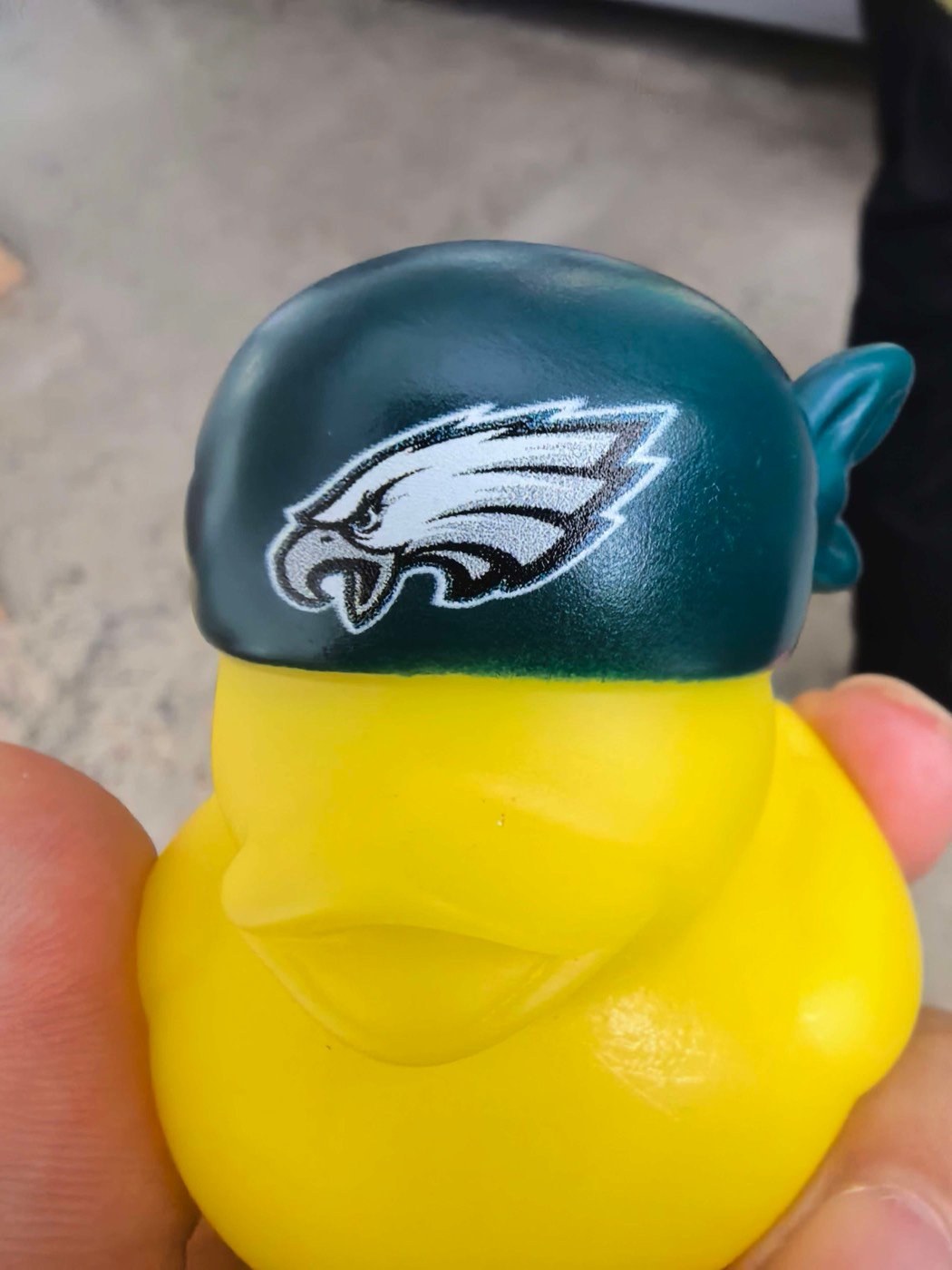
Logo adhesion is where most promotional ducks fail. Pad printing is the cheapest route, but it wears off after 100+ swipes. At a busy event, that means your brand mark is already degrading by the time the first batch reaches the parking lot.
Pad vs. UV: The Real Cost Difference
Pad printing is the budget default: a typical 3-inch duck with a two-color logo runs $0.35–$0.55 per unit at 5,000 pieces. UV digital printing adds about $0.05–$0.08 per unit, which pushes the total up by roughly 15%. For that premium, you get about five times the durability. Compare FOB pricing from suppliers who quote UV and pay attention to what they actually include.
Why Corona Treatment Changes Everything
Most factories print UV ink directly on PVC and call it done. That ink sits on the surface and lifts with handling. In our production line, every UV-printed duck gets a corona pre-treatment before ink application. It raises the surface energy of the PVC so the ink chemically bonds. Multi-layer UV printing with corona pre-treatment lifts logo adhesion by 40% compared to single-pass pad printing.
Ask your supplier to state the number of printing passes and whether they apply corona treatment. If they can’t answer, you’re buying a logo that will fade in under 12 months of outdoor use.
The White Underbase Rule
Dark logos on yellow ducks are a classic trap. Yellow PVC is opaque and high-chroma; a single pass of dark ink will not hold. Specify at least two white underbase layers before the color layers. Without them, the logo looks washed out and the coverage fails.
Put the print spec on your sample approval form and define the quality tolerance before mass production. Ten minutes of extra review on a pre-production sample beats an entire batch that has to be re-run.

Safety and Certification: What Brands Must Demand
A CE mark proves little.
A CE mark on a rubber duck looks reassuring, but it is a self-declared conformity label, not a safety verdict. The documents that actually protect your brand are EN71-3 (EU) and ASTM F963 (U.S.) third-party lab test reports. Both standards cap phthalate content at 0.1% in children’s products — and uncertified ducks routinely exceed 15%.
Phthalates: The Hidden Liability
Most suppliers advertise “BPA-free,” which misses the real risk. Phthalate plasticizers make PVC soft, and cheap recycled PVC bleeds them out over time. DOTP phthalate-free plasticizers add 8–12% to material cost, which is exactly why budget suppliers skip them. For event ducks that children might handle, REACH SVHC compliance is the legal safeguard that actually matters.
The 24-Hour Document Test
- EN71-3: Limits migration of 19 elements; the lab report must reference the specific production batch.
- ASTM F963-17: U.S. toy safety standard; phthalate limit is 0.1% per component, verified by independent testing.
- REACH SVHC Technical File: Declares substances of very high concern in the final product, not just raw material ingredients.
This vetting step alone eliminates most Alibaba suppliers — over half lack third-party safety test reports when asked. We run this check on every new inquiry, and our production line ships 5,000,000+ ducks monthly using DOTP phthalate-free plasticizers. Test reports ship with every order confirmation.
How to Test a Promotional Rubber Duck Mockup in 5 Minutes
A five-minute sample test catches what no photo mockup can show: material resilience, plasticizer migration, and print adhesion.
The digital mockup tells you the color. The physical sample tells you the material. On the factory floor, operators can flag a bad duck by feel before it reaches the polybag; you don’t have that intuition, but these four hands-on checks give you the same signal in five minutes.
The 5-Minute Sample Sequence
- Squeeze: Press the duck hard and release. It should spring back immediately. A dent that lingers means the PVC is under-cured or cut with recycled resin; that duck will lose shape in a hot warehouse and feel cheap in hand.
- Smell: Open the polybag and sniff the duck directly. Any chemical odor points to uncured plasticizer. Later, that plasticizer migrates to the surface, making the duck sticky and turning it into a dust magnet.
- Scratch: Run your thumbnail across the logo. A UV print that flakes or lifts means the PVC surface was not pre-treated before printing. Those ducks ship with ink sitting on top instead of bonding, so the coating will fade within weeks. Corona pre-treatment before UV printing improves logo adhesion by roughly 40%, and the difference shows up immediately under a thumbnail.
- 60°C Water: Submerge the duck in 60°C water for 10 minutes. If the body deforms, it will also deform in a summer delivery truck or on a sunny event table. Good promo ducks survive that test without losing their shape.
What These Tests Actually Measure
The squeeze test checks the Shore hardness of the PVC. Our internal standard is virgin PVC at Shore A50–A60, which keeps the duck squeezable but still durable. Recycled or heavily filled materials fail that resilience check almost immediately.
The scratch test matters because most logo ducks ship with ink that sits on the surface. At Lzegno, we corona-treat every PVC surface before UV printing, so the ink chemically bonds to the duck rather than sitting on top. That extra step is the reason our prints resist flaking and hold color beyond 12 months of outdoor use.
Our internal quality data shows 80% of promo duck failure complaints involve print fading and sticky surfaces — exactly what the scratch and smell tests expose. Run all four checks on every pre-production sample before you approve. It eliminates most of the subpar inventory that gives promotional ducks a bad reputation.
Conclusion
A good promotional rubber duck is not a commodity; it is an engineered giveaway that carries your brand into someone’s home or office. Material, printing method, and safety paperwork decide whether it becomes a desk fixture for years or a sticky, faded embarrassment within weeks. The supplier’s willingness to share batch-level test reports is the fastest quality signal you will get.
- Demand virgin PVC with Shore A50–A60 hardness; recycled PVC cracks and leaches plasticizers within 90 days.
- UV printing with corona pre-treatment boosts logo adhesion by 40% and resists fading for 12+ months outdoors.
- Specify phthalate-free DOTP plasticizers; ASTM F963-17 and EN71-3 limit phthalate content to 0.1%.
- Over half of Alibaba-listed promo ducks lack third-party safety test reports; request batch-level certificates.
Before you request quotes, write down this benchmark: virgin PVC at Shore A50–A60, a phthalate-free plasticizer, and UV printing with corona pre-treatment. Put it next to your FOB pricing sheet and run every supplier quote against it. If a supplier cannot produce batch-level EN71-3 or ASTM F963 reports within 24 hours, that tells you everything. When you are ready to compare ducks that actually meet these thresholds, the Lzegno catalog is a useful place to start.
Quality comes first, then placement: the swag bag trends 2026 guide shows where verified promo ducks fit the modern event bag.
Frequently Asked Questions
How can rubber ducks be customized for branding purposes?
You can customize color, logo, mold shape, and packaging. Pad or UV printing on a standard duck mold is fastest, while a full custom shape needs a new mold and longer. Start with logo and color before investing in a custom mold.
What is the minimum order quantity for custom promotional rubber ducks?
The MOQ for custom promotional rubber ducks is 1,000 units per design. Some suppliers accept lower quantities for stock ducks or simple logo-only items, but 1,000 is the standard threshold. Confirm whether the MOQ applies per colorway or per artwork.
Are custom rubber ducks safe for children under 3 years?
Custom rubber ducks made from non-toxic, phthalate-free PVC can be safe, but they are not automatically certified as toys for infants. For children under 3, you must confirm EN71 or FDA compliance and avoid ducks. Request safety test reports before approving samples.
What is the typical production time for bulk rubber ducks?
Bulk production usually takes 2–4 weeks after sample approval. Sample lead time is about 7 days, but the exact schedule depends on mold changes, print complexity, and order size. Lock the production schedule before placing your deposit.
Can rubber ducks be made from non-toxic, eco-friendly materials?
Yes, custom rubber ducks can be made from non-toxic, phthalate-free PVC and eco-friendly alternatives like natural rubber or recycled materials. Confirm the material certification, such as EN71 or REACH, because ‘eco-friendly’ varies by. Request material spec sheets and test reports before sampling.