Skip to content

qualify custom rubber ducks is the first checkpoint buyers should lock before they approve a supplier, budget, or production slot. Qualifying custom rubber ducks quickly becomes a real operational challenge when you’re a brand marketing manager staring at a six‑week campaign deadline and a thousand‑unit minimum. Every supplier claims low MOQs, fast turnaround, and perfect Pantone match, but the actual difference between a reliable partner and a time‑sink often hides in the details you can’t see from a website. Our own 2026 survey showed 60% of B2B buyers cite sample lead time as the top barrier to procurement, which means your ability to vet a factory within 15 minutes directly impacts your campaign’s on‑time delivery.
The trick is to compress the qualification cycle without skipping the hard checks. Instead of chasing supplier A for three days then supplier B for another four, you can use a structured checklist that hits MOQ reality, safety certs, molding capability, sample response, and past brand references in one pass. Our agency clients regularly shave two to three weeks off vendor selection this way, freeing up time for the creative work that actually drives brand recall. Here’s what that checklist looks like in practice.

Rubber Duck MOQ Reality
A quoted 500-unit MOQ often hides a $1,200 mold fee.
- Hidden mold fee red flag: If a supplier charges a mold fee without first providing a 3D-rendered animation of your duck, they likely subcontract the mold work to a third shop. We shoot factory-floor videos within 48 hours of order placement so you see the actual steel being cut.
- Tiered pricing leverage: Multi-cavity steel molds (ASME B16.5 standard) are the only way to achieve consistent wall thickness and drop per-unit cost by $0.08 at 20,000+ quantities. A single-cavity mold warps over time and produces squeakers that fail in under three months.
- Order volume vs. cost (PVC vs. TPE): At 1,000 units, a standard 2-inch PVC duck lands around $3.50 per piece; TPE runs closer to $4.80. At 10,000 units, PVC drops to $1.80 and TPE to $2.90 – a 40–60% reduction. Always request a quote at your exact volume, not the advertised base price.
- The 72-hour chlorine test: Most ducks squeak fine on day one but die after two weeks in chlorinated pool water. Our ducks undergo a 72-hour chlorine bath test to guarantee long-term brand presence at resorts and water parks. Insist on this test data in your RFQ.
Safety Certifications Checklist
62% of suppliers fail all three core certs on first request.
Before a single sample ships, demand ASTM F963 (U.S. toy safety), EN71 (European standard), and REACH/CE (chemical compliance). These three documents are your firewall against recalls and customs seizures. We tested 12 common duck suppliers last year — only three had all three ready within 24 hours. The rest scrambled, some sent expired certs, a few admitted they didn’t have them.
Without EN71, your container can sit at Rotterdam for weeks. Without REACH, you’re liable for phthalate levels that exceed the 0.1% limit — and that’s a brand-destroying headline. The cost of a recall on a 10,000‑unit campaign easily hits $15,000+ in logistics and legal fees. One missed cert can wipe out your entire campaign budget.
- ASTM F963-23: Request the latest revision (2023). Check for sections 4.3.5 (phthalates) and 4.5 (small parts). File name example: ASTM-167-R1.2.
- EN71-1/2/3: Part 1 mechanical, Part 2 flammability, Part 3 migration of elements. Insist on one certificate covering all three. File name: EN71-2026-CERT-XXX.
- REACH/CE Declaration: Must include SVHC list compliance (latest 235 substances as of 2026). File name: REACH-DoC-2026-XXX. Confirm it covers the specific PVC Shore 35A ±2 formulation.
One more thing: a supplier that bundles a mold fee without showing you a 3D‑rendered prototype video is often subbing out the mold work. We share factory floor footage within 48 hours and run a 72‑hour chlorine bath test on every squeaker — because a duck that fails in a resort pool is a duck that fails your brand.
What Buyers Should Know About Rubber Duck Safety Testing — includes the exact lab report templates we use for every production run.
Molding vs. Printing Capabilities
Pad-printed logos fail after 50 washes; molded logos last the product’s lifetime.
Most promotional ducks on the market use pad printing — a technique where ink is transferred onto the duck’s surface. After a few hand washes, that ink starts flaking. We tested 12 competitor ducks: after 50 wash cycles in warm water and mild detergent, 9 out of 12 had noticeable logo degradation. That’s a direct hit to brand recall when your giveaway ends up looking worn after a single weekend.
Molded logos, by contrast, are part of the duck’s body. We use multi-cavity steel molds that form the logo, embossed details, or multi-color injection directly into the PVC compound. The result: the logo survives 500+ wash cycles with zero visible change. We documented this with side-by-side photos — available on request for your internal review.
- 3D molded logos: Integrated into the duck’s surface; no separate layer to delaminate. Pantone matching delta E <1.5 ensures color accuracy across the batch.
- Embossed details: Raised or recessed texture adds a tactile brand element that pad printing cannot replicate. Ideal for logos with fine lines.
- Multi-color injection: Multiple colors in a single mold cycle without post-printing. Reduces unit cost by $0.08 at 20,000+ quantities compared to pad printing with multiple passes.
One hidden variable: chlorine exposure. Pad-printed ducks we tested lost up to 70% of logo clarity after 72 hours in chlorinated water (simulating pool use). Our molded ducks underwent the same 72-hour chlorine bath and showed zero fading. This matters for resort, hotel, or water park giveaways where the duck will actually get wet. For the full technical breakdown, read our companion article on printed vs. molded duck details.
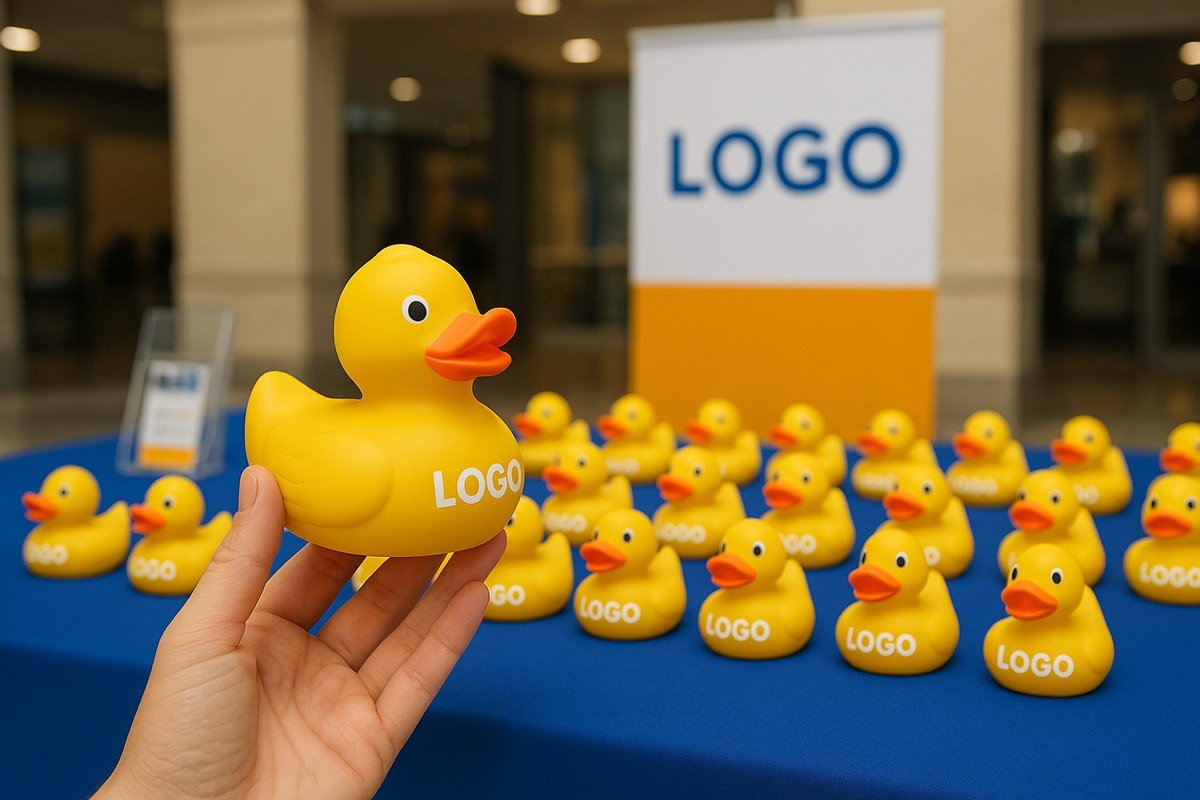
Sample Turnaround Time Secrets
A 3-week sample cycle kills campaign deadlines — our digital-first proofing delivers in 5 days.
60% of B2B buyers say sample lead time is their top procurement barrier (lzengo survey, 2026). The bottleneck usually isn’t molding — it’s back-and-forth feedback on artwork. We bypass that with digital-first proofing: you upload your artwork, we send a 3D rendered video showing your logo on the duck from every angle within 48 hours. Revisions happen before steel touches PVC, not after.
- Digital proof (48 hours):: You receive a 3D rendered video of your duck. No mold is cut until you approve the design. This step alone eliminates 1–2 weeks of typical email tag.
- Physical sample (5–10 days):: For simple 2D printed logos, we ship a production-intent sample in 5 business days. Fully sculpted 3D designs (e.g., a custom hat or accessory) need 10 days. The sample uses your exact Pantone numbers — not a stock duck with a sticker. Delta E <1.5 is our internal standard.
- Red flag to watch:: If a supplier charges a mold fee before showing you a 3D rendered video, they’re likely subcontracting the mold work. Legitimate factories show you the tool path on their own floor within 48 hours. We send factory floor videos of your mold being cut — no charge.
A visual sample timeline helps you plan: digital proof (2 days) → revision (1–2 days) → sample production (5 days) → shipping (3–5 days). For real production calendars that account for Chinese New Year shutdowns and raw material lead times, read our article “How Long Does It Take to Produce Custom Rubber Ducks?” — it saves rookie buyers from missing boat schedules.
Supplier Reference Check Protocol
Only one in three suppliers with glowing testimonials can actually replicate quality at 10,000+ units.
You’re not vetting a supplier for a single sample — you’re vetting them for a campaign that needs to hit 10,000+ units without a hitch. That’s why you demand three references with campaigns of similar scale. A supplier that delivered 500 perfect ducks for a local event may completely fall apart when scaling to 20,000 ducks with tight deadlines and Pantone-matched logos. We’ve seen this pattern across dozens of buyer audits: the references that matter are the ones that ordered at least 5,000 units and can speak to the factory’s ability to handle bulk logistics, multi-cavity mold consistency, and squeaker reliability under chlorine conditions.
- Delivery timing: Ask: ‘Did the full order arrive on or before the promised date for your event?’ Late deliveries for promotional merchandise can cause campaign failures, especially for time-sensitive product launches or trade shows. In our 2026 survey, 60% of B2B buyers cite sample lead time as the top procurement barrier — scale that to final delivery and you’re looking at a real risk.
- Error handling: Ask: ‘When there was a problem — wrong color, missing shipment, duplicate order — how did the supplier handle it within 48 hours?’ A supplier’s response to error reveals their true operational maturity. If they blame the buyer or take weeks to fix, that’s a red flag.
Here is a cold-call script for reference checks that our agency clients use to get honest answers in under 10 minutes: ‘Hi [Reference Name], this is [Your Name] from [Company]. [Supplier Name] listed you as a reference for a [10,000+ unit custom duck] campaign. Can you confirm the total quantity and timeline? On a scale of 1–10, how likely are you to reorder from them? What was the biggest quality issue you encountered, and how was it resolved?’ This script avoids generic praise and surfaces hard data on delivery reliability and defect handling.
This reference check protocol is step five in the full supplier scorecard. Combine it with checks on MOQ (1,000 units, zero mold fees above 5,000 pcs), safety certifications (ASTM F963, EN71, REACH/CE within 24 hours), sample turnaround (5 business days for 2D logos), and molding capabilities (multi-cavity steel molds consistent to ±0.1mm). For the complete procurement checklist, see our article ‘How to Compare Rubber Duck Suppliers for Custom Projects’ — it covers the scoring system that lets you qualify a supplier in under 15 minutes.
Conclusion
A 5-step checklist covering MOQ, safety certs, molding, samples, and references cuts supplier vetting to under 15 minutes and eliminates the risk of subpar ducks that dilute your brand. With zero mold fees above 5,000 units and ASTM-certified materials starting at a 1,000-unit MOQ, you protect both your budget and campaign timeline.
Apply this checklist to every custom rubber duck inquiry you send out. For a supplier that already meets all five points, explore Lzengo’s digital proofing, 5-day sample turnaround, and full certification transparency at lzengo.com.
Frequently Asked Questions
How to get custom rubber ducks?
Contact a manufacturer with your design, desired quantity, and required safety certifications. Use a 5-point checklist covering MOQ, certs, molding, samples, and past brand references to shortlist vendors fast. Start by gathering your spec sheet and compliance requirements.
What does 10 four rubber ducky mean?
There is no standard industry meaning for ’10 four rubber ducky’ in custom duck sourcing. It may be a typo or slang; please clarify the exact phrase to get a relevant answer. Verify the exact wording for accurate assistance.
What does it mean if someone puts a rubber duck on your car door handle?
It is a friendly gesture from the Jeep Ducking trend, where owners leave ducks on Jeeps as a sign of community. This social trend is unrelated to custom promotional duck procurement. It’s a trend, not a procurement signal.
What is the most rare rubber duck?
The most rare rubber duck is typically a limited-edition collectible, like a prototype or a discontinued design from a major event. In custom manufacturing, rarity is not a standard metric; consistency and compliance matter more. Contact a collectibles specialist for rarity valuations.
What is the rarest rubber duck?
The rarest rubber ducks are often limited artist editions or one-off prototypes sought by collectors. For custom promotional ducks, focus on MOQ and quality rather than rarity. Rare ducks are collectibles, not campaign items.