Skip to content
custom rubber ducks pantone is the first checkpoint buyers should lock before they approve a supplier, budget, or production slot. You sign off on the pre-production sample. It looks perfect under the office lights — that signature blue is dead on. Six weeks later, the full container arrives for your Q3 campaign launch. You open a carton, pull out a duck, and your stomach drops. The blue is flat, chalky, and a full shade lighter than the sample you approved. That $50K order? It just became a warehouse liability because the pre-production sample didn’t match the mass production run. This exact scenario plays out across a dozen supplier audits on three continents. The root cause never changes: the buyer assumed Pantone matching was a binary yes-or-no checkbox. It is not.
The reality is that custom rubber ducks pantone matching sits at the intersection of ink chemistry, PVC substrate behavior, and production discipline. Most suppliers will tell you they can match any color. Few will explain the tolerance levels, the material constraints, or the hidden fees buried in sample approval. After managing over 40 supplier audits across Asia and Europe, experience has shown that the difference between a duck that nails your brand color and one that misses by a mile comes down to three things: theyellow undertone in the base plastic, whether the factory uses a spectrophotometer instead of a visual check, and whether you locked down a golden sample with a Lab* report before production started. Those are the details that separate a procurement pro from a rookie making an expensive mistake on FOB pricing.
What Pantone Matching Really Means for Ducks
Printed logos hit Pantone; molded bodies need a white base or blue-violet tint.
The Pantone Matching System (PMS) works differently on a rubber duck than on a brochure. For printed logos—pad or screen-printed onto the surface—the factory mixes a spot ink to match your Pantone code. This can achieve a ΔE ≤ 2.0 (barely perceptible) when verified with a spectrophotometer. But the duck body itself, if you want a molded color (the entire duck cast in a custom hue), is a completely different process. The liquid PVC is blended with a masterbatch pigment, and here the material fights you: standard PVC has a natural yellow undertone that shifts light colors by ΔE 3–4 unless you add a blue-violet neutralizer or start with a bright white base. Most suppliers won’t tell you this until your sample comes back looking like a faded Post-it.
- Printed (spot ink): Cost adds 10–15% per unit vs. CMYK. Works best on white or light duck bodies. Requires vector artwork with Pantone codes (C or U). Tolerance: ΔE ≤ 2.0. Spectrophotometer verification adds $30–$60 per sample batch.
- Molded base color: Requires masterbatch pigment mix. One-time facility charge $150–$300, often waived above 5,000 units. Inherent PVC yellow shift means pastels (e.g., Pantone 2026 C Peach Fuzz) come out muddied unless the formula is adjusted. Demand a physical golden sample with Lab* values.
‘Close enough’ is a trap. A global beverage brand once rejected 10,000 ducks because their signature red appeared orange under event lighting. The human eye catches a ΔE of 3.0 or more instantly. 61% of consumers say brand colors are critical for recognition (University of Loyola, Maryland). Inconsistent presentation can reduce revenue by up to 23% (Lucidpress). On a curved duck surface, even a 0.5 mm registration error in multi-color printing leaves a white gap. You do not fix this by trusting a JPEG mockup. You enforce a written tolerance clause in your purchase order: ΔE ≤ 2.0, validated by a spectrophotometer report on the pre-production sample. Anything less and you’re gambling your brand’s visual equity on a $0.30 giveaway.

The Real Cost of Pantone Matching on Rubber Ducks
PVC’s yellow undertone shifts light Pantone shades by ΔE 3–4 — most suppliers won’t tell you.
For printed logos, Pantone matching adds a 10–15% premium to the unit cost compared to standard CMYK. On a $1.50 duck, that’s $0.15–$0.23 extra. The factory also charges a spot-color ink mixing fee of $50–$100 per Pantone color. If your artwork has three separate spot colors — say, a logo, a text, and an accent line — expect that fee multiplied. Vector artwork (AI/EPS) cuts prepress time; sending a low-res PNG will cost you in revision hours.
- Masterbatch development for molded bodies: Custom duck body color requires pigment masterbatch — a one-time facility charge of $150–$300. This fee covers lab time and small-batch mixing. Many suppliers waive it for orders above 5,000 units, but few proactively offer that. You must ask.
- The PVC undertone trap: Standard PVC has a natural warm cast. Light Pantone shades — like Peach Fuzz 2026 C — will read 3–4 Delta E warmer than the swatch unless the manufacturer adds a blue-violet tint to the masterbatch or uses a bright white base duck. Skipping this step means your pastel looks muddy.
- Spectrophotometer verification: Demand a Lab* report with the pre-production sample. The test costs $30–$60 per batch but catches shifts as small as ΔE 0.5. Without it, you’re approving by eyeball under office lighting that differs from event lighting.
Here’s where the savings live: if you consolidate orders into a single body color and run 5,000+ units, the masterbatch fee disappears, the per-unit ink surcharge drops to 8–10%, and the supplier will include a spectrophotometer check for free. That’s the difference between a $3,000 line item and a $1,800 one.
| Cost Factor | Standard Cost | Volume Break | Key Note |
|---|---|---|---|
| Unit Price Uplift (Printed) | +10% to +15% over CMYK | Applies across all volumes | For pad/screen printing spot Pantone colors |
| Masterbatch Pigment Fee (Molded) | $150 – $300 one-time | Waived for orders ≥ 5,000 units | Required for custom duck body color |
| Physical Color Sample Lead Time | +7 to +10 calendar days | No volume discount on time | Adds to design approval timeline |
| Spectrophotometer Verification | $30 – $60 per sample batch | Usually flat fee per order | Catches ΔE shifts as small as 0.5; recommended for brand consistency |
| MOQ for Pantone Match Guarantee | 1,000 units minimum | Below 1,000 exact-match guarantee often declined | Standard MOQ stays at 1,000; color development fee may vary |
Color Accuracy Risks Most Buyers Overlook
PVC’s warm undertone can shift your brand pastel by ΔE 3–4 unless you counteract it.
Most buyers assume the Pantone code they send will translate directly to the duck. They don’t realize that PVC — the standard vinyl used in rubber duck manufacturing — has a natural yellowish tint. That tint acts like a filter over the pigment. If you order a pastel shade like Pantone 2026 C (Peach Fuzz), the yellow base can shift the perceived color by ΔE 3–4, which is clearly visible. The fix is not obvious: the manufacturer must either add a blue-violet optical brightener to the masterbatch or start with a white base duck. Most suppliers will not tell you this unless you ask.
A global beverage brand rejected 10,000 ducks because the red on the printed logo turned orange under event lighting — the printed ink was matched perfectly, but the underlying PVC body reflected the yellow undertone through the thin white ink layer. That is the kind of surprise that kills a campaign budget.
- PVC Undertone Problem: Standard PVC resin has a ΔE 2–3 yellow cast. For molded body colors, this raises the effective color difference from your Pantone target by ΔE 1–2 on top of any pigment tolerance. Light pastels (e.g., 2026 C, 12-0752) amplify the shift, while deep colors (navy, charcoal) mask it.
- Why Spectrophotometer Reports Beat Visual Check: A ΔE of 2.0 is the acceptable threshold for promotional ducks — anything above is noticeable to the average eye. A spectrophotometer measures Lab* values digitally and catches drift as small as ΔE 0.5. The cost to add this report to your pre-production sample is roughly $30–$60 per batch. Visual checks under office lighting miss the metameric effect between factory light (yellow-rich) and retail lighting (cool white).
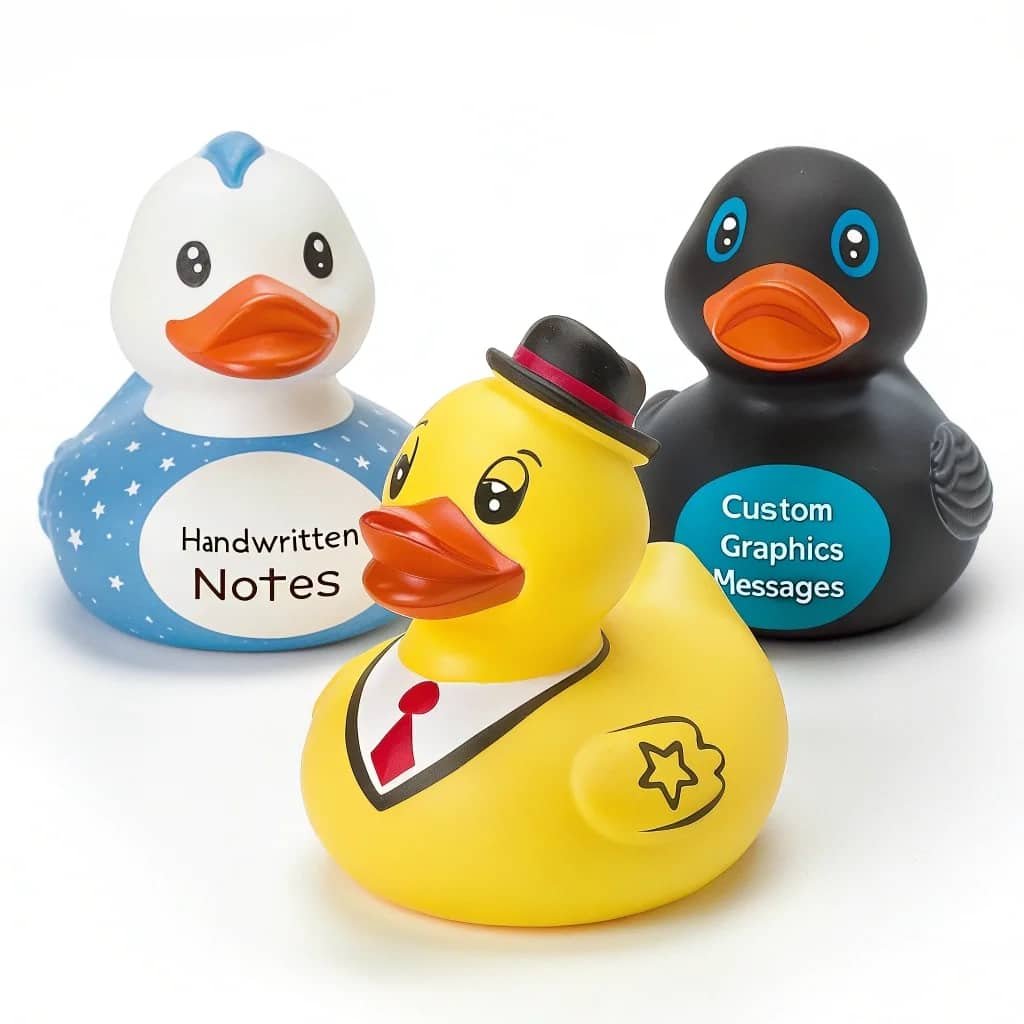
Demand a physical ‘golden sample‘ accompanied by a
How to Get a 100% Pantone-Approved Duck Sample
A digital render is a promise; a spectro report is proof.
Every Pantone rejection observed traces back to sloppy artwork. Most buyers send a PNG with a hex code. That’s not enough. A factory screen-printer needs vector files with the exact Pantone code plus the finish notation — C for coated (gloss), U for uncoated (matte). The substrate matters: on a standard glossy duck, a Coated Pantone reference gives the factory a better target because the ink dries with a similar sheen. If you send an Uncoated reference, the dried print will look flat compared to your brand’s glossy packaging. A $12,000 print job was observed getting binned because the buyer’s file tagged 186 C as 186 U — the red looked desaturated.
- File format: Supply layered AI, EPS, or PDF with all spot colors named exactly (e.g., ‘PMS 186 C’). No flattened PDFs — the prepress team needs to isolate each ink channel.
- Trap allowance: For multi-color logos printed on the duck’s curved surface, specify a 0.5 mm trap (overlap) between adjacent colors. Without it, registration drift on compound curves creates white gaps — a defect that looks like a bad knockoff.
- Bleed and live area: Keep all critical text or brand marks at least 3 mm from the edge of the print area. The duck’s 3D contour distorts the last 1.5 mm of any print; anything closer gets stretched into illegibility.
- Step 1 — Artwork proof: Review the vector file on screen. Confirm all Pantone codes and trap allowances. Sign off digitally.
- Step 2 — Masterbatch or ink drawdown: Request a physical color chip on the actual PVC or ink that will hit production. Do not accept a printed paper swatch — the absorption differs. This adds 3–5 days.
- Step 3 — Golden sample: Mold or print one full duck. Measure with a spectrophotometer under D65 lighting. The target is ΔE ≤ 2.0 for printed areas, ΔE ≤ 2.5 for molded base colors. Approve and lock that duck in a sealed bag as the master reference.
- Step 4 — Pre-production audit: After the factory runs 2% of the total order, pull 5 random ducks and compare against the golden sample using the same spectrophotometer settings. Any duck exceeding ΔE 2.0 gets quarantined before shipping.
The sample approval workflow is where most procurement professionals drop the ball. They approve a digital mockup and skip the physical sample. That’s a $50K mistake waiting to happen. Here is the protocol that works: Demand a physical ‘golden sample’ — a single approved duck that becomes the contractual reference for the entire production run. Ask for a spectrophotometer Lab* report alongside it. A standard spectrophotometer verification costs $30–$60 per batch and catches shifts as small as ΔE 0.5. Without the report, you’re relying on a human eye under office lighting that masks the warm PVC undertone. That undertone shifts pastels by ΔE 3–4 unless the factory adds a blue-violet tint to the masterbatch or starts with a white-base duck.
I’ve worked with buyers who skipped Step 4. They received 10,000 ducks that looked identical to the golden sample in the factory’s fluorescent light — but under the halogen spots at their expo booth, the signature blue shifted greenish. The spectrophotometer would have caught that metameric failure. The delta was only 1.8 ΔE under D65, but it jumped to 3.1 ΔE under the event’s halogen spectrum. A proper golden sample contract doesn’t just specify the color; it specifies the illuminant (D65 standard daylight). Ask your supplier for the spectral curve data, not just a single number.
Conclusion
Pantone-matched rubber ducks are a baseline requirement for any brand protecting its visual identity. The difference between a giveaway that looks cheap and a desktop staple that reinforces brand credibility lies in whether you enforce a spectrophotometer-checked sample and account for PVC’s warm undertone. Write this number down: demand a ΔE ≤ 2.0 for printed logos and a ΔE ≤ 2.5–3.0 for molded base colors on your next supplier call.
Now take that benchmark and compare it against your current supplier’s offering. Review the custom rubber duck catalog to see how leading brands enforce color fidelity across production runs.
Frequently Asked Questions
What Pantone color matching accuracy can I expect on rubber ducks?
Expect ΔE ≤ 2.0 for printed logos, but molded base colors shift pastels up to ΔE 3–4 due to PVC’s warm undertone. Always order a white-base duck or request optical brighteners for light. Request a pre-production sample to verify before full production.
Does Pantone matching increase the MOQ for custom rubber ducks?
Pantone matching by itself does not raise the MOQ, but molded base colors add a masterbatch mixing fee of $150–$300. This fee is usually waived on orders over 5,000 units. Confirm the fee structure when you place the order.
How much extra time does Pantone matching add to the production timeline?
Pantone matching typically adds 2–3 business days for color formulation and sample adjustment. Most factories still deliver a color-approved sample within 7–10 days total. Factor these days into your campaign schedule.
Can I mix multiple Pantone colors on a single custom duck?
Yes, through pad printing or screen printing you can apply multiple Pantone ink colors on one duck. For molded base colors, each color requires a separate PVC batch, so mixing. Stick to printed logo colors if you need more than one Pantone.
What artwork file do I need to send for a Pantone color match?
Send a vector file (AI, EPS, or PDF) with each Pantone reference clearly labeled on a separate layer. Raster files like JPEG or low-res PNG will delay color matching and risk miscommunication. Provide the file before the mockup stage to save time.