Skip to content

The single most common question B2B buyers ask about custom rubber ducks is: what does each unit actually cost? The honest answer is that the unit price depends almost entirely on order volume. A buyer ordering 1,000 ducks pays a different per-unit price than a buyer ordering 50,000, and the difference is not marginal — it can be a factor of two or more. Understanding how the pricing structure works across volume tiers is the difference between budgeting accurately and being surprised by the quote.
LZENGO manufactures bulk rubber ducks with a minimum order quantity of 1,000 pieces and a monthly production capacity exceeding 5 million units. That capacity range — from 1,000 to 100,000+ — is where the most significant cost compression happens. This guide breaks down what drives the price drop at each tier so you can plan your order at the volume that gives you the best cost-per-impression without overcommitting inventory.
What Drives the Per-Unit Cost Down
Three factors explain why a rubber duck that costs roughly $0.85 at the 1,000-piece entry point drops significantly as volume increases. None of these are trade secrets — they are standard manufacturing economics, but most buyers never see them explained.
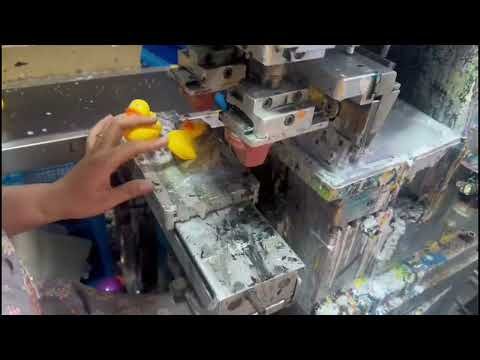
First: mold setup amortization. Every custom duck order requires mold preparation, machine setup, and color mixing before the first piece is produced. These are fixed costs — they do not change whether you order 1,000 or 100,000 ducks. At 1,000 pieces, each duck carries a larger share of that setup cost. At 50,000 pieces, the same setup cost is spread across 50 times as many units, and the per-unit impact shrinks to near zero.
Second: production line efficiency. Once the line is running, each additional duck costs less to produce than the one before it. The first 1,000 pieces involve machine calibration, operator adjustment, and QC ramp-up. Pieces 5,001 through 50,000 run at steady-state speed with no additional setup. The factory’s monthly capacity of 5 million+ ducks means even a 100,000-piece order represents roughly 2% of monthly output — well within efficient production territory.
Third: material purchasing power. PVC, TPR, and silicone resin is purchased by the ton. Larger orders allow the factory to buy material in bulk, reducing the per-unit material cost. At 1,000 pieces, the material lot is small and priced accordingly. At 100,000 pieces, the material purchase qualifies for volume pricing from the resin supplier, and that savings passes through to the buyer.
Price Tier Breakdown: 1K to 100K Units
The table below shows how per-unit cost typically behaves across order volume tiers. The entry-level price anchor of approximately $0.85 per unit at the 1,000-piece MOQ is consistent with existing MOQ pricing documentation. Higher-tier figures are estimates based on standard manufacturing cost curves — actual quotes depend on design complexity, material choice, and printing method.

| Order Volume | Estimated Per-Unit Cost | What Changes at This Tier |
|---|---|---|
| 1,000 (MOQ) | ~$0.85 | Full setup cost spread across minimum volume; most expensive per unit |
| 2,500 | ~$0.70 | Setup cost amortized further; modest material volume discount kicks in |
| 5,000 | ~$0.55 | Production line hits steady-state efficiency; resin purchased in bulk lots |
| 10,000 | ~$0.45 | Significant cost compression; preferred for mid-scale promotional programs |
| 25,000 | ~$0.35 | Maximum line efficiency; material cost drops to wholesale levels |
| 50,000 | ~$0.30 | Near-floor production cost; further drops are marginal |
| 100,000+ | ~$0.25 or less | Floor pricing; savings come from packaging and logistics, not production |
Note: All prices are estimates for standard PVC ducks with single-color pad-printed logos. Custom-molded shapes, multi-color printing, premium packaging, and silicone materials carry additional costs at every tier. Request a formal quote for exact pricing.
The key insight from this table is the diminishing returns curve. The steepest cost drop happens between 1,000 and 5,000 units — the per-unit cost nearly halves. Between 25,000 and 100,000, the drop is much smaller. For most B2B buyers, the sweet spot where you get maximum cost reduction without overcommitting inventory is between 5,000 and 10,000 units.
How to Decide Which Tier to Order
Choosing the right order volume is not just about getting the lowest per-unit price. It is about matching production volume to your actual distribution plan. Ordering 100,000 ducks to get the floor price makes no sense if you only need 5,000 for a single campaign — the unsold inventory eats the savings.
The custom rubber duck ordering process works best when you map your distribution channels first. A company running a single trade show booth needs 1,000 to 2,500 ducks. A franchise with 20 locations doing simultaneous promotions needs 10,000 to 25,000. A national retail chain stocking ducks as resale merchandise needs 50,000 or more.
The most cost-effective approach for buyers uncertain about volume is to start at the 1,000-piece MOQ, confirm the product meets expectations, then place a larger reorder at a better per-unit price. Reorders are faster and cheaper because the mold and artwork are already on file — no new setup costs. The B2B bulk ordering guide covers this reordering strategy in detail.
What Adds Cost Beyond the Base Tier Price
The tier pricing above covers standard ducks with basic logo printing. Several customization choices add cost at every volume tier, and understanding these add-ons helps you budget accurately:

- Custom-molded shape — if your duck needs a unique body shape (not the standard mallard), a new mold must be carved. This is a one-time tooling cost that does not scale down with volume; it is a fixed investment regardless of order size.
- Multi-color printing — single-color pad printing is the baseline. Each additional color in the logo requires a separate printing pass, adding a per-unit cost. UV printing handles full-color designs more efficiently for complex logos.
- Pantone-matched body color — molding the duck body in a custom Pantone shade (rather than a standard stock color) adds a color-mixing setup cost that amortizes well at higher volumes but is noticeable at the 1,000-piece tier.
- Premium packaging — individual retail boxes or gift boxes add cost per unit. Polybag packaging is the most cost-effective option and is standard for bulk orders.
- Squeaker assembly — silent ducks are the baseline. Adding a single or double squeaker involves additional assembly steps that add a small per-unit cost.
For buyers comparing quotes across suppliers, the quality verification checklist helps ensure that the quotes you receive are for comparable products. A supplier offering a lower price may be quoting thinner walls, unbranded ink, or no compliance testing — differences that are invisible in a quote but visible in the finished product.
The Hidden Cost of Going Too Cheap
Not all rubber ducks are manufactured to the same standard, and the lowest quote is not always the best value. Wall thickness varies between factories — thin walls crack under squeeze pressure, leading to returns and reputational damage. Ink quality varies — cheap pad printing fades after weeks of UV exposure, while factory-grade ink holds color for years. And compliance testing, which confirms the absence of phthalates and heavy metals, is an additional cost that some suppliers skip entirely.
LZENGO ducks are manufactured with REACH, CPSIA, and BSCI compliance, with testing conducted through Intertek. These certifications are not marketing decoration — they are the legal and safety foundation that allows your ducks to be distributed at public events, in retail environments, and to households with children. A supplier that cannot produce the Intertek test report is a liability, regardless of how low their per-unit price appears.
Planning Your Order for Maximum Cost Efficiency
The most cost-effective ordering strategy depends on your campaign timeline. For a single event, ordering at the tier that matches your distribution plan is optimal — the slight per-unit premium at lower volumes is less than the cost of storing and managing excess inventory. For ongoing programs with multiple touchpoints throughout the year, batching annual demand into a single larger order unlocks better tier pricing and reduces per-unit production cost.
For example, a company planning four quarterly appreciation drops could order 5,000 ducks in one production run (4 designs, each with 1,250 pieces) rather than placing four separate 1,000-piece orders. The single 5,000-unit order benefits from the 5,000-piece tier pricing, which is meaningfully lower than four separate MOQ orders. The key constraint is that the designs must share the same duck body mold — only the printing varies. This batching strategy is covered in the giveaway planning framework.
Frequently Asked Questions
What is the minimum order quantity and starting price?
The MOQ is 1,000 pieces, with a starting per-unit cost of approximately $0.85 for a standard PVC duck with single-color pad printing. This is the entry-level pricing tier; per-unit cost drops as volume increases.
How much cheaper per unit at 10,000 pieces versus 1,000?
At approximately 10,000 units, the estimated per-unit cost drops to around $0.45 — roughly half the MOQ price. The exact savings depend on design complexity, material choice, and printing method. Request a formal quote for tier-specific pricing.
Do reorders get better pricing than the first order?
Yes. Reorders benefit from having the mold and artwork already on file, eliminating setup costs. This means reorder pricing typically matches or beats the next volume tier up, even if the reorder quantity is the same as the original order.
What adds the most cost to a base duck price?
Custom-molded shapes (requiring new tooling) and premium packaging (retail or gift boxes) are the two most significant cost add-ons. Multi-color printing and Pantone-matched body colors add moderate per-unit costs that amortize well at higher volumes.
Are lower quotes from other suppliers for the same product?
Not necessarily. Lower quotes may reflect thinner walls, unbranded ink, or absent compliance testing. Always verify that quotes include REACH, CPSIA, and BSCI compliance documentation before comparing prices. The cheapest duck is not always the best value.
Get a tier-specific quote for your order volume.
Tell us your quantity and design specs. Contact LZENGO for a formal quote with per-unit pricing at your volume tier.