Skip to content
Poly bags and plain shipping cartons are the default for bulk rubber ducks, and for event handouts they are correct. But when ducks are sold rather than given, retail, club merch, gift shops, subscription boxes, the poly bag gives away the moment that a gift box creates. Retail-ready packaging for ducks is its own spec: it changes how the product photographs, how it stacks on a shelf, what it costs per unit, and how much of the container it consumes.
We ship ducks in bulk poly and carton configurations as standard, with packaging customization as part of the OEM program, and buyers deciding between shipping-grade and retail-grade packing ask us the same five questions every time. This guide answers them: format choice, unit cost impact, printing, assembly labor, and freight math.
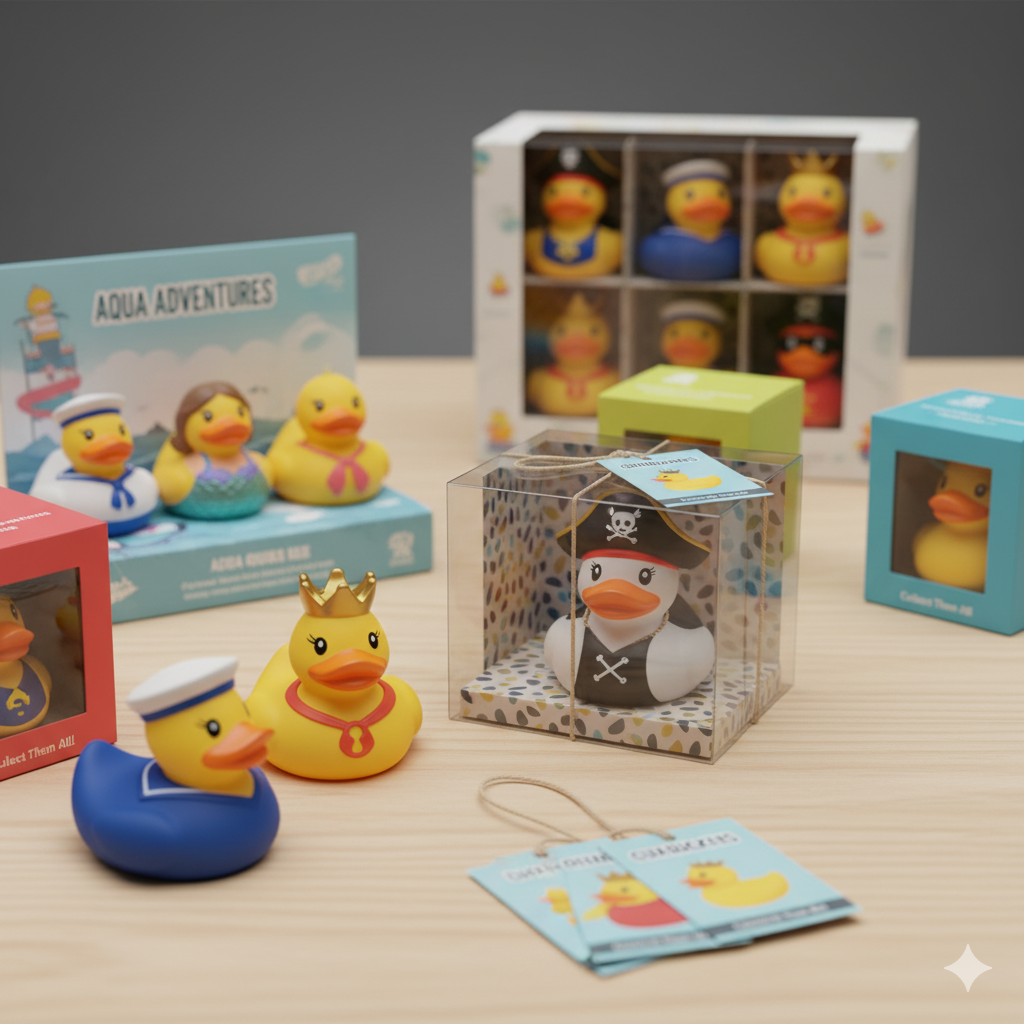
Three packaging grades and when each wins
Grade one is bulk packing: individual poly bags, counted into export cartons, the freight-efficient default our carton specs guide documents. It wins whenever the duck is a giveaway. Grade two is the printed header card or hang tag: the duck stays in a poly bag but gains a branded card with a peg hole, retail-ready at a modest cost step, with the design considerations in our hang tag guide. Grade three is the gift box: a printed folding carton, sometimes with an insert that seats the duck and its accessories, the format that turns a duck into a present, used in the sets shown in our corporate gift kits guide.
What the upgrade actually costs
Three cost lines move together. Materials: a printed folding carton costs more than a poly bag by an order of magnitude per unit, with paperboard weight, print colors and finish driving the range. Assembly: a duck in a poly bag takes seconds; a duck seated in a formed insert inside a box takes a packing step, and across 10,000 units that is a production line decision. Freight: boxes are bulkier per duck than flat-packed poly, so container yield drops, the CBM arithmetic from our landed cost guide. None of these lines argues against gift boxes for genuine retail programs; they argue for knowing the true per-unit delta before pricing your shelf.

Sustainability claims on the box
Retail packaging is where environmental claims concentrate, and where they need care. “Recyclable”, “made from recycled board”, “FSC-certified”: each is a specific claim with a specific substantiation path, and paper-based certification has an entire standards system behind it, referenceable at the Forest Stewardship Council, whose chain-of-custody marks are the recognized evidence for fiber sourcing claims on packaging. Print and finish choices interact with claims, too: plastic lamination and foil stamping complicate recyclability statements that plain kraft board supports cleanly. Buyers making green claims should also review the material-claim rules in our labeling guide, since the duck inside and the box outside get judged together.
Packaging grades compared
| Grade | Format | Cost impact | Best for |
|---|---|---|---|
| Bulk | Poly bag in export carton | Baseline | Event handouts, giveaways |
| Retail-ready | Poly bag plus printed header card | Low | Peg-hook retail, club merch |
| Gift box | Printed folding carton, optional insert | Material, assembly and freight adders | Gift retail, corporate kits, collectibles |
Video: gift set packaging in practice
The clip shows duck and packaging production of the kind behind retail programs. Packaging customization runs through our product development process, with mockups in 12 hours and samples in 7 days before any bulk commitment.
Frequently asked questions
Do retail ducks need gift boxes?
Peg-hook retail often works with a printed header card at much lower cost. Gift boxes earn their cost when the duck is a present or collectible and the unboxing is part of the product.
How much does a gift box add per unit?
Three lines: carton material and print, a packing step per unit, and lower container yield from bulkier boxes. Get the combined per-unit delta before setting shelf price.
Can we claim the box is eco-friendly?
Only with the substantiation behind the specific words. Recycled-board and FSC chain-of-custody claims have defined evidence paths; plain kraft supports recyclability statements more cleanly than laminated or foil-stamped finishes.
Does packaging change the MOQ?
Packaging print runs have their own minimums at the print supplier, which is why packaging decisions belong in the initial order conversation rather than as a post-production upgrade.