Skip to content
Two quotes for the same duck design can sit 40 percent apart, and the process behind the number explains most of the gap. Rotocasting, the hollow-cast vinyl process that makes the classic squeeze duck, and injection molding, which produces solid rigid toys, have different tooling costs, different unit economics and different safety-test behaviors. Buyers who know which process a quote assumes understand the price instantly, and understand which process their design actually needs.
Rotocasting: Hollow Walls, Soft Squeeze, Low Tooling
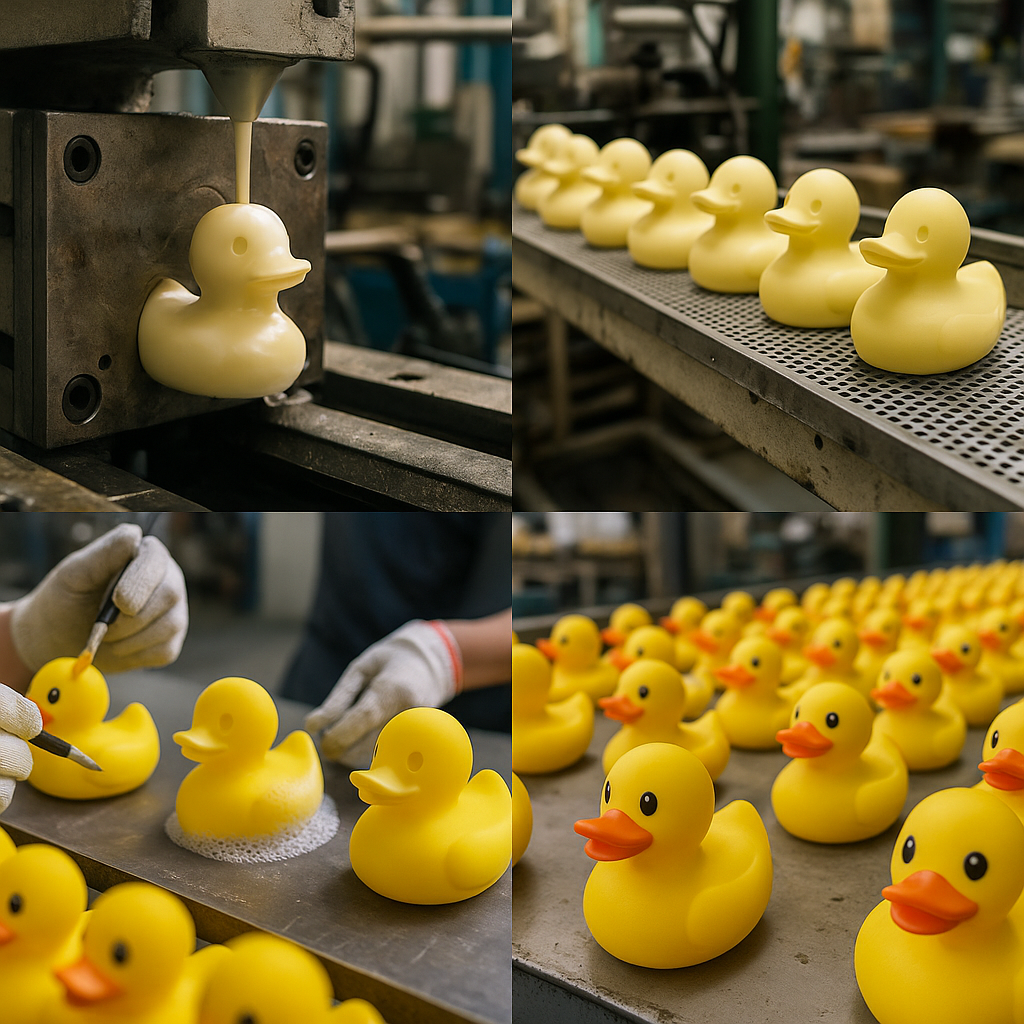
Rotocasting pours liquid PVC plastisol into a metal mold, then rotates the mold in an oven so the plastisol coats the cavity walls and gels into a hollow shell. Three consequences follow. Tooling runs modest, typically 1,500 to 4,000 US dollars for a duck-sized mold, because the tool sees no injection pressure. Wall thickness is controlled by dwell time and plastisol viscosity, which is why weight and squeeze feel are specifiable per program. And the hollow body with a sealed hole is what makes the classic duck buoyant and squeezable. Decorated details such as eyes and beaks are typically assembled after casting, a step with its own QC, as covered in the small-parts and safety discussion in the ASTM F963 toy safety framework.
Injection Molding: Precision at a Different Price Shape
Injection molding forces solid PVC or TPE into a steel tool at high pressure. Tooling starts where rotocasting ends and climbs with detail: a duck-sized injection tool commonly runs 5,000 to 15,000 US dollars or more, but the per-unit price drops hard at volume because cycles run in seconds, not the 8 to 15 minute oven cycles of rotocasting. Wall thickness is uniform, tolerances are tight, and multi-cavity tools scale output for programs in the hundreds of thousands. The trade is feel: solid injection ducks do not squeeze the same way, and buoyancy depends on trapped air in the design rather than the hollow shell process gives for free.

Which Process Fits Which Program
Rotocasting wins on 3 program types: custom designs under roughly 50,000 units, where the tooling gap dominates; any duck that must squeeze or float; and programs needing hand-painted or assembled detail at moderate volume. Injection wins on scale and precision: six-figure quantities, tight assembly tolerances, or designs with rigid multi-part assemblies. Between them sit hybrid programs, a rotocast body with injection-molded hats or props, whose added assembly steps and tooling are itemized in our multi-material and overmolding guide. When quotes arrive without a process named, ask; the answer re-frames every other line, and the full line-by-line reading is covered in the quotation line items guide. To see both processes priced against 1 duck design, start from the custom rubber ducks desk, where quotes state the process next to the tooling line.

Video: Ducks Moving Through Production
FAQ
Why is my custom duck quote higher than a stock duck price?
Custom tooling sits in the first quote: rotocast molds typically run 1,500-4,000 dollars. The per-unit price drops once the mold is amortized across the order and future reorders.
Which process makes ducks that float?
Rotocasting, structurally: the hollow shell traps air naturally. Injection ducks can float only if the design traps air deliberately, which must be engineered into the tool.
At what quantity does injection molding beat rotocasting?
Commonly above roughly 50,000 to 100,000 units depending on design complexity, where the low per-unit cycle cost repays the higher tooling.
Do the two processes test differently for toy safety?
The base materials face the same chemical limits; the difference is mechanical: small assembled parts on rotocast ducks and rigid projections on injection ducks each carry specific tests under ASTM F963.
Related reading: From Order to Shipment: A Two-Week Duck Production Run