Skip to content
A duck that tips over in the bath is a joke; a duck that tips over in a photo shoot, a display installation or a pool game is a problem. Float behaviour is not luck. It comes from where the mass sits, how wide the base is where it meets the water, and how evenly the walls were moulded.
This guide explains what makes a duck float upright, why the sample often behaves better than the bulk, and how to specify float stability as an acceptance point on a run from a line like our rubber duck production.

The Physics in Plain Terms
A floating duck is stable when its centre of gravity is low and its waterline is wide. The body forms a hull; the beak and head add mass above the waterline. If the meat of the moulding sits low and the base is broad, the duck self-rights after a nudge. If the head is heavy or the hull is narrow, it sits like a buoy and rolls easily.
The design lever available to a factory is where material thickness goes. Thickening the base and thinning the head lowers the centre of gravity, and it also changes the duck’s total weight and cost. For large ducks used in displays, a separate internal ballast or a designed cavity can achieve the same result more efficiently.
Squeaker and drain features interact with buoyancy. A hole that lets water in inverts the calculation: a duck that floated dry sits lower once water enters, and if it fills unevenly the tilt becomes permanent. This is why float behaviour must be tested with the vent design in place, not on a sealed sample.
Why Samples Float Better Than Bulk
A prototype is often made on a short run with careful handling, sometimes by a different process than the production line will use. Wall thickness on a rotational casting depends on how the mould is rotated and how the material distributes before it sets, and a prototype may simply have been moulded by a more experienced operator or with a longer cycle.
Bulk runs introduce variation: slightly different cycle times, material batches with marginally different density, and demoulding while pieces are still warm, which can deform the base. Any of those moves the waterline and changes how the duck sits.
The remedy is to specify float behaviour as an acceptance point with a stated method rather than as a qualitative hope. Something as simple as a float duration and an upright check at a defined water depth and temperature turns a subjective complaint into a testable line item.
Specifying Float Stability
A workable float specification has four elements: a water depth, a temperature range, a placement method (the duck is set on the surface, not dropped from height) and a pass definition. A common pass definition is that the duck remains upright, within a small angle from vertical, for a set period after a defined nudge.
Measurement methods for moulded products and materials support this. Dimensional and physical tests, including methods for wall thickness and mass, are catalogued in the ASTM standards library, and a supplier that already measures these can document the float result rather than describe it.
The specification should be written for the actual use. A duck for a bathtub campaign needs less stability than one photographed on a moving pool surface or displayed outdoors in wind, and writing the same specification for both wastes money.
Design Choices That Help or Hurt
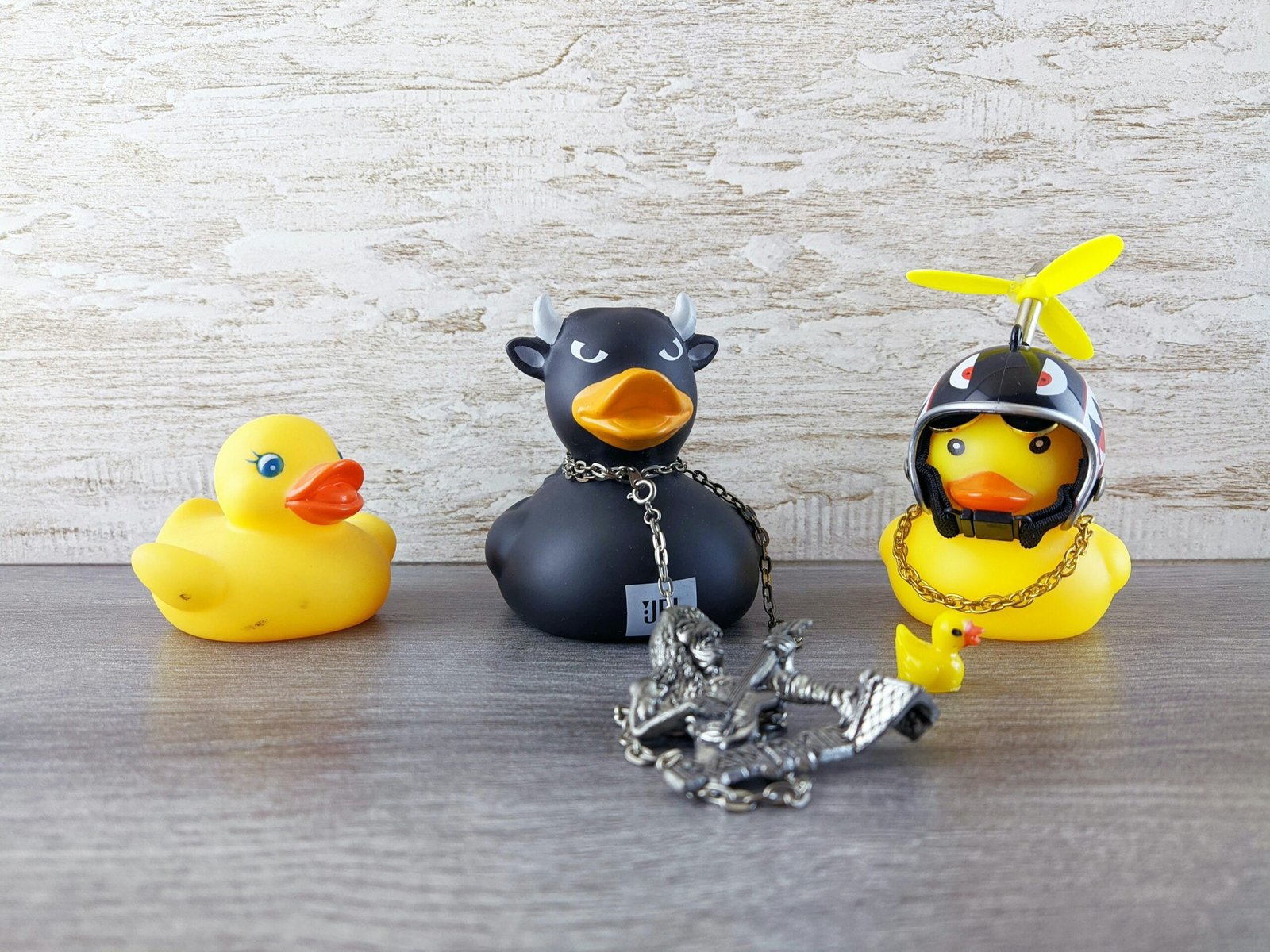
Four design decisions dominate float behaviour. Base width: wider is more stable and more material. Head mass: a large head with a heavy beak raises the centre of gravity. Vent placement: a hole beneath the waterline lets water in and destabilises over time. And accessory mass: hats and props add weight high on the body.
Where a program needs both a heavy prop and stable floating, the answer is usually ballast low in the body, agreed at the design stage and documented. Retrofitting stability after tooling is expensive, which is why this conversation belongs in the sampling round. The tooling implications of added parts are covered in our notes on multi-material ducks and overmoulding.
Colour and finish have a small effect through surface tension and material density, but they are second-order compared with mass distribution. A buyer chasing a tipping problem should look at thickness and head weight first.
Testing Without a Laboratory
A float test can be run in a bucket. Fill to a defined depth, bring the water to room temperature, set the duck on the surface, wait, then nudge it gently and observe. Record how long it takes to settle and whether it returns upright. Do this with a sample from the actual production run, not the approved prototype.
Ten pieces from across the run tell you whether float behaviour is consistent. If one or two misbehave, the issue is usually wall thickness variation, which the factory can measure with a gauge and correlate back to the moulding cycle.
If your design has to float well and carry a prop, send the sketch to our rubber duck design and tooling team. We will propose a mass distribution and a float acceptance method alongside the quotation.
FAQ
Why does my duck tip over?
Usually a high centre of gravity from a heavy head or prop, a narrow base, or water entering through a vent. Check thickness distribution first.
Why did the sample float and the bulk not?
Prototype runs are often moulded more carefully. Bulk variation in wall thickness moves the waterline and changes stability.
How do I write a float requirement?
State water depth, temperature, placement method, a settle time and a nudge test with an angle tolerance.
Do drain holes affect floating?
Yes. Below the waterline they let water in, which lowers and tilts the duck over time. Test with the vent design in place.
Can a large duck with a heavy prop float stably?
Yes, with low ballast designed in at the tooling stage. Retrofitting stability later is expensive.
Video: How moulded products float: weight and balance explained
If float stability matters for your duck design, our design and tooling team can propose mass distribution, base geometry and a bucket-test acceptance method before tooling is cut.
Related reading: Cold Weather Ducking: Winter Jeep Ducks and the Plastic
Related reading: Vinyl or Silicone Rubber Ducks: Material Behaviour and Cost