Skip to content
A rubber duck that lives on a dashboard, a windowsill or a market stall meets the sun every day, and the sun is the hardest test a plastic colour ever takes. Two ducks with the same Pantone reference can leave the factory identical and come back from summer looking like different products, because the difference was never in the colour: it was in the masterbatch and the UV stabiliser behind it.
This guide explains how colour and UV protection are built into a PVC duck, what changes fade resistance, and how to specify the combination without paying for protection the product does not need.

How Colour Gets Into a PVC Duck
PVC compound arrives as a base resin with plasticisers, stabilisers and process aids already blended. Colour is added separately as masterbatch: pellets of pigment or dye carried in a resin, dosed at a percentage in the mixer before moulding. The masterbatch formulation, not the mould, decides the colour, which is why a colour change costs a mixing run rather than a new tool.
Pigments and dyes behave differently. Inorganic pigments are stable but limited in brightness; organic pigments give vivid colour with more sensitivity to light and heat; dyes can be bright but migrate. For ducks, most colours are built from pigments chosen to survive processing heat, and the lab dip approved by the buyer is produced from the actual masterbatch that will run.
Dosing accuracy matters as much as formulation. A masterbatch dosed at a few percent by weight leaves little room for mixing error, and a small swing shows as a visible shade difference between batches. Factories that keep their dosing calibrated and their blends documented produce colour that holds between runs; the rest produce colour that the buyer re-approves every time. The colour-matching workflow behind an approved duck run is covered in our notes on Pantone matching on PVC ducks.

What UV Does to an Unstabilised Duck
Ultraviolet light breaks polymer chains and attacks pigment molecules. In an unstabilised or lightly stabilised PVC part, the visible results arrive in a predictable order: colour shifts first, then surface chalking, then embrittlement as the polymer itself degrades. A light duck usually yellows; a saturated colour often goes pale or dull rather than changing hue.
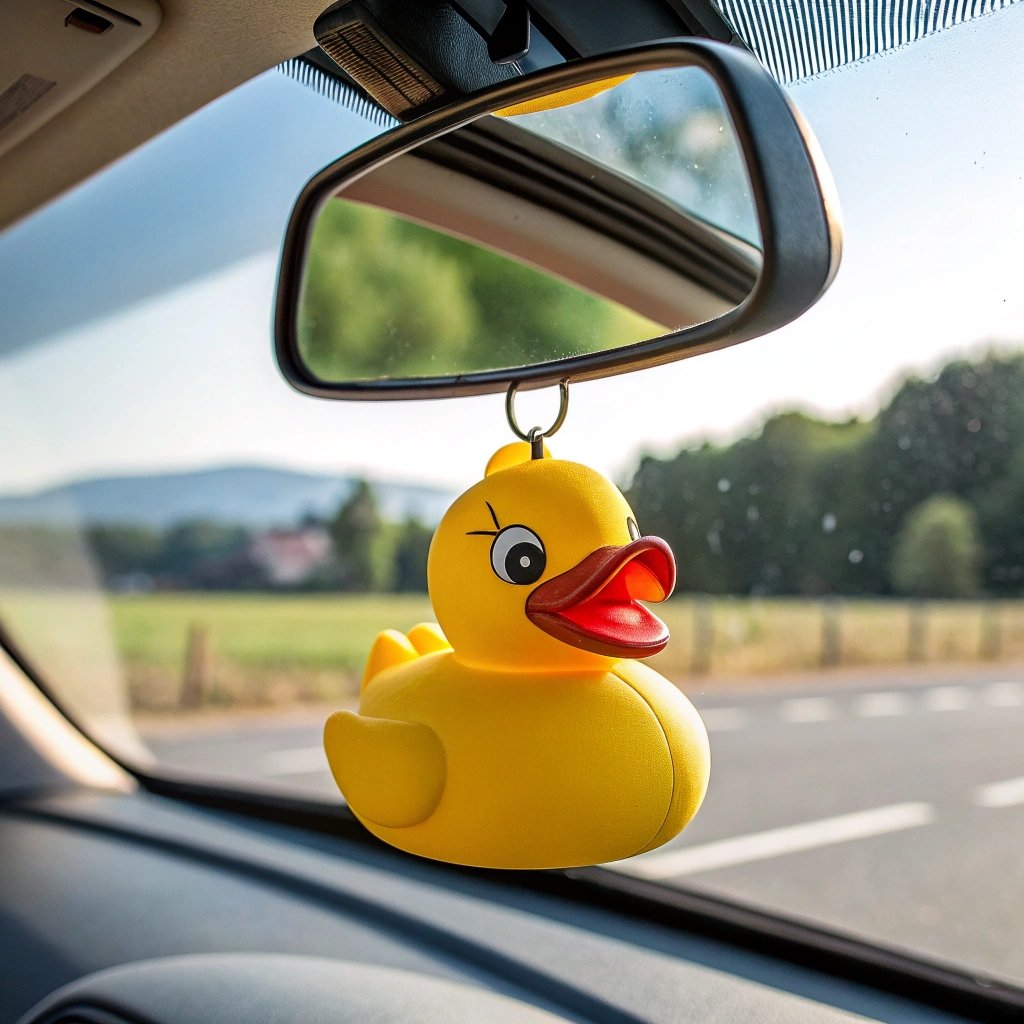
Heat accelerates the same chemistry, which is why a duck on a dashboard fades faster than the same duck on a shelf in the same room, and why black interiors are harder on plastics than light ones. Moisture and pollution add to the load. The combination is why outdoor installations and car interiors are the two applications where duck buyers notice fade fastest.
Testing makes this manageable rather than mysterious. Accelerated weathering chambers expose samples to controlled light, heat and moisture and measure colour change against the original, and the methods are catalogued in the ASTM standards library. A weathering report turns a claim about fade resistance into a comparison between two formulations, which is exactly what a specification needs.

Choosing the Stabiliser Level
UV stabilisers are dosed alongside the masterbatch, and the level is a cost decision as much as a technical one. A promotional duck used indoors for a season needs modest protection. A duck sold for dashboard use, or a large outdoor duck, needs a materially higher loading, and usually a pigment system chosen to work with it.
The trap is specifying stabiliser levels in isolation. A high load of a light-sensitive pigment will fade even with good UV protection, while a robust pigment in an unstabilised compound can still chalk and embrittle. Pigment and stabiliser are one system, and the factory should be asked what combination it recommends for the intended exposure, with a weathering result attached.
There is also a compliance dimension. Stabiliser systems in PVC sit within the additive rules that apply to the compound, and for products sold as toys the applicable safety requirements are the toy regulations of the destination market, summarised in Title 16 of the US Code of Federal Regulations. A factory that can name the stabiliser system it uses, and show the test documentation, is answering the compliance question and the fade question in one response. Our bulk duck programme documents the compound, masterbatch and stabiliser combination for every colour run it ships.
What the Buyer Should Specify
Four lines cover most programmes: the approved colour reference with the masterbatch lot, the pigment system the factory will run, the UV stabiliser level or exposure class, and the weathering test method with a colour-change limit. Where the duck will live outdoors or on a dashboard, add the intended exposure in plain words so the factory can recommend a system rather than guess.
Ask for the lot to be recorded. Colour consistency across a long campaign depends on running one masterbatch lot and one stabiliser lot, and on the factory telling the buyer when a lot runs out. A mid-campaign lot change is the single most common cause of a colour complaint that the buyer cannot explain, because both batches passed their own approval.
Finally, test the way the product will live. A weathering test on a duck that will sit in direct sun is different from one on a duck in a shop window behind glass, and the specification should say which case applies. Read alongside the general material comparison in PVC, TPR and silicone for ducks, these lines give a complete exposure specification for any duck SKU.
Reading a Fade Complaint
When a fade complaint arrives, the first question is where the duck lived. Sun, heat and glass create different loads, and a photograph with the duck’s position answers more than a colour chart. The second question is which lot it came from: if the complaint clusters in one production window, the investigation is about that lot’s masterbatch or stabiliser dosing, not about the design.
The third question is the control sample. A programme that kept a sealed duck from the approved run can compare aged product against the original and show what changed: a hue shift is usually pigment, a pale or chalky surface usually stabiliser, and embrittlement points to polymer degradation. That diagnosis directs the fix to the right line in the formulation.
Fixes are usually about the next run rather than the failed one. Replacing the pigment with a more light-stable alternative, raising the stabiliser loading, or moving the product to a different exposure class are all normal steps, and each should be verified with a weathering test before the next run is committed, so the same complaint cannot arrive twice.
FAQ
Why do two identical ducks fade differently?
Different masterbatch or stabiliser lots, or different exposure: sun, heat and glass each change the load.
What is masterbatch?
Pigment carried in resin pellets and dosed into the PVC compound before moulding. Colour changes happen in mixing, not in the mould.
Do all ducks need UV stabilisers?
No. Indoor promotional ducks need modest protection; dashboard and outdoor products need a higher loading and a suitable pigment system.
How is fade measured?
With accelerated weathering tests that compare colour before and after controlled exposure to light, heat and moisture.
What causes a campaign-wide colour problem?
A mid-campaign masterbatch lot change. Run one lot and have the factory flag when it ends.
Video: Processing Additives and UV Stabilizers Explained
If fade complaints keep arriving from the same climate, the fix is in the formulation, not the mould. The bulk duck programme documents pigment, stabiliser and lot for every colour and can run weathering comparisons before the next season is committed.
Related reading: Painted Faces and Moulded Colour on Bath Ducks: What Survives the Tub
Related reading: Vinyl or Silicone Rubber Ducks: Material Behaviour and Cost