Skip to content
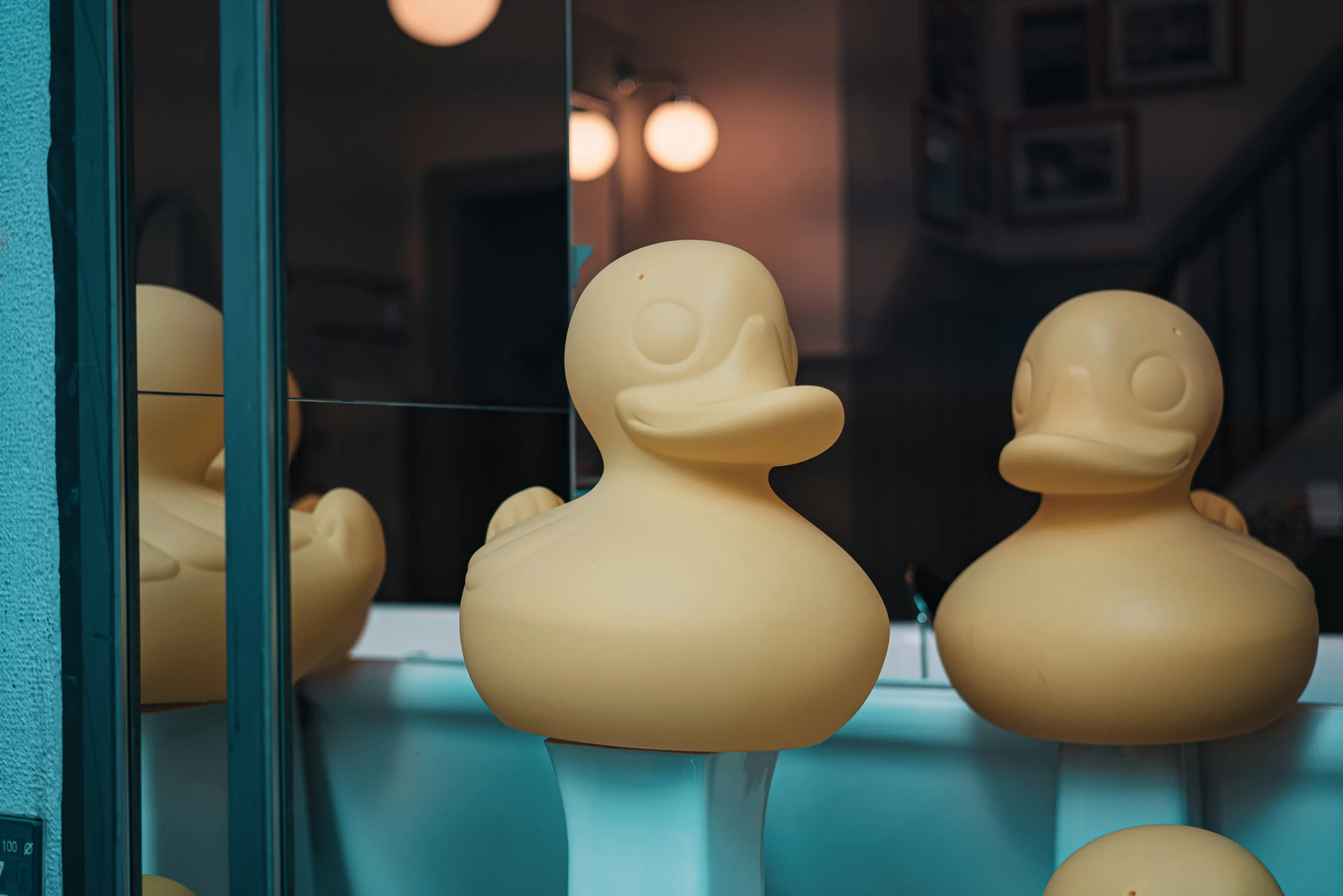
A buyer sketching a duck with a different coloured beak, or a logo panel in a contrasting shade, is usually imagining paint. Production rarely works that way.
Multi-colour ducks are made by splitting colour across the mould, over-moulding a second shot, or assembling parts after moulding. Each route changes tooling cost, minimum order quantity and how the duck behaves after a few summers in the sun, so the design decision and the production decision have to be made together.
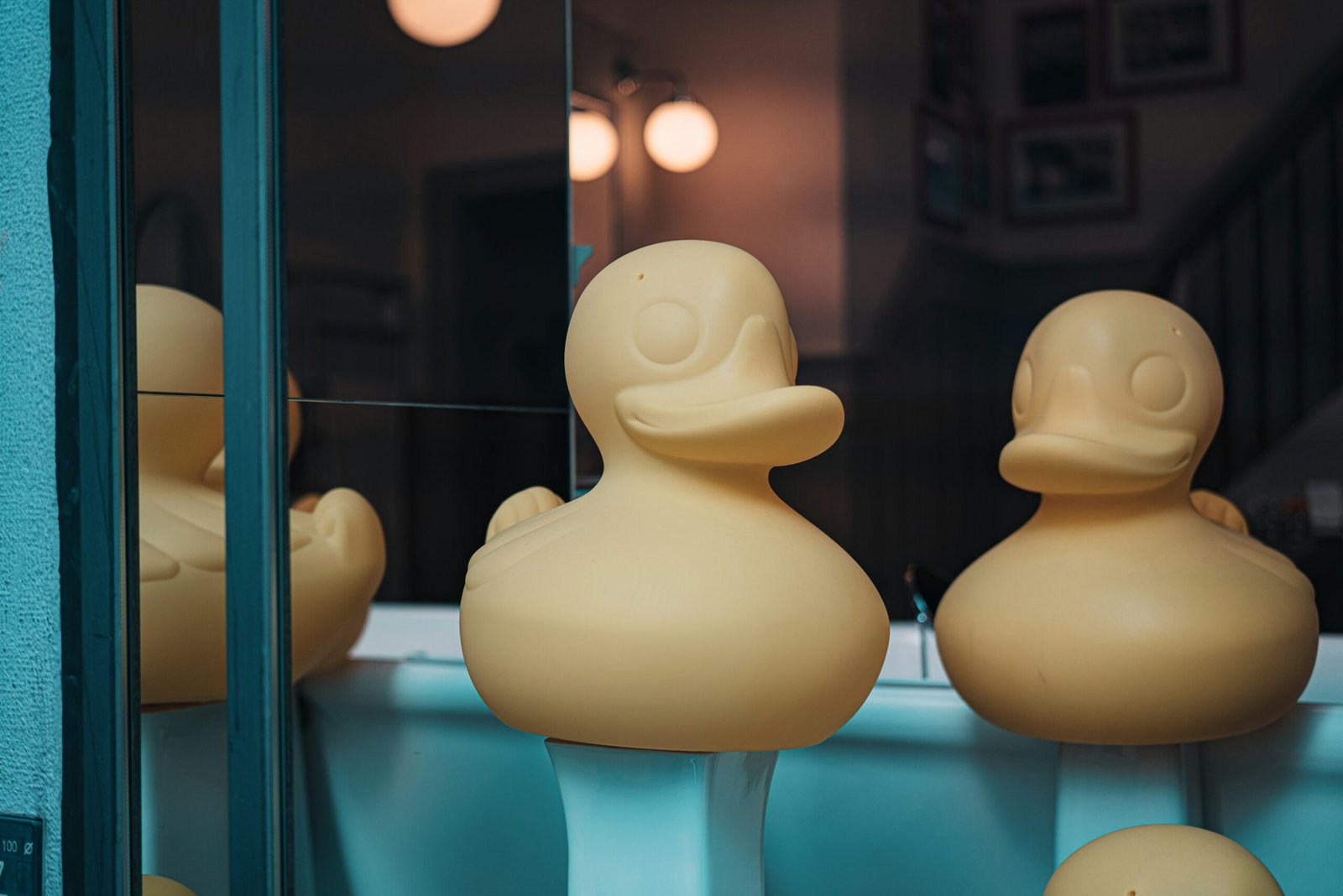
Where Colour Can Live on a Duck
There are four places colour can sit on a rubber duck: through the material, in a second over-moulded layer, on an inserted component, or applied to the surface after moulding. The first three are structural, the fourth is a coating.
Structural colour survives handling and water because it is part of the part. Applied colour, whether pad-printed or painted, sits on top and wears from the highest-contact areas first, which on a duck means the beak, the head and wherever fingers grip.
This is why a duck with a painted eye can look tired after a season while the same design with moulded eye detail still reads clearly. The comparison between painted and moulded finishes, and which traffic each suits, is set out in our notes on painted and moulded colour.
Separate Cavities: The Straightforward Route
The simplest structural two-colour build moulds the body and the beak or accessory as separate parts in separate cavities and assembles them. It is predictable, easy to cost, and the two parts can be produced in different materials where that helps.
The trade-off is an assembly step and a visible joint line. On a duck where the beak meets the head, the joint has to be designed so it reads as a feature rather than a seam, and the assembly has to be strong enough to survive being squeezed.
Cavity count and tool wear are the cost drivers behind this route, and both are covered in our notes on duck mould tooling. A two-part duck needs two cavities, and the cost of the second tool is the price of the colour split.
Over-Moulding: Colour in One Piece
Over-moulding produces a single part with two colours by moulding one material onto another, usually with a mechanical or chemical bond between them. The result has no assembly joint, which is exactly what a premium duck design wants.
The cost is tooling complexity. An over-mould tool has to hold the first shot precisely while the second is injected, and the process window between the two shots is narrower than a single-material run. That narrow window is why over-moulded ducks carry a higher MOQ and a longer sampling cycle.
Where the design calls for a colour split on a curved surface without a seam, over-moulding is the only route that delivers it. For designs where a small joint is acceptable, the assembled version usually costs less for the same visual effect.
Materials and Colour Stability
Colour stability depends on the material and the pigment system behind each colour. Pigments that are dispersed into the compound behave differently from masterbatch additions, and the difference shows up as fading, chalking or a shift in shade over time.
Where a duck is used outdoors, in a car or on a dashboard, colour stability matters more than on a bathroom shelf. Material testing against recognised methods gives a documented baseline for how a colour performs, and the ASTM standards catalogue carries plastics test methods a factory can test against.
The practical rule for a multi-colour design is to test the pair, not each colour alone. Two colours can each be stable and still drift differently, and a beak that fades faster than the body looks like a defect even when both materials met their own specifications.
What Multi-Colour Costs
Three cost lines separate multi-colour ducks from single-colour ones. Additional tooling, whether a second cavity or an over-mould tool. Additional production time, because each shot takes a cycle and assembly takes labour. And additional quality control, because colour registration and joint quality both have to be inspected.
Registration is the quality point people underestimate. On an assembled duck, registration is about fit; on an over-moulded duck, it is about the boundary between the two shots. Either way the sample has to be judged at the boundary, not at the centre of each colour.
Where budget is tight, a design that uses one structural colour plus a small applied detail is often the best compromise, because a small printed area wears more slowly than a large one. Our custom rubber duck manufacturing sets out tooling and MOQ implications for each colour route before a design is finalised.
Choosing the Route
Four questions decide it. Does the colour boundary have to be unbroken, with no visible joint? Is the duck used where the colour will be abraded? What volume justifies additional tooling? And does the design need the two colours to be different materials?
A joint-free split at volume points to over-moulding. A visible seam that reads as a feature points to assembly. A small detail on a large surface points to applied colour with a structural base. Most duck programmes end up using more than one of these across their range, which is entirely normal once the volume per design is known.
FAQ
Are multi-colour rubber ducks painted?
Not usually. Colour is normally achieved with separate moulded parts, over-moulding or inserts, because structural colour survives handling and water better than applied paint.
What is over-moulding?
Moulding a second material onto the first to produce a single part in two colours, without an assembly joint. It needs a more complex tool and a narrower process window.
Which route is cheapest for two colours?
Separate cavities and assembly, where a small joint line is acceptable. Over-moulding costs more in tooling but removes the joint.
How is colour registration checked?
At the boundary between the two colours, not at the centre of each one, on both photographs and the pre-production sample.
Does the material affect colour life?
Yes. Pigment systems behave differently, and two colours should be tested as a pair because they can fade at different rates.
Video: Inspection and Quality Control in Manufacturing
Send the design and the colour split you want, and the custom duck team will come back with the tooling route, the MOQ and a note on where the joint or boundary will sit.