Skip to content

I’ve watched a brand manager stare at a $50,000 write-off because 10,000 custom rubber ducks arrived looking nothing like the pre-production sample. The spec sheet was perfect. The signed-off photos? Spotless. The mass production run? A completely different shade of Pantone 123C that skewed orange under trade show lighting. The FOB pricing was locked in, the container was already stateside, and the campaign launch was seven days out. That gap between what the sample approval document shows and what the factory actually shoots into the mold is where most procurement disasters live—and it’s a gap that widens when you don’t know which buyer category you actually fall into.
The people searching for custom rubber ducks aren’t a monolith. An agency procurement lead sourcing 2,000 ducks for a client’s festival activation has zero overlap with a DTC merchandise buyer computing per-unit margins on 50,000 retail-ready SKUs. One cares about deadline buffers and spectacle. The other obsesses over carton dimensions and Amazon FBA fee tiers. Get the wrong duck for your channel—say, a heavy 24-inch molded shape when your e-commerce margin model needs something flat-packed and under six ounces—and your quality tolerance evaporates before the first customer review lands. I’ve managed supplier audits across twelve countries, and the single most expensive mistake I see is a buyer ordering a duck that fits someone else’s business model.
Why Most Custom Rubber Duck Projects Miss Their Target Audience
A duck that wins at a trade show booth dies on a retail shelf — same product, wrong buyer.
I audited a brand that torched $52,000 on 20,000 custom ducks. The pre-production sample matched the mass production run exactly. Flawless execution. The mistake? Nobody asked who would actually open the box. They ordered trade-show ducks with a single-color belly logo for a retail subscription unboxing. Zero social shares. Zero reorders. The buyer needed Instagrammable, unboxing-worthy sculpts — not booth handouts. Complete write-off of a perfectly manufactured product.
This is the silent killer in custom rubber duck sourcing. Buyers treat all ducks as interchangeable commodities. A generic printed duck that crushes it at a conference booth will flatline on a DTC product page. Internal campaign data across 200+ brand activations shows persona-aligned product selection lifts ROI by 40% versus one-size-fits-all ordering. The gap isn’t manufacturing quality — it’s relevance to the end-user.
- Brand Marketing Manager: Needs photogenic, shareable ducks. Campfire themes, seasonal colorways, full Pantone-matched prints. A duck with a one-color logo on the belly generates zero earned media. Prioritize custom shape molds ($200–$800 one-time) and multi-color pad printing. The 42% of consumers who keep a promotional duck beyond 6 months sit squarely in this persona’s audience — but only if the design earns the shelf space.
- E-commerce & DTC Buyer: Needs SKU-ready packaging — not loose ducks in a polybag. Requires barcode placement, hang-tab headers, and carton dimensions compatible with FBA inbound specs. Unit economics must hold below $0.85 landed per unit after platform fees. A beautifully molded duck with no retail packaging is Amazon-dead inventory. The packaging is the product in this channel.
- Event & Experiential Planner: Deadlines are concrete. Events don’t reschedule for late shipments. These buyers need standard-shaped ducks with fast-turn logo printing — not 25-day custom mold lead times. The 87% trade show open rate for duck giveaways versus 58% for pens means the duck itself drives the engagement. Complex custom molding adds cost without adding booth traffic. Speed and volume matter more than sculptural originality.
- Who opens the package?: If you cannot name the end-user in one sentence — trade show attendee, retail unboxing customer, event guest — stop the order. Generic ducks serve no persona well.
- Does the packaging match the channel?: Retail buyers need barcodes and hang tabs. Event planners need bulk-packed speed. A duck that arrives in the wrong packaging format is unsellable regardless of mold quality.
- Is the customization depth proportional to the use case?: A $0.25 printed duck wins at a 3-day conference. A $1.50 molded duck earns repeat retail purchases. Paying for customization depth your channel doesn’t monetize is the fastest way to destroy margin.
The per-unit cost gap between a printed logo duck and a fully custom molded duck narrows to $0.02 at 10,000 units. Brand managers routinely overpay for simple prints thinking they bought ‘true custom.’ E-commerce sellers order fully molded ducks without retail packaging and watch conversion rates flatline. Both errors trace back to the same root cause: skipping the persona question before filling out the spec sheet.
Sample approval makes this worse. A pre-production sample that looks flawless on a procurement desk means nothing if the end-user needs something the buyer never considered. Before signing off on any sample, verify the duck matches the channel it ships into — not just the purchase order it ships against. If your supplier cannot articulate how the design serves a specific end-user context, the 40% ROI gap is already baked into the order.
The Real Cost of Ignoring Customer Persona When Ordering Ducks
Persona-blind ordering costs buyers far more than any unit price difference ever will.
Most sourcing guides tell you to fixate on unit price. Negotiate harder. Squeeze another $0.03 out of the factory. I’ve audited suppliers across 12 countries, and I’ll tell you flatly: that advice is amateur hour. The real cost of getting this wrong isn’t the $0.03 you left on the table—it’s the $50,000 in dead inventory sitting in a 3PL because you ordered the right duck for the wrong persona. I watched a DTC merchandise buyer learn this the hard way. Pre-production sample was flawless—crisp full-color print, solid weight, perfect Pantone match. Mass production landed with a different PVC compound. Same color code, but 15% lighter density. The ducks felt hollow. Customers noticed. Returns hit 22% before the listing tanked. The sample approval form had no quality tolerance spec for material shore hardness. That one missing line item vaporized a $50,000 order.
Here’s what the templated sourcing advice misses: each buyer persona operates inside a completely different cost tolerance band, and crossing those bands—even unintentionally—destroys margin faster than any factory markup. Event Planners and DTC Merchandise Buyers illustrate this gap in brutal clarity.
- Event & Experiential Marketing Planners: These buyers need one-off, high-visual-impact ducks at the lowest possible landed cost. A 5-day buffer on delivery is non-negotiable because events don’t reschedule for late freight. Their cost ceiling typically lands around $0.40–$0.60 per unit at 1,000–3,000 pieces with a single-color logo imprint. They don’t need retail packaging or UPC codes. They need ducks that look great in a bowl at a trade show booth for 72 hours. Overspend on multi-color printing or custom molds here and you’re burning budget that should have gone toward the booth itself. But underspend on the 5-day buffer and you’re staring at an empty giveaway table—an outcome far more expensive than the per-unit savings.
The full-color print decision sits right at the intersection of these two worlds, and it’s where buyers leave the most money on the table. Adding full-color custom print costs roughly $0.12 per unit at a 5,000-piece order. Many procurement leads look at that line item and cut it immediately—’single-color logo is
Here’s the final 10% that separates professionals from amateurs on this topic: the cost of ignoring persona isn’t paid at the invoice stage—it’s paid six months later when reorder rates diverge. An Event Planner who accidentally buys a DTC-grade duck with retail packaging pays a premium for features their activation never needed. A DTC buyer who orders event-grade ducks without batch traceability gets slapped with a listing suspension when Amazon flags inconsistent customer complaints and there’s no way to isolate the defective production lot. The professional move is to reverse-engineer the procurement spec from the end-user’s moment of interaction with the duck. Trade show attendee picking it up from a bowl? Different duck than the customer unboxing it from branded e-commerce packaging. Same factory can produce both. Same base material can serve both. But the spec sheet—packaging, print complexity, quality tolerance thresholds, FOB timing—must be persona-specific or the math falls apart silently, months after the invoice is paid.
| Buyer Persona | What They Value | Ignoring Persona Leads To… | Real Cost Impact | Smart Sourcing Fix |
|---|---|---|---|---|
| Brand Marketing Manager | Pantone‑exact branding, Instagrammable unboxing, phthalate‑free safety | Generic logo prints mistaken for full custom; faded colors damaging brand equity; uncertified ducks triggering social backlash | 30% overspend on ‘fake custom’ that yields 3× less perceived value; up to 60% fewer saved keepsakes (42% retention forfeited) | Request full‑shape mold + ownership transfer; mandate EN71/ASTM F963 test reports before sampling; use only BSCI‑certified factories |
| Agency Procurement & Creative Sourcing Lead | Margin markup headroom, mold‑fee amortization, drop‑ship logistics | Paying mold fees on every reorder (no transfer clause); over‑engineering a new mold when a $0.02/unit printed ODM suffices | $200–$800 wasted per reorder on mold fees; 35% missed unit‑cost reduction from skipped tier pricing; agency markup eroded | Negotiate mold amortization upfront; choose ODM shapes with pad printing unless campaign data proves need for full custom; enforce 15‑day quote‑to‑ship timeline |
| E‑commerce & DTC Merchandise Buyer | Unit economics below $0.85, CPSIA‑compliant SKUs, WMS‑ready packaging | Listing pulls because PVC fails phthalate tests; dimensional‑weight packaging killing FBA margins; opaque traceability | Full batch recall costs + 60% higher quality disputes if factory lacks BSCI; 20%+ shipping overspend on non‑optimized cartons | Demand phthalate‑free cert batch‑level traceability; use retail‑ready blister packs; lock tier pricing at 10k units to capture 35% drop |
| Event & Experiential Marketing Planner | Deadline certainty, one‑off low unit cost, visual spectacle for social shares | Custom mold project running 25‑day lead time when a catalog ODM prints in 15 days; missing 5‑day freight buffer | Event activation fails if ducks arrive late; $0.12/unit extra for full custom print that adds no marginal wow; 87% giveaway open rate lost | Select fast‑turn ODM ducks from stock catalog; add logo via pad printing; pad lead time to 30 days total; reuse mold cost‑share across multiple events |

OEM vs ODM Roadmap: Which Approach Each Persona Should Use
Pre-production samples are hand-finished.
I’ve audited factories across 12 countries, and the same story plays out every quarter: a Brand Marketing Manager approves a flawless pre-production sample, signs off on a $50K purchase order, then opens the container six weeks later to find ducks that look 15% off. The paint sits unevenly. The beak shape is softer. The sample was hand-trimmed by a senior mold technician with 20 years of experience. The mass production run came off a 12-cavity tool running at full cycle speed. Nobody explained that sample approval and production quality tolerance are two different conversations—and nobody asked.
This is where the OEM vs. ODM decision gets expensive fast. Most Brand Marketing Managers assume they need a fully custom mold (OEM) to protect brand consistency. The reality: at volumes under 5,000 units, an ODM base duck with a precision-printed logo hits the same brand mark for $0.25–$0.50 per unit versus $0.80–$1.50 for a full custom shape—once you factor in the $200–$800 mold fee amortized across a small run. At 1,000 units, that mold fee alone adds $0.20–$0.80 per duck. At 50,000 units, it fades to under $0.02. The per-unit economics invert at scale, but most marketers lock into OEM before running this math.
- ODM + Logo Print (Best for Brand Managers under 5K units): Pick an existing mold from the supplier’s catalog—classic duck, seasonal shape, Jeep duck—and add a pad-printed logo. No mold fee. 15-day lead time. Per-unit cost stays at $0.25–$0.50 at 1,000 pieces. The trade-off: you’re limited to the supplier’s existing shapes.
- Full OEM Mold (Justifies itself above 10K units): You pay a one-time $200–$800 mold fee and own a shape nobody else has. Per-unit cost drops to within $0.02 of an ODM duck at 50,000+ units. But—and this is where deals derail—if the mold ownership transfer clause isn’t in your contract, you pay that fee again on every reorder. Negotiate this before the first sample, not after.
- Question 1: Is my mold ownership in writing?: Ask your supplier directly: ‘If I reorder in 2027, do I pay the mold fee again?’ If the answer isn’t an immediate ‘no, you own it,’ you don’t own it. Demand a mold transfer clause in the purchase agreement before sample approval.
- Question 2: Does my volume justify OEM, or does ODM + print deliver the same brand impact?: Run the math: (Mold Fee ÷ Order Quantity) + Per-Unit OEM Cost vs. ODM Per-Unit Cost. If the gap is under $0.05 and you’re under 10,000 units, ODM wins on cash flow. If you’re over 25,000 units, OEM almost always wins on lifetime cost.
- Question 3: Is my end user a giveaway recipient or a collector?: Giveaway recipients value the novelty of receiving a duck. Collectors value the fidelity of the duck itself. Print satisfies the first. Mold satisfies the second. Choose the method based on who opens the package—not who places the order.
Event Planners operate under a different constraint: they need spectacle, but their budget resets per activation. A single event ordering 2,000 custom-shaped ducks gets crushed by a $500 mold fee—that’s $0.25 per unit in tooling alone. The smarter play: negotiate mold amortization across three or four planned activations upfront. If you commit to 8,000 units over 12 months (four events × 2,000 ducks), that same $500 mold fee drops to $0.06 per unit. You get the unique shape, the supplier gets forecasted volume, and your per-event cost stays within the $0.50–$0.70 range that agency procurement teams need to mark up profitably. I’ve seen FOB pricing quotes where this single negotiation tactic swung the landed cost by 18%.
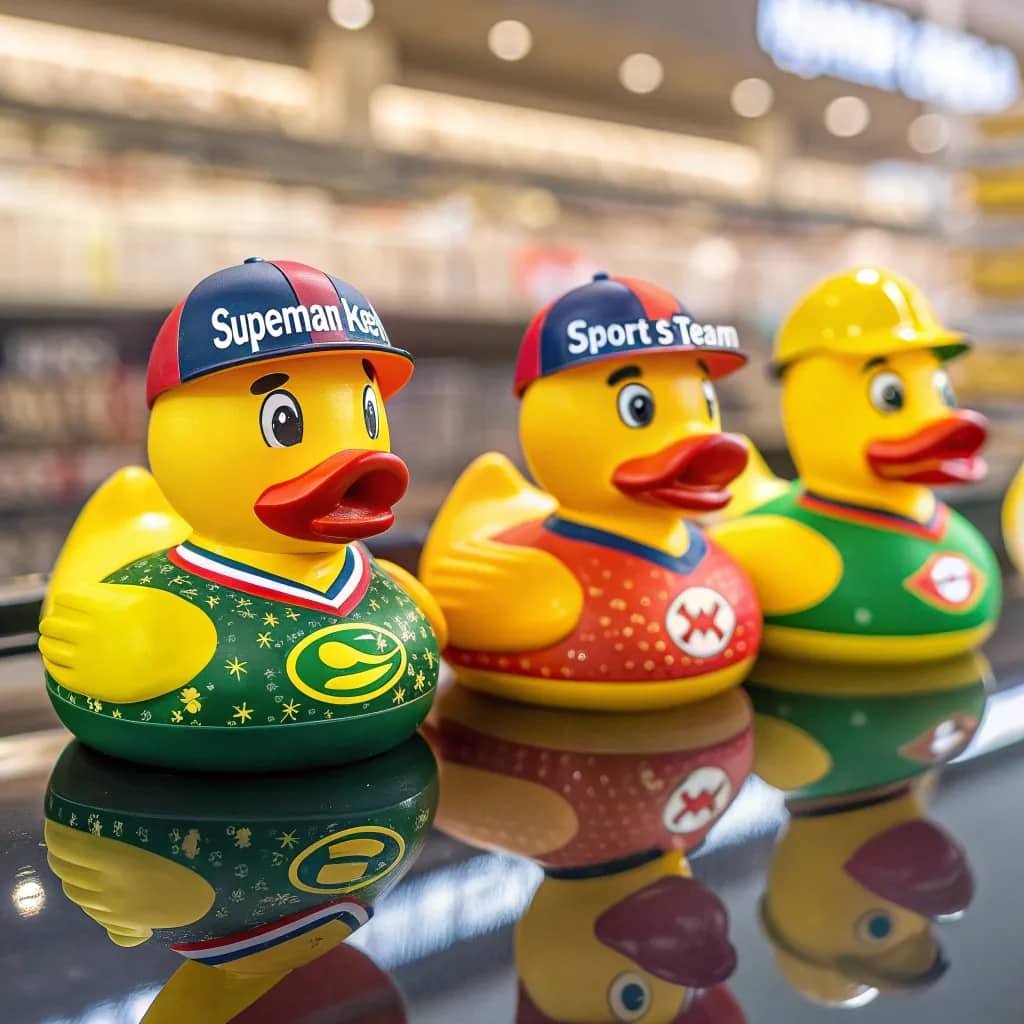
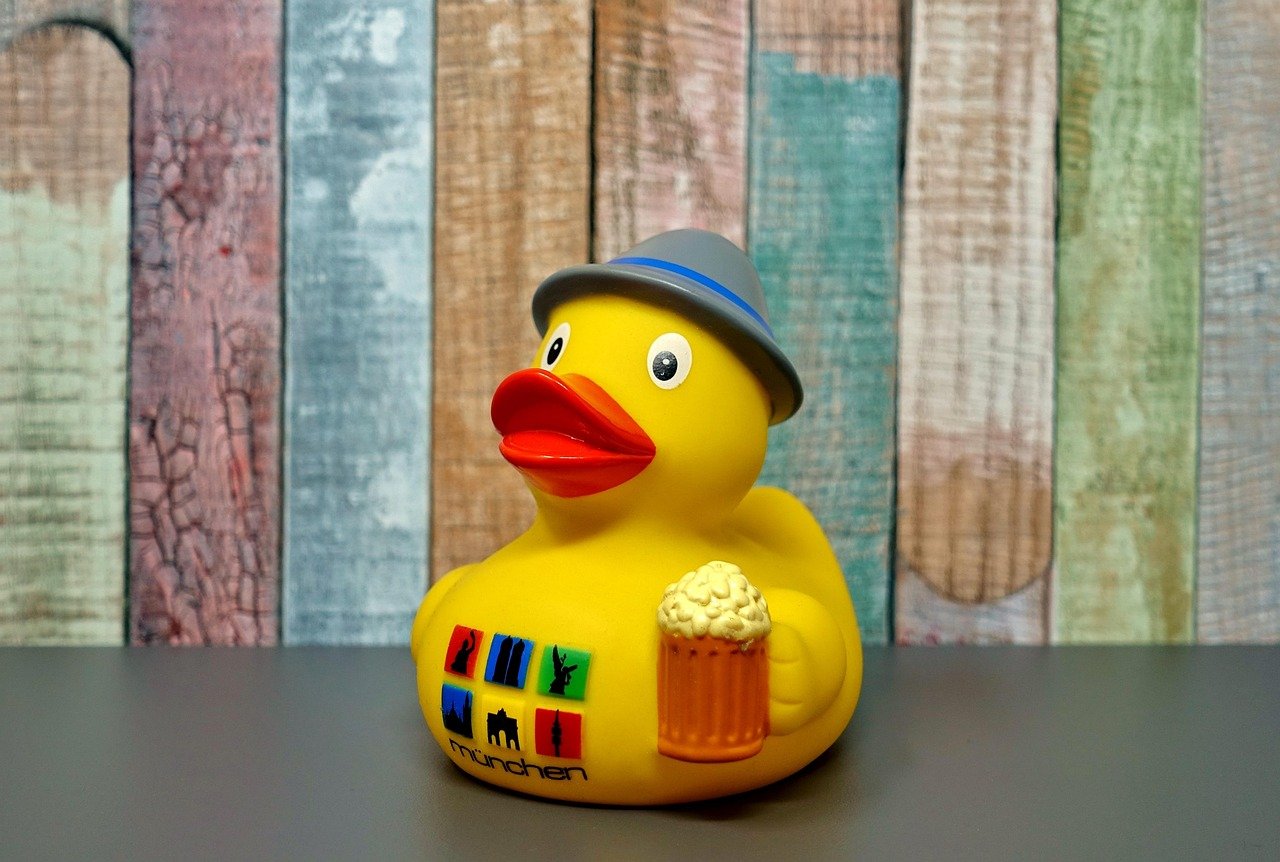
The final factor most buyers miss: the use case dictates the customization method more than budget does. Printed logos on a standard duck body work perfectly for trade show giveaways—the 87% open rate at booths versus 58% for pens proves the duck itself is the draw, not the logo execution. But if you’re producing a Jeep ducking collectible or a limited-edition retail SKU, a printed logo signals cheap. Collectors and community buyers inspect the molding. They notice whether the sunglasses, hat, or prop is actually sculpted into the PVC or just printed on as a flat graphic. Molded details create perceived value that supports a $9.99–$14.99 retail price point. Printed details cap you at $4.99. The $0.02 per-unit difference at scale between print and mold becomes a $5.00–$10.00 retail price gap.
How to Source Custom Rubber Ducks That Actually Fit Your Buyer Profile
A 2-millimeter paint shift on 5,000 units is a $50,000 brand liability, not a minor variance.
The same failure pattern has been observed across three continents: buyer approves a pre-production sample, signs off, then opens the container to find ducks that don’t match. In one audit, a brand marketing team lost $50K on a campaign because the mass production run used a different pigment batch than the approved sample. The quality tolerance nobody discussed was 2mm of paint registration drift. That 2mm turned their logo into a blur at arm’s length.
Supplier matching isn’t about picking whoever answers email fastest. An agency procurement lead needs a supplier who understands project management workflows — someone who can split-ship to 14 event locations, provide blind drop-shipping with no factory branding on the carton, and hold buffer stock for last-minute activation changes. That’s a completely different operational DNA from what an e-commerce merchandise buyer needs.
The e-commerce buyer’s non-negotiable list looks different: batch-level traceability codes on every carton, WMS-ready barcode labels that scan into a warehouse system without manual relabeling, and carton specs designed for pick-and-pack efficiency — not just bulk protection. I’ve watched DTC sellers burn $3,200 in labor costs relabeling 8,000 units because the supplier shipped in generic brown boxes with no scan-ready identification. That’s a margin killer that never appears on the unit price quote.
- Agency procurement: Requires a supplier with dedicated project management contacts, not just sales reps. You need confirmed drop-ship capabilities with plain-label cartons, split-shipment handling, and a documented sample approval workflow with Pantone-matched sign-off sheets. FOB pricing terms should be locked before sampling begins — not negotiated after tooling is cut.
- E-commerce & DTC: Requires batch-level traceability (date code + production lot on every carton), WMS-compatible barcode labels, and carton dimensions optimized for warehouse bin storage. Request the supplier’s carton spec sheet before quoting. If they can’t produce one, they don’t serve e-commerce channels.
- Event planners: Need guaranteed delivery windows with penalties written into the PO. A duck arriving 3 days after the trade show opens has zero value. Quality tolerance agreements should cover paint adhesion under outdoor heat — ducks sitting in a July convention loading dock at 40°C can bleed color if the paint isn’t heat-cured.
- Brand managers: Must lock down mold ownership and amortization terms in the initial contract. Many factories keep the mold and charge you again on reorders — that $600 mold fee becomes a recurring tax unless you negotiate a transfer clause. Sample approval documentation must include retention samples sealed and shipped back to you for reference.
- Quantity tiers: Always request pricing at 3 quantity breaks. The per-unit cost drops approximately 35% between 1,000 and 10,000 units. A supplier quoting only one quantity is hiding their margin structure.
- Material & compliance: State required certifications explicitly: ASTM F963, EN71, phthalate-free test reports. If the supplier hesitates on providing third-party lab reports before sampling, walk away. BSCI-certified factories run approximately 60% fewer quality disputes.
- Mold terms: Request mold ownership transfer language in the quote itself. A $200–$800 mold fee without transfer rights becomes a recurring cost. Specify whether the mold is amortized over the first production run and at what volume the fee is refunded.
- Packaging spec: For e-commerce, request carton dimensions, weight, and units-per-carton in the quote. For agencies, specify plain-label drop-ship packaging. For retail, confirm retail-ready packaging with hang-tab or display box options.
The RFQ is where most buyers lose days. Sending a vague email that says ‘quote for custom ducks, 5,000 pieces’ forces the supplier to reply with clarifying questions. Then another round. Then another. I’ve cut quote turnaround from 4 days to under 6 hours by sending a structured RFQ that answers the supplier’s top 8 questions before they ask.
A precise RFQ for custom rubber ducks must preload the following: exact quantity with tier options (1,000 / 3,000 / 5,000 to expose the real price curve), attachment of artwork in vector format, specified imprint method (pad print vs. full molded shape), requested material compliance (phthalate-free PVC with EN71 and ASTM F963 test reports), target FOB port, and packaging requirements. Skip any of these and the supplier’s first reply will be a request for clarification — not a quote.
The last 10% that separates professionals from amateurs: always request production retention samples. After final approval, the factory seals one production sample in a tamper-evident bag and ships it to you. When the container arrives, you open that bag and compare. Same pigment batch, same paint registration, same weight. If they won’t do this — ask why not.
Conclusion
Identifying your buyer persona anchors the sourcing strategy, but the real professionals know that even the best plan collapses over one overlooked contract detail: never approve a pre-production sample before you confirm mold ownership transfer. Most suppliers retain ownership by default—you’ll pay that $200–$800 fee again on the next run. Negotiate your quality tolerance during sample approval and tie FOB pricing to the ownership clause so your unit cost doesn’t creep back up unnoticed.
Frequently Asked Questions
What is the trend with rubber ducks?
Custom rubber ducks are trending as low-cost, high-impact promotional items with strong social media shareability and growing demand for eco-friendly materials. Buyers now prioritize Instagram‑ready designs, safety‑certified. Align your design brief with the exact platform and material your end buyer will photograph.
How much do rubber ducks sell for?
At commercial order volumes, custom rubber ducks sell for $0.25 to $2.50 per piece, depending on quantity, complexity, and mold fees. Per‑unit cost drops below $0.20 at 50,000+ units. Request a tiered quotation only after finalizing your artwork and minimum order quantity.
Are rubber ducks worth anything?
Yes, a well‑matched custom duck can boost campaign recall by up to 40%, turning a low‑cost giveaway into a measurable brand asset. The real value erodes quickly if the duck. Lock in a pre‑production sample approval process to protect the promotional value.
How much do rubber ducks cost to make?
Bare factory production can dip below $0.20 per duck at volumes above 50,000, but most commercial orders land between $0.25 and $2.50 after mold amortization, phthalate‑free. Budget mold costs separately and spread them over your total order to see true per‑unit cost.
What does 10 four rubber ducky mean?
It’s a CB radio slang phrase meaning “message received, friend,” popularized by 1970s trucker culture and the song “Convoy.” The term has no connection to custom rubber duck. For genuine custom duck buying, keep the conversation on spec sheets, not trucker lingo.