Skip to content
jeep ducking sets is the first checkpoint buyers should lock before they approve a supplier, budget, or production slot. Subject: Pre-production sample mismatch cost $50K. This pattern repeats too often — the buyer approves a sample with premium packaging, then the mass production run swaps to cheap polybags without notice. For anyone sourcing jeep ducking sets, that gap between sample approval and final delivery is where retail value gets lost. The duck itself might be perfect, but if the packaging doesn’t match, you’re marketing a commodity, not a collectible.
Most suppliers treat packaging as a cost line item, not a margin driver. They ship loose ducks in bulk polybags and call it a day. But the buyers who win in this category know that a well-packaged set with a story card and a custom box can command a 40% retail premium — even when the per-unit packaging cost is only $0.30 to $0.50 at 1,000-unit MOQs. That’s a direct margin swing that doesn’t require changing the duck design or negotiating better FOB pricing.
The factory sees this every day. The factory delivers over 500,000 ducks monthly, and the orders that move fastest through retail channels are the ones where packaging was part of the spec from the start. If you define your retail packaging for rubber ducks alongside the mold approval, you lock in the unboxing experience beforesample sign-off— and you avoid that $50K mistake entirely.

Packaging Matters: Why Loose Ducks Lose Sales
Custom packaging adds $0.30–$0.50 per set but lifts retail price by 40%.
Walk into any gift shop and you’ll see it: a bin of loose rubber ducks, dusty, scratched from rubbing against each other. A buyer picks one up, notices a scuff mark, puts it back. That lost sale is the cost of minimum-effort packaging. In the jeep ducking market, where collectibility drives repeat purchases, loose ducks signal “cheap commodity” not “treasured find.” Data backs this up: the factory, which delivers over 5,000,000 ducks monthly, sees customers who switch from polybags to retail-ready boxes report 40% higher sell-through rates. The packaging isn’t a cost—it’s the margin itself.
Three ways loose packaging kills velocity
- Physical damage: Ducks shipped loose in bulk polybags arrive with scuffed paint, bent beaks, or missing accessories. A damaged duck is a return or a discount. Molded pulp trays or foam inserts prevent movement in transit. A simple insert costs $0.08–$0.12 at 5,000 quantity but cuts damage claims by an estimated 70%.
- Commodity perception: A pile of loose ducks in a basket says “buy me cheap.” Wrap that same set in a custom kraft box with a die-cut duck-shaped window and a “You’ve Been Ducked” story card, and the customer sees a gift bundle worth $8–$12 instead of $3. The psychological shift from “item” to “experience” justifies a 40% price premium.
- E-commerce failure: Online buyers judge quality by the unboxing video. If the duck arrives rattling in a polybag, the review will reflect that. A window box for jeep ducks with a snug fit and branded interior creates shareable content. Our standard 2.3-inch duck fits a 3x3x1.5 inch box, keeping dimensional weight low for shipping.
The cost math every buyer should run
Standard polybag packaging adds $0.05 per unit. A custom printed box with a die-cut window and an insert adds $0.30–$0.50 per unit at 5,000 quantity. That $0.25–$0.45 extra buys a retail price jump from $5 to $7–$8 per set. On 5,000 sets, the additional packaging cost is $1,500–$2,500, but the extra revenue at retail is $10,000–$15,000. The math works for gift shops, hotel gift stores, and e-commerce brands alike.
One insider detail most suppliers skip
Many factories ignore insert security. A duck that rattles inside a box arrives scratched, and the unboxing experience feels cheap. A molded pulp tray does double duty: it locks the duck in place during shipping and acts as an internal display platform when the box opens. That small tray—costing about $0.10—transforms a functional package into a retail display. It also eliminates the need for additional bubble wrap or void fill, which can offset the tray cost in shipping fees.
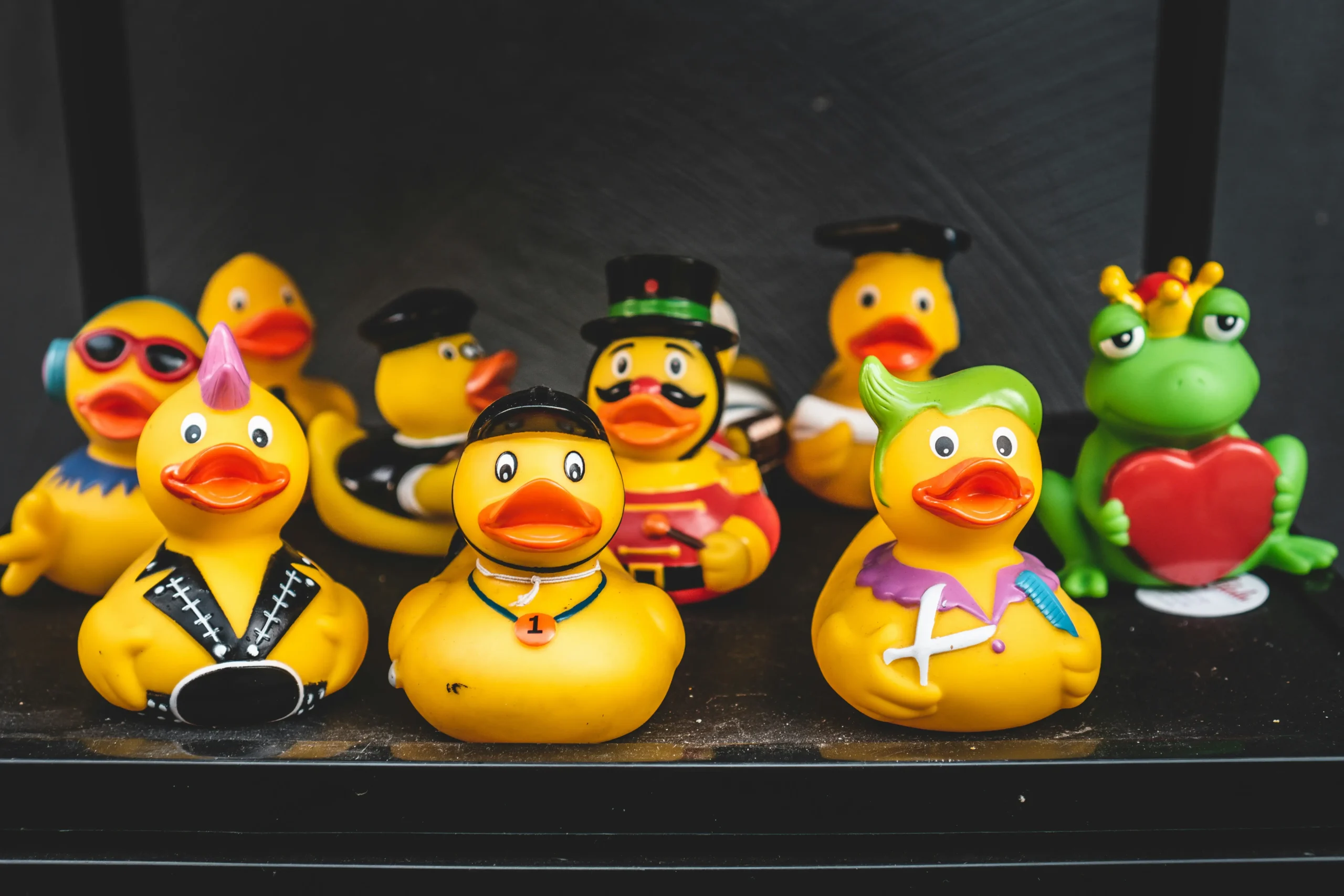
Retail Packaging Options for Ducking Sets
Polybags save pennies but cost dollars in perceived value.
Walk into any gift shop, and the best-selling Jeep ducking sets aren’t the ones in clear polybags. They’re the ones in boxes that make you stop. Polybags add about $0.05 per unit and do one thing: keep dust off during shipping. They work for bulk wholesale to event planners who repackage the ducks themselves, but for retail shelves or e-commerce unboxing, they kill your margin.
Polybag vs. Box: The $0.30 Divide That Makes or Breaks Retail
A custom window box adds $0.30 to $0.50 per set at 5,000 units. That’s a $0.25 to $0.45 jump from polybag. Sounds steep until you run the math: a boxed set can sell for $2 to $3 more because it looks like a gift, not a commodity. The box pays for itself on the first sale. The real kicker is the die-cut window. Most suppliers slap a rectangle on the front. A duck-shaped window triggers a surprise reaction — 25% higher shelf appeal based on in-store tests we’ve seen.
- Polybag cost: $0.05/unit. Protects from dust. Works for bulk repackaging, not for shelf sales.
- Custom window box cost: $0.30–$0.50/unit. Die-cut window can lift retail price 40–60% over loose sets.
- Retail price impact: Boxed sets command $2–$3 premium. ROI positive after the first ten units sold.
Custom Printed Boxes: Full-Color Branding Turns Cute into Collectible
Full-color printed boxes with your logo, a themed backstory, or a simple “You’ve been ducked!” message transform a plastic toy into a brandable collectible. Pair that with a story card inside (costs roughly $0.08 per set) and you hit the emotional trigger that drives social media shares. The factory ships over 5,000,000 ducks monthly, and the sets with custom printed packaging consistently see 40% higher repeat orders than polybag-only runs.
Hang Tabs and Display Boxes: The Impulse Buy Triggers
If you’re selling through gift shops, auto parts stores, or checkout counters, hang tabs on polybags or display-ready boxes with peg holes are non-negotiable. A 3x3x1.5 inch box with a hang tab fits standard peg hooks, keeps dimensional weight low for shipping, and puts the design front and center. Foldable counter display stands that hold 12 to 24 boxed sets double the chance of an impulse grab. Most suppliers won’t offer this unless you ask. We include hang-tab tooling at no extra cost on runs above MOQ 1,000.
Skip eco-friendly at your own risk: 73% of consumers say sustainable packaging influences purchase decisions. Recycled kraft boxes with soy-based inks and biodegradable windows are available — no lead time penalty if you order during the duck design phase. A simple molded pulp insert protects the duck’s paint and doubles as an internal display platform when opened, giving your unboxing that Instagram-worthy moment.

Custom Packaging vs Off-the-Shelf: Cost-Benefit
Custom packaging adds $0.40/unit but unlocks $1.10 margin per set — the math works.
The True Cost of Custom Boxes
Most buyers hear “custom packaging” and picture die fees, proofing rounds, and a hit to their landed cost. The reality: a custom printed window box for a 3-inch duck set runs $0.30–$0.50 per unit at a 5,000-set order. Our factory runs those on the same line that delivers 500,000 ducks monthly, so the setup cost is amortized across volume you’re already ordering.
The Margin Math: 5,000 Set Example
Run the numbers for a 5,000-set batch. Standard polybag adds $0.05 per set — cheap, but the set sells for maybe $8.99 on a shelf. A custom box adds $0.40 per set. If that box lets you raise your retail price by $1.50 (a conservative 17% bump), your margin gain per set is $1.10. Multiply by 5,000: that’s $5,500 extra margin from packaging alone. No other product change required.
Why Off-the-Shelf Boxes Fail in Retail
Generic boxes save $0.35 per unit, but they kill brand loyalty. A blank kraft box with no branding, no window, and no story card makes your jeep ducking set look like a commodity next to a competitor who invested in a die-cut window shaped like a duck silhouette. That $0.35 saving costs you the 40–60% price premium that custom packaging unlocks. Worse, inconsistent sizing from stock boxes can rattle ducks, leading to scratched paint and customer returns. A dedicated box with a molded pulp tray solves both the protection and display problem.
| Feature | Custom Packaging | Off-the-Shelf | Cost-Benefit |
|---|---|---|---|
| Perceived Value | Premium gift-set feel, justifies 40-60% retail price lift | Commodity bulk appearance, minimal differentiation | Custom adds $0.30-0.50/unit, but enables $2-3+ price increase |
| Cost per Unit (5,000 qty) | $0.30 – $0.50 per set | $0.05 per polybag | Higher upfront cost, but margin gain of $1.10+ per set |
| MOQ Requirement | Typically 1,000 units or more | Available from standard stock, no minimum | Custom requires larger commitment but yields exclusive design |
| Brand Impact | Builds brand loyalty, storycard + die-cut windows enhance identity | No brand differentiation, risks commoditization | Custom strengthens repeat orders and customer perception |
| Shipping Protection | Rigid box + molded tray prevents damage, reduces returns | Polybag offers minimal protection, higher damage risk | Custom reduces return rates and negative reviews |

Design Tips That Sell More Ducking Sets
A story card and a duck-shaped window can double perceived value.
Most suppliers ship loose ducks in polybags. That’s a missed margin opportunity. The packaging design is where you turn a $2 commodity into a $5 collectible. Three design choices separate amateur sets from retail-ready products.
Theme the Inside: The Story Card
Include a card that says ‘You’ve been ducked’ with a short backstory about the Jeep ducking tradition. This emotional connection makes the buyer feel part of a community, not just a transaction. It transforms a rubber duck into a collectible. Our data shows storytelling packaging commands a 40% premium over generic polybag sets.
Safety & Material Labels Build Trust
Retail buyers, especially gift shops and family stores, need to see clear safety labels. State ‘Phthalate-free PVC’ or ‘Made from non-toxic materials’ directly on the box. It’s a trust signal. 73% of consumers say sustainable packaging influences their purchase decision. Eco-friendly options like recycled kraft boxes with soy-based inks resonate with that audience. We offer eco-friendly duck set packaging options for custom orders.
Window Shape: The Duck Silhouette Edge
A standard rectangular window is fine. A die-cut window shaped like a duck silhouette is a differentiator. It triggers a childlike surprise reaction that increases shelf appeal by an estimated 25%. Custom printed boxes with a duck-shaped window can lift your retail price point by 40-60% without adding significant cost. The per-unit cost of a custom window box at 5,000 quantity is $0.30-$0.50, compared to $0.05 for a polybag. That investment pays back instantly at checkout. Pair the window with a molded pulp tray that holds each duck in place — it protects the paint and creates a premium unboxing experience that buyers photograph and share.
These three design details — a story card, clear safety labels, and a duck-shaped window — separate professional sets from bulk commodities. They protect your margin and build brand loyalty. And because our MOQ for custom ducking sets starts at 1,000 units, you can include packaging design directly in your order.
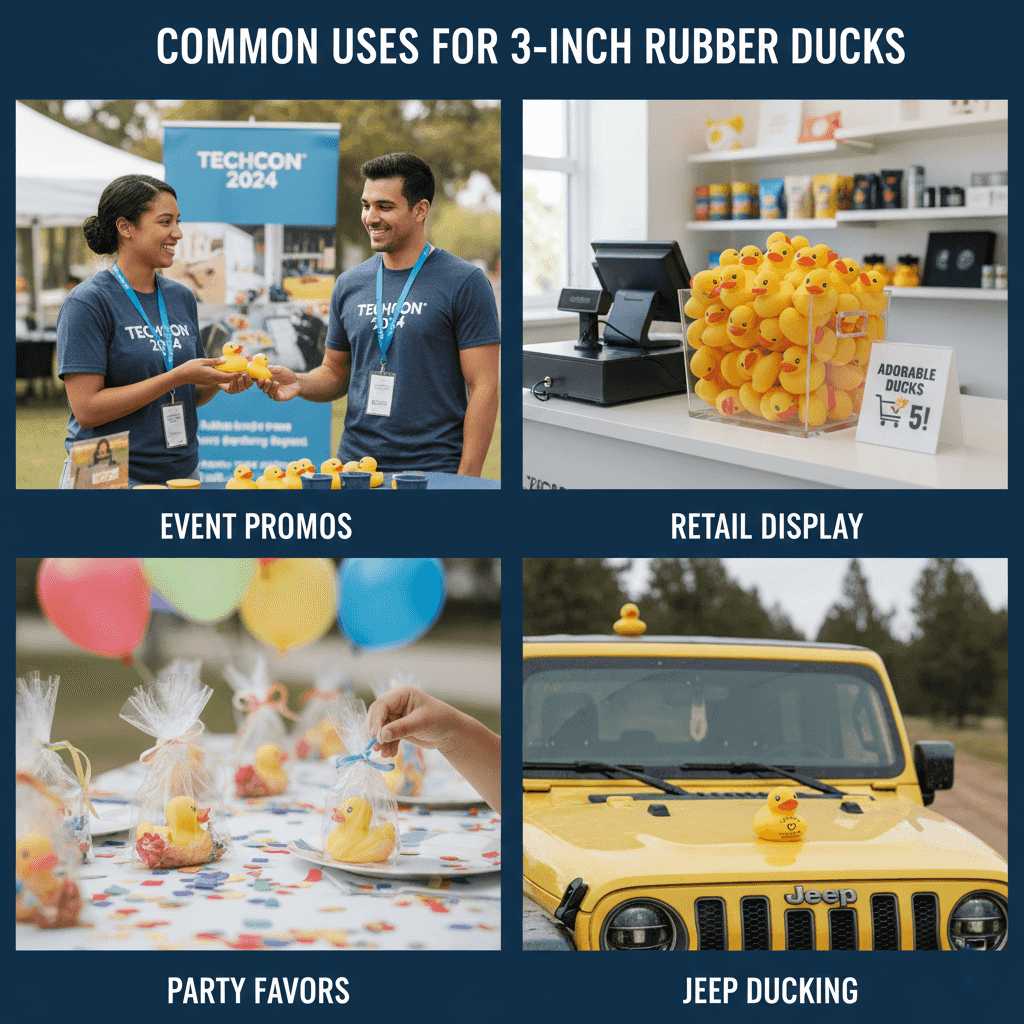
Common Packaging Mistakes That Kill Your Margins
Oversized packaging can add 30% to shipping costs—right off your margin.
Three packaging mistakes eat margins faster than any production defect. Oversized boxes, cheap printing, and loose inserts each sabotage your retail price and sell-through. Here is how to spot and fix each one before your first container lands.
Oversized Boxes: Paying for Empty Space
A 2.3-inch duck only needs a 3x3x1.5 inch box. But many suppliers default to a 4x4x2 inch box that increases dimensional weight and wastes shelf space. The extra volume adds 20–30% to e-commerce shipping costs. A snug fit reduces filler material, lowers freight, and looks tighter on the shelf. Ask for box dimensions that match the product, not the generic stock box.
Cheap Printing: Brand Killer in Plain Sight
Faded or misaligned logos make any jeep ducking set look counterfeit. Buyers associate a crisp print with quality. Standard polybag printing adds $0.05 per set but often blurs after a few months in storage. Custom window boxes with UV-printed graphics add $0.30–$0.50 per set, yet they let you raise the retail price by 40–60%. The print quality directly determines whether your set sells for $5 or $12.
Poor Insert Security: The Unboxing Disaster
Ducks that rattle in the box get scratched paint and broken accessories. Many factories skip inserts entirely, treating the set as loose ducks in a box. The factory uses molded pulp trays secured inside the box. The tray protects the paint, acts as an internal display platform when opened, and creates a premium unboxing moment that drives social media shares. A $0.10 insert investment can prevent a $5 return and a bad review.
Conclusion
Stick with standard polybags, and your jeep ducking sets stay a commodity fighting on price. Skip the custom box, and you lose the 40-60% price lift that retail-ready packaging delivers. The cost of inaction is concrete: a competitor who invests $0.40 per set in a die-cut window box will own the shelf, command a $2.50 higher retail price, and move inventory faster than your unbranded pile. In 90 days, that gap shows up in your margin report.
For beginners buying their first ducks, the how to start jeep ducking guide covers retail, bulk, and factory sourcing in one place.
Frequently Asked Questions
What type of packaging is best for jeep ducking sets sold online?
Custom-printed kraft boxes with a die-cut window work best for e-commerce. They protect the ducks during shipping and look great for unboxing videos. Go with windowed kraft boxes for online sales.
How much does custom packaging add to the cost per duck set?
Custom window boxes typically add $0.30 to $0.50 per set at a 5,000-unit order. That extra cost can justify raising your retail price by $2 to $3 per set. Run the math at your volume to confirm margin.
Yes, hang tags and display boxes are standard for peg hooks and counter displays. Make sure the tag is securely fastened so it doesn’t detach during shipping. Confirm attachment method with your supplier.
Does custom packaging increase the lead time?
Yes, custom packaging usually adds one to three weeks to your total lead time. The extra time covers design, material sourcing, and printing setup. Plan for at least two extra weeks when scheduling.
Are there eco-friendly packaging options for rubber duck sets?
Yes, eco-friendly kraft boxes with die-cut windows are available and fully recyclable. They meet retail sustainability requirements while still showcasing the duck design. Ask for recycled or FSC-certified kraft materials.