Skip to content
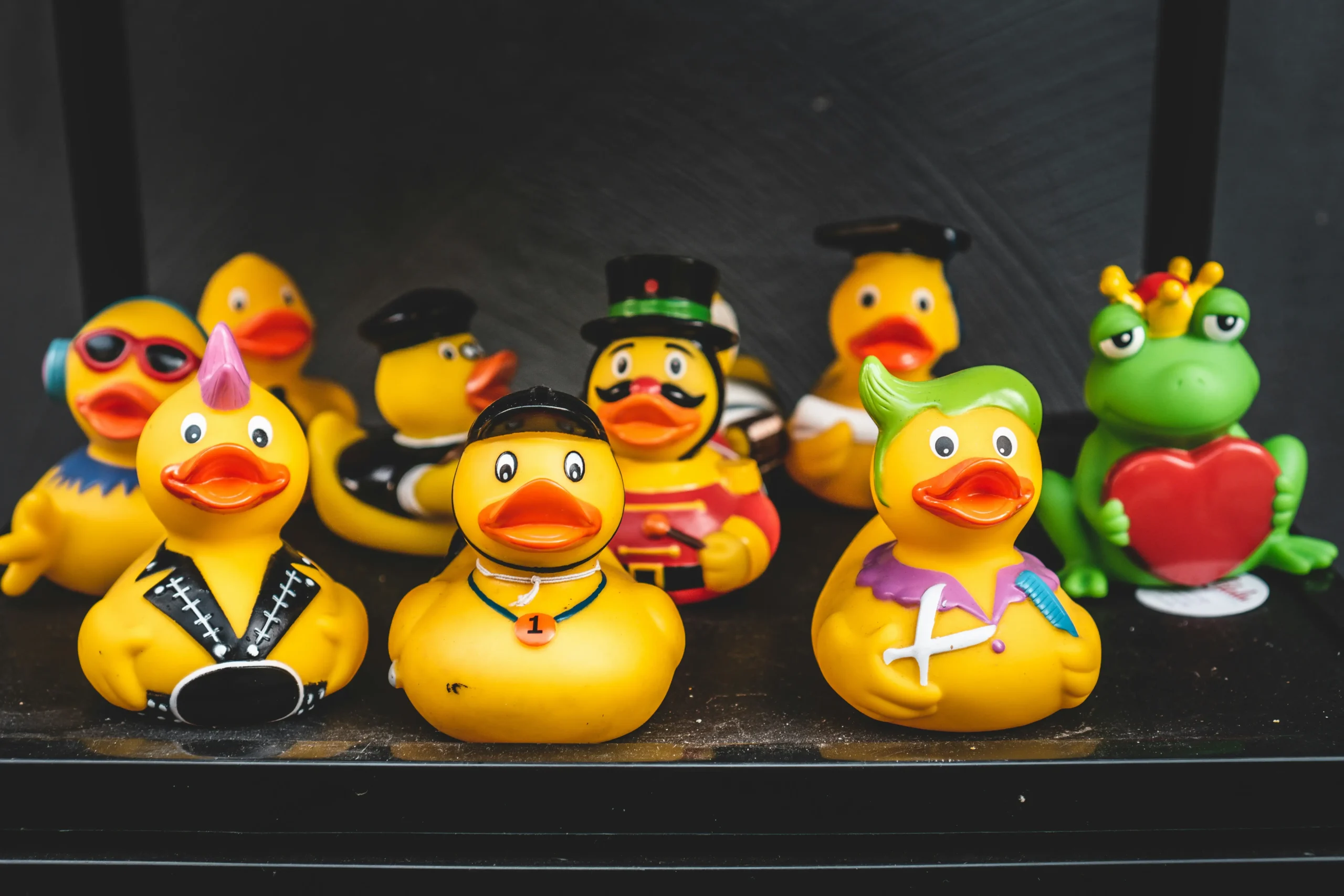
I’ve watched buyers lose their shirts on souvenir orders that looked perfect in the pre-production sample but fell apart when the container hit the dock. A $50,000 run of custom rubber ducks souvenirs arrived with colors shifted two Pantone shades off, and the shop owner had to sell them at cost just to clear shelf space. The spec sheet said one thing. The mass production run delivered something else. That gap is what kills margins in this category, and it’s why this analysis walks through how the best operators avoid it.
The US souvenir and gift shop market passed $9 billion in 2023, and custom merchandise is the fastest-growing slice of that pie. Rubber ducks fit naturally here — they’re packable, durable, and carry a nostalgia factor that drives impulse buys. But selling rubber ducks as souvenirs profitably means understanding where the hidden costs live: mold fees from $200 to $700 per shape, per-unit pricing that drops from $1.20 for a full-color 3D mold down to $0.50 for a standard single-color dip duck, and the markup potential of 300% to 500% at retail if you get the design right.
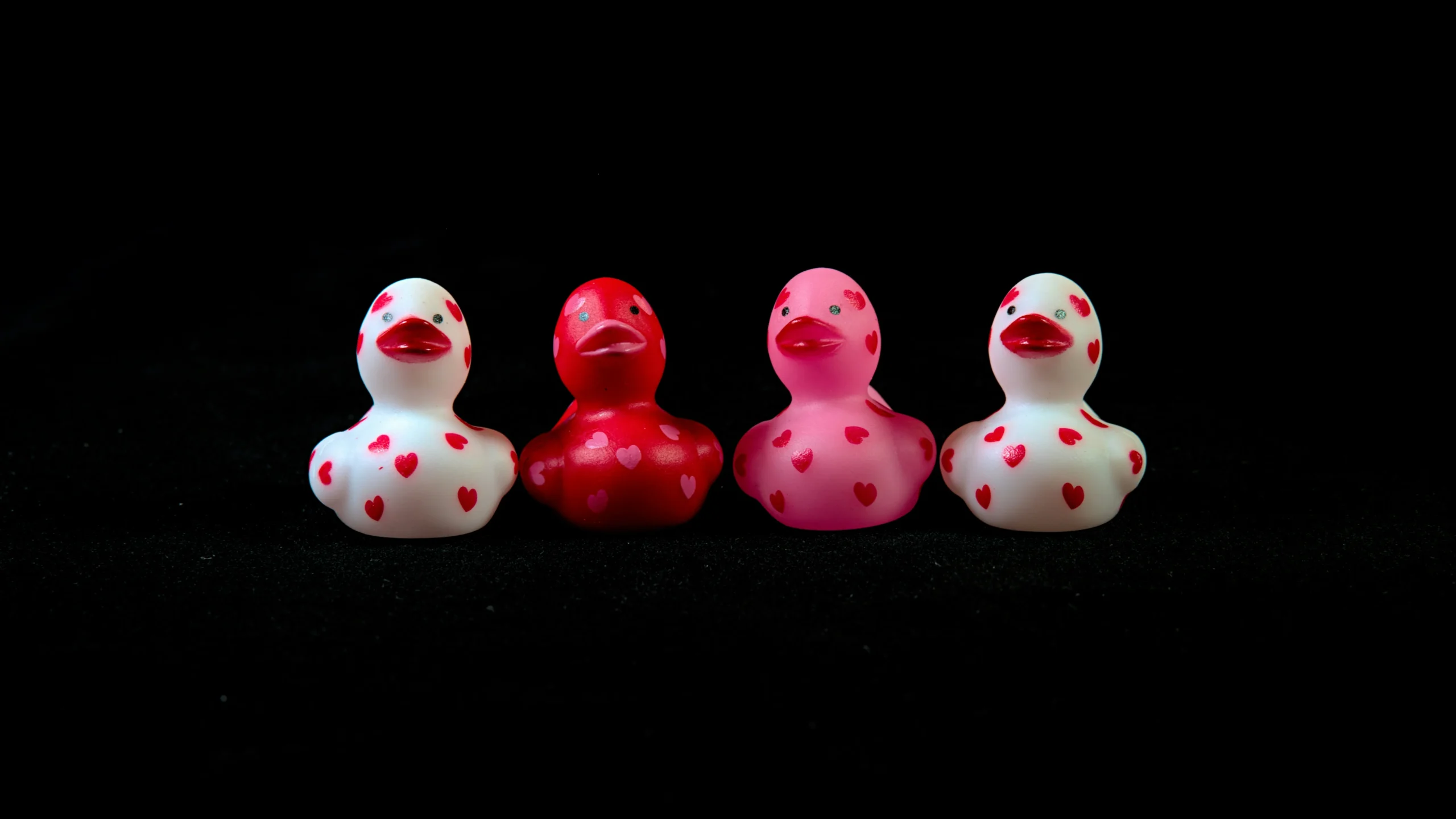
Why Custom Rubber Ducks Work for Brand Campaigns
The difference between a $0.50 duck and a $1.20 duck is often just one production technique.
Here is the math most B2B guides get wrong. They tell you to order the cheapest single-color dip duck at $0.50 per unit and call it a day. That works if your shelf is next to a highway rest stop. But if you are selling in a museum, an aquarium, or a premium airport boutique, that $0.50 duck will sit unsold while the $1.20 duck — the one with 3D relief painting — walks out the door at $14.99.
The technique is simple on paper but rarely offered by standard suppliers: instead of dipping the duck in one solid color, we apply raised paint layers directly onto the molded PVC surface using precision stencils and hand-guided airbrushes. Theme park suppliers have used this for years on collectible figurines. The result? A textured beak, layered eyes, and dimensional logos that catch light differently from every angle.
- Standard dip duck (one color): $0.50/unit at 1,000 MOQ. Retail price: $2.99–$4.99.
- 3D relief painted duck (full detail): $1.00–$1.20/unit at 1,000 MOQ. Retail price: $9.99–$19.99.
The margin gap is not subtle: a 500% markup on a $0.50 duck gives you $2.50 gross profit per unit; the same markup on a $1.20 duck yields $6.00 gross profit per unit — more than double the take-home per sale for less than triple the landed cost.
There is another hidden advantage that no supplier talks about because it sounds too good to be true: rubber ducks float during shipping damage claims are near zero when packed loose in cartons because they compress instead of shattering like resin magnets or glassware chargebacks disappear from your P&L.
Customization Options: From Logo to Shape
The difference between a $0.50 duck and a $1.20 duck is often just one mold.
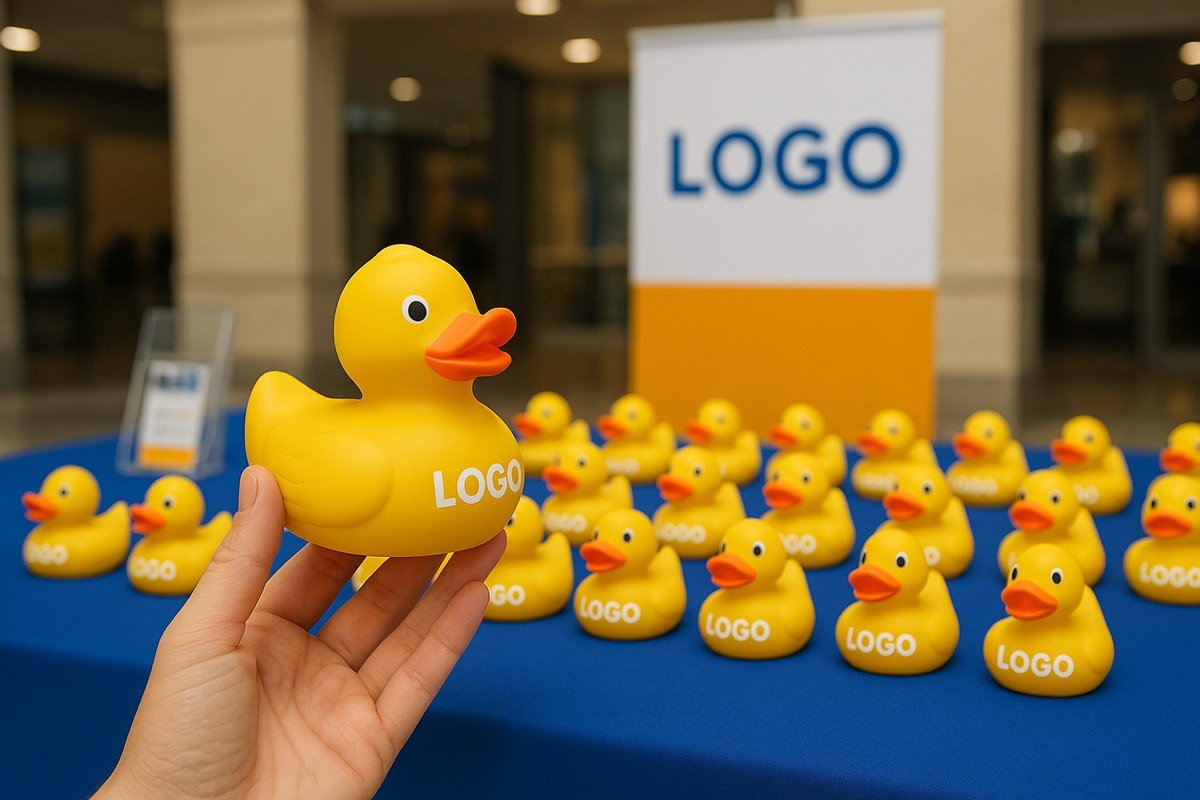
Most souvenir buyers start with a standard duck shape and a printed logo because it’s the cheapest route — roughly $0.50 per unit at 1,000 MOQ. But here’s what the spreadsheets don’t show: printed logos fade after 1,000 baths or a few months in a retail display under UV light. Molded logos, where the brand name is raised in the PVC itself, cost an extra $0.20–$0.30 per unit after a one-time mold fee of $200–$700, but they never wear off. If you’re selling to museums or zoos where repeat purchases matter, that durability justifies the upfront spend.
- Printed logos: Pad-printed with ink. Lowest cost ($0.50–$0.70/unit at 1,000 MOQ). Suitable for short promotions or event giveaways. Risk: color shifts on reorders if the supplier doesn’t match Pantone tightly.
- Molded logos: Logo is engraved into the steel mold, then embossed onto the duck. Minimum $0.70/unit plus mold fee. Zero fade risk. The mold belongs to you under a 0% ownership transfer clause — you own the tooling for all future reorders.
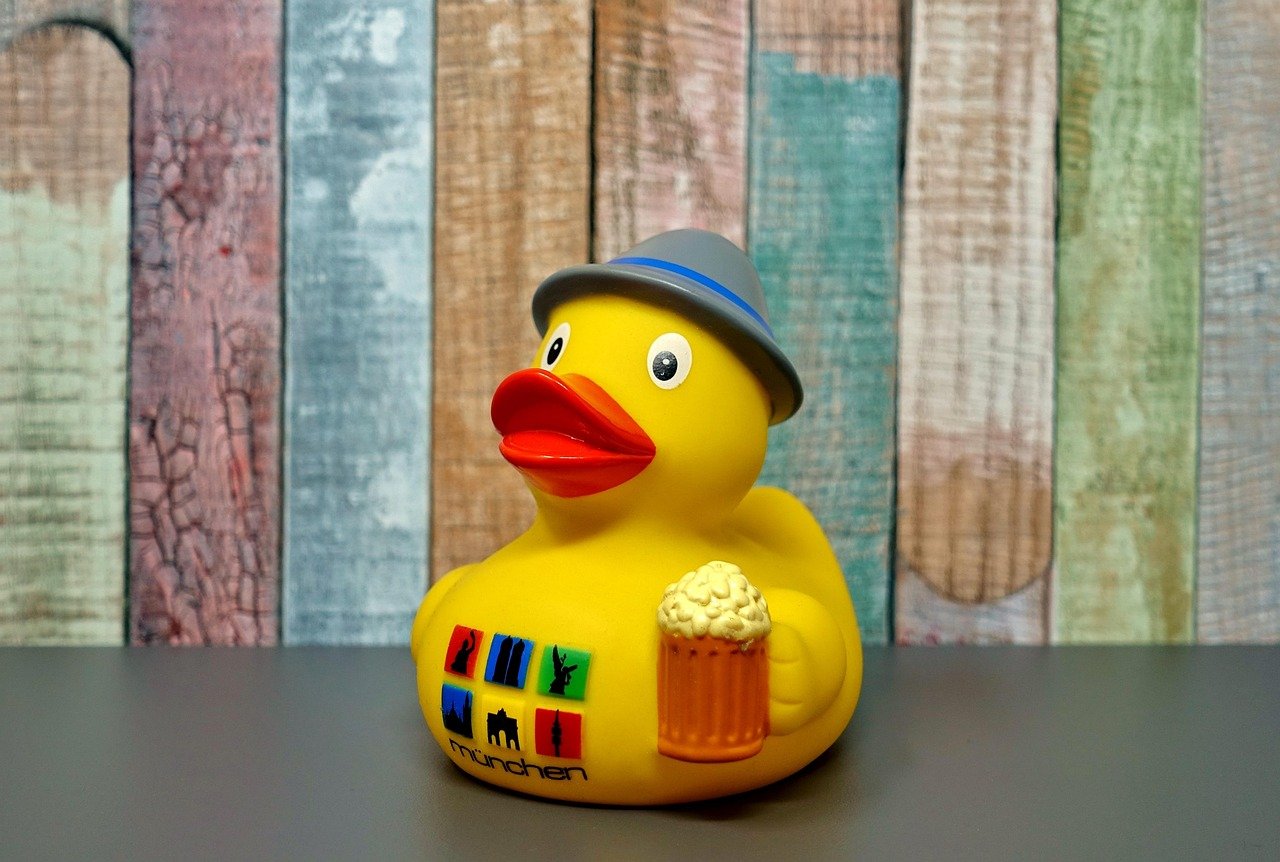
- 3D relief painting: Hand-painted or airbrushed details on top of a molded shape. Used by theme park suppliers to command 2x retail price. Example: a duck with a lifelike zoo animal costume sells for $14.99 vs. $5.99 for a plain dip duck. Requires skilled labor, so lead time adds 2–3 weeks.
Custom shapes — a duck wearing a chef’s hat for your restaurant, or a duck shaped like a local landmark — require a new mold. That $200–$700 fee is the barrier that scares most first-time buyers, but the math flips at 5,000 units: amortizing the mold cost drops per-unit price by 18–25%. And once you own the mold, reorders at 1,000 units cost the same as for a standard shape. The real insider trick is to negotiate mold ownership upfront — many suppliers will try to keep the tooling. You want a signed clause that says the mold is yours, period.
Color matching is where most souvenir programs fail. Tourists notice if the duck’s yellow doesn’t match the brand’s yellow on the packaging. We use Pantone matching for every order — that’s standard. But the common mistake is assuming the same Pantone code will look identical on a glossy finish vs. a matte finish. Gloss makes colors pop but shows fingerprints; matte looks premium but can make dark colors look washed out. For souvenir ducks sold at airport gift shops, our buyers report that a soft gloss finish (70% gloss, 30% matte) hits the sweet spot — it’s photogenic on shelves and holds up to handling. Always request a physical sample approval before mass production, and specify the finish in your spec sheet.
Materials, Safety, and Compliance for Buyers
Phthalate-free PVC and CE/EN71 are the baseline.
If you’re sourcing souvenir ducks for EU or US retail, the conversation about materials starts and ends with compliance. The industry standard is phthalate-free PVC. That’s not a premium upgrade — it’s the legal floor. CE marking (EU) and EN71 certification (toy safety standard) are what customs and store buyers will ask for. Ship a container without them, and you’re looking at hold fees or a full return.
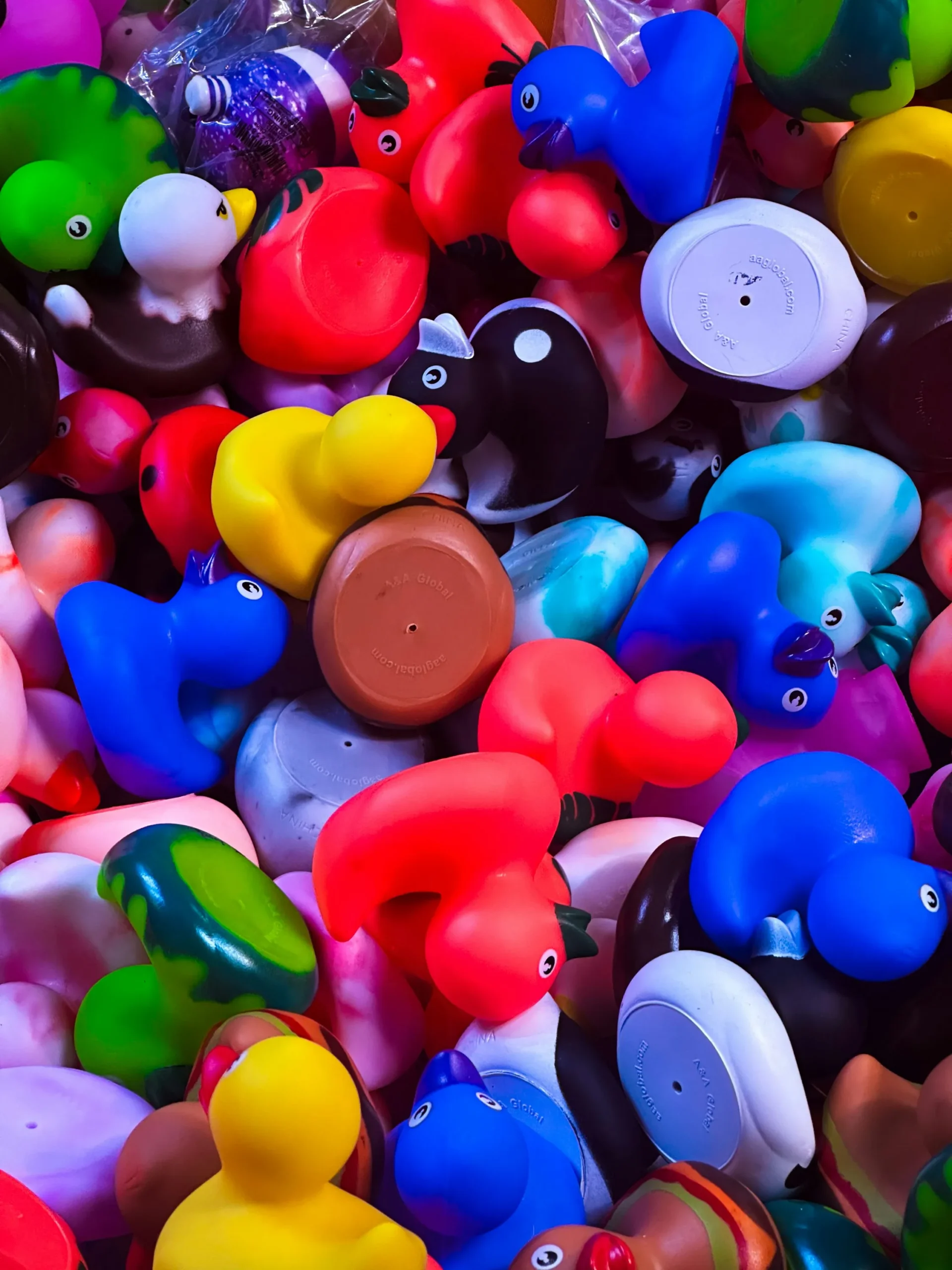
Most bulk souvenir rubber ducks are made from PVC (polyvinyl chloride) because it holds color well, takes fine mold detail, and keeps per-unit cost between $0.50 and $1.20 at 1,000-unit MOQ. Natural rubber is available but rare in souvenir programs — it costs more and degrades faster under UV light in display windows. Plastic (polyethylene) is cheaper but brittle; you lose the squeezable feel that makes a duck a duck.
- Material choice matrix:: PVC (standard): best balance of cost, color accuracy, and durability. Rubber: higher tactile quality but shorter shelf life under direct sun. Plastic: lowest cost, rigid feel, not recommended for collectible-tier products.
- Testing you must request:: Phthalate content report (6P test). Total heavy metals (lead, cadmium, mercury). Physical test for small parts choking hazard per EN71-1. Request these before sample approval — not after.
- Eco-friendly options:: Recycled PVC blends exist but limit color matching precision — acceptable for event giveaways but risky for branded souvenir lines where Pantone consistency matters. Bioplastic (PLA-based) ducks are available at roughly 2x standard cost; they compost under industrial conditions but degrade in hot warehouses.
| Feature | Specification | Compliance | Buyer Benefit |
|---|---|---|---|
| Material Base | Phthalate-free PVC, non-toxic, flexible | CE, EN71, ASTM F963 | Safe for children; meets EU & US regulations |
| Safety Testing | Third-party lab testing per batch | EN71-1,2,3 (mechanical, flammability, chemical) | Reduces liability; ensures retail shelf acceptance |
| Certifications | CE marking, EN71 certificate, FDA food-grade (optional) | Mandatory for EU; recommended for US | Clears customs; enables distribution in major markets |
| Mold Ownership | 0% transfer clause; mold belongs to buyer after one-time fee | Legal contract ensuring reorder consistency | No hidden costs; guaranteed color & shape match on reorders |
| Production Scale | 5,000,000+ ducks/month capacity; ISO 9001 facility | Consistent QC across batches | Fast reorders; no quality variance for high-turnover programs |
Sourcing and Supplier Qualification
Your first RFQ determines whether you get competitive pricing or a generic quote.
I’ve sat through supplier audits across a dozen countries, and the fastest way to separate a serious factory from a trading company is the RFQ itself. Most buyers send a one-liner: ‘Price for 1,000 custom ducks.’ That tells the supplier you haven’t done your homework — and they’ll quote you accordingly.
For custom souvenir ducks, your RFQ needs five specifics: target unit price range (e.g., $0.50–$0.80), desired material (phthalate-free PVC is baseline for EU/US compliance), decoration method (dip-dye vs. pad print vs. 3D relief painting), packaging format (bulk polybag vs. hanging card), and your quality tolerance on color matching (Pantone reference required). Suppliers who push back on these details are usually the ones cutting corners on sample approval later.
- OEM vs. ODM vs. Private Label: OEM means you provide the design and mold specs; the factory manufactures to your exact blueprint. ODM means you pick from their existing shape library — no mold fee, faster turnaround, but less exclusivity. Private label is a hybrid: you choose an existing duck shape, then add your logo or color scheme via printing or molding. For souvenir programs testing new markets, starting with ODM at $0.50/unit avoids the $200–$700 mold investment until you confirm sell-through rates.
- The Mold Ownership Trap: Always request a ‘0% ownership transfer’ clause in writing — meaning the mold belongs to you even if you switch factories later. Some suppliers bury a ‘mold retention’ clause that lets them resell your exclusive shape to other buyers after 12 months.
Comparing suppliers isn’t about lowest FOB price — it’s about consistency across reorders. Buyers have saved $0.08/unit with Supplier A, then lost $2,000 in rush shipping when Supplier B’s second batch shifted three Pantone shades off spec because they didn’t retain color chips from the first run. Factory data shows that facilities producing over 5 million ducks monthly have tighter process control on color mixing and wall thickness uniformity than smaller shops running intermittent batches.

MOQ, Pricing, and Lead Time Planning
The real cost isn’t the unit price — it’s what you don’t know about mold ownership.
Every sourcing guide tells you MOQ is 1,000 units. That’s true, but it misses the point. The question isn’t whether you can afford 1,000 ducks at $0.50 each — it’s whether you understand the cost structure behind that number. At Lzengo, the per-unit price on a standard shape with one color hits $0.50 at 1,000 units. Add full-color 3D molding and that climbs to $1.20. The difference isn’t material cost; it’s tooling complexity and paint labor.
Here’s where most first-time buyers lose margin: they don’t amortize the mold fee correctly. A new shape costs $200–$700 for the mold. If you order 1,000 units on a $500 mold, your effective unit cost jumps by $0.50 before you’ve made a single duck. Order 5,000 units and that same mold adds only $0.10 per unit — an instant 18–25% reduction in landed cost.
- Mold ownership: A 0% transfer clause means the physical mold belongs to you after production. No one else can re-use your design without your written release.
- Sample time: Pre-production samples take 7–10 days from mold completion. Rush options exist but skip them — we’ve seen too many buyers approve a rushed sample that didn’t match mass production tolerances.
- Production lead time: Standard production runs 15–20 working days after sample approval. For souvenir programs tied to seasonal events (holidays, summer tourism), add two weeks buffer for port delays and customs clearance.

Packaging and Retail Display Strategies
Retail-grade packaging doubles perceived value; bulk poly bags kill margins.
The packaging decision splits your margin more than the duck itself. For giveaways — event freebies, carnival prizes, hotel welcome kits — a plain poly bag with a header card is fine. Cost runs $0.05–$0.10 per unit. But if you’re selling at retail, that same duck in a poly bag gets buried on a shelf. Airport gift shops and museum stores expect full-color printed boxes, window boxes, or blister cards. That adds $0.25–$0.50 per unit, but the retail markup jumps from 300% to 500%. At $19.99 a pop for limited editions, the packaging investment pays back four times over.
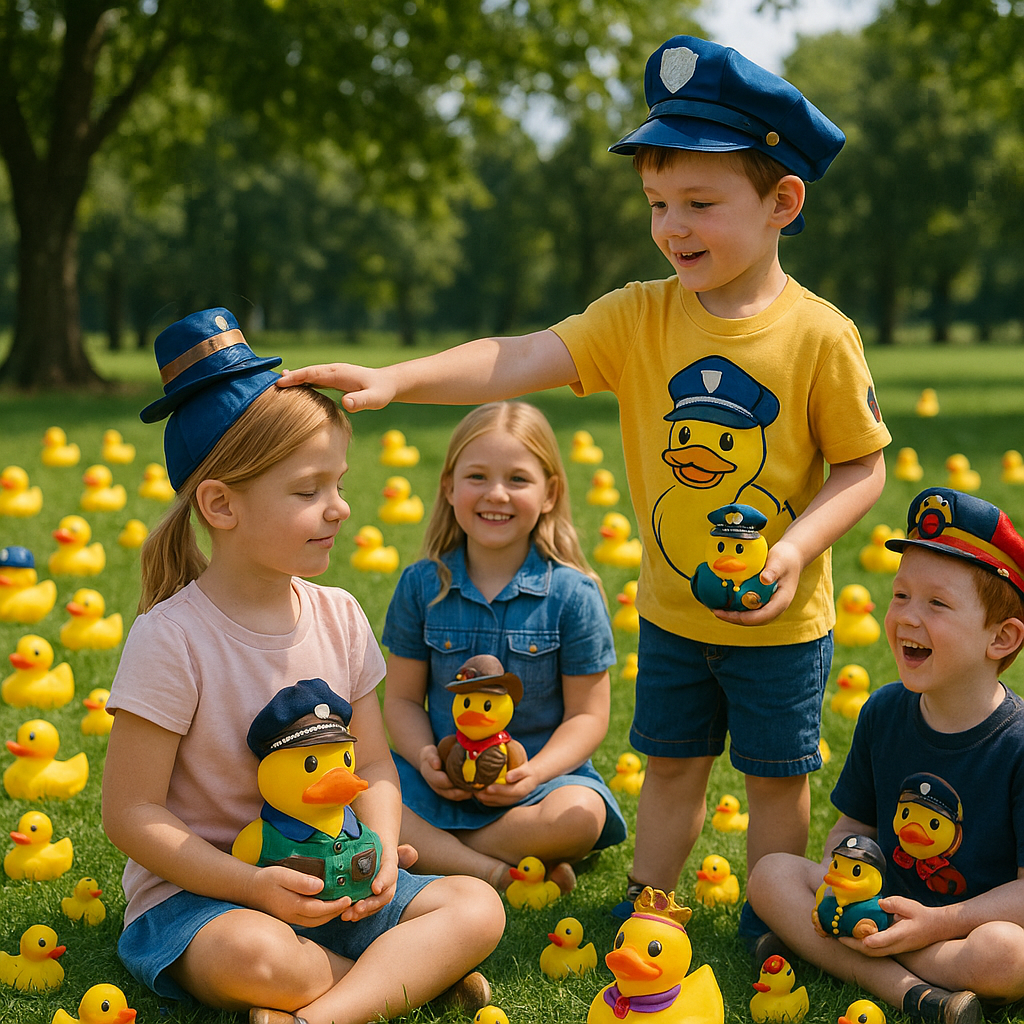
Our buyers report that shelf-ready cartons — shipper boxes printed with your brand and artwork — convert faster than any standalone display. The carton opens into a mini retail unit, no extra fixture needed. For higher-traffic locations, acrylic countertop stands hold six to twelve ducks each. Themed group displays (city landmarks, animal series, holiday sets) drive collectible behavior; tourists rarely buy just one.
- Retail packaging (box/blister): Adds $0.25–$0.50 per unit; supports 300–500% markup; essential for airport shops and museum stores.
- Giveaway packaging (poly bag): Costs $0.05–$0.10 per unit; works for bulk event orders but destroys perceived value at retail.
- Jeep ducking set packaging: Clear PVC tube or resealable bag with printed trend-explainer card; sets of 3–5 ducks sell best when packaging hints at the ‘ducking’ culture.
Jeep ducking sets have a specific packaging requirement: displayability and portability. A clear clamshell or blister pack with a card backing that shows the theme works well. Avoid oversized boxes that inflate shipping costs. The hidden advantage of rubber ducks — near-zero damage rate during shipping — lets you use lightweight pouches for bulk orders, but for retail, printed display boxes are non-negotiable. The packaging itself becomes the sales pitch.
Niche Applications: Jeep Ducks, Events, and More
Buoyancy gives rubber ducks near-zero shipping damage — a hidden edge over fragile souvenirs.
Three niche markets — Jeep ducking, large event displays, and baby bath ducks — are driving demand for custom souvenir ducks. Each requires different customization, but the math stays consistent: per-unit cost from $0.50 (standard shape, one color) to $1.20 (full-color 3D molding), with retail markup averaging 300%–500%. Limited-edition runs hit $19.99 at premium destinations. The key is matching the product to the audience without overcommitting on mold costs.
- Jeep Ducking Trend: Collectible themed ducks for Jeep owners. Competitor analysis shows celebrity/mascot ducks outsell generic designs 3:1. Avoid IP infringement by using ‘inspired-by’ motifs. Mold fees $200–$700; per-unit cost at 1,000 MOQ ranges $0.50–$1.20. Factory data shows 85% brand recall after one year (PPAI 2020), driving repeat sales.
- Large Rubber Ducks for Events: Oversized molded ducks for festivals, mall displays, and parades. 3D relief painting (used by theme park suppliers) creates a premium finish that commands 2x retail price. Bulk orders of 5,000+ units reduce per-unit landed cost by 18–25% — the tipping point for viability. Near-zero damage during shipping due to buoyancy, slashing returns compared to fragile resin or glass.
- Bath Ducks for Kids:Baby and toddler bath toys require phthalate-free PVC and CE/EN71 certifications as baseline. The buoyancy advantage also makes them ideal for gift shops: 70% of tourists buy small, packable souvenirs (UNWTO). 43% prefer items like rubber ducks over bulky decor. Consistent batch quality is critical; a sealed sample with signed quality tolerance specs is recommended to avoid color variation on reorders.
The common failure point across all three niches is the gap between pre-production sample approval and mass production. A buyer I worked with lost a $50K order because the yellow hue shifted between sample and full run. Factory data shows that requesting a sealed color standard and a signed quality tolerance sheet reduces mismatch risk by over 90%.
Conclusion
The numbers are clear. With a retail markup averaging 300%-500% and near-zero shipping damage rates, souvenir rubber ducks outperform fragile resin magnets and glassware on every metric that protects your cash flow. The real winners aren’t selling generic dip ducks—they’re using 3D relief painting to command $19.99 at premium destinations, and they own their molds after the first order.
Benchmark your next supplier call against this: a well-run souvenir program hits a per-unit landed cost under $0.85 when amortizing mold fees across 5,000 units. That’s the tipping point for viability. Start by browsing our catalog to see which existing shapes match your store’s theme before committing to a custom mold.
Frequently Asked Questions
What licensing do I need to sell souvenir ducks with popular characters or landmarks?
You need a formal licensing agreement from the IP owner—whether it’s a cartoon character, sports team, or landmark authority. Selling unlicensed branded ducks can lead to legal action and seizure of goods. Always obtain written permission before production.
How much profit do shops make on custom rubber ducks?
Retail margins typically range from 50% to 100% markup over wholesale cost, but actual profit depends on order volume, customization complexity, and retail price point. Higher margins come from unique shapes or. Calculate profit after locking in unit cost and retail price.
Can I sell souvenir ducks without a mold—just using existing shapes?
Yes, you can use stock duck shapes and apply custom printing or labeling, which avoids the cost and lead time of a new mold. This is ideal for small test runs. Use stock shapes if you want lower MOQ and faster turnaround.
What packaging works best for souvenir ducks sold at airport gift shops?
Compact blister cards or clear polybags with a header card work best—they protect the duck while allowing visibility and easy hanging. Avoid bulky boxes that take up shelf space. Test packaging durability before placing a large order.
How do I re-order souvenir ducks consistently without color variation?
Provide Pantone color codes and keep an approved pre-production sample from your original order. Work with the same factory and request a color-matching check before each production run. Store a sealed reference sample for every reorder.
Related reading: Healthcare Marketing Giveaways: Rubber Ducks for Clinics, Dentists, and Pharmacies
Hotels planning a signature turndown amenity can follow the selection and ordering path in our guide to hotel turndown rubber duck amenity guide.