Skip to content
Sourcing a large rubber duck for a promotion or event looks straightforward — until you get a batch with seams splitting after a weekend in the sun. I’ve seen buyers order 1000 ducks only to find the vinyl gauge was thinner than promised. That’s money down the drain and a reputation hit when the giveaway deflates before the event ends.
The real difference between a good supplier and a bad one comes down to three things: vinyl thickness, seam weld quality, and the printing process. I always ask for a 50cm x 50cm sample of the actual material, not a finished duck. Measure it with a micrometer. If they hesitate or offer excuses, walk. A reliable supplier will tell you their standard is 0.5mm PVC, double-stitched seams, and UV-resistant ink. Anything less and you’re gambling.

What Defines a Large Rubber Duck
Most buyers think “large rubber duck” means one size. The gap between a 3-inch party favor and a 9-inch jumbo duck changes material, weight, cost, and supply chain complexity entirely.
Size Definitions: Jumbo vs. Standard
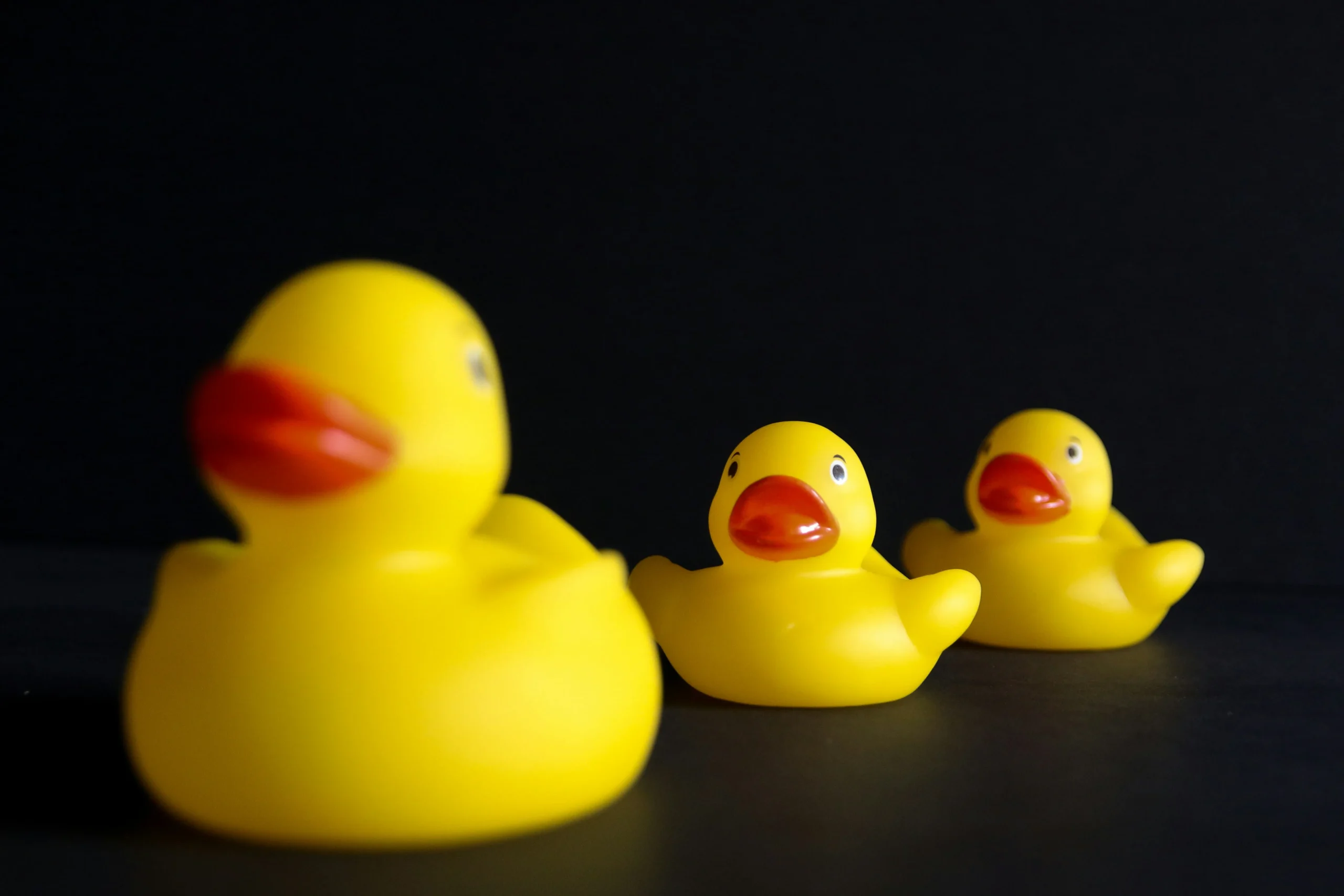
Industry classification splits into two distinct categories. Standard promotional ducks sit at 3 to 4 inches — think bathtub toys and small giveaways. A large rubber duck starts at 9 inches, with jumbo variants reaching 11 inches or more. The volume jump is not linear: a 9-inch duck holds roughly 27x the material volume of a 3-inch duck, which directly impacts per-unit cost and shipping cube.
Here is the practical breakdown for bulk sourcing:
- Standard (3–4 inches): Common for high-volume giveaways. MOQ often 5000+ units. Weight per duck: 10–15 grams.
- Large (9 inches): Brand centerpieces, event photo ops, retail shelf displays. MOQ 1000 units. Weight: 80–120 grams per duck.
- Jumbo (11+ inches): Statement pieces. Requires thicker walls to hold shape. Weight can exceed 200 grams. Expect 500–1000 unit MOQ minimum.
If your bulk large rubber ducks for events campaign uses 9-inch ducks, confirm the actual molded height not including the base — some suppliers measure to the top of the head, others include the base, and the difference can be 0.5 inches, enough to throw off display spacing.
Common Materials: PVC, Vinyl, and Natural Rubber
Three materials dominate the market, and each forces trade-offs in cost, feel, and durability.
- PVC (Phthalate-Free Grade): The standard for most wholesale large rubber duck supplier orders. It is rigid enough to hold detail, accepts pad printing and heat transfers well, and keeps unit costs between $1.20 and $2.00 at MOQ 1000. The downside: PVC can stiffen in cold storage and may feel plasticky to the touch.
- Vinyl (Softer Blend): A PVC variant with added plasticizers. Softer, more squeezable, closer to the classic toy-store feel. But soft vinyl is harder to decorate — paint adhesion drops if the surface isn’t pre-treated. Most custom large rubber duck manufacturer shops charge a 10–15% premium for vinyl over standard PVC.
- Natural Rubber: Premium tier. Biodegradable, natural elasticity, and a matte finish that photographs well. Cost jumps to $2.50+ per unit. Natural rubber also requires different curing times — expect 20–25 days production instead of 15. Use it only if sustainability is a core brand requirement.
An insider note: many factories label “natural rubber” products as NR latex. If your certification requires EN71 or CPSIA, verify the latex protein content — some end-users have allergy sensitivities.
Weight Specs: Why It Matters for Logistics and Feel
Weight is not just a shipping number — it is a quality signal. A properly molded 9-inch large rubber duck for promotional giveaways should weigh between 80 and 120 grams. Below 70 grams, the walls are too thin; the duck will dent under light pressure and may collapse in transit. Above 130 grams and the duck is likely over-molded or solid, which drives up freight cost unnecessarily for a hollow toy.
For reference, a standard 20-foot container holds roughly 18,000 units of 9-inch ducks at 100 grams each. Every 5-gram increase per unit reduces container capacity by about 900 ducks. When you are sourcing jumbo rubber duck wholesale pricing, ask your supplier for the exact gram weight per duck — not just the mold size — before you calculate landed cost.
How Material Choice Affects Durability and Feel
Durability in a large duck is not just about puncture resistance — it is about how the duck behaves over a campaign lifecycle. A 6-week promotional event exposes ducks to sun, handling, and occasional drops.
Here is what we have observed from field returns:
- PVC ducks (thin wall, under 1.5mm): Show cracking at the seam after repeated squeezing. Paint flakes off within 3 weeks if UV-cured coating is not applied.
- Vinyl ducks with primer coat: Survive 8+ weeks of event handling. Feel better in hand — slight give without collapsing. The trade-off is a higher reject rate during screen printing because the softer surface can distort registration marks.
- Natural rubber ducks: Best tactile feel, but degrade faster under direct sunlight due to UV sensitivity. If your event is outdoors, request a UV stabilizer additive — adds roughly $0.15 per unit but prevents the duck from turning sticky after 4 weeks.
The material also drives the molding method. Most Asian factories default to rotational molding for large ducks because the tooling cost is lower. But rotational molding produces inconsistent wall thickness — the bottom may be 2.0mm while the head is 1.2mm. The best quality large rubber duck factory uses injection molding for large sizes. Injection molding delivers uniform wall thickness (within 0.1mm tolerance) and sharper detail on logos. It costs about 20% more per unit, but if your brand design includes fine text or gradients, it is the only reliable path. Always ask: “Is your large duck rotationally molded or injection molded?” If the sales rep hesitates, request a cross-section photo.
Sizing Up Your Sourcing Needs: MOQ and Budget
Price-per-unit is what gets quoted. Total cost — including shipping, duties, and rework — is what gets paid. Plan for the latter.
How MOQ Determines Per-Unit Pricing
Every supplier uses a tiered pricing model because the fixed costs — mold creation, setup fees, color mixing, and line changeover — are spread across the total run. At 1,000 units for a custom 9-inch large rubber duck, you are typically looking at $1.20 to $2.00 per unit depending on decoration complexity. Move up to 5,000 units and that same duck drops to roughly $1.10 per unit. At 10,000 units, expect pricing around $0.85 to $1.00 per unit.
The math is straightforward. A factory needs to clear a certain dollar amount per production shift. Smaller orders carry a higher per-unit burden because the machine setup and labor cost are fixed. Your job as a buyer is to find the MOQ that gives the steepest price drop before your inventory carrying costs eat the savings. For most promotional campaigns, the 5,000-unit tier is the sweet spot — you get a 25-30% discount off MOQ 1,000 pricing without over-committing warehouse space.
Negotiating MOQ Using Samples
New buyers often ask: “Can I get 500 units instead of 1,000?” The answer is yes, but the per-unit price climbs closer to $2.50-$3.00. A smarter path is to order samples first. Here is how to use samples as a negotiation tool rather than a sunk cost:
- Request pre-production samples tied to a larger order: Tell the supplier you will commit to a 5,000-unit production run, but you need 10-15 samples at cost (not markup) for internal approval and testing. Reputable manufacturers accept this because the sample costs are amortized into the bulk order.
- Use sample feedback to reduce MOQ risk: If 1,000 units is a stretch for your budget, run a small pilot with 200 samples. Validate paint adhesion, float stability, and packaging. Once you confirm quality, the factory is more willing to negotiate a lower MOQ on the next order because you have proven you are a serious, repeat buyer.
- Separate mold cost from unit cost: Some suppliers bundle mold fees into the per-unit price for small runs. Ask for an itemized quote: mold cost (typically $200-$500 for a basic large duck mold) plus unit price. This transparency lets you compare apples to apples across factories.
Shipping Costs: Sea vs. Air and the Real Impact on Budget
This is where first-time buyers get burned. They fixate on the unit price of $1.20 but forget that shipping a container of 10,000 large rubber ducks from a manufacturing hub to a U.S. port adds $0.20 to $0.35 per unit for sea freight. Air freight, often triggered by a missed event deadline, can double that shipping cost to $0.70-$1.00 per unit or more. A 10-day production turnaround is useless if you spend two weeks in transit or customs clearance.
Here is what actually moves the needle on your total cost:
- Container consolidation vs. full container load: If you order 1,000 to 3,000 units, you will ship via LCL (less than container load). That incurs higher handling fees per cubic meter. At 5,000+ units, you can fill a 20-foot container (roughly 28 cubic meters) and drop the per-unit freight cost by 30-40%.
- Customs and duties: Large rubber ducks manufactured from PVC or vinyl often fall under HS code 9503.00.00. Import duty into the U.S. is around 6.8% of declared value. Some buyers forget to budget for this — 6.8% on a $12,000 order is $816 that disappears before your product hits the warehouse.
- Hidden port fees: Demurrage charges (if you do not pick up the container within the free window) can run $100-$300 per day. If your order arrives during a port congestion period, allocate an extra $500 in contingency. I have seen buyers lose their entire margin on a $15,000 order because they left a container sitting for two weeks.
The bottom line: when you calculate your true landed cost per unit, use this formula — (factory unit price × quantity) + mold cost + shipping + insurance + import duties + port fees ÷ total units. If that number still fits your promotional budget or retail margin, proceed. If not, adjust your MOQ upward or downsize your duck size to a 7-inch model to reduce both production and freight costs.
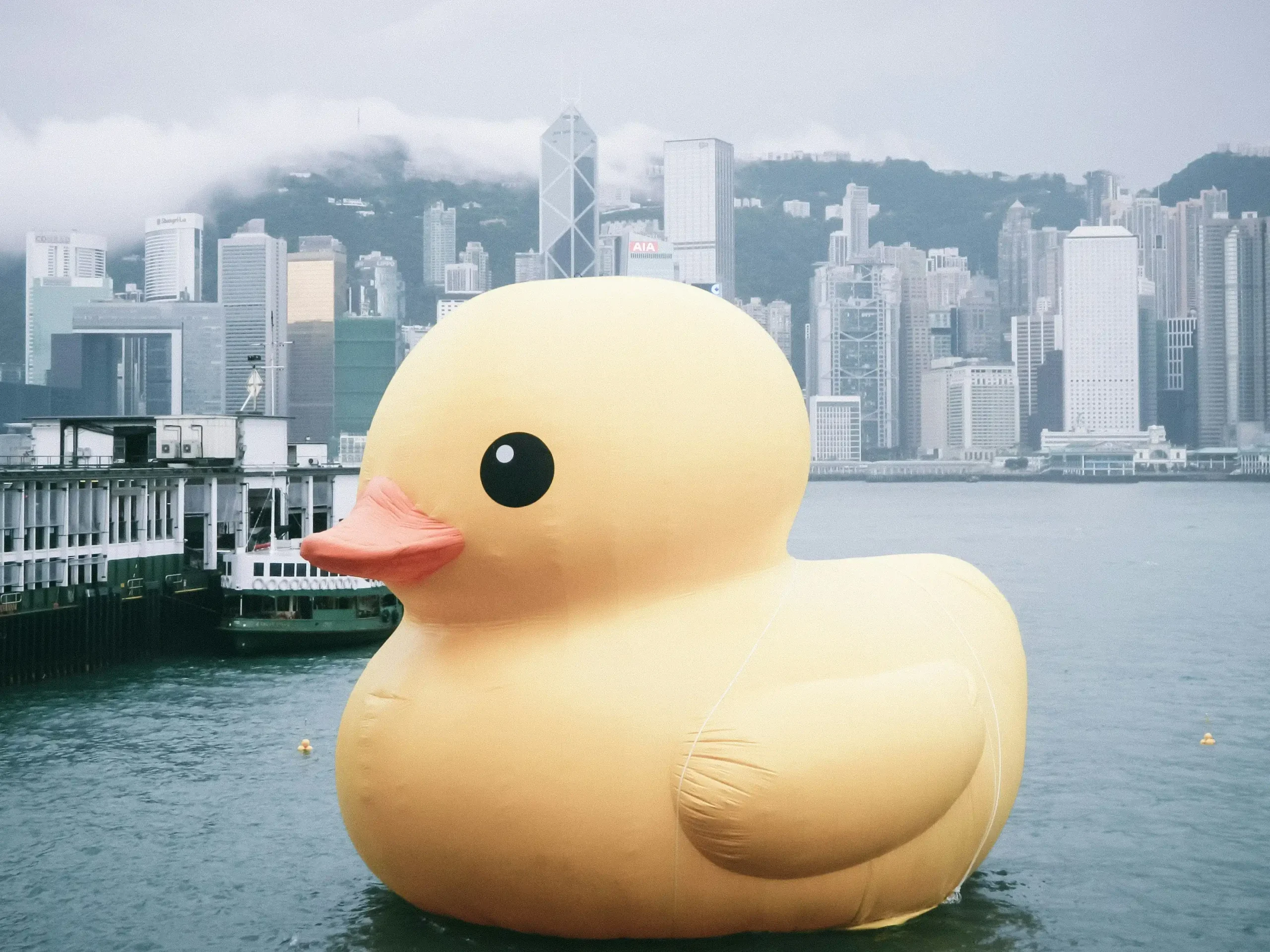
Why Customization Matters for Large Ducks
With a 9-inch duck, a poorly placed logo or a mold seam running through the face kills shelf appeal. Customization isn’t vanity — it’s the difference between a promotional piece that gets displayed and one that gets tossed.
The Three Axes of Customization
For a large rubber duck — anything in the 9-to-11-inch range — you have three levers to pull: surface decoration, the physical mold, and the packaging. Each serves a different function, and each comes with trade-offs you must understand before you send your art files to a factory.
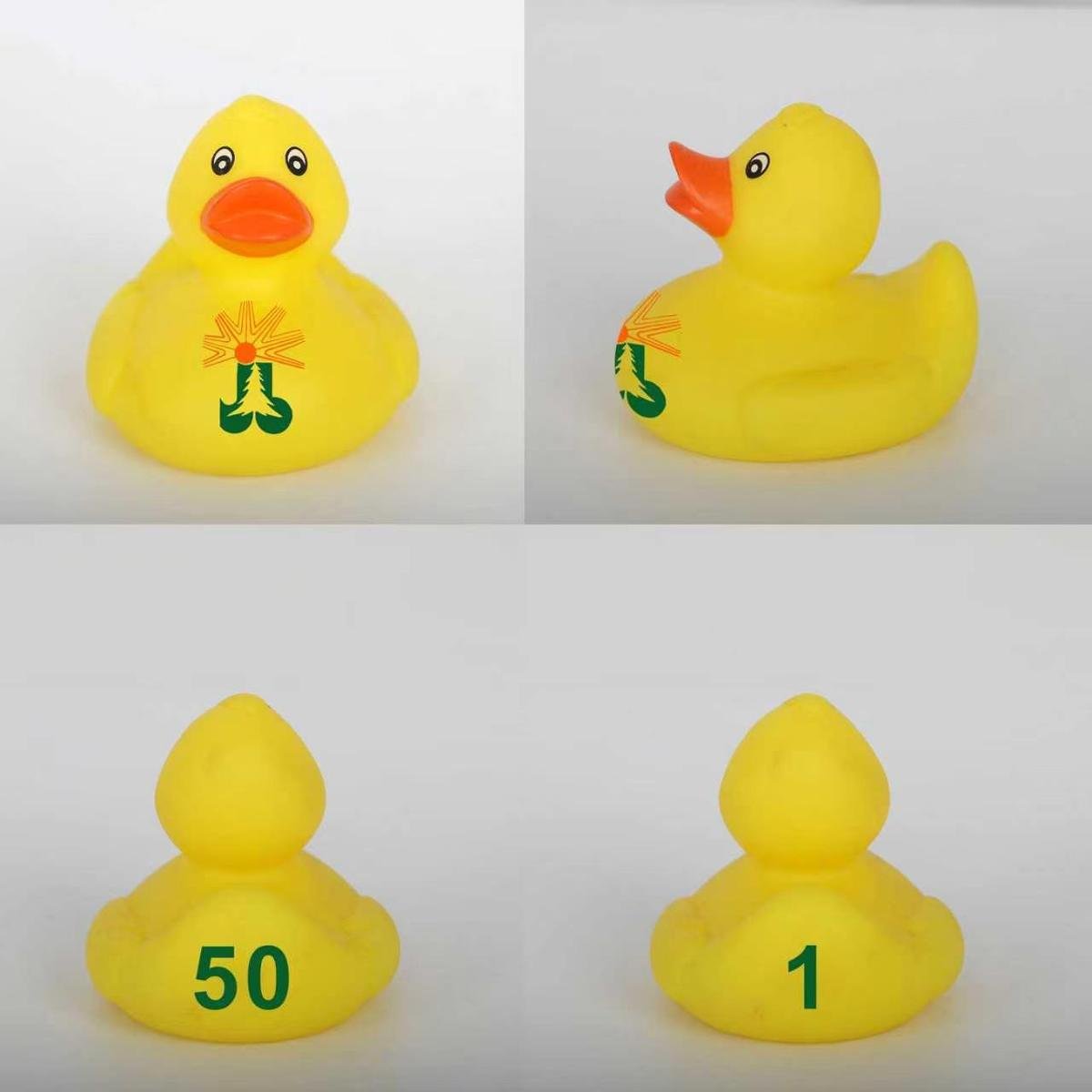
On the surface level, logo printing is the most common request. The three standard methods are pad printing, heat transfer, and screen printing. Pad printing works well for small, detailed logos on curved surfaces — think a brand mark on the duck’s chest. Heat transfer delivers vibrant, full-color artwork and is ideal if your design includes gradients or photographic elements. Screen printing is the brute-force option: durable and cost-effective at high volumes, but limited to simple, solid-color graphics. If your brand uses PMS colors, screen printing gives you the closest match at scale.
Then there is the shape itself. A custom mold lets you alter the duck’s posture, add a hat, a cape, or even turn the duck into a mascot. This is where injection molding becomes non-negotiable. Rotational molding — the cheaper, more common method — leaves uneven wall thickness and blurs fine details. Injection molding gives you sharp edges, consistent weight, and the ability to add undercuts or small features that rotational molding simply cannot hold. The tooling cost is higher (typically $2,000–$5,000 per cavity), but the result is a duck that looks engineered, not squeezed out of a clamshell.
Decoration Method Comparison for Bulk Orders
If you are sourcing for a promotional campaign, your choice of decoration method directly impacts unit cost and lead time. Here is the breakdown based on real factory lead times and minimum quantities:
- Pad Printing: Best for small logos (under 2 inches). Setup is cheap, about $50–$100 per color. Run speed is moderate. Expect 1–2 days for tooling, then 5–7 days for production on a 1,000-unit order.
- Heat Transfer: Allows full-color, high-resolution graphics. Requires a separate transfer film, which adds $150–$300 in setup. Unit cost is slightly higher than pad printing, but for complex art, it is the only reliable option at scale.
- Screen Printing: High durability — useful for ducks that will be handled repeatedly at trade shows or events. Setup costs run $100–$200 per color. Minimum order is typically 500 units per color. For a 1,000-unit job with one color, this is the most economical route.
One insider note: paint adhesion failure is the most common defect we see from low-cost factories. A supplier who skips the primer coat or uses low-temperature curing will ship you ducks whose logos chip off within three weeks. Always request paint adhesion test results — a quality factory will have ASTM D3359 cross-hatch test data on file. If they cannot produce it, walk.
3D Rendering: The $0 Cost for Reducing Risk
Before any steel is cut for a custom mold, a 3D rendering should be your mandatory checkpoint. This is not a rough sketch — it is a photorealistic digital model that shows you exactly how your logo sits on the duck’s curved surface, how the light hits the material, and where the parting lines land. A competent manufacturer will deliver this within 2–3 business days after receiving your art files.
Why does this matter? Because a logo that looks perfect in 2D on your screen can warp, stretch, or disappear into a mold seam when applied to a 3D object. We have seen a brand pay $4,000 for a mold, only to discover that their text wraps around the duck’s belly in an illegible curve. A 3D render catches that before you commit to tooling. It also gives your stakeholders — the marketing director, the event lead, the agency account manager — a single visual reference point so everyone signs off on the same duck.
If a supplier offers you 3D rendering as a free part of the pre-production process, take it as a signal that they understand dimensional design. If they charge extra or skip to a physical sample without a render, you are flying blind. Insist on the render. It costs the factory almost nothing to produce, and it can save you weeks of revision cycles and thousands in wasted tooling.
Frequently Asked Questions
What is the minimum order quantity for custom large rubber ducks?
Standard MOQ is 1,000 units for a custom shape or custom printing. Some factories accept 500 units at a higher per-unit price, but 1,000 is the industry baseline for injection-molded 9-inch ducks. At any lower volume, the tooling cost per unit becomes prohibitive for most B2B campaigns.
How long does sample production take?
For a custom decorated duck using an existing mold, sample lead time is 7–10 days. For a full custom shape requiring a new mold, add 15–20 days for mold fabrication plus 7–10 days for the first samples. Always budget for two rounds of sample approval.
Can I get a custom shape that is not a duck?
Yes. The term “rubber duck” in the industry covers any custom hollow PVC or vinyl figure. You can request a penguin, a mascot character, or a branded sculpture. The tooling cost scales with complexity, but the manufacturing process is the same.
Evaluating Supplier Quality: Certifications and Samples
A generic certification PDF is worthless. What matters is a batch-specific test report from an accredited lab and a pre-production sample you can physically inspect.
Required Certifications for Promotional Rubber Ducks
If you’re sourcing bulk large rubber ducks for events or promotional giveaways destined for the US or EU markets, three standards are non-negotiable: ASTM F963 (US toy safety), EN71 (European Toy Safety Directive), and CPSIA (Consumer Product Safety Improvement Act, covering lead and phthalates). A legitimate wholesale large rubber duck supplier will hold active certifications from an ISO 17025-accredited lab like SGS, Bureau Veritas, or TÜV. But here’s the hard truth – many suppliers show you a single certificate from 2019 that covers a completely different product batch. That certificate means nothing for your order. You need a test report tied to your specific production run, verifying that the pigments meet heavy-metal limits and the material is phthalate-free. For a custom large rubber duck manufacturer, this is standard procedure; if a supplier hesitates to provide batch-specific documentation, walk away.
Pre-Production Samples: What to Inspect
A pre-production sample is your only real insurance against a costly recall. When you order a sample from a large rubber duck factory, you are not just checking the logo placement. You are verifying three critical failure points that rookie buyers overlook.
Paint peeling: Paint adhesion failure is the most common defect on promotional rubber ducks. Cheap factories apply paint directly onto the PVC without a primer, and the paint flakes off within weeks. A quality supplier uses a primer coat + UV-cured paint. Ask them to run a cross-hatch tape test (ASTM D3359) and share the video. If the paint lifts, reject the batch. Seam quality: Large rubber ducks (9 inch and jumbo) are often made using rotational molding, which can leave uneven wall thickness and visible mold lines. The best factories use injection molding for consistent thickness and sharper details. Run your finger along the seam – if you feel a sharp ridge or thin spot, you will have complaints about durability. Squeaker function: Test the squeaker at least 50 times in rapid succession. Cheap squeakers die after 20 compressions. A reliable best-quality large rubber duck factory will install a one-way valve squeaker that lasts for thousands of squeezes. If the sample squeaker fails or sounds weak, require a redesign before production.
Demanding Full Test Reports, Not Just Certificates
A certificate is a piece of paper stating that a product “type” meets a standard. A test report is the raw data proving that your specific batch passed. For a bulk large rubber ducks for events order, you must request the full test report covering:
- Material composition: Verify no phthalates (DEHP, DBP, BBP, DINP – EU and US limits differ), no heavy metals (lead, cadmium, mercury, chromium), and compliance with CPSIA total lead limit of 100 ppm.
- Mechanical and physical properties: Small parts test (if the duck has loose components), sharp edges, and torque/ tension tests for any attached accessories.
- Flammability: For promotional giveaways that may be near candles or heat sources, request EN71-2 or CFR 1610 report.
A trustworthy custom large rubber duck manufacturer will provide these reports within 7–10 days after sample approval, and each production shipment should come with a certificate of conformity matching the test data. If a supplier cannot deliver this documentation or tries to charge extra for it, you are working with a trader, not a factory. For a large rubber duck MOQ 1000 order, the cost of testing is typically absorbed by the manufacturer – do not accept any line item for “certification fees” unless the supplier explains exactly which lab and standard is being covered. This is your due diligence, and skipping it can cost you your entire promotional budget.
Comparing Supplier Types: Factory vs. Trading Company
A factory owns the mold, the material, and the quality lever. A trading company owns the relationship, the paperwork, and the communication—but not the production floor. Know which one you’re buying from.
Direct Factories: Lower Unit Cost, Harder Customization Friction
When you buy directly from a factory, you cut out the middleman margin. For a 9-inch large rubber duck, that can save you $0.20–$0.50 per unit compared to going through a trading company. At an MOQ of 1,000 units, that’s a real line-item difference. But low price comes with trade-offs. Factories specialize in their own production lines. If you need a custom mold for a jumbo rubber duck with fine details—like a company logo with small text—most factories will push back on mold costs or tell you to pick from their catalog. They are set up for repeat runs of the same design, not one-off creative projects.
Another hidden issue: direct factories often have limited English-speaking sales staff. You might get a technical drawing instead of a clear “yes we can do that.” That communication gap causes delays in sample approval and rework cycles. Our internal data shows that first-sample approval rates are roughly 20% higher when a dedicated sourcing representative manages the back-and-forth—something trading companies provide as their core service.
Trading Companies: Higher Price, More Flexible Services, Better Communication
Trading companies aggregate multiple factories under one roof. For a bulk large rubber duck order, they can source the raw material from one factory and the pad-printing from another. This flexibility lets them handle complex custom orders that a single factory would reject. The catch: you pay a markup of 10–30% on the ex-factory price. For a promotional giveaway run of 5,000 jumbo ducks at $1.40 each, that markup adds $700–$2,100.
What you get for that premium: single-point communication, sample coordination, and often better English-language support. Trading companies usually have dedicated QC teams that perform middle-inspection and final random inspection before shipment. They also manage logistics—cutting down your risk of a container full of defective large rubber ducks arriving at your warehouse. If you value time and peace of mind over raw unit cost, a reputable trading company can be the right call.
Alibaba Verification and Factory Audits: What Actually Matters
Alibaba’s “Verified Supplier” badge means a third-party inspector visited the address and checked business licenses. It does not—repeat, does not—verify production capacity, material quality, or worker conditions. Many trading companies register as “trading companies” under that scheme, then list factory addresses they have contracts with. A buyer can be misled into thinking they are dealing with a direct manufacturer.
The real test is a factory audit performed by you or a hired agency. For large rubber duck production, the audit should check:
- Mold inventory and maintenance logs – A factory with worn molds produces ducks with blurred logos and uneven surfaces.
- Material testing records – Ask for ASTM F963 or EN71 test reports on PVC or vinyl batches. A supplier that can’t produce these likely sources scrap material.
- Paint adhesion test results – We run a cross-hatch tape test on every custom color sample. A score below 3B means the paint will peel within weeks. Only injection-molded ducks with primer-coat UV cure pass at 5B consistently.
- Wall thickness caliper readings – Rotational molding produces uneven walls. A good jumbo duck should have a minimum thickness of 1.5 mm at the thinnest point. If the factory won’t let you measure, that’s a red flag.
A quick shortcut: request a video call with the production floor manager. Ask them to show you the injection molding machine running your specific duck design. If they can’t or won’t, you’re likely talking to a trading company. That’s not automatically bad—but you should price the markup accordingly.
| Comparison Aspect | Factory Strength | Trading Company Strength | Buyer’s Verdict |
|---|---|---|---|
| Manufacturing Process | Owns production lines; uses precision injection molding for consistent wall thickness and sharp details. | May offer mixed sources; often relies on rotational molding with variable thickness. | Choose factory for detailed designs and durability; ask for injection-molded samples. |
| Quality Control | In-house QC with paint adhesion tests, ASTM F963 & EN71 compliance, and UV-cured paint to prevent peeling. | Limited QC; quality depends on chosen manufacturer; no direct control over paint adhesion or material consistency. | Request paint adhesion test results and certification documentation upfront from any supplier. |
| Customization Capabilities | Full OEM/ODM: custom molds, logo, color, packaging (blister, box). Handles solid or hollow variants. | Flexible sourcing but limited to existing factory molds; less control over packaging specs and material swaps. | For complex branding, factories offer deeper customization; trading companies suit standard designs. |
| Pricing & MOQ | MOQ 1000 units for custom ducks; wholesale price $0.80–$2.50/unit (9″). Custom packaging adds 5–15%. | Often higher per-unit cost due to markup; may offer lower MOQ (500+) but at premium price. | Direct factory gives better value at scale; compare all-in landed costs including shipping. |
| Lead Time & Communication | Sample turnaround 7–10 days; mass production 15–30 days. Direct communication with production team. | Additional layer delays samples and production; communication via middleman increases risk of errors. | For event deadlines, factories provide faster, more reliable timelines without translation lag. |
| Certifications & Compliance | Holds ASTM F963, CPSIA, EN71; can provide batch-specific test reports and material safety data sheets. | Certifications may be generic or from a different factory; harder to trace origin and validity. | Always request factory-specific, dated test reports to avoid liability issues in retail or events. |
Conclusion
A good large rubber duck supplier delivers consistent wall thickness, paint adhesion that lasts, and a MOQ that matches your campaign. You get that with injection molding, UV-cured paint, and phthalate-free PVC. Stick with factories that show you test reports — not just product photos.
Run your current supplier against these benchmarks. If they fall short, request a sample from LZENGO — we ship custom 9-inch ducks in 7 days, MOQ 1000.
Frequently Asked Questions
How are custom rubber ducks made?
Custom rubber ducks are produced through rotational molding using phthalate-free PVC or vinyl. Liquid material is poured into precision aluminum molds engraved with your brand’s logo and design, then heated and cooled to form a seamless, inflated duck. After flash trimming, each duck undergoes rigorous quality checks for color accuracy, shape consistency, and structural integrity. This process ensures vibrant, durable ducks ideal for high-volume brand promotions.
How to choose a wholesale supplier?
Evaluate suppliers on production scale—our facility delivers over 500,000 ducks monthly—and their ability to handle MOQs as low as 1,000 units. Look for proven customization expertise, including Pantone color matching, logo engraving, and custom packaging. Verify certifications like ASTM F963 and EN71, and assess lead times and communication reliability. A supplier trusted by global brands ensures consistent quality and on-time delivery for your campaigns.
What makes a good large rubber duck supplier?
A good large rubber duck supplier offers low MOQs starting at 1,000 units with scalable capacity for major brand promotions. They provide end-to-end customization from mold creation to final packaging, ensuring precise logo replication and vibrant color matching. Reliability is demonstrated through consistent on-time delivery, clear communication, and adherence to international safety standards. Our track record with global brands—500,000+ ducks shipped monthly—proves trust and quality.
What materials are used?
Large rubber ducks are made from phthalate-free, food-grade PVC or vinyl that is non-toxic, BPA-free, and compliant with toy safety regulations. The material is durable, flexible, and resistant to tearing and fading, even after repeated use. We source eco-friendly compounds that meet CPSIA, REACH, and RoHS standards. This ensures your branded ducks are safe for all audiences and maintain their vibrant appearance over time.
What certifications should I look for?
Essential certifications include ASTM F963 (U.S.), EN71 (EU), and CPSIA for lead and phthalate content. Additionally, REACH and RoHS compliance guarantee the absence of harmful chemicals. Our facility is ISO 9001 certified and regularly audited to maintain rigorous quality management. These certifications protect your brand’s reputation and ensure the ducks are safe for distribution in global markets.
Related B2B sourcing page: For production options, MOQ and custom project support, see our bulk rubber ducks page.