Skip to content

Rubber duck safety testing is often treated like an afterthought until a $50,000 container lands with ducks that look nothing like the approved sample. The disconnect between pre-production sample approval and mass production is where most buyers get burned — the paint shade shifts, the material feels different, and thechemical compliance paperworkturns out to be a photocopy of a test from three years ago. That’s the reality of sourcing custom rubber ducks without understanding what the safety testing actually covers.
The real cost isn’t just the lost order — it’s the liability from unchecked chemical compliance, the FOB pricing surprises when you have to re-test at your own lab, and the quality tolerance gaps that turn a branded giveaway into a recall risk. Most suppliers will happily send you a sample that squeaks perfectly and shows a clean certificate. But the difference between a sample approval and a production run that meets CPSIA lead limits, phthalate thresholds, and ASTM F963 physical safety sections is the difference between a smooth campaign and a CPSC headache. I’ll walk you through the specific tests that matter, which certificate to demand, and how to verify your supplier’s claims without taking a flight to their factory.

Why Safety Testing Matters for Bulk Orders
One shipment without a CPC can cost you $50,000 in recall fees.
You’ve signed off on a sample. The factory ships 50,000 custom rubber ducks. They land at Long Beach. Customs flags the shipment—no Children’s Product Certificate. The container sits for three weeks at $400/day storage. Then it gets re-exported or destroyed. That’s a $10,000 loss before you even talk about brand liability. This is not a hypothetical; it has been observed twice in the last 18 months.
Most promotional duck suppliers serve gift shops and carnivals—markets where nobody asks for a CPC. For a B2B buyer in the US or EU, rubber duck safety testing isn’t optional; it’s federal law. CPSIA lead limits (100 ppm for substrate, 90 ppm for paint) and phthalate thresholds (less than 0.1% each for 8 banned phthalates per 16 CFR 1307) apply to any toy intended for children under 12. That includes your ‘novelty’ or ‘promotional’ ducks if a child could reasonably play with them.
- Legal requirements: CPSC-accepted lab testing is mandatory per CPSIA Section 14. A Children’s Product Certificate (CPC) must accompany each production lot. The CPSC lab list is public at cpsc.gov/labsearch.
- ASTM F963 trap: Many suppliers claim ‘ASTM compliant’ but only test for physical hazards. Chemical testing for lead and phthalates is often outsourced or omitted. Flammability testing is not required for rubber ducks, yet many generic certificates claim it anyway. Request a section-by-section applicability report.
- Customs consequences: Non-compliant shipments face detention, storage fees ($200–$500/day), and re-export or destruction costs averaging $2,000–$5,000 per container. A single CPSC recall can cost $10,000–$50,000+ in legal fees, product retrieval, and brand damage.
- Cost of compliance: Annual third-party testing adds $800–$2,500 per SKU. That’s $0.05–$0.15 per unit amortized over a typical order—cheap insurance compared to a $50,000 recall.
The suppliers that pass only a physical test and skip chemical analysis are gambling with your brand. A CPC per production lot is the only way to prove compliance. I always advise buyers to ask for the full lab report—not just a certificate—and cross-check the lab on the CPSC-accepted list. If a supplier hesitates, that’s your red flag.

CPSIA Lead and Phthalate Limits Explained
CPSIA limits: 100 ppm lead in substrate, 90 ppm in paint, <0.1% per phthalate.
The Consumer Product Safety Improvement Act (CPSIA) sets two separate lead limits that apply to any rubber duck intended for children under 14. The substrate—meaning the PVC or rubber body itself—must test below 100 parts per million (ppm). The paint or surface coating has a tighter limit of 90 ppm. These thresholds are enforced by the CPSC under 16 CFR part 1303 for paint and 16 CFR §1107 for substrate. Both require testing at a CPSC-accepted lab; a factory’s internal report does not count.
- Substrate lead limit: 100 ppm maximum for all accessible materials in the toy body. This applies to the PVC compound and any plastic components, including squeakers.
- Paint or coating lead limit: 90 ppm maximum for any applied surface coating, including logo imprints, eyeglasses, and beak paint. A separate test report is required for each color used.
Phthalate regulation under 16 CFR 1307 is just as strict. Any plasticized component—typically the soft PVC body—must contain less than 0.1% (1,000 ppm) of each of the eight banned phthalates: DEHP, DBP, BBP, DINP, DIBP, DPENP, DHEXP, and DCHP. This applies regardless of whether the duck is marketed as a toy or a promotional item, as long as it is intended for children under 14.
Here is where most promotional duck suppliers fall short. They will hand you a generic “ASTM F963 compliant” certificate, but that certificate often covers only physical hazards—sharp edges, small parts, torque tests. The chemical testing for lead and phthalates is outsourced to a separate lab or skipped entirely. Many certificates claim compliance but list no CPSC-accepted lab number and no batch-specific test results. If a supplier cannot produce a Children’s Product Certificate (CPC) per production lot, per CPSIA Section 14, you are importing unverified chemical risk.
One more nuance: not every section of ASTM F963 applies to a hollow rubber duck. Flammability testing (Section 4.14) is not required because the material does not sustain combustion. Yet many generic certificates include it. A smart buyer asks for a section-by-section applicability matrix. If your vendor cannot explain which tests were run and which were omitted, assume they only tested the cheap ones. Demand the actual lab report from a CPSC-accepted lab, cross-reference it on the CPSC’s lab search page (cpsc.gov/labsearch), and require a batch-level CPC before production ships.
ASTM F963: Which Sections Apply to Rubber Ducks?
Not every ASTM F963 section applies to rubber ducks.
Most suppliers hand you a generic ASTM F963 certificate that reads like the toy passed everything. That certificate is smoke. ASTM F963 is a suite of tests, and only a handful apply to a hollow plastic duck. Flammability testing is irrelevant here, yet plenty of certificates claim it. A buyer who doesn’t ask for a section-by-section breakdown is accepting a blank check of compliance claims.
- Section 4.6: Small parts: The duck must not fit entirely into the CPSC small parts cylinder. For a standard 3-inch duck this is usually fine, but if you add detachable accessories — sunglasses, hats, floaties — those pieces must be tested individually. One loose beak can fail the entire batch.
- Section 4.9: Sharp points and edges: Mold lines, gate marks, or poorly trimmed flash can create a sharp edge that cuts through the tape test. A legit supplier runs a sharp point tester and a edge gauge on every sample approval round. If your supplier can’t show you those measurements, assume the ducks haven’t been checked.
- Section 4.30: Certain chemicals (flammability exempted): This section covers chemical hazards but explicitly exempts toys made from non‑flammable materials like PVC. Despite that, many certificates list flammability as passed. A factory that can’t tell you which subsections of 4.30 were actually tested — versus which were simply marked N/A — is hiding something. Demand the exact lab report lines.
The pattern is consistent: professional suppliers test only the sections that apply, and they provide a lab report that lists each subsection and its result. Anyone selling a one‑line ‘ASTM F963 Compliant’ with no detail is selling air. Push for the full test matrix.

Children’s Product Certificate (CPC): Your Proof
Your supplier’s ‘Certificate of Analysis’ is not a CPC — and a CPSC audit won’t accept it.
Under CPSIA Section 14, every production lot of children’s toys sold in the US requires a Children’s Product Certificate (CPC). This document is not a generic compliance letter — it is a legally binding certification issued by the manufacturer or importer. The CPC must list the specific product, cite each applicable safety rule (e.g., ASTM F963, 16 CFR 1303 for lead, 16 CFR 1307 for phthalates), identify the CPSC-accepted third-party lab that conducted the tests, and include the date and place of manufacturing and testing. Without a CPC per lot, Customs can detain your shipment, and a downstream retailer can reject the entire order.
- What CPC must include: Product identification (SKU/lot number), citation of each applicable children’s product safety rule, identification of the CPSC-accepted lab (name, address, accreditation number), date and place of manufacturing and testing, and a certification statement. The lab must be listed on cpsc.gov/labsearch.
- The hidden risk: skipped chemical testing: Many promotional duck suppliers issue a ‘Certificate of Analysis’ after only a physical safety test (sharp points, small parts). They omit chemical testing for lead and phthalates because it costs an extra $400 – $800 per SKU. A CPC based solely on physical testing is legally incomplete and exposes your brand to recall liability.
- Action for buyers: Demand a formal CPC per production lot before shipment. Cross-check the lab name on the CPSC-accepted lab list. If the supplier cannot provide a CPC or offers only a generic ‘Certificate of Compliance’, walk away — they are not compliant with US toy safety law.
How to Verify a Supplier’s Testing Claims
A supplier avoiding a detailed lab report is hiding compliance gaps.
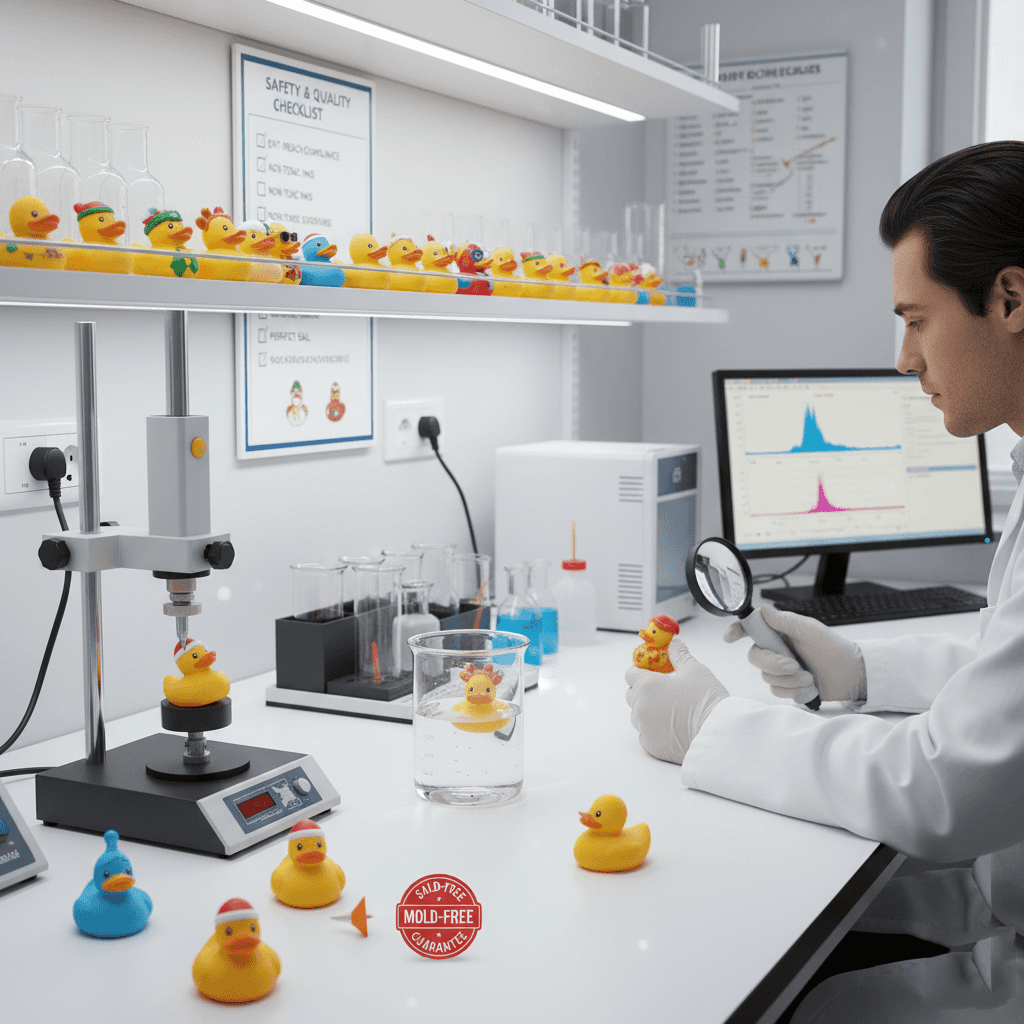
Every week, buyers who accepted a supplier’s generic ‘ASTM F963 compliant’ statement later discover that no chemical tests were run. The lab report is your only hard evidence. If a supplier hesitates to provide the lab’s name, address, and report number, that’s a red flag. Take that number and cross-check it against the CPSC-accepted lab list at cpsc.gov/labsearch. If the lab isn’t listed, the certificate is worthless.
Even with a valid lab report, production batches can vary. That’s where a pre-shipment inspection (PSI) comes in. For roughly $300–$500 per container, a third-party inspector randomly samples ducks according to ANSI/ASQ Z1.4 AQL standards. They check for sharp edges, small parts (must not fit into the small parts cylinder per ASTM F963 Section 4.6), and correct labeling. A PSI won’t catch chemical issues—those require lab testing—but it catches physical defects that slip past factory quality control.
- Lab Report Verification: Ask for the full test report including lab name, physical address, and report number. Verify the lab on cpsc.gov/labsearch. If they only offer a ‘Certificate of Analysis’ without these details, reject it.
- Pre-Shipment Inspection (PSI): Hire an independent agency like SGS or Bureau Veritas to perform random sampling of your batch. The inspector checks for sharp points, small parts, and labeling compliance. PSI cost is usually $300–$500 and can be done at the factory before container loading.
- What PSI Misses: A PSI does not test for lead content or phthalate levels. You still need a batch-specific Children’s Product Certificate (CPC) from a CPSC-accepted lab. Use PSI as your final physical safety gate, not a substitute for chemical testing.
Conclusion
The difference between a safe order and a recall isn’t just a test report—it’s knowing which sections of ASTM F963 were actually run and whether the CPC covers chemical analysis for lead and phthalates. I’ve seen suppliers hand over a generic certificate that lists flammability testing on a rubber duck, which tells you they never read the standard. The real pro move is to demand a section-by-section applicability statement and a batch-level CPC from a CPSC-accepted lab. That’s the 10% that protects your brand and your FOB pricing from hidden compliance costs.
Frequently Asked Questions
Are rubber ducks safe for children?
Yes, but only if they meet CPSIA lead and phthalate limits and ASTM F963 standards. These requirements apply when the duck is intended for children under 12. Always require a valid Children’s Product Certificate before purchase.
What regulations apply to rubber ducks in the US?
U.S. regulations include CPSIA lead limits (100 ppm substrate, 90 ppm paint), phthalate bans per 16 CFR 1307, and ASTM F963 toy safety standards. Confirm your supplier tests to these standards per batch.
Do promotional rubber ducks need safety testing?
Yes, if the ducks are intended for children under 12, they must pass the same safety testing as retail toys. Many promotional suppliers skip CPC certification, creating a hidden risk. Verify testing is done on your actual production run.
How much does safety testing cost per order?
Third-party CPSC-accepted lab testing costs $800 to $2,500 per SKU per year, plus an added $0.05 to $0.15 per unit in landed cost. Budget this cost upfront to avoid surprises.
What is a Children’s Product Certificate?
A Children’s Product Certificate (CPC) is a legal document certifying that a product passed mandatory third-party testing for lead, phthalates, and ASTM F963. It must reference a specific lab test report and cover. Never accept a CPC without the matching lab report.
Related reading: Are Rubber Ducks Safe for Babies and Toddlers? Age Grading Explained.