Skip to content
Beyond onboarding, employee and customer loyalty programs apply the same duck to repeat rewards, as the loyalty program rubber duck rewards guide explains.
The first morning at a new job carries a particular kind of nervous energy. New hires scan their desks, open their welcome boxes, and within seconds form an impression that no amount of orientation slides can overwrite. Companies that invest in a thoughtfully assembled new hire welcome kit understand this moment. Among the branded notebooks, laptop stickers, and company swag, one item has quietly earned a reputation for punching well above its weight: the custom rubber duck.
It sounds playful because it is playful. But the best onboarding gifts walk the line between fun and function, and a custom rubber duck does exactly that. It sits on a desk for years, sparks conversations, and keeps the employer brand visible long after the welcome session ends. For HR teams and marketing managers designing their next onboarding program, here is a practical look at why this small object belongs in the box, what to pair it with, and how to source it without overcomplicating procurement.

Why the Welcome Box Matters More Than You Think
Research from the Brandon Hall Group found that 82% of employees who participated in a structured onboarding experience reported significantly higher job satisfaction. That number alone should make any talent acquisition leader pause and examine what actually lands on the new hire’s desk. A welcome kit is not a throwaway gesture. It is the physical embodiment of how much the company values the person walking through the door.
Most organizations include a mix of practical items (notebook, pen, water bottle) and brand-building pieces (t-shirt, stickers, culture card). The problem is that practical items get used up, and brand-building pieces often end up in a drawer. What you need is something that occupies a permanent spot in the workspace, something that carries an emotional charge every time the new employee glances at it. A custom rubber duck with your company logo does precisely that. It is small enough to fit any desk, durable enough to last years, and distinctive enough that nobody mistakes it for generic corporate merchandise.
The psychology behind this is straightforward. Behavioral scientists call it the “endowment effect”: once people feel ownership of an object, they assign it disproportionate value. A duck that was placed in their personal welcome box, that they chose to keep on their desk, becomes theirs in a way that a company-issued mouse pad never will.
What to Include Alongside the Duck
A rubber duck works best as the surprise element inside a larger kit. The surrounding items should be useful, and the duck should be the piece that makes the whole package memorable. Based on what leading HR teams are assembling, a well-balanced welcome box contains five categories of items.
Start with the functional essentials: a quality notebook, a reliable pen, and perhaps a branded laptop sleeve. These set the tone that the company cares about the employee’s daily workflow. Next, add a culture carrier, typically a welcome letter from the CEO or a card explaining company values. This is where context lives.
Then comes the comfort layer: a coffee mug, a reusable water bottle, or a snack selection. These items signal that the company thinks about the employee as a person, not just a resource. After that, place the brand keepsake: this is where the custom rubber duck earns its position. It is the item that breaks the pattern, the thing the new hire picks up first and shows to their partner that evening.
Finally, include a practical tech accessory: a cable organizer, a webcam cover, or a phone stand. According to the 2025 Vistaprint promotional products survey, 67% of consumers say the most desirable quality in a promotional item is usefulness. The tech accessory covers the usefulness requirement; the duck covers the memorability requirement. Together, they create a kit that is both practical and emotionally resonant.

Choosing the Right Duck for Your Brand
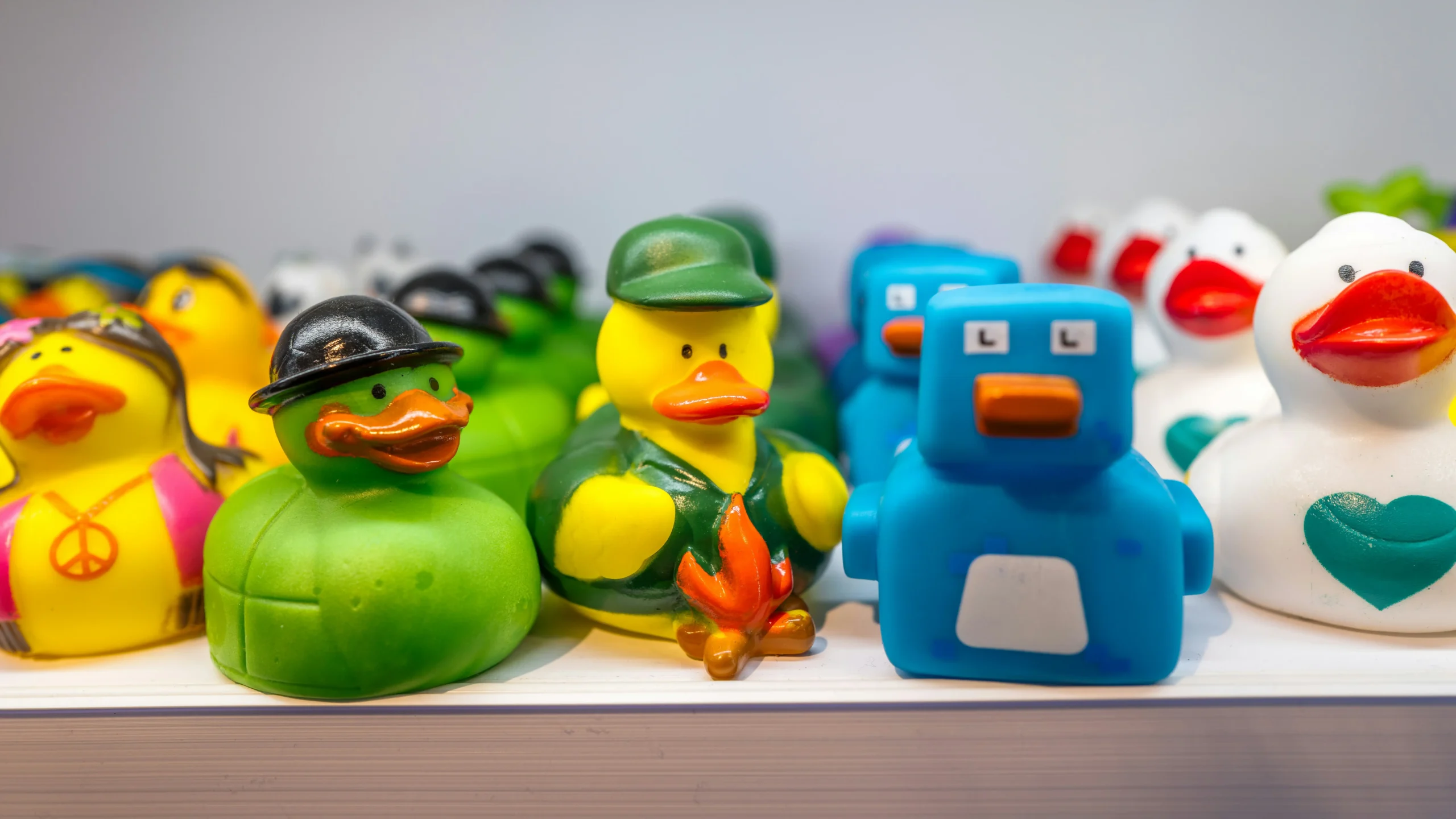
Not all rubber ducks are created equal, and the duck you choose should reflect your company’s identity. For a tech startup with an irreverent culture, a duck wearing a hoodie or sunglasses might feel right. For a law firm or financial services company, a duck in professional attire, perhaps wearing a tiny suit or glasses, communicates the same brand message through a different lens.
The material matters as much as the design. Most custom ducks for corporate programs are made from PVC or TPR (thermoplastic rubber). PVC offers sharper detail for intricate logo work and holds color well over time, making it the preferred choice for branded pieces that need to look crisp after months on a desk. TPR provides a softer, more flexible feel, which works well if the duck will also double as a stress-relief squeeze toy.
Size is another decision point. For a welcome kit, the duck needs to fit inside a box alongside other items. A 2.5 to 3-inch duck is the sweet spot: large enough to show detail and feel substantial in the hand, small enough to nestle between the notebook and the water bottle. Larger ducks (4 inches and above) work better as standalone desk gifts or shelf displays.
When it comes to branding, there are two main approaches. Pad printing transfers your logo directly onto the duck’s surface with good durability. UV printing allows full-color, photographic detail if your brand requires complex artwork. Both methods are available from manufacturers like LZENGO, where custom rubber duck MOQs start at 1,000 pieces, making this viable even for mid-size companies with annual hiring volumes in the hundreds rather than the tens of thousands.
Budgeting for the Duck Component
The cost question is usually the first one HR teams ask, and the answer is more favorable than most expect. Standard custom rubber ducks in the 2.5 to 3-inch range typically cost between $0.30 and $0.80 per unit at quantities of 1,000 to 5,000 pieces. Fully custom molds (where you create a unique duck shape rather than modifying an existing one) add a one-time mold fee of $200 to $500, but the per-unit cost remains in the same range.
To put this in context: a typical new hire welcome kit costs between $25 and $75 per person when you include all items. Adding a custom rubber duck increases that budget by less than $1. The duck also has one of the highest cost-per-impression ratios of any item in the box, because it sits in plain sight for months or years, whereas a notebook gets filled and discarded, and a pen eventually runs out.
For companies hiring at scale, the economics improve further. At 10,000+ units, per-piece pricing can drop below $0.25 for standard designs. And because ducks are lightweight and compact, shipping costs per unit are minimal, especially when packed in bulk cartons rather than individual retail boxes.
Timing Your Order Around Hiring Cycles
One logistical detail that catches some companies off guard is lead time. A first-time custom duck order involves three phases: design and mold creation (7 to 10 days), sample production and approval (5 to 7 days), and bulk manufacturing (15 to 25 days). In total, plan for four to six weeks from initial brief to delivery.
If your company has seasonal hiring surges, place the duck order at least two months before the cohort start date. For organizations with continuous onboarding (new hires every week or month), a standing reorder arrangement with your manufacturer ensures you never run out. Many buyers keep a buffer stock of 200 to 300 ducks on hand, which represents roughly $60 to $240 in inventory cost, a negligible amount against the risk of a new hire arriving to find an empty spot in their welcome box.
Making the Duck Part of the Onboarding Ritual
The duck’s impact multiplies when you build a small ritual around it. Some companies place the duck face-down in the box with a note that says “Flip me when you’re ready to start.” Others use the duck as an orientation icebreaker: each new hire introduces themselves and their duck to the group. A few organizations have turned the duck into an internal mascot, with teams competing to customize theirs or creating duck-related traditions around project milestones.
These rituals cost nothing to implement but transform the duck from a generic gift into a shared experience. They also generate organic social media content. New hires who post photos of their welcome kit on LinkedIn or Instagram are, in effect, running a free employer branding campaign. The duck, because of its visual distinctiveness, is the item most likely to appear in those posts.
For companies that want to extend the concept, consider creating a small duck collection: one duck per department, or a seasonal series that evolves over the year. This gives long-tenured employees something to look forward to and creates an internal collector culture that reinforces belonging.
Sourcing Checklist for Procurement Teams
If you are ready to add a custom rubber duck to your welcome kit, here is what you need to prepare before contacting a manufacturer. First, have your brand guidelines available, specifically the logo file (vector format preferred), Pantone color codes, and any character or mascot specifications. Second, determine your annual hiring volume to set the right order quantity. Third, decide whether you want a custom shape (unique to your company) or a modified standard design (faster and cheaper). Fourth, confirm the material preference: PVC for detail and durability, TPR for softness and squeeze appeal, or silicone for premium positioning.
Request samples from at least two suppliers before committing to a production run. A physical sample reveals details that photos cannot: the actual color accuracy, the weight and balance in the hand, and the quality of the logo application. For companies new to sourcing custom promotional products, the RFQ preparation guide covers exactly what specifications to include in your inquiry to get accurate quotes.
Final Thoughts
A new hire welcome kit is a company’s first physical handshake with a new team member. Every item in that box sends a signal about what it is like to work there. The custom rubber duck sends a signal that the company takes its culture seriously but does not take itself too seriously. It is a small investment, typically under $1 per unit, that delivers outsized returns in employee morale, brand visibility, and social sharing. For organizations looking to differentiate their onboarding experience in a competitive talent market, the duck is not a novelty. It is a strategy.
Related reading: Employee Recognition Ducks: Monthly Programmes That Actually Get Shared