Skip to content

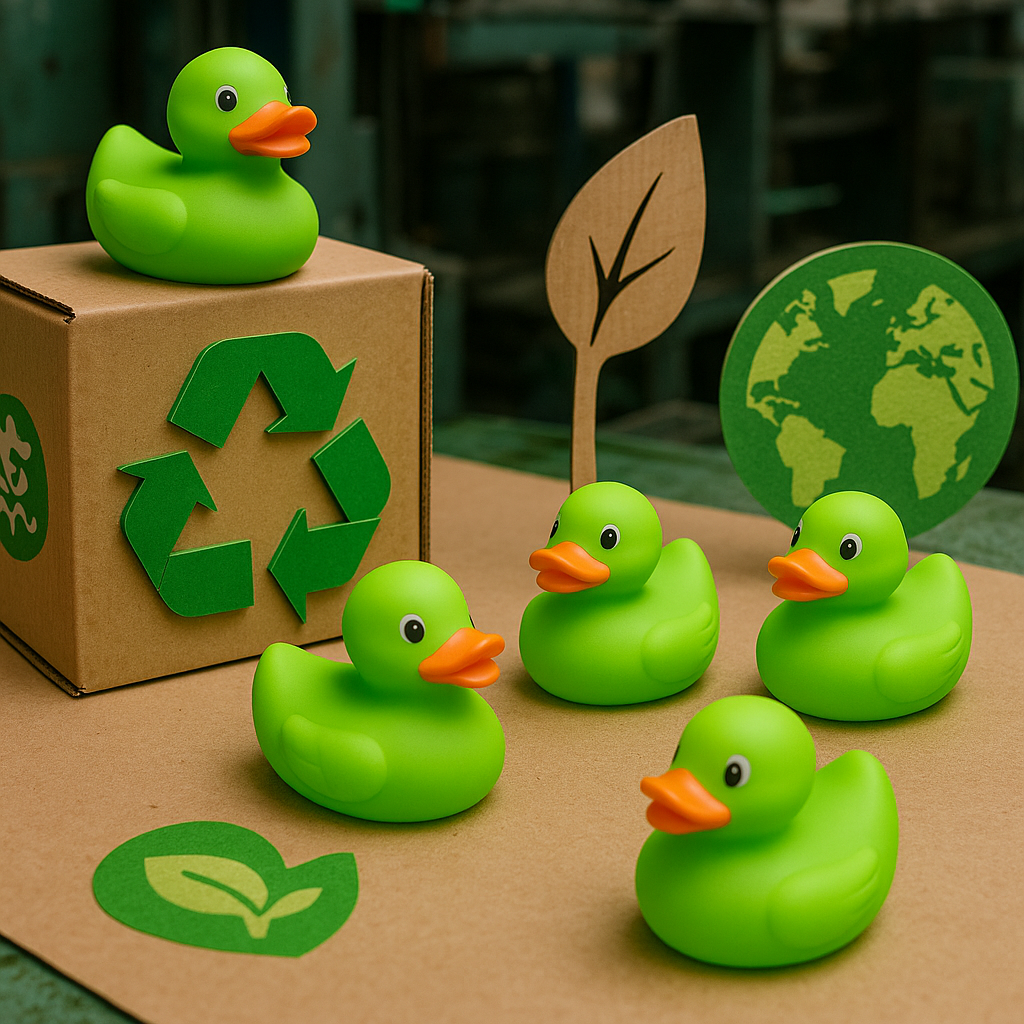
A rubber duck made from recycled vinyl sounds like a contradiction until you see the compounding line. PVC, the material behind roughly 90 percent of custom ducks, is recyclable, and the recycled compound can be molded into the same duck shapes, with the same printing, at the same 1,000-piece MOQ. The difference is documentation: a GRS-certified recycled rubber duck carries a verifiable chain of custody from recycled input to finished product, which is what makes the sustainability claim real instead of decorative.
This guide explains what the Global Recycled Standard actually certifies, how recycled vinyl becomes a duck, and how a buyer verifies the claim before printing it on a hang tag.
What GRS Actually Certifies
The Global Recycled Standard is run by Textile Exchange, and it is a certification of content and process, not a marketing badge. The GRS standard page sets a 50 percent minimum recycled content for consumer-facing claims and a 20 percent floor for business-to-business use of the claim. On top of the content check, GRS audits social and environmental requirements at the facility and restricts chemicals with harmful potential from the certified product. That is a materially higher bar than a supplier saying “we use some recycled material.”
GRS sits above the lighter Recycled Claim Standard (RCS): same family, same chain-of-custody logic, but GRS adds the social, environmental, and chemical layers and a higher content floor. A buyer comparing certificates should treat the two as different tiers, not interchangeable labels.
The standard is also a living document. GRS version 4.0 dates to July 2017, and Textile Exchange is moving the standard into its Materials Matter framework, effective at the end of 2026 and mandatory through 2027. For buyers, the practical consequence is simple: ask for the certificate’s version and validity dates, and confirm the facility’s certification is current, not archived.
The Recycling Chain Behind a Recycled Duck
Recycled vinyl reaches a duck factory through a chain that starts upstream of the mold. Post-industrial scrap from PVC processing and post-consumer vinyl both enter the chain, and the industry has built programs around both streams; the Vinyl Institute documents how PVC is collected and diverted from landfill. The material is sorted by type, cleaned, ground into regrind, and re-compounded into pellets with fresh stabilizers and plasticizers before it is usable in a mold.
For a duck, the compound matters more than the source. PVC hardness, color, and flow behavior are set during compounding, and recycled inputs shift those variables unless the compounder manages the blend. That is why GRS-certified ducks are not “recycled-looking” products; the visible quality is controlled by the same compound discipline as virgin PVC, and the certification covers the input ratio.
The chain-of-custody system is where the certification earns its weight. Every ton of recycled input is tracked with a transaction certificate from the recycler to the compounder to the factory, and the factory’s scope certificate lists which product lines carry the recycled content. A buyer who asks for those documents is doing exactly what the standard expects.
How Recycled PVC Becomes a Duck
The molding process for a recycled-compound duck is the same rotational or slush-molding cycle used for virgin material: compound, heat, mold, cool, trim. The recycled pellets feed the same machines that run 5 million ducks a month at LZENGO’s facility, which means recycled-content orders ride the same capacity and the same 1,000-piece MOQ as standard orders. Design mockups still land in 12 hours and physical samples in 7 days, because the recycled input changes the compound, not the process.
Color is the visible difference a buyer should plan for. Recycled inputs carry residual color from their previous life, so the compounder either sorts aggressively for clear or white regrind or accepts a tint that gets corrected with pigments. For brand colors matched to Pantone codes, the factory mixes the custom resin with the recycled base and validates the match on the sample, the same way it validates any custom color. A buyer who needs a precise white or a bright pastel should confirm the recycled base can hit the shade before approving the mockup.
Printing behaves the same on recycled PVC: pad printing and UV printing both work, the 30/50 logo-size limits still apply, and the print zone on the belly still governs placement. The recycled content does not change the duck’s geometry, so every standard customization rule carries over.
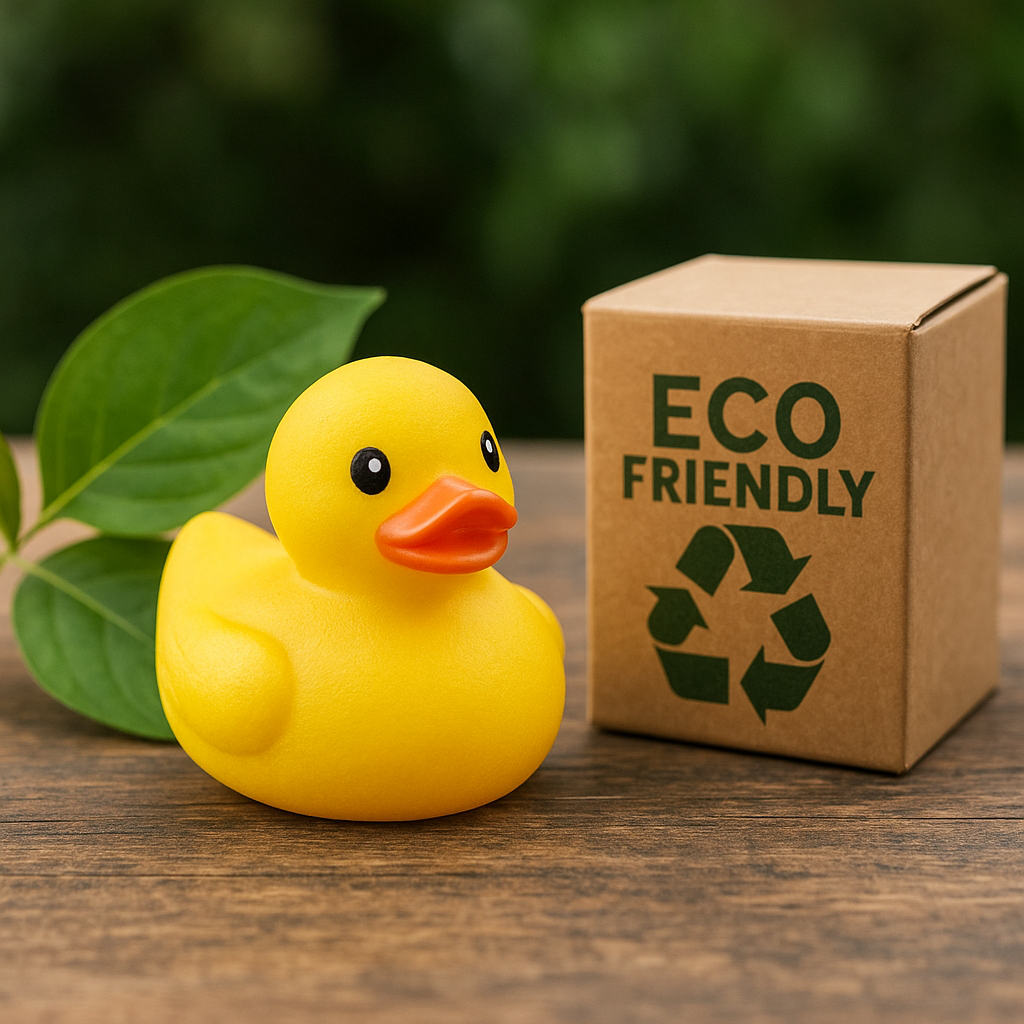
What Changes When the Compound Is Recycled
Quality control is where recycled compounds earn or lose trust. Virgin PVC arrives with a predictable specification; recycled blends require batch-level checks on hardness, plasticizer content, and color stability, because the input varies by source. A GRS-certified factory runs those checks as part of the certification audit, and the batch records become part of the certificate file. Buyers who see batch records without being asked are looking at a facility that treats the standard as a process, not a sticker.
Safety compliance does not relax for recycled content. A duck destined for children still must meet CPSIA and the applicable small parts and chemical limits, and a recycled compound is only as clean as its sorting and compounding. LZENGO ships with BSCI, GRS, REACH, and CPSIA documentation tested through Intertek, which means the recycled line carries the same test file as the virgin line, not a lighter one.
The cost picture is roughly neutral per unit at scale, because the recycled input trades against the sorting and compounding work. The real economics show up in the claim’s value: a brand that can document GRS content has a defensible sustainability message, and a brand that cannot is one customer audit away from a greenwashing conversation.
Reading the Label: Claims and the FTC Green Guides
The marketing claim is where recycling programs succeed or backfire. The Federal Trade Commission’s Green Guides in 16 CFR Part 260 require environmental claims to be substantiated and qualified, and “made with recycled content” is exactly the kind of claim they govern. The substantiation for a GRS duck is the certificate file; the qualification is the percentage, because “recycled” without a number tells the buyer nothing.
Three documents close the loop. The scope certificate names the certified product lines and the facility. The transaction certificates trace each batch of recycled input. The product specification states the recycled-content percentage for the specific duck. When all three line up with the supplier’s GRS certificate number, the claim is verifiable; when any one is missing, the claim is a promise.
Buyers should also watch the transition. With GRS moving into the Materials Matter framework at the end of 2026, certificates issued under the old version stay valid through their term, and new audits will come under the new framework. A hang tag printed with “GRS certified” should name the version and the certificate holder, which protects both the brand and the buyer when the standard itself changes.

When GRS Ducks Make Sense for a Campaign
Recycled-content ducks earn their place when the claim is part of the program, not when sustainability is a footnote. Corporate ESG campaigns, Earth Day promotions, and brands with published recycled-content goals are the natural fit: the duck carries the message and the certificate file carries the proof. For those programs, the recycled line is available through the same custom rubber duck ordering process as the standard line, with the same MOQ and timeline.
The material choice matters elsewhere too. Buyers comparing PVC, vinyl, and TPR for ducks will find that recycled-content options sit on the PVC side of the comparison, while TPR and silicone solve different problems: softness, squeeze feel, and premium positioning. The recycled claim is an input attribute, and it layers onto the material decision rather than replacing it. For buyers already questioning eco claims, the traceability-first guide for eco-friendly ducks covers the audit trail before the order, which is the same discipline this certificate check applies after it.
One boundary worth naming: recycled content is not the same as phthalate-free or BPA-free. Those are separate chemical attributes with their own labeling logic and verification paths. A buyer who wants both should ask for both in the specification and check that the certificate file covers each claim independently.
What Recycled Content Does Not Mean
Three claim mix-ups cost brands the most, and each one is worth naming before it reaches a hang tag. Recycled does not mean biodegradable. PVC with recycled content is still PVC, and its end-of-life behavior is the same as virgin PVC; a “recycled and biodegradable” label conflates two separate attributes that the Green Guides treat separately. Recycled does not mean plastic-free, and it does not mean the product will be recycled again after use, which is why “recyclable” and “recycled” are different claims under 16 CFR 260.
GRS certification also does not say anything about carbon footprint, water use, or biodegradability. The standard verifies recycled content and the facility’s social, environmental, and chemical practices, and a buyer who sees “GRS certified” and hears “carbon neutral” is adding meaning the certificate never made. When a campaign needs a fuller environmental story, each attribute needs its own claim and its own substantiation.
This matters commercially because the fastest way to lose a sustainability-minded buyer is a claim that overreaches. A verifiable recycled-content statement backed by a certificate file outperforms a vague “eco-friendly” promise every time, and the FTC enforcement history in the Green Guides section is full of brands that learned the difference the expensive way.
Pricing, MOQ, and Lead Time for the Recycled Line
The recycled line does not change the order mechanics. The MOQ stays at 1,000 pieces, design mockups still arrive in 12 hours, physical samples in 7 days, and bulk production runs 15 to 25 days after approval. The recycled input replaces part of the compound, not any step of the process, so a recycled-content order fits the same production slot as a standard order at the same 5-million-ducks-a-month capacity.
Cost is close to neutral at scale, with one planning caveat. The recycled input trades against the sorting, cleaning, and re-compounding work, which usually balances the bill of materials; the caveat is color. A recycled base that must be stripped or heavily pigmented to hit a bright white or pastel adds compounding work, so those shades can carry a small premium (a planning estimate, confirmed at quote time). Standard brand colors matched to Pantone codes typically land in the same $0.80 to $0.85 per unit band as the virgin line at the 1,000-piece entry point.
For brands that already run sustainability programs, the recycled line slots into the same ordering channel as every other custom duck, and the certificate file ships with the order rather than arriving as a follow-up email. That is the difference between a program and a promise.
Frequently Asked Questions
What does GRS certification mean for a rubber duck?
It means the duck’s vinyl compound contains verified recycled content, and the facility that made it met the Global Recycled Standard’s social, environmental, and chemical criteria. The certification is audited and documented, not self-declared.
How much recycled content does GRS require?
GRS requires 50 percent minimum recycled content for consumer-facing claims and 20 percent for business-to-business use of the claim. The percentage sits in the scope certificate for each product line.
How do buyers verify a GRS claim?
Ask for the scope certificate, the facility’s transaction certificates, and the recycled-content percentage in the product specification. Cross-check the certificate number against the certification body’s public directory.
Do recycled ducks still need safety compliance?
Yes. Recycled content does not replace CPSIA, REACH, or other children’s product requirements. A GRS duck destined for kids still needs the same testing and certification file as a virgin-material duck.
Final Thoughts
GRS-certified recycled rubber ducks are a documentation product as much as a molded one. The recycled input changes the compound, and the certification changes the file: scope certificate, transaction certificates, and a stated recycled-content percentage, all traceable to the Global Recycled Standard. The duck itself rides the same molds, printing rules, and safety tests as any other custom duck, which is exactly why the claim holds up.
When you brief a factory for a recycled-content program, ask for the certificate version, the recycled percentage for your product line, and the batch records for the compound. If the answers come back with the sample, you have a campaign asset. If they come back as promises, you have a liability.