Skip to content
Float Testing 101: Why Some Custom Ducks Sink and How Factories Fix It

Rubber duck float testing: why some custom ducks sink, how buoyancy is controlled, and how a factory fixes a duck that tips or dives instead of floating.
Carton Specs for Rubber Duck Orders: Box Size, Weight and Pallet Planning
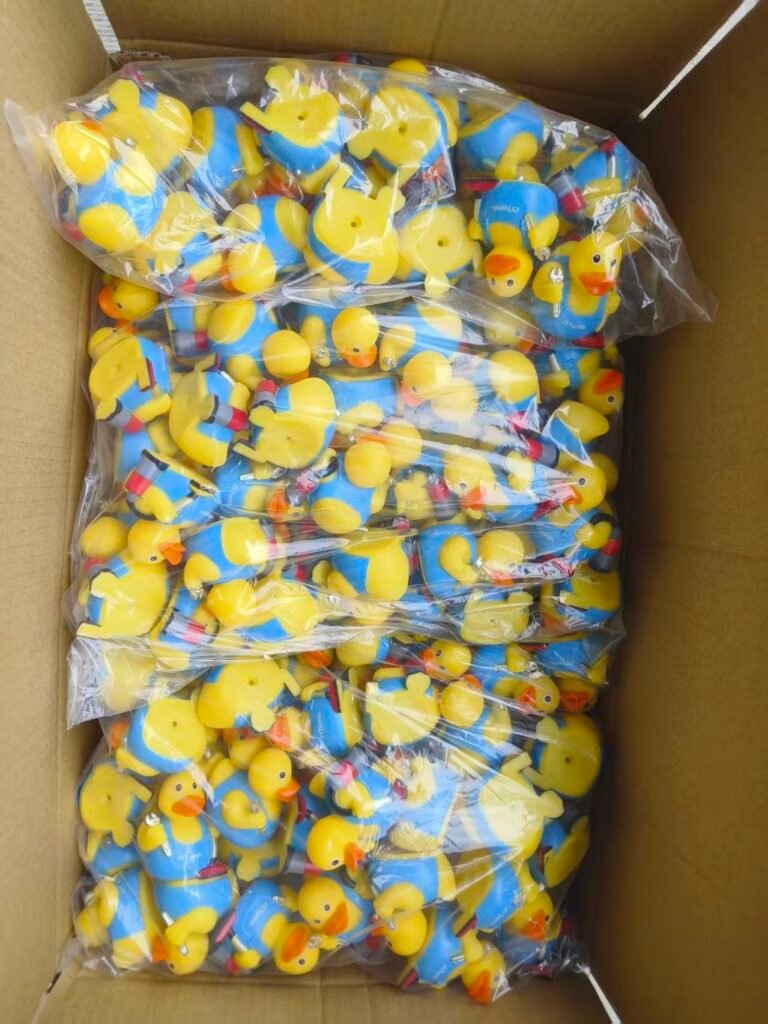
Plan the carton for a bulk rubber duck order: box dimensions, weight, per-carton quantity, CBM, and pallet and container planning.
How Much Does a Rubber Duck Weigh? Freight-Relevant Specs

The honest answer is that a rubber duck weighs about 60 to 80 grams, and the useful answer is why, because the number moves with the spec. For a buyer quoting freight, the weight is where the real cost hides: a few grams per duck multiplies across a 1,000-unit order, and a mismatched spec turns…
Rubber Duck Size Charts: Mini, Standard, Jumbo, and Giant Dimensions

Rubber duck sizes are a sourcing spec, not a vibe: the number on the ruler decides packaging, freight, safety labeling, and what the duck is for. “Standard duck” means nothing on a purchase order, because the category runs from keychain charms that fit on a thumbnail to pool floats taller than a person, and every…
Toy Safety Labels on Custom Ducks: Where Warnings Go and Why They Matter

A custom duck’s safety label is easy to treat as a print detail, but it is the first thing a retailer’s compliance team checks and the last thing a buyer wants to explain to customs. The label tells the market who made the duck, when it was made, and what age group it is for,…
Are Rubber Ducks Safe for Babies and Toddlers? Age Grading Explained

Rubber ducks and babies are a combination parents ask about constantly, and the answer is not a simple yes or no — it is an age grading. The duck itself is not inherently dangerous; the risks sit in the details: small parts that break off, the squeaker that can be extracted, the material’s chemical safety,…
California Prop 65 and Rubber Ducks: Compliance Notes for U.S. Buyers

Any rubber duck sold or distributed in California must comply with Proposition 65, the Safe Drinking Water and Toxic Enforcement Act of 1986. The law requires businesses to provide warnings to Californians about exposures to chemicals known to cause cancer, birth defects, or other reproductive harm. For rubber duck importers and distributors, Prop 65 compliance…
Rubber Duck Durability Standards: What ASTM F963 and EN 71 Mean for Buyers

Not all rubber ducks are built the same way. A duck that sits on a shelf in a gift shop faces very different stresses from one that goes into a bathtub, a car dashboard, or a child’s toy bin. For B2B buyers who source rubber ducks at scale, understanding the durability standards — particularly ASTM…
Recycled PVC vs Biodegradable Duck Materials: A Realistic Comparison
The Material Debate Every B2B Buyer Needs to Understand Clearly “Can you make biodegradable rubber ducks?” It is one of the most common questions landing in manufacturer inboxes this year. The short answer is: not yet in any commercially viable way. The longer answer involves understanding what biodegradable actually means for PVC, what recycled alternatives…
GRS-Certified Recycled Rubber Ducks: How Vinyl Recycling Works
A rubber duck made from recycled vinyl sounds like a contradiction until you see the compounding line. PVC, the material behind roughly 90 percent of custom ducks, is recyclable, and the recycled compound can be molded into the same duck shapes, with the same printing, at the same 1,000-piece MOQ. The difference is documentation: a…