Skip to content
Rubber duck sizes are a sourcing spec, not a vibe: the number on the ruler decides packaging, freight, safety labeling, and what the duck is for.
“Standard duck” means nothing on a purchase order, because the category runs from keychain charms that fit on a thumbnail to pool floats taller than a person, and every step between them changes the order economics. This guide lays out the size classes buyers actually specify, the weight and carton consequences of each, the safety threshold that divides duck sizes into two regulatory worlds, and how to read a supplier’s dimensions so the duck that arrives matches the one in the mockup. Toy safety dimensions follow ASTM F963 and its international counterparts, and the small-parts rule inside those standards is the single most important number in this article.

1. The size classes buyers specify
Working in centimeters of duck height, the trade recognizes five bands. Keychain and mini ducks run about 3 to 4 centimeters, made as charms, Advent-calendar fillers, and mail inserts. Small ducks around 5 centimeters are the classic claw-machine and party-bag size. The standard classic duck, the bathroom icon, sits at roughly 7 to 8 centimeters tall and about the same wide, and it is the default shape most custom-logo programs quote. Large ducks run 10 to 15 centimeters, common for corporate gifts and shelf displays with more branding surface. Jumbo ducks start around 20 centimeters and climb past 30, priced and shipped more like plush than like promo. Beyond them sit the giant inflatable ducks measured in meters, which are a different product category entirely with their own engineering and are covered in our importing guide’s freight sections.
2. Weight, cartons, and the freight math
Size drives weight roughly by the cube, which is why the freight line item moves faster than the unit price when ducks grow. A standard 7-to-8-centimeter hollow duck weighs a few tens of grams, and cartons pack in the hundreds; jumbo ducks pack in dozens per carton and volumetric weight starts dominating the quote. Two structural choices interact with all of this: hollow versus solid construction, compared in our hollow versus solid guide, where solid material raises unit weight and freight but changes hand feel and durability; and compressed packing, which is standard for minis and saves meaningful volume on six-figure quantities. Buyers comparing quotes at different sizes should force every supplier to quote the same landed basis: duck height, pieces per carton, carton dimensions, and gross weight, or the comparison is fiction.

3. The safety threshold that splits the category
Small-parts rules divide duck sizes into two regulatory worlds. Below the small-parts cylinder threshold, ducks are not suitable for children under 3 and the packaging must say so; at or above it, with appropriate testing, the duck can be rated for all ages. That is why mini and keychain ducks almost universally carry the under-3 warning, and why a program targeting family audiences sometimes sizes up to the standard band on purpose. The testing regime behind the label, including what EN 71 and ASTM F963 reports should look like, is covered in our toy safety labels guide; the size decision comes first, and the label follows it.
4. Reading supplier dimensions without getting fooled
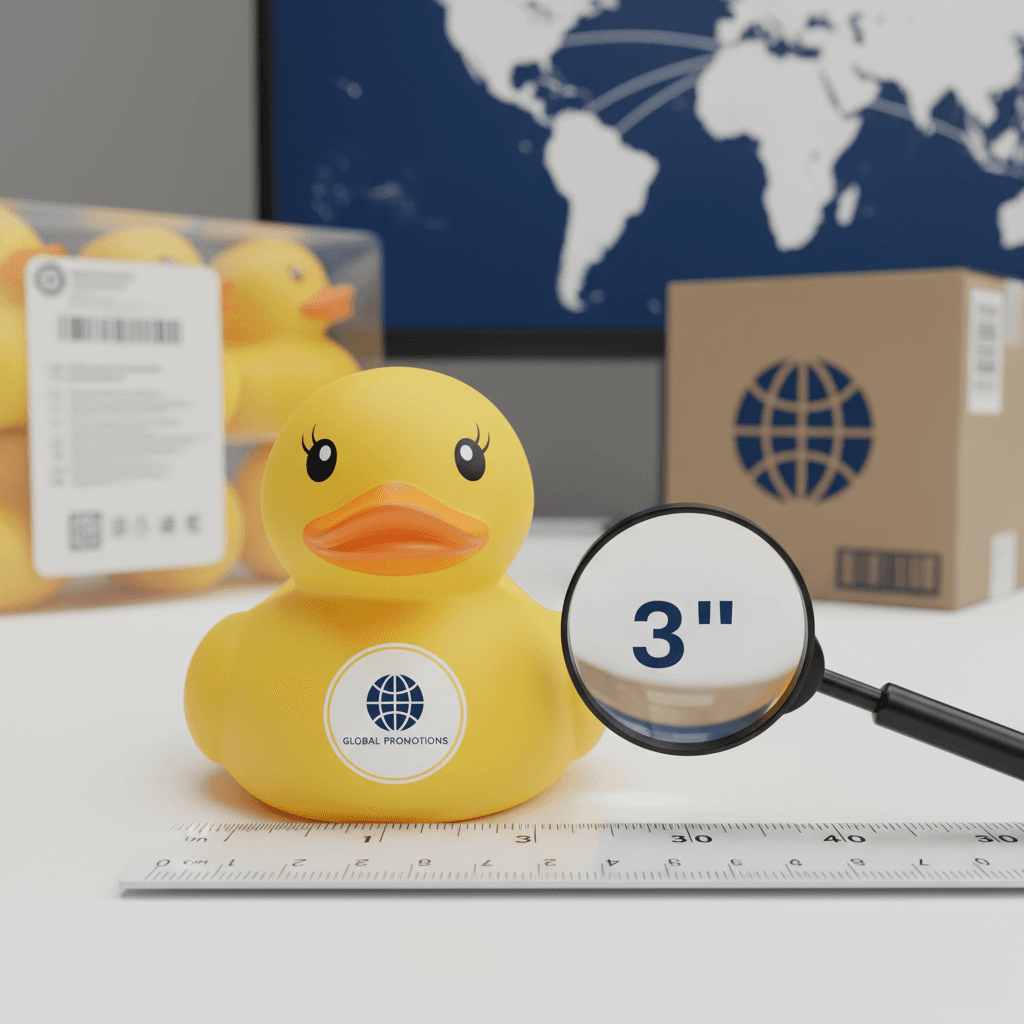
Three habits keep size honest. First, ask for the dimension with the reference: height measured how, beak to tail or base to head, and width at the widest point. Second, require the ruler in the photo: the 12-hour mockup and the 7-day sample stage are where a 3-centimeter duck gets caught being 2.6, and measurement shots belong in the inspection set for production too. Third, tolerate honestly: promo vinyl runs plus-or-minus a few millimeters at production scale, and a spec that demands machining tolerances on a rotocast duck will pay for rejects. The professional pattern is to write the nominal size, the tolerance band, and the measurement method into the order, then let the retained sample arbitrate.
5. Choosing the size by program goal
| Program goal | Size band | Why it works |
|---|---|---|
| Mail inserts, calendar fillers, event drops | Mini 3-4 cm | Compressed packing, minimal freight, high count per 1,000 |
| Party bags, claw machines, bulk giveaways | Small ~5 cm | Classic prize size, fastest handling |
| Corporate logo programs, bathroom classic | Standard 7-8 cm | Default custom platform, balanced branding surface and cost |
| Executive gifts, shelf presence | Large 10-15 cm | More branding area, premium read |
| Statement pieces, mascot replicas | Jumbo 20-30+ cm | Plush-like logistics, display-grade impact |
Every band runs on the same 1,000-unit order floor and the same mockup-to-sample approval chain, so the size decision costs nothing to revisit before artwork locks; it only gets expensive after production. The custom ducks program quotes any band against artwork, and the mockup that returns within 12 hours shows the duck at true proportion next to the logo, which is usually where the size decision actually gets made.
Frequently asked questions
What is the standard rubber duck size?
The classic bathroom duck runs about 7 to 8 centimeters tall and roughly the same across; it is the default platform most custom-logo programs quote.
How big is a mini rubber duck?
Keychain and mini ducks run about 3 to 4 centimeters, used for mail inserts, Advent calendars, and compressed bulk packing in the hundreds per carton.
What sizes do jumbo rubber ducks come in?
Jumbo ducks start near 20 centimeters and run past 30, shipped and priced more like plush; giant inflatable ducks measured in meters are a separate engineered category.
Why do small ducks carry an under-3 warning?
Ducks below the small-parts cylinder threshold fail the under-3 suitability rule in standards like ASTM F963 and EN 71, so the packaging must state the age restriction.
For the weight bands and the freight math behind a duck order, see our rubber duck weight guide.