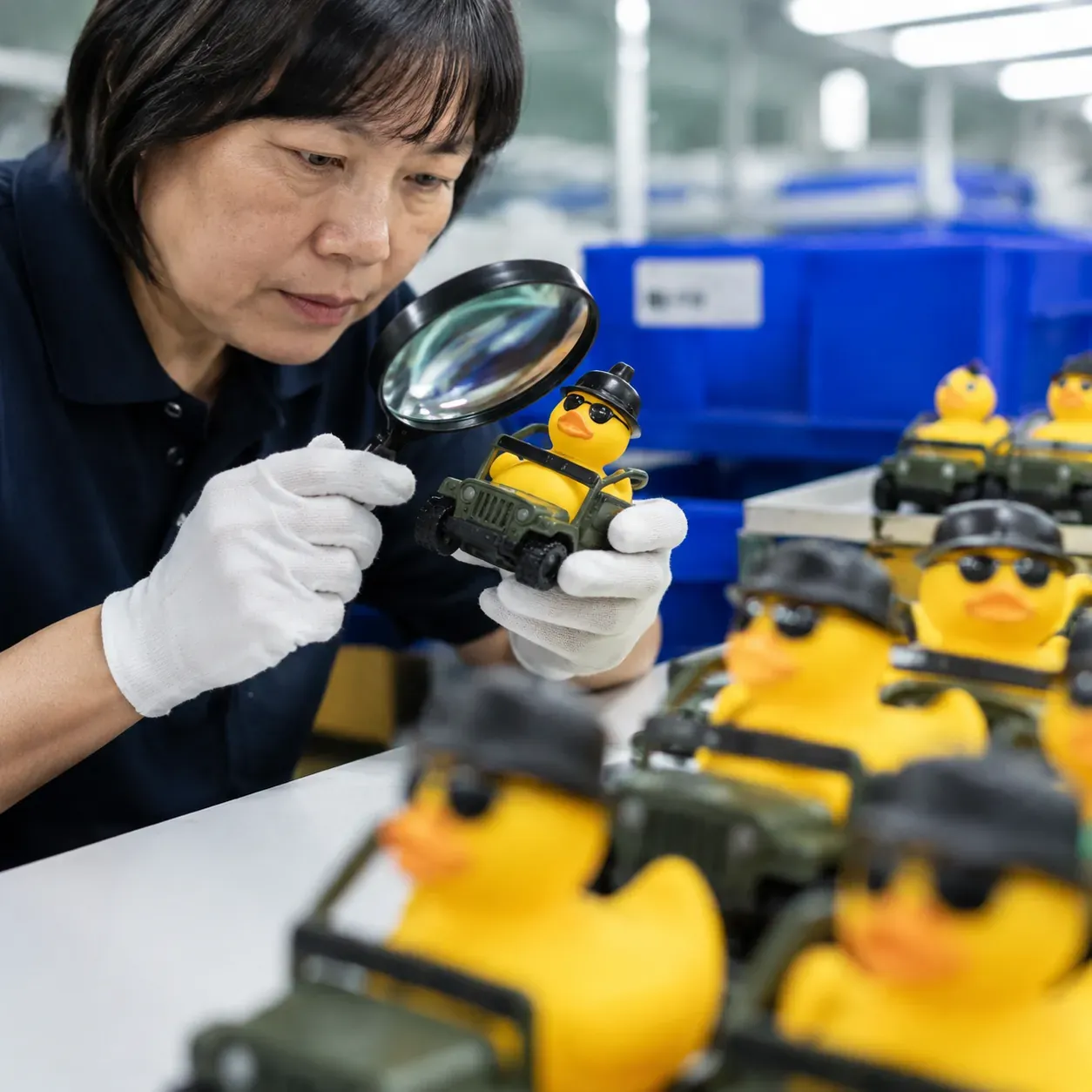
A sample is judged against a written spec, not against how it looks in the hand, because it is the last place to catch a colour mishap, a logo that will not survive washing, or a mould line that ruins the duck — before you have committed to thousands of units. That makes the sample the most important checkpoint between your idea and a full production run. The checklist below is the order to inspect in, from the carton to the squeeze test.
In short: check the sample against the written spec — colour, print, seam, squeeze, float, smell, size, hardness, accessories and packing — photograph each result and keep the duck as the retained standard. A sample approved on looks alone is not an approval.

The 10 checks
- Colour against the Pantone or the approved chip, in daylight.
- Print position, size and edge quality.
- Seam for flash, sharpness and alignment.
- Squeeze and recovery; the body should return to shape.
- Float and upright position, if the duck is for water.
- Smell after a day in a bag.
- Size and weight against the spec.
- Hardness by hand, against the agreed feel.
- Accessories for fit, colour and small-parts security.
- Packaging and the carton, if they are part of the order.
How should the checks be recorded?
Photograph each check, write the result and keep the sample. A checklist with photos is the standard for the production comparison.
If a check fails, describe the difference and ask for a revised sample before the run.
What is a fail vs an opinion?
A fail is outside the agreed spec: a colour beyond the tolerance, a print off-position, a sharp seam, a loose accessory. An opinion such as "softer" is useful, but it needs to become a spec before it can be a fail.
What happens after approval?
Keep the sample as the retained standard. Compare the production run against it, and use the same checklist at goods-in.
Final Note
A checklist is only worth the paper it is written on if every line has a spec behind it. An extra sample round belongs on the two checks that decide the product, the print edge and the seam, rather than on finding both at goods-in. The sample you keep is the only version of the order everyone can still see.
What should a buyer decide before approving a sample?
- Which checks have a written spec, and which are only a preference?
- Who signs off, and against which sample number?
- What triggers a revised sample rather than a note on the file?
- Which two checks would stop the run if they failed?
- Where is the retained sample kept until the reorder?
Frequently Asked Questions
What should be checked on a rubber duck sample?
Colour, print position and edge, seam, squeeze, float, smell, size and weight, hardness, accessories and packaging. Photograph each check, use a checklist, take photos, keep the sample as the standard, check each one, keep the record and book the run.
What is a sample fail?
A result outside the agreed spec: a colour beyond tolerance, a print off-position, a sharp seam or a loose accessory. A preference is not a fail until it becomes a spec. Check the spec, keep the record and ask for a sample.
How long should a sample be kept?
Until the production run is approved and the reorder is placed. The retained sample is the reference for goods-in checks and any claim. Keep it and check it at goods-in with the same list, ask for a report and keep the file.
Ready to check the sample?
Send the sample spec. We reply with the comparison and the checks.
Figures are LZENGO QC data for 2026 and move with product, quantity and inspection.