Skip to content
It’s Tuesday afternoon in Chicago, and a pallet of 5,000 custom rubber ducks just cleared the warehouse dock. The event launch is in three days. Your assistant opens the first carton, pulls out a duck, and holds it against the pre-production sample you approved six weeks ago. The color is off—the Pantone 186C red you signed off on reads more like a burnt orange. Worse, the logo on the duck’s chest, printed for a flat surface, smudges along the curved contour. That $50,000 order just turned into a liability because the sample approval never accounted for mass-production surface variation.
Making matching sets of custom rubber ducks isn’t a matter of dialing in a single Pantone code. It sits at the intersection of pad printing limits, mold design, and raw material batch control. When you negotiate FOB Ningbo prices, the factory’s quality tolerance—typically 5–8% printed reject rate on curved surfaces—gets silently amortized into the per-unit cost. That’s the cost of not understanding how a duck’s shape dictates whether your logo stays legible across 5,000 units. This article digs into the two manufacturing paths that determine whether your matching sets stay brand-consistent or become a warehouse headache.

Why Your First Custom Order Fails: The Hidden Risks
5-8% of pad-printed ducks fail adhesion checks on curved chests.
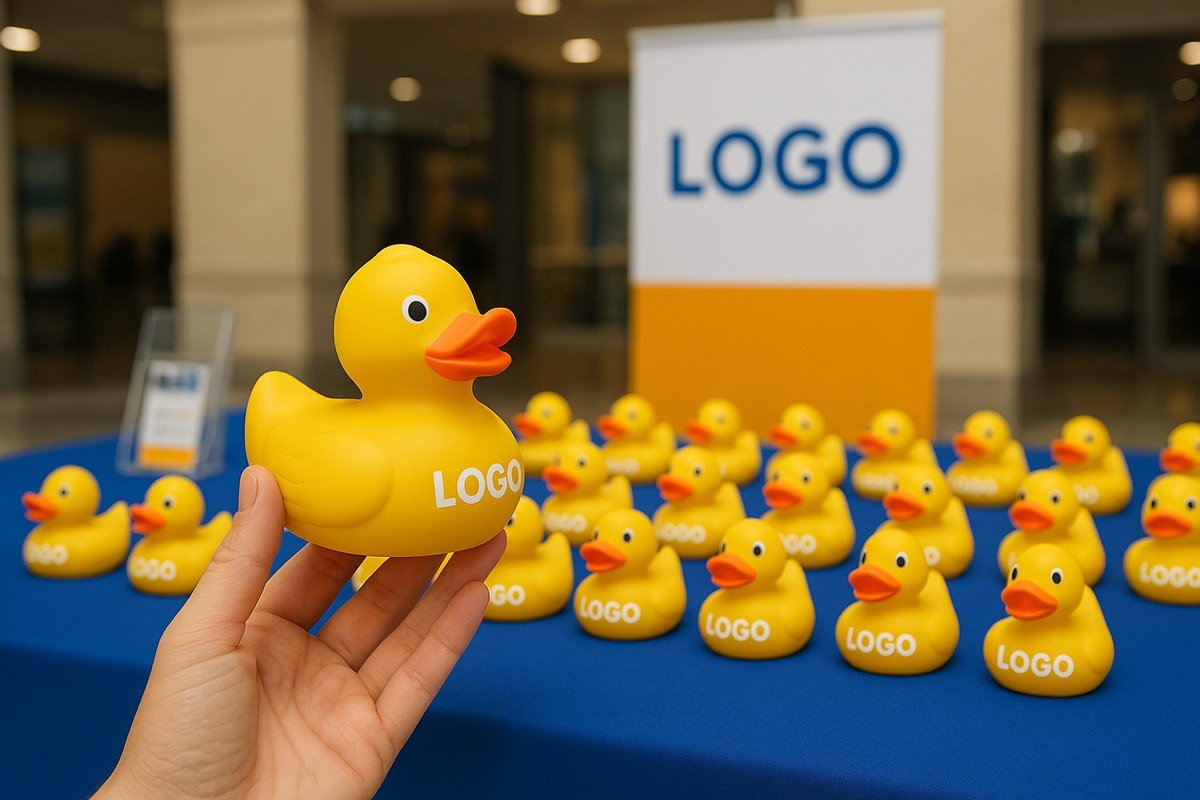
The single biggest reason a first order for custom rubber ducks fails is simple: the buyer asked for pad printing on a surface that cannot hold ink. A brand manager specifies a detailed logo with small text for a 2-inch standard duck, signs off on the artwork, and then receives 1,000 units where the print smudges, cracks, or flakes off within days of a trade show handout. The factory sent exactly what the buyer approved—the failure was in the method selection, not the production. Pad printing transfers ink via a silicone pad from an etched plate onto the duck. The process works on flat or gently curved areas, but any surface with aggressive curvature, deep texture, or undercuts creates uneven pad contact. The result is poor ink adhesion and a reject rate that experienced sourcing managers quietly bake into the per-unit price, typically 5–8% of the batch.
- Curvature fails adhesion: A standard duck chest has a compound curve. When the printing pad presses down, the edges lift, leaving ink thickness inconsistent. After baking, that thin ink layer cracks under minimal flexing. This is why text-heavy logos on the duck belly often look fine on the pre-production sample but degrade during mass production—samples are hand-applied with extra care and curated to avoid rejection.
- Textured surfaces cause voids: Many promotional ducks include feather texture, mesh patterns, or grip ridges. Pad printing bridges air gaps across these micro-geometries. Factories can compensate by over-inking, but that leads to bleeding and loss of fine detail. A logo requiring crisp 6-point type on a textured duck is a job for in-mold text, not post-production printing.
- Molded detail is mandatory for 360° branding: For designs that wrap completely around the duck or require raised/embossed elements, the artwork must be integrated into the CNC-cut mold cavity during the sculpting phase. This adds $350–$1,800 to the project depending on mold complexity, but eliminates the adhesion lottery. A molded logo shares the same PVC material as the duck body and cannot separate, scratch off, or leach color.
The cost conversation this triggers is predictable: a procurement lead sees a $0.30 printed duck vs a $1.20 molded option and picks the cheaper route. What that math misses is the amortization of the mold fee across even a 3,000-unit order, where the per-unit surcharge drops to $0.12–$0.60. More importantly, it misses the real cost of brand damage when a promotional item fails in the hands of a potential client. An industry benchmark for a responsible production batch is a defect rate under 2%, with a factory reprint policy for anything exceeding that threshold. That level of assurance simply is not possible with pad printing on geometry that fights the process; it becomes achievable only when the design is physically part of the duck itself. Before submitting an RFQ, ask a supplier one direct question: ‘Show me a photo of a pad-printed logo on this exact duck shape from a production run, not a pre-production sample.’ If they hesitate, you are already looking at the cause of your first failed order.
Real Cost Breakdown of Custom Rubber Ducks for 2026
The quoted unit price is never your landed cost.
Let’s get the numbers on the table. After auditing factories across Shenzhen and Yiwu, the mold fee band is tighter than most buyers assume. A simple, single-cavity steel mold that stamps out a standard duck shape will run you $350 to $500. Step up to a multi-part character mold—something with separate body, head, and accessory inserts—and you’re looking at $1,200 to $1,800 before you’ve produced a single unit. Any supplier quoting below $300 for a new mold is either using soft aluminum that deforms after 20,000 cycles, or they’re amortizing the cost into your per-unit price without telling you. Neither serves your long-term interest.
Unit cost at the 1,000-piece MOQ is where the print-versus-mold fork gets real. A printed logo on a standard duck body, using a factory’s open mold, lands between $0.30 and $0.60. The range depends on logo color count and print position—a single-color chest print is cheap; a three-color wrap-around with under-base white gets expensive fast. A fully custom molded shape in the same quantity sits between $0.80 and $2.00. The delta is driven by material density and labor: a rotocast PVC DUCK with hollow body and thin walls costs less than a solid slush-molded character with a 12mm wall thickness that needs hand trimming.
Here’s where the promotional catalogs stay silent. The line items that blow up your budget are not the ducks themselves. Artwork setup and color separation for pad printing costs $50 to $150, depending on how many cliches the factory needs to etch. Pantone color matching on the base material—not the print, but the actual duck color—requires a custom masterbatch mix and a $80 to $120 lab fee that most buyers never see in the first quote. Custom hang tags, polybag header cards, and branded box inserts can add $0.15 to $0.40 per unit, and if your supplier doesn’t show these broken out, assume they’re marking up packaging 50% to cover their own margin.
- Mold ownership transfer: Insist on a written clause that transfers mold IP to you after final payment. Without it, your mold becomes the factory’s open mold for the next client. Cost to add this clause: $0. The alternative: losing your unique shape to a competitor who orders 5,000 pieces.
- Printing reject premium: Pad printing on a curved duck chest has a 5% to 8% fail rate baked into the unit price. If you push for a sub-$0.40 price on a printed duck, the factory compensates by lowering the quality tolerance on print alignment. You’re not paying less; you’re accepting more smudged ducks in the box.
- FOB versus landed reality: The $0.30 to $0.60 unit cost is ex-works or FOB Ningbo. Factor in ocean freight, customs bond, and last-mile delivery, and your landed cost climbs 18% to 30% depending on fuel surcharges. Veterans budget $0.08 to $0.15 per duck for logistics at the 1,000-unit level; the heavier the custom mold, the heavier the shipping hit.
| Cost Component | Printed Logo on Standard Duck | Custom Molded Character Duck | Key Driver |
|---|---|---|---|
| Unit Price (1,000 MOQ) | $0.30 – $0.60 | $0.80 – $2.00 | Complexity of shape & color count |
| Mold Fee (One-Time) | Not required | $350 – $1,800 (single to multi-cavity) | CNC sculpting & cavity count |
| Artwork & Color Matching | $50 – $150 setup; $30–$75 PMS match | Included in mold design; optional PMS fee | Vector file readiness & Pantone precision |
| Hidden Defect Cost | 5–8% reject rate built into unit price | Negligible; shape integrity from tooling | Pad-print smudging on curved chest surfaces |
| Lead Time (Business Days) | 10–15 days + 5–7 shipping | 25–35 days + 5–7 shipping | Tooling fabrication vs. stock shape availability |
Custom Printer Duck vs. Custom Molded Duck: Which is Better?
Most “custom duck” vendors only sell printing, not actual customization.
Walk into any promotional products trade show and you’ll hear the same pitch: “We do custom rubber ducks.” What they mean is they’ll slap
This is the core of the printed vs. molded decision. It’s not a question of “better” in the abstract. It’s a question of whether your design geometry and brand requirements align with the production method. Get this wrong, and you’re not just wasting money—you’re explaining to your VP of Marketing why the “memorable brand moment” at the industry conference gave people a duck with a blurry, peeling logo.
- Pad-Printed Ducks (The ‘Print’ Path): A silicone pad transfers a 2D image from an etched steel plate (called a cliché) onto an existing duck shape. It works brilliantly on flat or gently rounded surfaces. On a standard duck, the side flank is printable; the chest curve is a reject zone. Lead times run 10–15 business days because no new tooling is required. At 1,000 units, expect a unit price of $0.30–$0.60 with the understanding that a 5–8% reject rate has been quietly factored into that quote by any factory that knows what they’re doing.
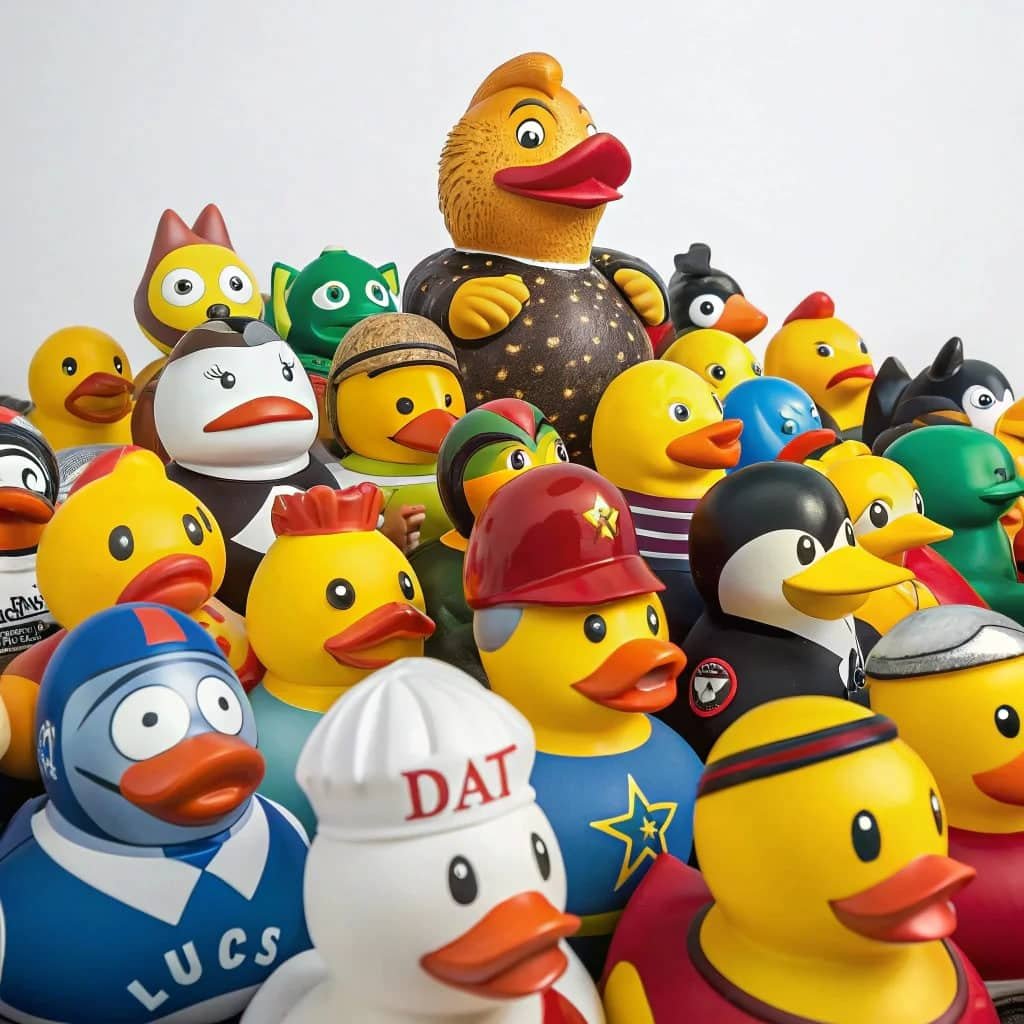
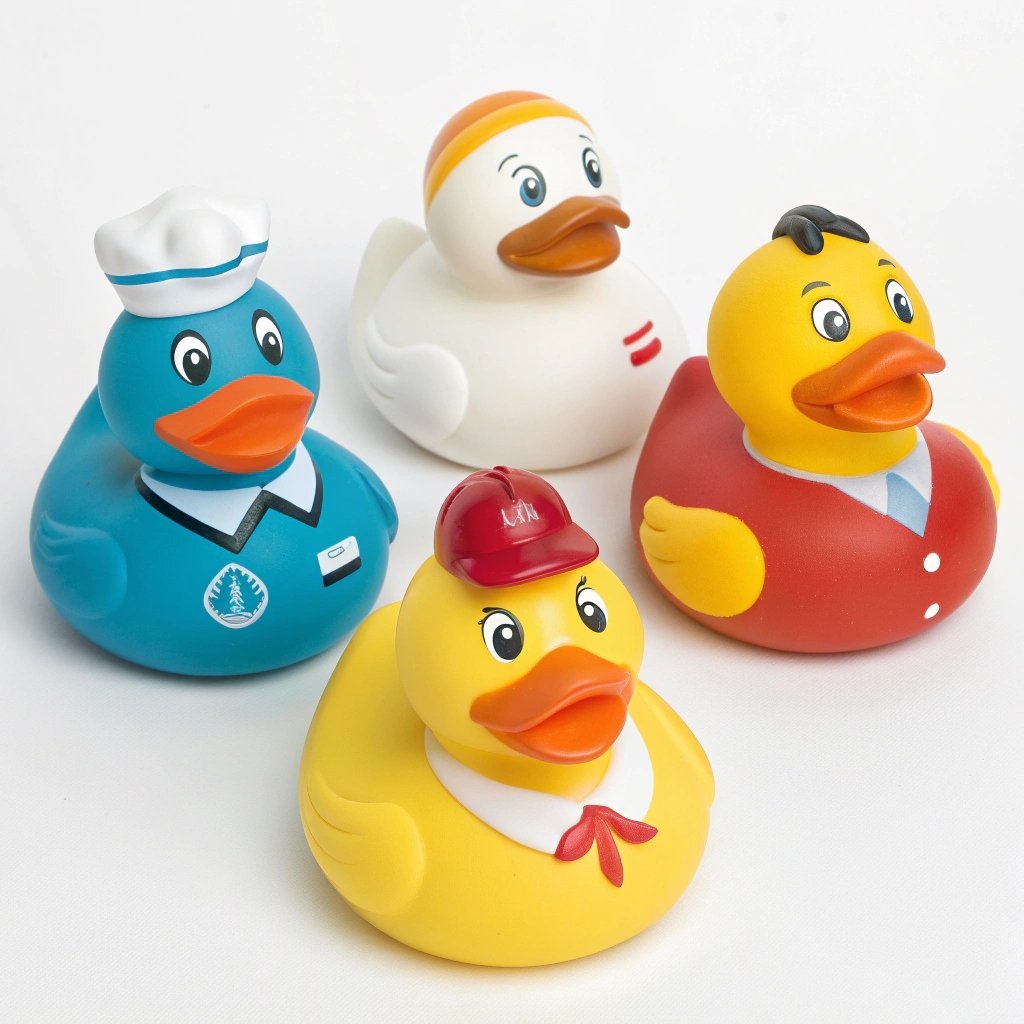
- Custom-Molded Ducks (The ‘Mold’ Path): A CNC machine cuts a brass or steel mold cavity in the exact shape of your design—a duck wearing a chef’s hat, a duck shaped like a pizza slice, a duck with your mascot’s head. The mold fee runs $350–$1,800 depending on cavity count and complexity. Unit cost at 1,000 units lands between $0.80–$2.00 because the per-unit material and labor cost is higher for a non-standard shape. Lead time stretches to 25–35 business days. The payoff: zero printing smudges, full 360° brand integration that competitors like Promotions Now and Totally Promotional structurally cannot deliver because they only trade in stock shapes.
A structural gap exists in the promotional products supply chain. Most large platforms are aggregators. They connect you to a print shop that has pre-bought 100,000 blank ducks from a factory. That print shop cannot create a new mold. They cannot change the duck’s silhouette. So when a brand manager at a pizza chain wants a custom-shaped duck that looks like a slice, the aggregator says, “Sorry, we only offer the standard duck with your logo.” This limitation is almost never disclosed on their websites. You find out after the RFQ has already consumed two weeks.
The decision framework is straightforward. If your campaign needs 1,000–3,000 units of an inexpensive giveaway with a simple one-color logo and a hard deadline under 20 days, pad-printed ducks make sense—provided your graphic designer understands to keep all artwork on the duck’s flat side and away from any compound curves. If your brand strategy requires a unique silhouette, a character representation, or 360° sculpted branding that cannot rub off, allocate a $350–$1,800 tooling budget and a 35-day production window. The mold is a one-time capital expense. Amortize it across 3,000 units, and it adds roughly $0.12–$0.60 per duck. Over a multi-year campaign using the same mold, the incremental cost approaches zero.
An industry benchmark to anchor your sourcing conversation: In the promotional rubber duck sector, fewer than 15% of suppliers operate their own mold shop. The rest are traders reselling print-on-stock work. When you request a quote for a custom shape, ask the supplier this specific question: “Do you perform CNC mold cutting in-house, or do you subcontract the tooling?” A subcontracted mold adds 7–10 days to lead time and introduces quality tolerance risks between the mold maker and the casting house. In-house shops can adjust and polish a mold cavity within hours based on sample approval feedback. This is the difference between a 30-day project and a 45-day delay.

How to Source Custom Rubber Ducks Without Getting Scammed
The biggest hidden cost isn’t the mold—it’s the 5–8% of units factories throw away from pad-printing smudges, baked into your per-unit price.
I’ve audited rubber duck suppliers across 12 countries. The fastest way to filter out a trading company posing as a factory: ask for high-resolution photos of their last three custom molds. Not stock ducks with a logo slapped on—actual sculpted characters, multi-cavity steel tooling, or complex geometries. A real OEM runs its own CNC shop and will show you the brass electrode alongside the molded part. If the supplier sends only white-background shots of finished ducks but can’t produce tooling photos, walk away. They’re sourcing from someone else and slapping a 20–30% margin on top.
- Mold Proof: Demand close-ups of the mold cavity itself. Look for CNC tool marks, texture grain, and sprue marks—not just a polished outer shell.
- Multi-SKU Capability: Ask if they can combine 500 units of Design A and 500 units of Design B to split a single mold cost. A ‘no’ signals a reseller with rigid MOQs.
- Compliance Docs: Before paying a deposit, insist on a sample SGS or TÜV test report for phthalates and heavy metals. For EU-bound eco friendly custom rubber ducks, BSCI certification and phthalate-free declarations are non-negotiable. Many EU buyers have been burned by customs blocks for missing REACH paperwork.
- Shared Tool Cost: Lock the total mold investment, then ask: ‘If I run three variations in the same mold base, can we split that tooling fee across all SKUs?’ This works especially well for custom shape rubber duck MOQ negotiations.
- Sample Approval: Never approve a mold sight-unseen. Get a photo-documented rendering with dimensional callouts. Confirm the Pantone (PMS) match on the rendered duck before steel is cut. Post-cut changes cost $150–300 and eat 3–5 days.
Mixed SKU MOQs remain the single most underused lever in custom rubber duck sourcing. Most buyers lock in 3,000 units of a single shape and eat the full $350–$1,800 mold fee. Instead, propose two or three variations that pull from the same mold base—different head accessories, fill colors, or surface textures—and ask the supplier to amortize the tooling across the combined volume. Some will push back with ‘each cavity counts as separate MOQ.’ Push harder. A competent manufacturer using CNC-machined multi-cavity molds can load different cavity inserts for different designs during the same production cycle. You’ll get three unique ducks for a combined mold fee of $600–$900 instead of $1,500+.
Before the container ships, demand a pre-shipment photo report showing the actual batch spread out on a table—not a single hero sample. This catches inconsistent paint fill, seam flashing, and off-register prints. Agree on a defect rate cap in writing: 2% is standard for fully molded custom ducks. But for logos pad-printed on curved duck chests, there’s a hidden reject factor. The chest curve distorts the silicone pad transfer; unless alignment stays within 0.5mm tolerance, you get smudging. Good factories cull these units before packing. Less scrupulous ones box them and let the 5–8% scrap get amortized into your per-unit price. Ask point-blank: ‘What is your actual reject rate on chest printing, and do you separate those pieces or ship them?’ Silence is your answer.
Conclusion
I’ve audited supplier lines in 12 countries, and the pattern never changes: a buyer who treats custom rubber ducks as a simple commodity skips sample approval, ignores FOB pricing breakdowns, and pays for it later — sometimes $8,000 later, when a full container arrives with a 7% defect rate that exceeds the 2% quality tolerance a professional shop should honor. The choice between pad printing and custom molding isn’t just about unit cost. It’s about whether your campaign assets will float exactly as envisioned or sink your brand credibility on delivery day.
Get an itemized quote that amortizes the mold fee across your order, and ask for a sample approval gate before mass production kicks in. If you don’t lock in those gates now, you’ll budget for ducks and end up paying for a warehouse of regrets.
Frequently Asked Questions
What is the minimum order quantity for custom rubber ducks?
The minimum order quantity for pad-printed ducks on a standard shape starts at 1,000 units. Fully custom molded shapes often carry a higher initial MOQ to cover mold investment. Lock in your MOQ after confirming print or mold requirements.
How long does production take for custom rubber ducks?
Production typically takes 15–20 business days after pre-production sample approval. Mold fabrication adds extra lead time before sample stage. Build sample approval and transit buffer into your timeline.
Can you get custom rubber ducks made with a specific color matched?
Yes, both pad-print inks and base PVC can be matched to Pantone references for close brand alignment. Expect slight tolerance shifts on flexible material. Provide Pantone codes early so the lab can dial in the match.
How much does it cost to make a rubber duck mold?
A simple single-cavity mold starts around $350, while a detailed multi-part character mold can reach $1,800. Mold fees are one-time and separate from per-unit pricing. Budget mold cost separately and submit a 3D design file for an accurate quote.
Does anyone know how to make actual customized duck characters?
Yes, actual custom duck characters require a CNC-cut mold built from your 3D design, not just printing on a stock shape. This delivers a fully unique silhouette and surface details. Start with a sculpt or vector file to initiate mold engineering.