A durability clause written into an order beats an argument about a split seam eight months later, because the argument is unwinnable in both directions. A clean test report proves what a duck survived on one day, and a split proves what it met over a season, and neither document contradicts the other. They describe different things.
Written from LZENGO's tooling, inspection and sample room work, plus public toy safety guidance from the CPSC and the European Commission.
In short: ASTM F963 and EN 71 are safety standards, and both test a sample on a day rather than a duck over a life. They cover the hazards a toy can present, not how long a body will stay the body the buyer approved. So the order needs a second document, a durability clause, that names the checks, the environment and the reference duck the next carton will be judged against.
A standard tests a sample, not a season
Every test in a toy system is run on a sample, at a point in time, in a conditioned room. That is exactly what a safety standard should do, because its job is to ask whether the object can hurt a child in the ways the standard knows about. It is not built to answer whether the object will still look and behave like the approved product after a summer in a shop window.
Buyers meet that gap as a surprise, because a report reads like a verdict on the product. It is a verdict on a sample. The duck that comes back with a hairline split along the neck seam and a bead of water inside the body may well have passed every clause in the report, and the report may still be accurate. The two facts are compatible.
The practical consequence is that a standard and a durability clause are written side by side rather than one behind the other. The standard says what the duck must survive to be sold. The clause says what the duck must survive to stay the duck the buyer approved, which is the question a retailer asks in month eight.

What ASTM F963 makes mandatory
In the United States the chain of authority is short and worth knowing by heart. The CPSC toy safety guidance sets it out: section 106 of the Consumer Product Safety Improvement Act made ASTM F963 a mandatory consumer product safety standard for children's toys, and the requirement is codified at 16 C.F.R. part 1250.
The same page defines the product scope and the certification boundary. A toy is any object designed, manufactured or marketed as a plaything for children under fourteen years of age. Then the line that decides most duck programmes: while ASTM F963 covers products for children under fourteen, the CPSC testing and certification requirements only apply to products designed or intended primarily for children twelve years of age or younger.
For a duck, that boundary is a marketing question as much as a material one. A bath toy for a toddler sits on one side of it. A promotional duck handed out at a trade show, marketed to adults and never presented as a plaything, sits somewhere else and needs its own reasoning. Deciding that at the brief stage is far easier than deciding it after a retailer asks for the paperwork.
The sections a duck actually meets
A duck is a simple object, so it touches fewer clauses than the length of the standard suggests. The CPSC's own summary of ASTM F963 shows where a hollow vinyl duck lands: material quality, small objects, accessible edges and points, plastic film where the duck is bagged, and a use and abuse sequence that includes drop, torque and tension.
That list is worth reading as a description of how a duck fails. Small objects matter for anything that can detach. Edges and points matter at a seam or a moulded fin. Plastic film matters because the bag is part of the product as sold, and a thin bag is a hazard in a way the duck is not. The use and abuse sequence is the closest the standard comes to durability, and it is still a short, deliberate sequence rather than a life.
The sections that matter most to a duck programme are therefore the ones a buyer can picture. A squeaker that pulls out, an eye that pops, a bag that tears and a seam that opens are the four ways a low grade duck announces itself. Each one is addressed by a clause, and each one also shows up in the field long after the clause was checked.
EN 71 is a list, not a logo
The European route is a different structure with the same purpose. The European Commission's toys sector pages describe the framework: the 2009 Toy Safety Directive sets the safety requirements, and harmonised standards are the technical route that gives a product a presumption of conformity with them.
EN 71 is that series. It is published in parts, each aimed at a class of hazard, and a duck programme usually meets the mechanical and physical part first, then the part that limits migration of certain elements where a child might mouth the product. The harmonised standards register is where the current list lives, and it is worth opening rather than trusting a memory, because the citations change.
Two details on that page are worth noting for a programme with a long horizon. The Directive is the base today, and Regulation (EU) 2025/2509, adopted in November 2025, repeals and replaces it with effect from 1 August 2030. A duck range planned across several seasons will meet both regimes, and the earlier the file records which one it was tested against, the less work the transition becomes.

The seam is where a duck starts to fail
The place to watch on a hollow duck is the neck seam. A moulded duck is closed along a joint, and that joint is where wall thickness, mould temperature and demoulding all meet. A seam that is slightly thin, slightly cold or slightly stressed will look perfect on the day and open later, usually after a season of squeezing and drying.
The failure is rarely dramatic. It starts as a faint line that catches the light, then a hairline that holds water, then a split with a bead of water inside the body. By the time a customer sees it, the duck has been through hundreds of compression cycles, and each one has worked the weakest point a little further.
That is why a seam check belongs in the clause rather than in the standard conversation. The standard asks whether the duck has hazardous edges and points and whether it survives use and abuse on a bench. The clause asks whether this seam, on this body, on this tool, holds under a squeeze in water, which is the test a buyer can run in a receiving bay with a bowl and two hands.

Bench checks a buyer can run on arrival
None of the checks below needs a laboratory, and all of them need a written pass or fail line so that the next carton is judged the same way. That is the point of writing them down: a check that lives only in somebody's hands leaves no record and cannot be repeated by a different person.
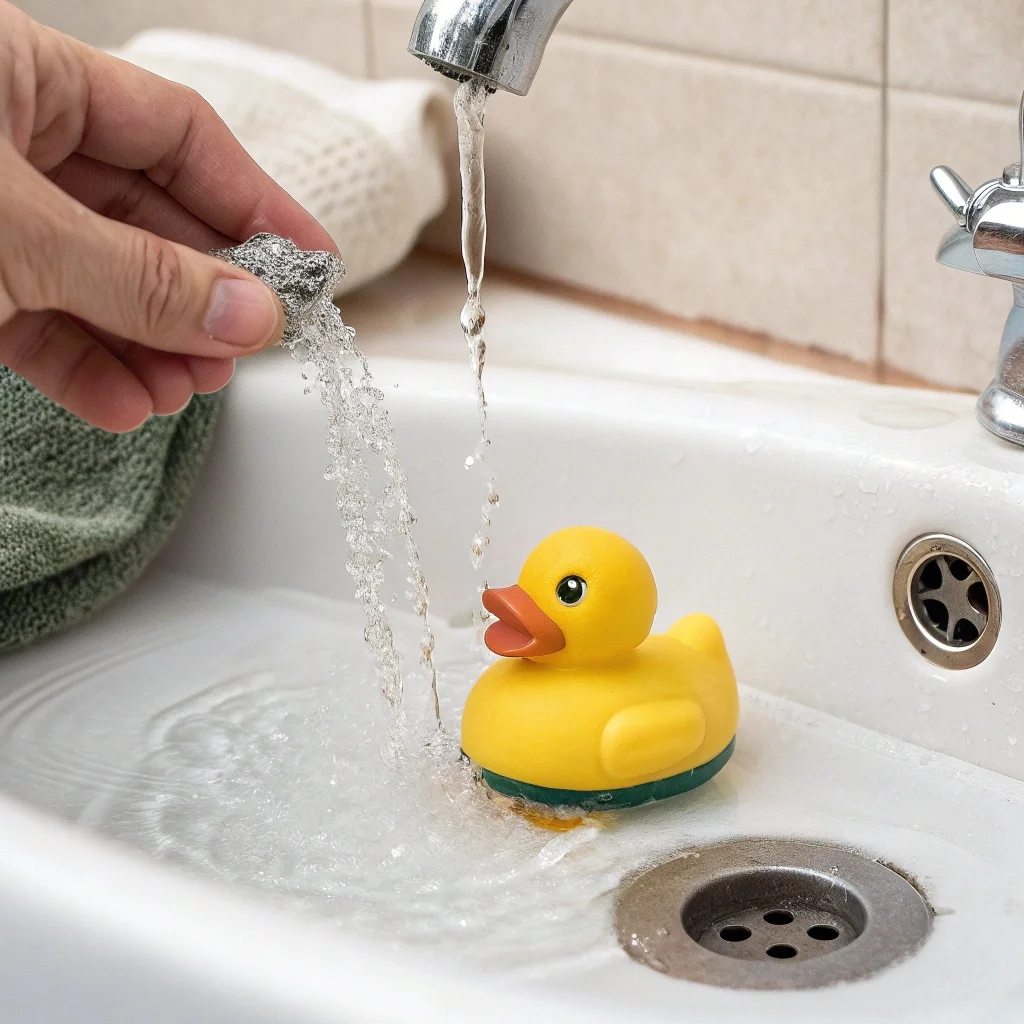
- Squeeze the body under water and watch the seam, the fill hole and the base for a stream of bubbles.
- Pull every attached part once, firmly, including the squeaker if it is a separate piece, and look for a lifted edge.
- Twist each part a quarter turn and check that the material returns rather than whitening.
- Rub the print with a thumb for a few seconds and look for ink transfer on the skin.
- Drop the duck onto a hard floor from waist height and check the seam and the beak afterwards.
Each one is a crude version of a clause in a standard, and each one catches the failures a report cannot see because the report happened months earlier. A buyer who records the results per carton builds a small evidence base, which is what makes a complaint conversation short.
Heat and light are the cycle test the standards skip
Neither standard ages a duck in sunlight, because that is not what a safety standard is for. A shop window, a car dashboard and a garden water bowl all apply a load that no bench sequence reproduces, and the effects show up as changes in colour and surface rather than as a hazard.
Heat is the underrated half of that load. A duck behind glass in summer sits at temperatures well above the air outside, and heat softens the surface chemistry that holds a print and speeds the reactions that break a polymer down. Light supplies the energy, heat supplies the rate, and the two together do more in a season than either does alone.
The reason this belongs in a durability clause rather than in a lab conversation is that the fix is usually a choice, not a test. A duck that will live in a window needs a compound and a pigment chosen for exposure. A duck that will live on a shelf needs less. Writing where the duck will live is the single most useful line a buyer can add, and the colour and UV notes go deeper on the compound side.

When the duck is large, the standard does not scale
A large duck is often treated as the same product at a bigger size, and that is where durability conversations go wrong. At building scale the body is a different structure, the wind load is real, the fixing is part of the product and the water it floats in is a working environment rather than a bath. A test report written for a bath toy tells a buyer almost nothing about that.
What survives the change of scale is the method. The claim still has to name the property, the test and the conditions it was written for. A large duck specified for a harbour, a shopping plaza or a four day event is three different products with three different expectations, and the useful document names which one is being bought rather than implying that all of them are covered.
That is also why the factory can sign what it makes and not what it does not control. We can guarantee the body, the seam and the batch. Nobody can certify a site, a mooring or a season of weather in advance. Writing that boundary into the page, rather than discovering it during an installation, is the same discipline a small duck order needs and it is the same quality routine applied at a different scale.
The durability clause: five lines for the order
A duck order that has a standard number attached and no clause is a duck order with half a specification. The five lines below are the half that the report does not cover, and they are written in the buyer's language rather than the laboratory's.
| Clause line | What it settles | What to write | What it prevents |
|---|---|---|---|
| Environment | The load the duck will actually meet | Shelf, window, dashboard or outdoors, in words | A package or finish matched to the wrong place |
| Reference duck | The standard the next carton is judged against | A sealed duck from the approved lot, kept in a drawer | Arguments settled by memory or by photograph |
| Seam and fill check | Whether the body holds | Squeeze under water, bubbles recorded per carton | A split discovered by a customer |
| Attachment check | Whether anything can detach | Pull and quarter turn on every part, pass or fail | A small part found by a child |
| Review point | When the claim is revisited | On a compound change, a new part or a new market | A report that describes a duck you no longer buy |
The lines are deliberately plain, because a clause that nobody can run on a bench is a clause that will not be run. The table is also short for a reason: each row has an owner. Two rows belong to the buyer, who knows the market. Three belong to the factory, which knows the body.
Questions to settle before the first carton
- Which market is the duck sold into, and which standard number is on the file?
- Is the duck primarily for children twelve or younger, or is it marketed as something else?
- Where will the duck live after the sale: a shelf, a window, a dashboard or outdoors?
- Has one duck from the approved lot been sealed and kept as the reference?
- Who runs the arrival checks, and where are the results written down?
A buyer who can answer those five has a specification that survives a rational conversation in month eight. The answers also tell a factory which body and which finish to recommend, because both follow from the environment rather than from a preference.
If the duck will be handled by very young children, the age grading notes cover the extra thinking, and the label guide covers where the marks that go with a standard belong. The print route comparison explains why a print can wear before a body does, and the dashboard test shows what a season of heat and light does when nobody is watching.
Frequently Asked Questions
Does passing ASTM F963 mean the duck will last?
No. It means the sample survived the hazards the standard covers on the day it was tested, in the condition it was submitted. A duck can pass and still split at a seam a year later, because the standard does not age the product or predict a service life. That is what a durability clause is for.
Why does a duck split at the seam when the sample was fine?
Because the sample was inspected once and the seam was worked hundreds of times afterwards. Seam failures usually come from wall thickness, mould temperature or stress at demoulding, and all three can pass a visual check and still open under repeated squeezing. A squeeze in water on a sample of every carton finds it earlier.
Is EN 71 the same test as ASTM F963?
No. They are separate standards, written for separate markets, with separate lists, methods and paperwork. They cover similar hazard classes, and a duck built for one is usually close to the other, but a report under one does not certify the other. A programme selling into both markets needs both files.
Can a large duck stay outside all year?
That depends on the body, the fixing and the climate, and no test report can promise it in advance. A large duck is a structure as well as a product, so the useful conversation names the site and the season rather than asking for a blanket answer. What a factory can do is control the body and the batch, and say plainly where its responsibility stops.
Final Note
A standard tells a buyer that a duck can be sold. A durability clause tells a buyer what the duck will be like when it comes back, and most of the argument that a duck programme has with itself is really a missing clause rather than a bad product.
Written well, the clause is five plain lines that anybody in a warehouse can run, and it turns a dispute into a comparison against a sealed duck from the same lot. That comparison is the only form of durability evidence a small brand can actually own, and it asks nothing but the decision to write the lines before the order rather than after the complaint.
Key takeaways
- A standard tests a sample, not a season: ASTM F963 and EN 71 answer a safety question, not a service life question.
- What ASTM F963 makes mandatory: section 106 of the CPSIA, 16 C.F.R. part 1250, and a certification line drawn at twelve years.
- EN 71 is a list, not a logo: the harmonised standards register is the current list, and Regulation (EU) 2025/2509 applies from 1 August 2030.
- The seam is where a duck starts to fail: squeeze the body under water and watch the joint, the fill hole and the base.
- The durability clause: five lines for the order: environment, reference duck, seam check, attachment check and a review point.