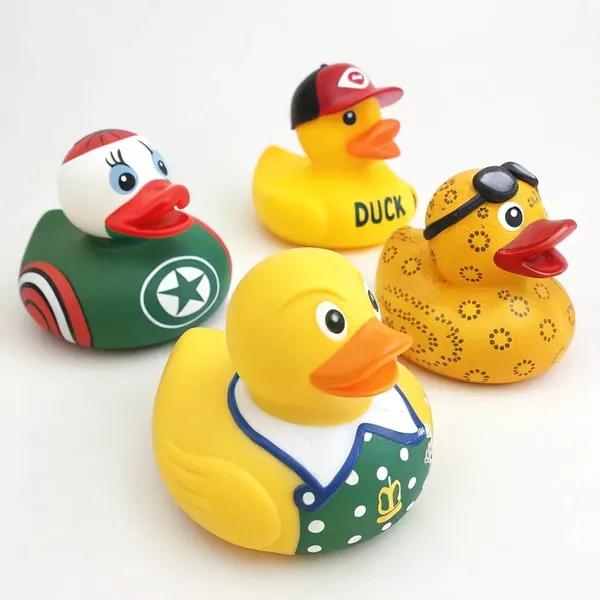
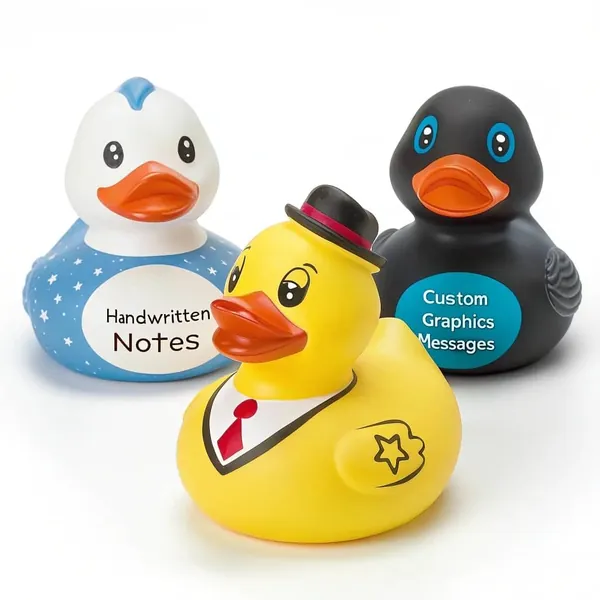
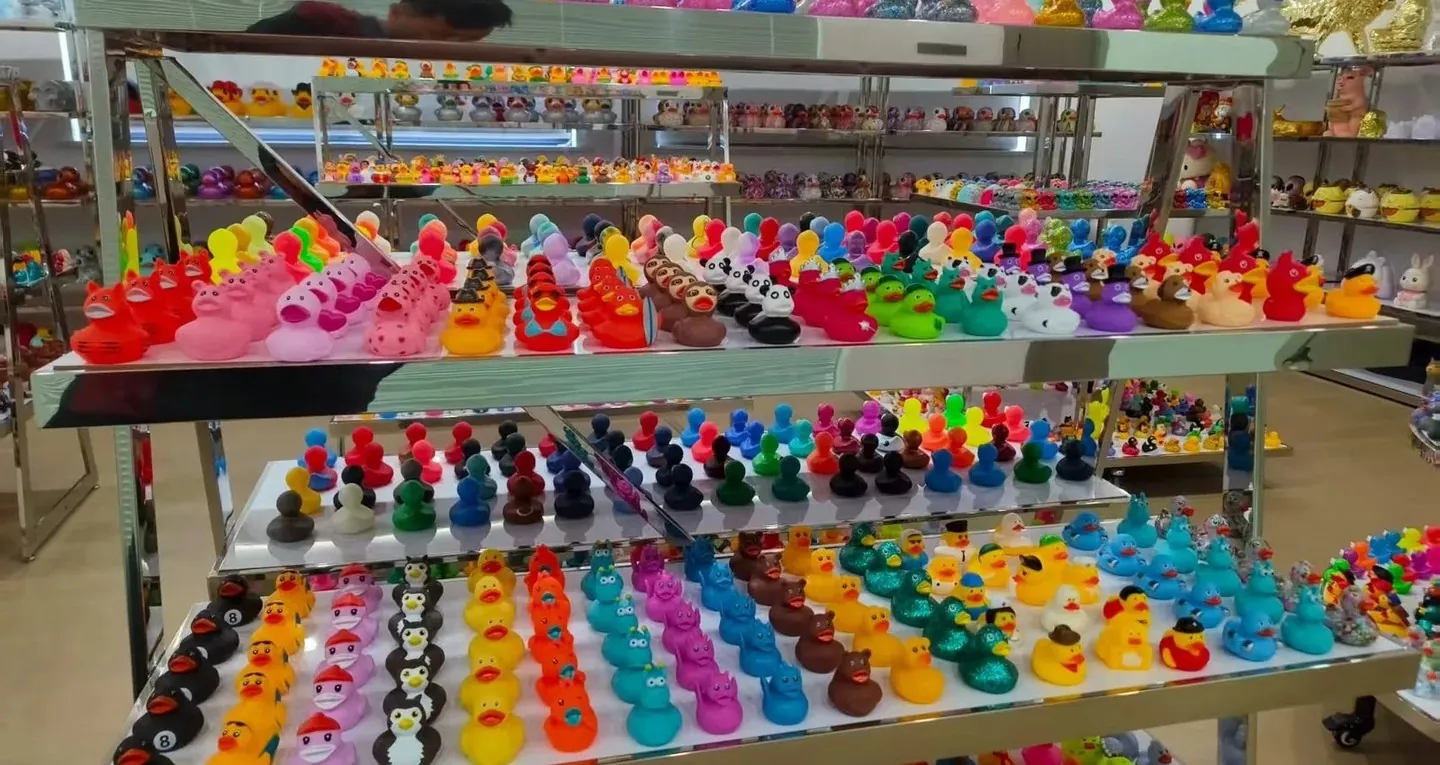
A duck range is three products, not three versions of one product, and each band is bought by a different person for a different reason. The moment a buyer treats the small duck as a scaled copy of the big one, the range gets a tool it cannot pay back. The first job is to name the job of each band, then check whether the drawing, the carton and the label still agree.
In short: A range sells when every size answers a different purchase. The small duck sells as a fill or add-on, the standard duck sells as the logo carrier, and the large duck sells as a display or gift. Sizing is a commercial decision first and a tool decision second, because every new body is a new cavity and a new carton. Three sizes that share one design language outsell five sizes borrowed from five catalogues.
What Each Size Band Does Commercially
A band earns its place by the counter it sits on. The small duck is bought in a mixed bin or added to a party bag, so its job is to make the basket look full and the unit count look generous. The standard duck, the familiar shape around 3 in tall, is the promo unit that carries a logo, a date or a team name. The large duck is a gift or a display, and it is the band where relief and separate parts start to matter more than a printed mark.
Each band also carries a different tolerance for detail. A mini duck cannot hold fine text, and a large duck can hold detail that would disappear on a small body. Setting the detail expectation per band stops the artwork from being approved on the wrong body.
| Band | What it is bought for | Detail it can carry | What it changes downstream |
|---|---|---|---|
| Small, party and filler size | Mixed bins, party bags, basket add-ons | One flat mark, simple eyes, block shapes | Highest count per carton, smallest carton |
| Standard, around 3 in | Promotional giveaways with a logo | A printed mark, a short line of text, moulded relief | The default carton and pallet pattern |
| Large, display size | Gifts, photo props, counter displays | Deeper relief, separate parts, large print | Lower count per carton, heavier carton |
| Giant, event size | Installations, events, landmarks | Structure, seams and access more than print | Freight and handling, not carton arithmetic |
The band set is also a cash decision. A range built around one standard body with two smaller variants shares tooling, inspection habits and packing material. A range built from four unrelated bodies shares nothing, and every change has to be made four times.
Why Volume Punishes a Size Increase
A body that grows in every direction does not grow politely. Material, displaced volume and carton space all rise with the cube of the dimension, so a duck twice as tall carries roughly eight times the material if the proportions stay the same. Nothing in the drawing warns the buyer about that, because the drawing only shows the outline.
The carton is where the arithmetic becomes visible. The same carton that holds a run of standard ducks holds far fewer large ones, and freight is paid on the space the carton takes rather than on the number of ducks inside it. A size increase that looks like a small drawing change can move a whole order into a different carton, a different pallet pattern and a different freight class.
The wall is the second consequence. A larger body needs a wall that holds its shape under its own weight, and a wall that is thick enough on a 3 in body is not automatically thick enough on a 9 in one. A body that dents at the base or sags at the tail is usually a wall decision that was never revisited when the size changed. Cooling follows the same rule, because a thick section takes longer to set, and a tool that was cut for a small body has no extra cooling to give.
The practical reading is simple. When a buyer asks for one size bigger, the honest reply has three parts: the new tool, the new carton and the new wall. Any one of them left out of the conversation becomes the reason the second run does not repeat the first.
Measure the Height, Not the Length
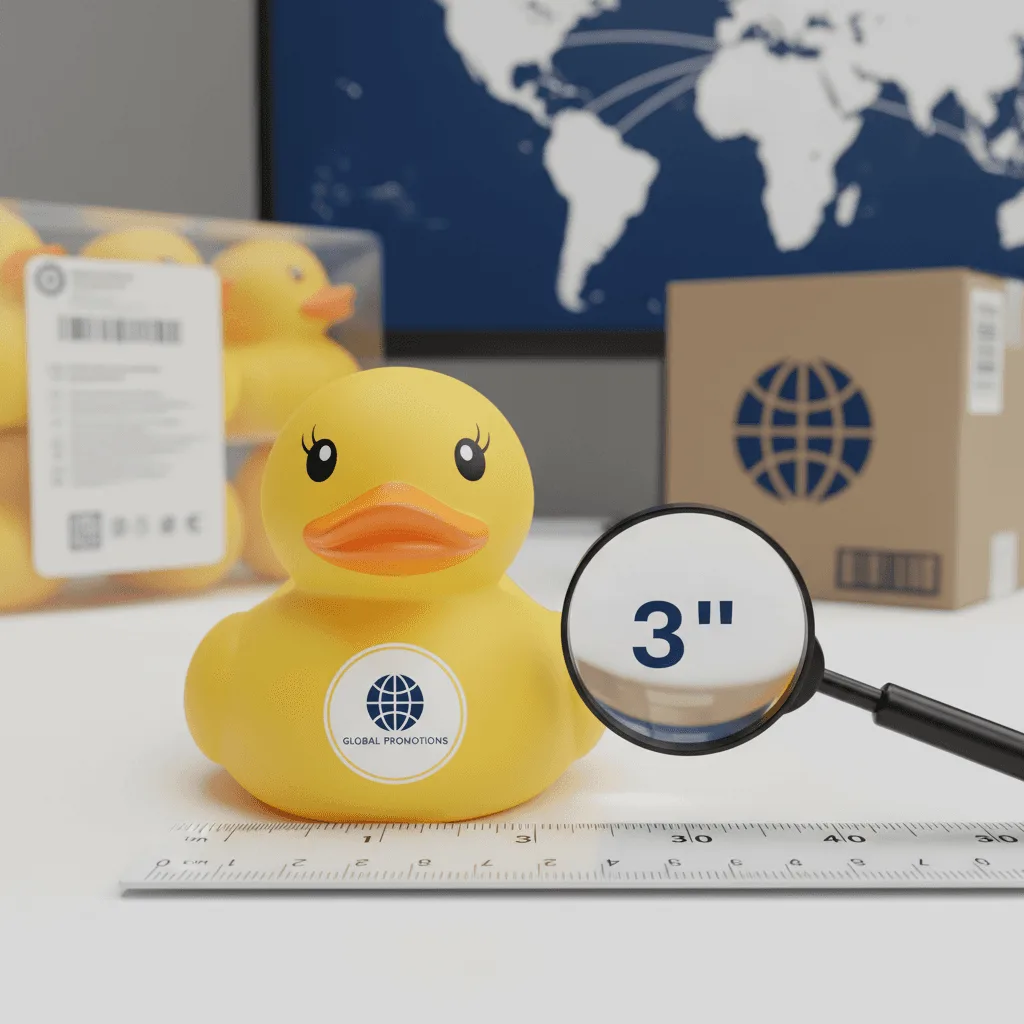
Most size confusion starts with an unstated measurement point. A duck has at least three dimensions worth writing down: the overall height from the base plane to the crown, the length from the beak tip to the tail, and the width across the body. A duck listed by length reads larger than it is, and a duck with a hat, a bow tie or a prop is taller than the body it was measured from.
The base plane is the only stable reference. Put the duck on a flat surface, measure to the highest point of the finished product rather than the moulded body, and say on the drawing that the number includes every fitted part. The same line should say whether the number refers to the tool dimension or the finished part, because a moulded body pulls away from the tool as it sets and the finished duck is not the cavity.
This single line prevents most sample arguments. A buyer who approved a 3 in duck and receives a 3 in duck with a hat that adds height has not been given the wrong product; the spec sheet simply never said where the measurement stops. The size chart page covers the band dimensions in more detail, and the large duck spec page covers the dimensions that matter once a body is too big to hand over a counter.
Holding One Design Language Across the Range
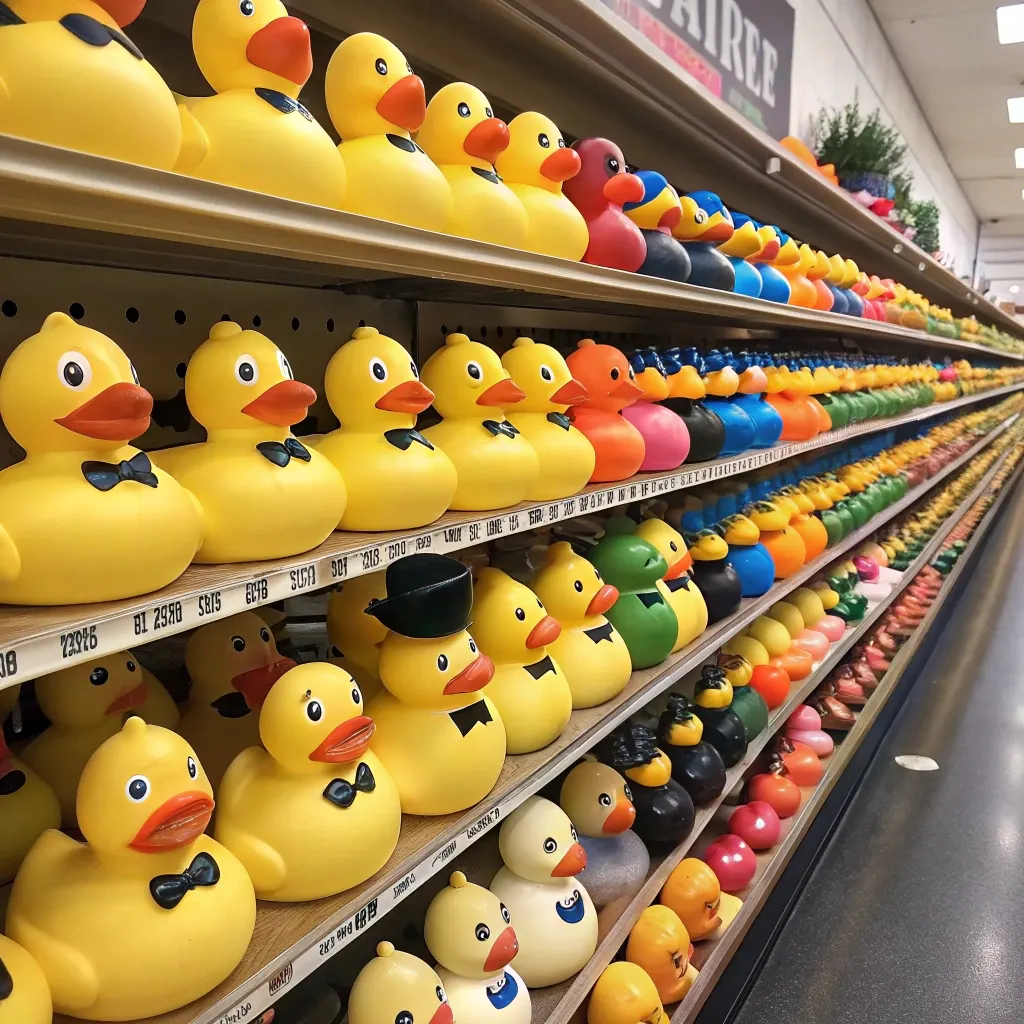
A range looks like a range when the family resemblance survives the size change. The eye shape, the beak geometry, the base family and the colour reference are the four things a buyer recognises before reading a single label. Keep those four and the small duck reads as a sibling; change them and the range reads as stock from three suppliers.
Scaling in the design file is not the same as redesigning for the size. Features that read well at 6 in turn into soft lumps at 2 in, and a printed mark that is legible on the standard duck becomes a smear on the mini. The rule I work to is that the silhouette scales and the small detail does not, because detail has a floor set by the material and the mould, not by the artwork.
The base deserves its own line in the range discussion. A larger duck needs a wider base for the same stability, so the base family has to be designed as a family rather than copied. The base designs page covers how the flat, weighted and suction options behave, and the size chart page shows how the footprint changes with height.

Shelf, Screen and Event Decide the Size
The channel decides the band more often than the buyer admits. A shop shelf has a depth and a facing, and a duck that is lost behind the shelf edge does not sell, which is why the standard body usually sits at eye level and the small one sits near the till. A screen has no depth at all: the thumbnail is the product, so silhouette and contrast matter more than detail.
An event is a third case. A duck that has to be found across a hall, photographed or used as a meeting point is a large duck by job description, and its size is set by sight lines rather than by shelf space. The giveaway duck that fits a hand and the landmark duck that fills a doorway are not the same product with a different batch number.
One practical habit keeps the channel honest: photograph the range with a reference that a buyer already knows, a hand or a ruler. A size comparison photo survives a bad product page and a bad catalogue, and it answers the question that a dimension line never does, which is how big the duck looks next to something else. The giveaway page covers how the promo band is used in practice.
Where a Size Becomes a Safety Question
The smaller the body, the closer the parts come to the size where a piece becomes a hazard. The CPSC small parts rule for toys intended for children under three is tested with a cylinder: a toy subject to the rule must not be small enough to fit entirely inside the Commission's test cylinder in any orientation, and any component that comes off during use and abuse testing is placed in the cylinder the same way. That test is why the mini band needs its own review rather than a note that the standard duck already passed. See 16 CFR 1501.4.
The scope of that rule is wider than most buyers expect. It applies to toys intended for children under 36 months, and the list of covered articles names bathtub, wading pool and sand toys, which is exactly where a rubber duck lives. A duck sold for the bath is therefore inside the conversation from the first drawing, and the size band decides how much of the argument is about eyes, squeakers and small fitted parts. The scope is set out in 16 CFR 1501.2.
The age decision comes before the size decision for that reason. A range that starts at the mini band and is sold to parents has to be graded before a single cavity is cut, and the age grading page covers how the grade is set and documented. A large display duck carries a different question, which is weight and handling rather than small parts, and it is answered in the spec sheet rather than in the toy rules.
A Practical Sizing Plan Before the First Tool Is Cut
Five steps settle a range before anyone spends on a cavity. First, write the job of each band in one line and drop any band that cannot state one. Second, choose the band that will carry the volume, because that is the tool worth paying for first. Third, confirm the wall and the base for each size rather than scaling the drawing. Fourth, check the artwork against the smallest body in the range. Fifth, write the measurement point on every drawing, including fitted parts.
The order matters. A buyer who starts from the artwork usually ends with a body that cannot hold it, and a buyer who starts from the largest body usually ends with a range that cannot be freighted. Starting from the volume band keeps the tool and the carton in agreement, and the smaller and larger bands can then be planned as relatives of that body.
Four questions decide the rest, and each one is worth an answer in writing before the tool is released:
- Which band carries the volume, and is the tool being cut for that band rather than for the largest duck?
- Does every drawing state where the height stops, including hats, bows and other fitted parts?
- Can the artwork survive the smallest body in the range, or does it need a simplified version?
- Is the duck sold on a shelf, on a screen or at an event, and does the band match that channel?
A range that answers those four is a plan. A range that does not is a set of drawings waiting to be rebuilt.
Frequently Asked Questions
What sizes do rubber ducks come in?
The trade works in bands rather than exact numbers: a small party size, the standard promotional duck around 3 in, a large display size and a giant event size. Each band has its own carton, its own detail floor and its own buyer, so the useful answer is which band does which job for you.
Do I need a separate mould for each size?
Yes, a different body means a different cavity, because the wall, the base and the cooling all change with size. That is why a range is usually built from one volume body plus close relatives, and why a size that cannot pay back its tool is better borrowed from a stock body than commissioned.
How does the size change the packing?
A larger body takes more of the carton and the pallet, so the count per carton falls and the freight per duck rises even when the carton looks the same. The packing conversation belongs in the sizing conversation, not after the tool is cut, because the carton is often what makes a size unaffordable.
How many sizes should a first order have?
Fewer than the plan wants and more than one, because a single size cannot show a range and four sizes cannot be checked properly. A first set of two or three bands, sharing one design language and measured the same way, is enough to learn which band sells before the next tool is opened.
Final Note: The Six Lines of a Size Sheet
- Name the job of every band and drop the ones that cannot state one.
- Mark the volume band, and cut the first tool for that body.
- State the height from the base plane to the top of the finished duck, fitted parts included.
- Check the wall and the base for each size instead of scaling the drawing.
- Test the artwork on the smallest body before it is approved.
- Confirm the carton and the age grade for each band before the tool is released.
A range is not a catalogue of sizes. It is a small set of bodies that share a language, a measurement method and a carton logic, and the difference between a range that repeats and a range that has to be rebuilt is usually a sheet of paper signed before the tool.
Key takeaways
- A size band earns its place by the job it does, not by the number on the drawing, covered under what each band does.
- Material and carton space rise with the cube of the dimension, so a bigger duck is a new tool and a new carton, covered under why volume punishes.
- Height needs a stated measurement point that includes fitted parts, or the sample argument is guaranteed, covered under measure the height.
- One design language across the bands sells better than five borrowed bodies, covered under one design language.
- The mini band meets the small parts rule first, and the bath use puts it in scope, covered under where size becomes safety.