A first order works as a series of closed decisions rather than one purchase, because every gate settles something the next gate needs. A buyer who starts with a duck and a quantity usually comes back to the market question, then to the age band, then to the label. Each return means another round of artwork, which is the argument for working in order.
The order in which a first import is settled matters more than the supplier it is settled with.
In short: settle the market and the age band first, then the route, then the document set, then the carton and the marks, and treat arrival as its own gate. The document set is the one most first orders underestimate: a test report that names the product, a certificate the importer signs, an HS classification and origin marking on the goods are four different pieces of work, and none of them can be finished after the container is booked.
A first order is a sequence, not a purchase
The gates are not a project plan, they are a dependency chain. The market decides which rules apply. The age band decides which of those rules bite hardest, because a duck offered for children under three carries small parts and labelling questions that a collectible for adults does not. The route decides whether the buyer is dealing with a factory or a trader, and therefore who can answer a question about a tool or a test, which is the ground covered by the supplier audit questions.
Only after those three does the duck itself become the subject. A design chosen before the market is a design that has to be re-cut when the label requirements arrive. That is the most common cause of a first order slipping: not a bad supplier, but a design approved against the wrong set of rules.
| Gate | The decision it closes | What it blocks if left open |
|---|---|---|
| Market and age band | which rules, warnings and age grading apply | artwork that has to be re-cut |
| Route | who can answer a question about the tool and the tests | a supplier who refers every question onward |
| Documents | whether the product may be sold and enter | a container that cannot clear |
| Carton and marks | how the goods move and how they are received | a freight figure that was never real |
| Arrival | who checks what, against which reference | an argument at goods-in |
The order also has a physical sequence that runs in parallel. Cartons are specified while the duck is still being revised, because carton count per duck decides freight, and freight decides whether the landed unit makes sense. The rest of this note follows the gates in the order they close.
The market and the age band come before the drawing
A duck sold in the European Union is a toy under Directive 2009/48/EC, which puts the safety assessment, the technical documentation and the CE marking on the manufacturer before the toy is placed on the market. A duck sold in the United States is a children's product if it is designed or intended primarily for children twelve or younger, and that brings the testing and certification rules with it.
The age band is the sharper question. Under three, small parts, choke hazards and the wording of the warnings all tighten, and a design detail that is harmless for a seven-year-old can be disqualifying for a two-year-old. Buying a duck first and deciding the age band later is how a first order ends up with a label that contradicts the product.
The practical move is to write three lines before any artwork exists: the market, the age band, and whether the duck is a toy or a collectible. Those three lines decide which test report is relevant, which warnings appear on the label, and whether the importer has to sign a certificate at all.
The documents that have to exist before the container does
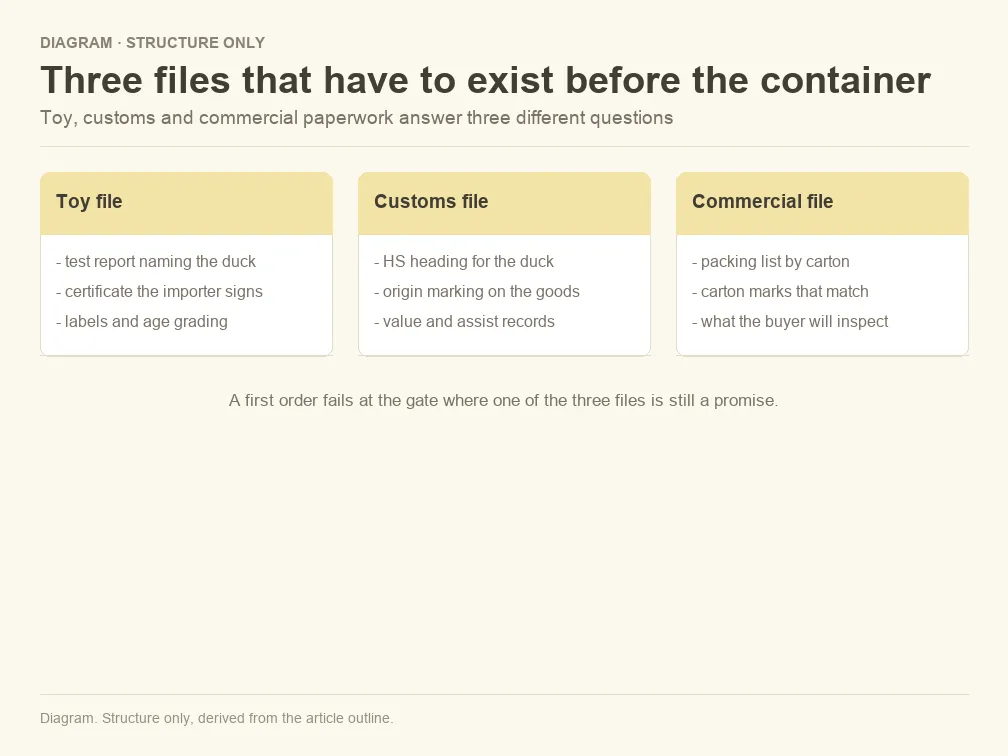
A first order needs three files, and they answer three different questions. The toy file answers whether the duck may be sold at all: a test report that names the product and the material, the declaration of conformity where the market requires one, and the label artwork that carries the age grading and the warnings. In the United States a children's product also needs a certificate, and the duty to issue it sits with the importer or the domestic manufacturer, not with the overseas factory, a point set out in 16 CFR Part 1110 (eCFR, 16 CFR Part 1110).
The customs file answers what the goods are and where they came from. That means an HS classification for the duck, which sits inside the international nomenclature maintained by the World Customs Organization and is worked through for this product in the HS note (WCO, HS nomenclature), and it means origin marking on the goods themselves, covered in the United States by 19 CFR Part 134 (eCFR, 19 CFR Part 134). The commercial file answers what is in the box: a packing list by carton, carton marks that match it, and the reference the buyer will inspect against.
The three files fail in different ways. A missing toy file is a compliance problem at the border or at retail. A missing customs file is a delay and a storage charge. A missing commercial file is an argument at goods-in, which is the least dramatic of the three and still the most common.
Cartons, marks and the freight decision
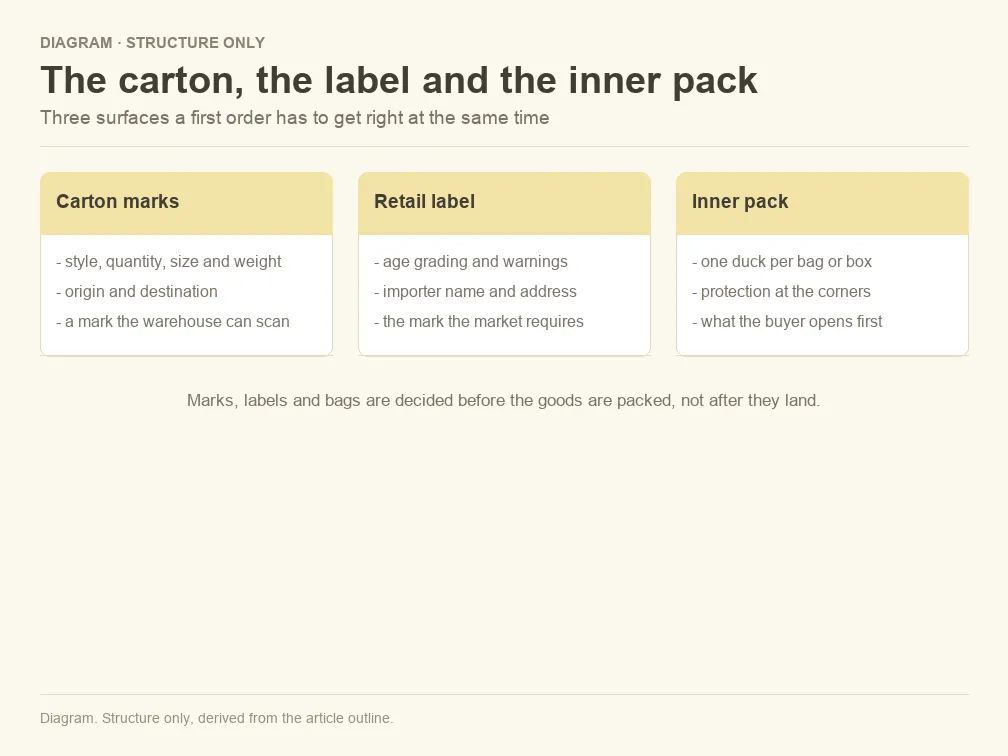
The carton is the part of a first order that is decided by arithmetic rather than taste. A duck has a size, a carton holds a number of them, and the carton has a weight and a dimension that feed directly into how the goods move. Get the carton count wrong and the freight estimate is wrong, which means the landed figure the buyer approved was never real.
Marks come next. A carton mark that names the style, the quantity, the size and the origin is the difference between a warehouse that can receive the delivery and a warehouse that opens every box. The retail label is a separate surface again, and it has to agree with the toy file: the age grading on the label must match the age band the testing assumed.
Inner packing deserves a line of its own because it is what the buyer sees first. One duck per bag, a bag that does not tear at the corner, and a box that survives a stack are unglamorous decisions that decide the first impression of the whole order. Transit performance is testable rather than hopeful, which is what the ISTA series of packaging tests is for (ISTA), and it is less painful to test a carton than to replace a pallet.
The existing note on carton specifications sets out the measurements, and the packaging note covers the retail and giveaway options.
What happens when the container lands
Arrival is a gate of its own because it has its own actors. A broker files the entry, a warehouse receives the goods, and the buyer or an inspector checks what arrived against the packing list. The documents that were assembled before shipment are the only thing that makes this quick. When the classification, the origin marking and the value are already settled, arrival is a handover. When they are not, arrival is a negotiation with a broker while the container waits.
The inspection question should be answered before the goods leave, not after they land. Decide what is being checked, on how many cartons, against which reference unit, and who signs the result. A first order that ends with we will see how they look has decided nothing, and a first order that ends with a written accept or reject criteria has created a record that the second order can reuse.
The same logic applies to the first order's real product, which is not the ducks but the file. A buyer who finishes the first order with a working toy file, a customs file and a carton specification has a template. A buyer who finishes with a container of ducks and a folder of emails starts again next time.

The five checkpoints for a first order
- Which market and which age band, written down before any artwork?
- Which route, and can the party you are buying from answer a question about the tool and the tests?
- Which test report names this product and this material, and who signs the certificate?
- Which HS classification, and is the origin marking on the goods rather than only on the carton?
- Which carton count, which marks, and which acceptance criteria will the arrival inspection use?
Five answers, written into one document, replace the sequence of email threads that a first order usually becomes. The next order then starts from a specification instead of a memory.
A first order is also the moment to decide how the buyer will run the second one. If the answers to those five questions are stored with the approved unit and the carton specification, a repeat order is a set of references rather than a rebuild (the reorder question).

Final Note
The sequence is the advice. Market, age band, route, documents, cartons, arrival: each gate closes something the next one needs, and skipping one does not save time, it only moves the consequences of the decision later.
My preference is a first order that produces a file worth keeping, even if the ducks themselves are plain. The file is what makes the second order a repeat instead of another first order, and it is the only part of the first order that gets better with age. A duck is used up or given away. A specification is reused, and every reuse makes the next batch easier to defend when someone asks why the label says what it says.
Frequently Asked Questions
What documents does a first rubber duck order need?
Three groups. A toy file (test report naming the product, declaration where required, label artwork), a customs file (HS classification and origin marking), and a commercial file (packing list by carton and carton marks). In the United States the children's product certificate is issued by the importer.
Should a buyer go to the factory or to a trading company?
It depends on which questions you will need answered. A factory can answer questions about the tool, the material and the test report in one conversation. A trader can be faster on coordination. The test is simple: ask who holds the tool and who holds the report, and see whether the answer is a name or a referral.
Can the retail label be printed before the testing is finished?
Only if the age band and the warnings are already fixed, because the label has to agree with what was tested. Printing early and testing later is how a first order ends up with a label that contradicts the report.
What is the first thing to fix in a first-order brief?
The market and the age band. Everything else, from the test report to the warning wording to the carton count, follows from those two lines.
Key takeaways
- A first order is a sequence, not a purchase: each gate closes a decision the next one needs.
- The market and the age band come before the drawing: the rules decide the design, not the reverse.
- The documents that have to exist before the container does: toy, customs and commercial files are three different jobs.
- Cartons, marks and the freight decision: the carton count is a freight decision before it is a packaging one.
- What happens when the container lands: the first order's real product is the file.