A buyer side comparison, read against the EU toy rules and the US lead paint rule.
My position on the China factory versus local supplier question is simple: it is not a question about the money, and the moment it becomes one, the comparison stops being useful. I would rather put the two routes side by side and ask what each one can still change about the duck, who ends up holding the tool, and who signs the papers that let the duck onto a shelf. Those three answers tend to settle the route before anyone opens a spreadsheet.
In short: a local supplier is close enough to visit and usually stands as the importer, while a China factory can change more of the duck and can hand the buyer the tool. The deciding questions are what has to be new, who holds the tool, and who signs the compliance documents. Transport can be arranged from either end.
Two suppliers, two kinds of distance
The first difference is physical. A local supplier is hours away, and a visit is a morning out of the office. A China factory is a flight and a time zone away, and the person answering your messages is often not the person who can open the mould. That distance is not a fault in itself. It changes what you can check with your own eyes and what you have to check through records.
The second difference is commercial shape. A local supplier usually sells what has already been made, so the duck you approve is close to the duck you receive. A China factory with its own tools can build a duck that does not exist yet, which is both a larger promise and a larger exposure.
The two distances pull against each other. More room to change the duck means less ability to stand in the room where it is made.
What each route can change
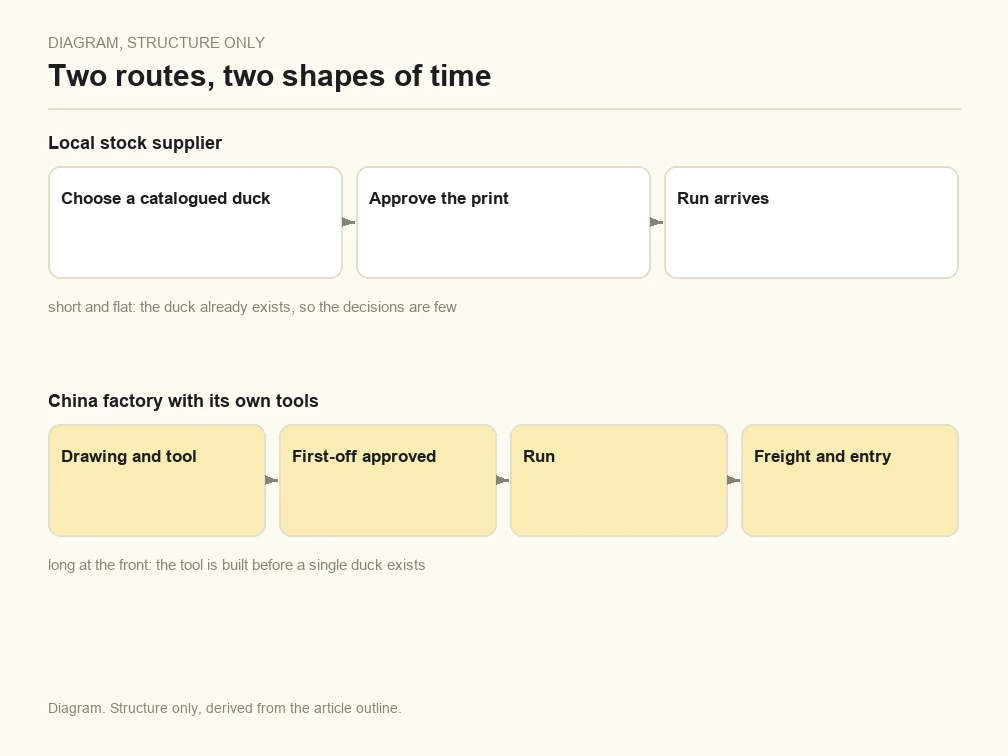
A stock supplier can change colour, print and packing on a duck that already exists in a catalogue. That is a real change and often a sufficient one: a giveaway duck with the brand on its chest does not need a new body. When the shape can stay, the short route is usually the local one, and the rubber duck guide sets out where that line sits.
A factory that owns its tools can change the body itself: the size, the posture, the beak, the tail, the seam and the wall section that decides how the duck sits in the hand. Those changes live in steel rather than in a print file, and the stock mould versus custom tooling comparison explains why one is a catalogued product and the other is a project.
The honest summary is that the factory route buys optionality. Optionality is worth paying for only when the design actually needs it, and a larger body makes that need more likely, which is why the large duck file treats size and tool as one decision rather than two.
Who holds the tool
Tool ownership is the question most buyers leave until after the first run, and it is the one that decides how easily they can ever leave. When the buyer pays for the tool and the transfer is written into the file, the tool travels with the buyer. When the tool stays on the supplier's books, the buyer is renting access to it, sometimes without knowing.
Neither arrangement is wrong on its own. A buyer running a single seasonal campaign may be well served by a supplier's own stock tool. A buyer planning several years around a signature character needs a tool that can follow them to another supplier without a rebuild. The tool and file checklist for a supplier request belongs in the first conversation, not the last.
Ask who can take the tool out of the building, and what happens to the drawings, the inserts and the repair history on the day the relationship ends. A supplier who cannot answer that has not thought about the second run.
Who carries the compliance duty
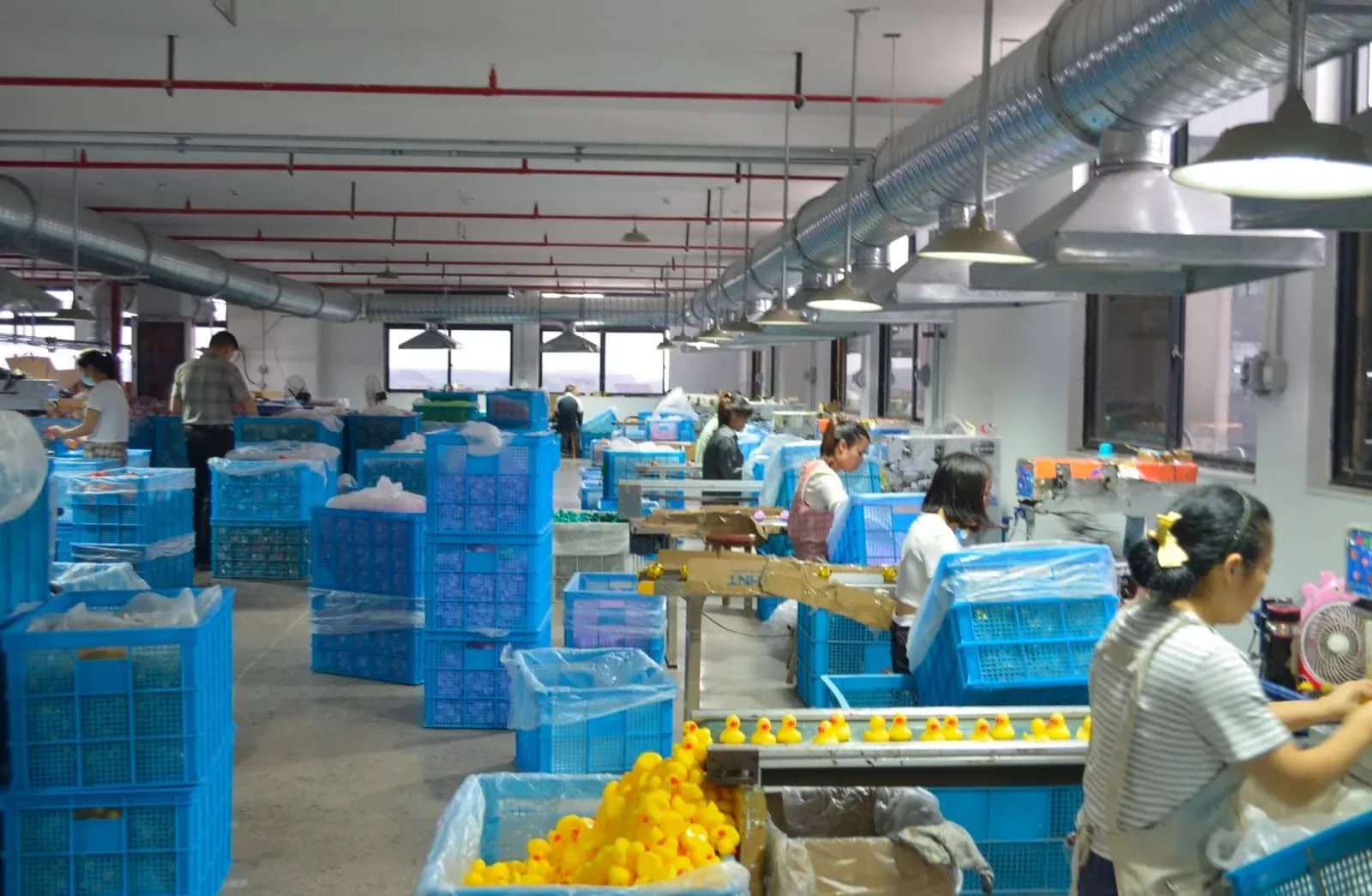
This is where the two routes separate most sharply, and where a good local supplier earns its place. Under the EU toy rules, only toys carrying CE marking may be placed on the EU market, and the importer has to hold a copy of the EC Declaration of Conformity, put its own name and address on the product and keep the technical file available to authorities (European Commission). A local supplier that already imports ducks absorbs that duty. A buyer who imports directly takes it on.
The same logic runs in the other direction. In the United States, the lead paint rule at 16 CFR 1303 sits on the surface finish, so a painted duck and a duck moulded in colour are not the same compliance story (eCFR). A buyer who has not read the label needs to know which of the two they are buying before freight is booked, and the toy safety label guide is where that reading starts.
A route that hides the paperwork has not removed the duty. It has only moved it later, and usually onto the buyer.
How evidence gets collected
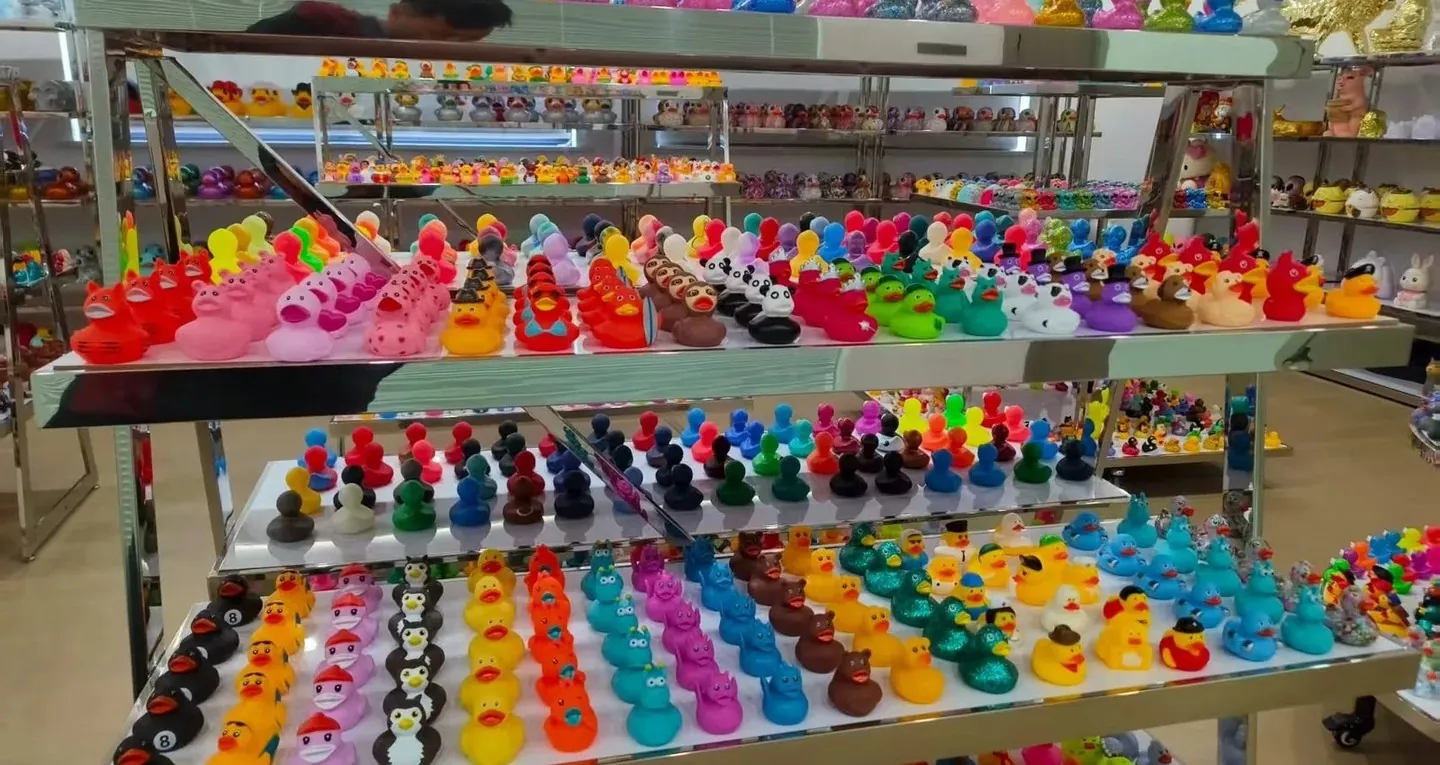
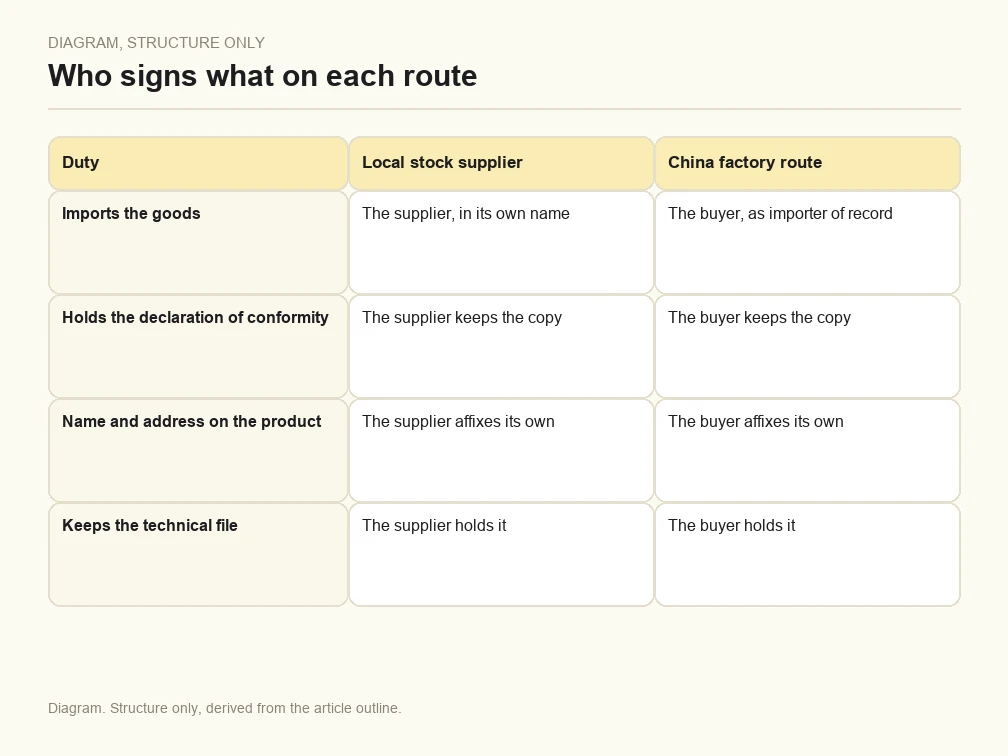
A buyer cannot watch a run in another country, so the evidence has to arrive as records. That means a sealed reference unit, an inspection record for each run with the checks named, carton markings that match the file, and photographs of the packing before the cartons close. The packing line below is the kind of stage a photo record should cover.
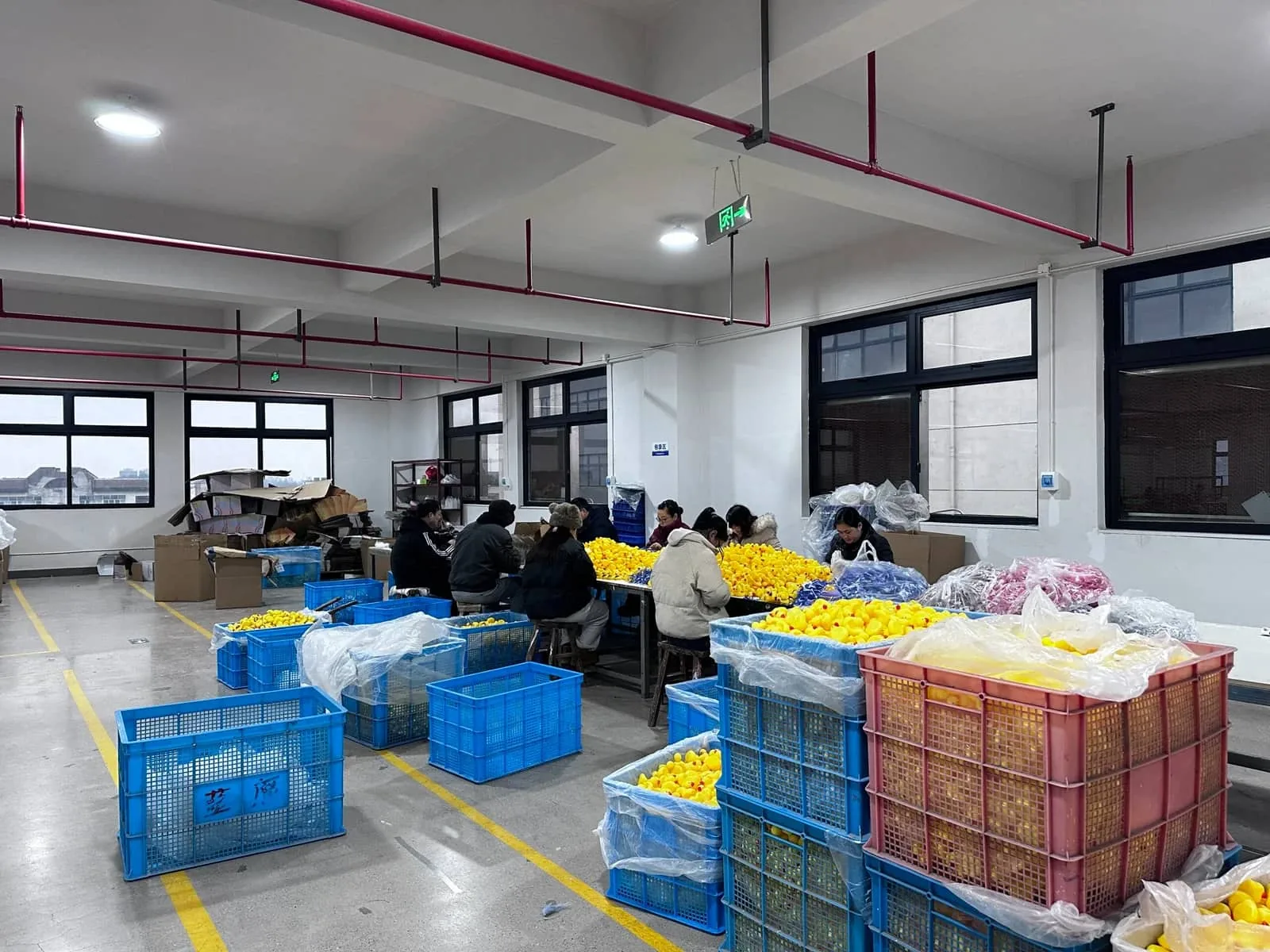
A local route collects evidence differently: you drive over and look. That is stronger for the things the eye can catch, such as colour drift or a loose eye, and weaker for the things only a test can catch. Neither form of evidence is complete on its own, and a buyer who trusts only a visit is trusting the smallest slice of the run.
The buyer's job is to decide which claims need a record and which need a look, then to ask for that mix in writing before the tool is cut.
What each route asks of the buyer
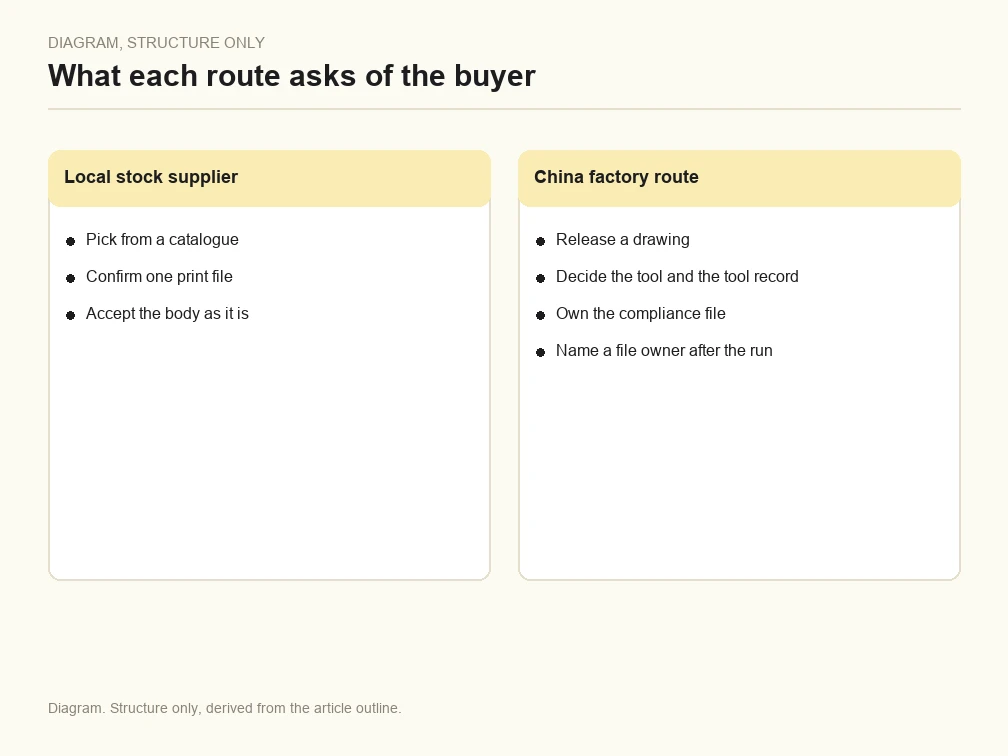
A local supplier asks for a short decision. The duck is chosen from a catalogue, the print is confirmed, and the run arrives. What the buyer gives up is the ability to change the body, and often the ability to see the tool that made it.
A China factory asks for a longer setup: a design file, a tool decision, a compliance plan, and a named person on the buyer's side who owns the file after the run. What the buyer receives in return is a duck that can be made to their design, plus a tool record that can travel if the relationship ever ends.
The two asks are not lighter or heavier versions of each other. They fall due at different points, and a buyer who plans for only one of them will feel the gap mid project.
The comparison at a glance
The table below is the comparison I would put in front of a buyer who has to choose a route this month. Read it as a map of who does the work, not as a ranking.
| Point of comparison | Local stock supplier | China factory with its own tools |
|---|---|---|
| What can still change | Colour, print and packing on a catalogued duck | Body, size and tool, within the limits of the steel |
| Who holds the tool | The supplier, or nobody, because the duck is bought ready made | The buyer, when the tool is paid for and the record says so |
| Compliance duty | The supplier imports and signs as the importer | The buyer usually imports and holds the file |
| Evidence | A visit, a shelf check and a carton to open | A sealed reference unit, run records and packing photographs |
| What it asks of the buyer | A short decision and a clean print file | A design file, a tool decision and a named owner |
Two rows decide most cases on their own. If the duck's body has to change, only one route can carry it. If the buyer cannot take on the importer role, only one route can carry that either.
Five questions before you pick a side
The questions I would want answered in writing before a route is chosen are narrower than a full supplier questionnaire. They are the five that change with the answer:
- Does the duck have to be new, or does it only have to carry a mark?
- Who owns the tool after the first run, and can it move with you?
- Who is the importer of record, and who signs the declaration of conformity?
- Which checks are looked at, which are measured, and who signs the result?
- Can you give the route the effort it asks for, honestly?
A buyer who can answer all five has already chosen the route. A buyer who cannot answer the second and third is choosing on the figure alone and will meet both questions later, at a worse moment.
Final Note
The fair read is that neither route is the serious one. The local route is faster and closer and carries the import duty, and it is the right answer when the duck already exists. The factory route is slower and further and asks the buyer to hold the file, and it is the right answer when the duck does not exist yet or when the tool has to belong to the brand rather than to the supplier.
What I would not accept is a comparison that starts and ends with a figure. The figure is the last line of the decision, not the first, and a buyer who inverts that order usually pays for it in a second run.
Frequently Asked Questions
Is a China factory always less expensive than a local supplier?
No. The factory route often starts higher because the tool and the compliance work sit at the front, and it climbs if the buyer has to fly out or repeat a run. The local route starts lower and stays flatter. Which one ends up ahead depends on how much of the duck has to be new.
Can a local supplier make a fully custom duck?
Some can, and the question is whether they own the tool or borrow it. A local supplier working through an importer may be able to commission a custom body, but the tool record, the repair history and the ownership usually sit with whoever paid for the steel, not with the brand that asked for it.
Who is the importer when I buy from a China factory?
Usually the buyer. In the EU that means holding the EC Declaration of Conformity, keeping the technical file and putting a name and address on the product, and in the US it means the entry and the testing obligations that go with it. A local supplier normally absorbs this role, which is a large part of what the buyer is paying for.
Do I need to visit a factory to trust it?
A visit is useful and it is not sufficient. It shows you the floor, the crates and the people, but it cannot show you the last run or the next one. A buyer who cannot travel should ask for the records a visit would have produced: the sealed unit, the inspection report and the packing photographs.
Key takeaways
- Two suppliers, two kinds of distance: distance changes what you can check yourself versus through records.
- What each route can change: the factory route buys optionality in the body itself.
- Who holds the tool: tool ownership decides how easily a brand can leave.
- Who carries the compliance duty: the importer signs, so pick the route that can carry it.
- What each route asks of the buyer: the two asks fall due at different points in the project.