A claim that arrives without a document behind it is an adjective rather than a fact, and three phrases arrive without documents more often than any others. Lead free, food grade and non toxic are all reasonable things for a buyer to want, and none of them is a standard that can be tested directly. Each one is shorthand for a rule, a scope and a report that either exists or does not.
In short: lead free maps to a number in a rule, food grade maps to a set of food contact rules that may not apply to a duck at all, and non toxic maps to a list of substance limits spread across several rules. A report can back a specific claim about a specific material, and a phrase on a sign cannot. Ask which rule, which material and which version of the duck the report describes, and the three phrases become three answerable questions.
Three phrases, three different kinds of statement
The three claims fail in different ways, which is why one document rarely covers all of them. Lead free is the easiest to pin down because it points at a measurable limit on a coating or a substrate. Non toxic points at a list of restricted substances, so it is only as strong as the list you name. Food grade points at a use rather than a material property: it describes what the object is allowed to touch. Mixing the three into one sentence on a marketing sheet is normal, and it is also why a buyer who asks for "the certificate" can receive a document that answers a different question than the one being asked.

Lead free and the number behind it
Lead free is short for a limit, and the limit sits in the paint and the substrate separately. For a toy, the paint or surface coating is capped at 0.009 percent lead under 16 CFR part 1303, which is 90 parts per million. The body compound is a different question with its own limit, so a report that covers the coating does not automatically cover the plastic. A supplier who says lead free without naming which layer was tested has given you a word, not a result. The useful follow up is not "are you sure" but "which layer, and what was the measured value".
Food grade is a contact claim
Food grade describes an intention about food contact, and food contact rules exist to protect food rather than to certify a toy. In the United States, materials intended to come into contact with food sit in a framework of indirect additive rules such as 21 CFR part 177, which addresses polymer substances used in food contact articles. A duck that is sold as a bath toy is not a food contact article, so applying the phrase to it borrows credibility from a rule that was never aimed at the product. That does not make the material bad; it means the claim is being used as a compliment rather than as a finding.
Non toxic has no threshold
Non toxic sounds absolute and is structurally not. Every material is made of substances, and the question is always which list of restrictions is being applied and at what limit. For a children's toy the phthalate rule is a good example of how specific a real limit is: eight phthalates are capped at 0.1 percent in accessible plasticised components, as CPSC's phthalates guidance sets out, with the detail codified in 16 CFR part 1307. That sentence is usable because it names substances, parts, a limit and a rule. "Non toxic" names none of the four.

What a report can and cannot prove
| Claim made | What actually backs it | What it does not cover |
|---|---|---|
| Lead free on the paint | A coating test against 16 CFR part 1303 | The body compound, or a different colour |
| Lead free on the body | A substrate test on the named material | Any decoration applied afterwards |
| Food grade | A food contact assessment for the intended use | A toy that never contacts food |
| Non toxic | The specific restricted substance list cited | Substances not on that list |
| Toy safe | The standard and year named on the report | A different size, colour or material |
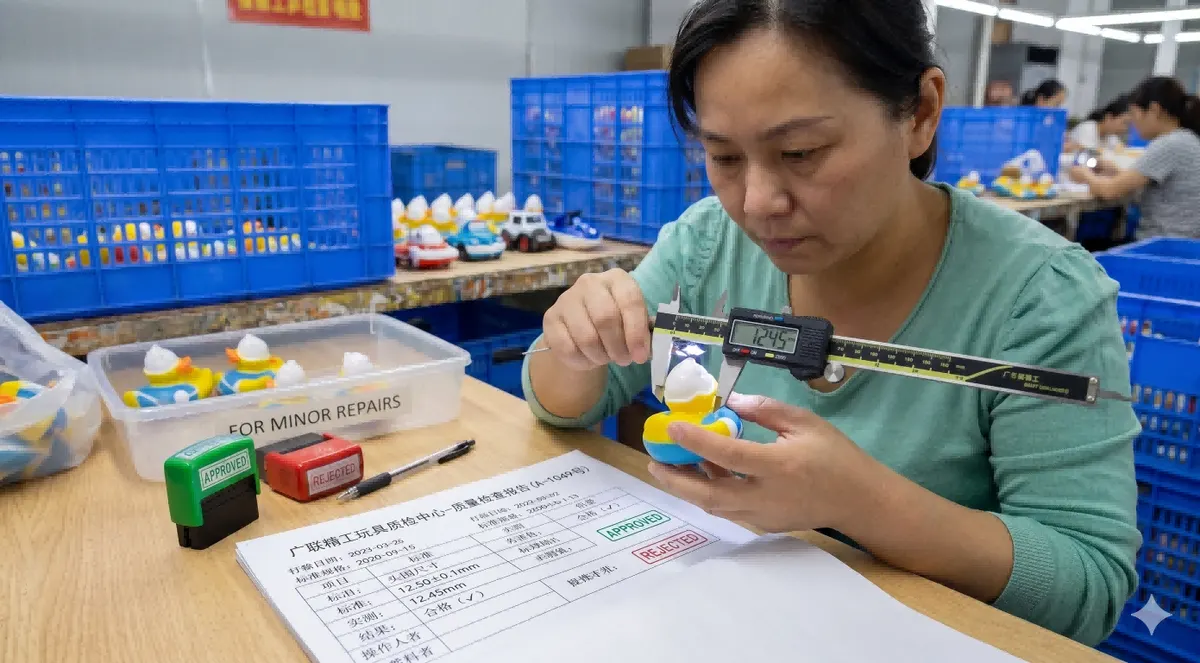
The pattern in the table is scope. A report is a statement about a named object under a named rule, and every change to the object or the rule is a change to the statement. This is why a buyer who collects one document per product and one for every variation is never surprised at a customs check, while a buyer who collects one document per supplier usually is.
Certification marks are printed at about 5 mm by 5 mm without distortion, and the base is the usual spot because it gives a large flat area that is normally left blank. The mark has to stay on, so the position must be flat and the print durable enough to survive rubbing; many buyers add a hang tag listing the certifications, and buyers with higher requirements put the marks on a colour box.
What to ask for instead of a phrase
Four questions turn a claim into a document. Which rule and which year does the claim reference? Which material or layer of the duck was tested? Which colour and which production version does the report describe? Who issued it and when does it expire? A supplier who can answer all four has a file, and a supplier who answers with an adjective has a marketing line. The toy safety label walkthrough shows how those answers map onto the marks printed on a finished duck, and the Prop 65 file notes show what a California retailer will ask on top of them.

Why the batch matters as much as the report
A report describes a test piece, and a shipment is thousands of pieces. The link between them is traceability: the compound lot, the colour batch and the production date have to line up with what the report describes. That is why a serious file includes a material declaration from the compound supplier alongside the test report, and why a buyer who changes colour mid project should expect a new test rather than an amended sentence. Traceability is also the reason a request for a document is a request about the batch and not only about the product.
Questions to settle before you approve
- Which rule and which year does each claim on the sheet reference?
- Which layer of the duck does the report describe, the coating or the body?
- Does the report name the exact colour and material you are buying?
- If the material or the colour changes, who carries the new test?
Frequently Asked Questions
Can a rubber duck legally be called food grade?
The phrase has no toy specific definition, so it is best read as a statement about intended contact. If the duck is a bath toy, the food contact rules were never aimed at it, and a supplier using the term is borrowing weight rather than reporting a finding. Ask which rule was applied and what was actually tested.
Is lead free the same as lead tested?
No. Lead free is a conclusion and lead tested is an action with a result attached. The conclusion is only as good as the test behind it, which is why the useful request is a report naming the layer, the material, the measured value and the rule, not a sentence on a spec sheet.
Does non toxic cover every chemical?
It cannot, because there is no single list behind the word. Real claims name a rule and a limit, such as the phthalate cap at 0.1 percent in accessible plasticised components under 16 CFR part 1307. A claim that names nothing cannot be checked, and an unchecked claim is a risk carried by whoever repeated it.
What is the minimum a buyer should ask for?
A report that names the rule and year, the material or layer, the colour and the production version, plus the issuer and the date. The materials overview explains why the material name alone is not enough, because the same family of compound can be formulated in several ways.
Final Note
The three phrases are not lies and they are not standards. They are shortcuts that either point at a document or hide the absence of one. A buyer who replaces them with four questions ends up with a file that survives a retailer's review, and a supplier who answers those questions honestly turns a marketing conversation into a technical one, which is a better place for both sides to stand. If the finish is what the claim is about, the glitter and metallic notes explain why a coating is a separate test scope, and the eye and facial detail piece covers the smallest decorated part on the duck.
Key takeaways
- Lead free points at a number: 0.009 percent lead in a surface coating under 16 CFR part 1303.
- Food grade describes an intention about food contact, and a bath toy is not a food contact article.
- Non toxic names no list and no limit, so it cannot be checked as written.
- A report is a statement about a named object under a named rule, so a change to either reopens it.
- Ask four questions: which rule and year, which layer, which colour and version, and who issued it.
- Traceability connects a test piece to a shipment, so the batch belongs in the same conversation as the document.