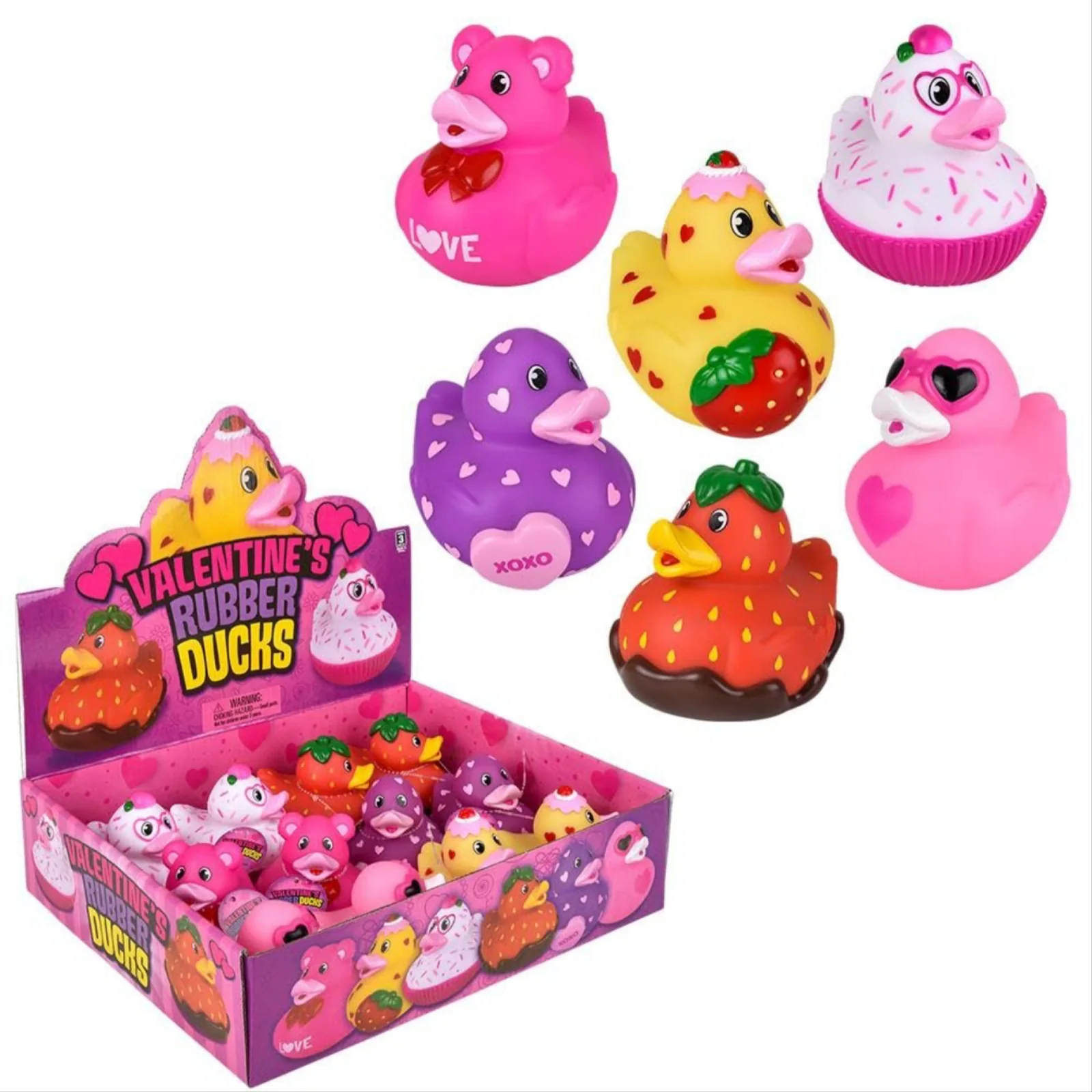
A Valentine duck is planned backwards from the date, because the fourteenth of February is the one part of the campaign nobody can move. The duck itself is indifferent to the date, which is exactly the trap: a design that would be fine in any other month becomes a compressed decision in January. The heart, the colour route and the pack are the three decisions that have to close first.
A fixed date reverses the sourcing order, because the date cannot be renegotiated and the duck can.
In short: A Valentine's rubber duck is a fixed date, a heart that reads at promo size, a colour route chosen before the artwork is final, and a pack that matches how the duck is handed over. Plan from the date back through the handover, the pack, the print and the body, and approve the card and the duck as one set rather than as two.
A Fixed Date Changes the Sourcing Order
Every other promo duck can slip a little. A Valentine duck cannot, because the campaign has a single day and the shelf space in front of it is bought against that day. That turns the usual order of decisions around. Instead of starting with the design and working out when it can be made, the line starts with the date, then the handover, then the pack, then the print, then the body.
The reversal has a practical consequence. Anything decided after the artwork is approved is decided against a clock that cannot move, and the answer to a late question is usually the option already in the tool. That is why the heart, the colour route and the pack belong in one conversation early, before the file is closed. It is also why a second design is often the wrong second decision: it doubles the print and the pack for a campaign that only needs one heart to read well.
The Heart Has to Read at Promo Size
A promo duck is a small object seen from two paces, on a desk, in a bag or on a counter, and that distance decides the artwork. A heart drawn in thin script, a cupid whose bow is a hairline, a heart outline that is one pixel wide in the file: each of those is legible on screen and gone in the hand. Solid shapes and fat lines survive the same reduction because they keep their area when they shrink.
Valentine’s leans on red and pink, and the heart is the shape that has to read at promo size. The palette is a starting point rather than a ranking: a single accent colour or a brand colour can carry the date when the duck sits inside a larger campaign.
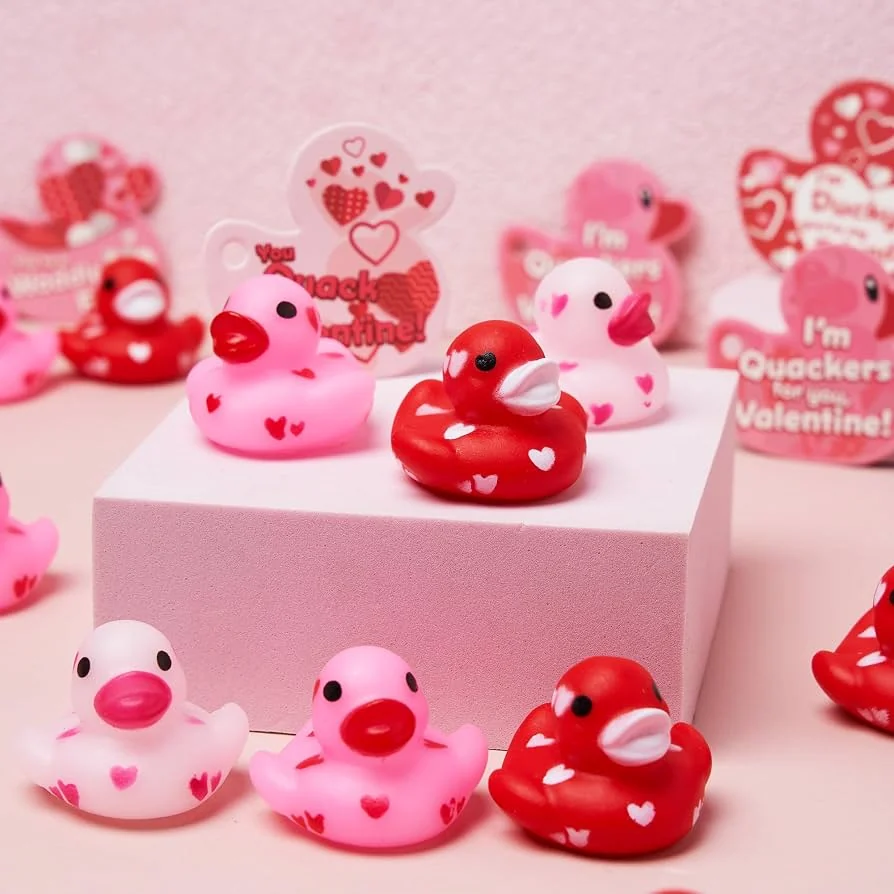
The print zone matters as much as the drawing. On a duck body the belly and the chest are the large flat areas, and the heart has the best chance there. A mark pushed onto the side of the body curves away from the viewer, and a mark crammed near the wing is a mark that reads as a smudge from two paces. The useful test is a printed paper proof pinned to a duck at the size the duck actually is, viewed from where a customer stands.
That test also settles the theme. A heart on a yellow body, a heart on a red body, a pair of ducks facing each other, a duck holding an arrow: the idea that survives the two-pace test is the one worth printing, and the ones that only work up close are decoration for the file rather than for the campaign.
Three Colour Routes for the Heart
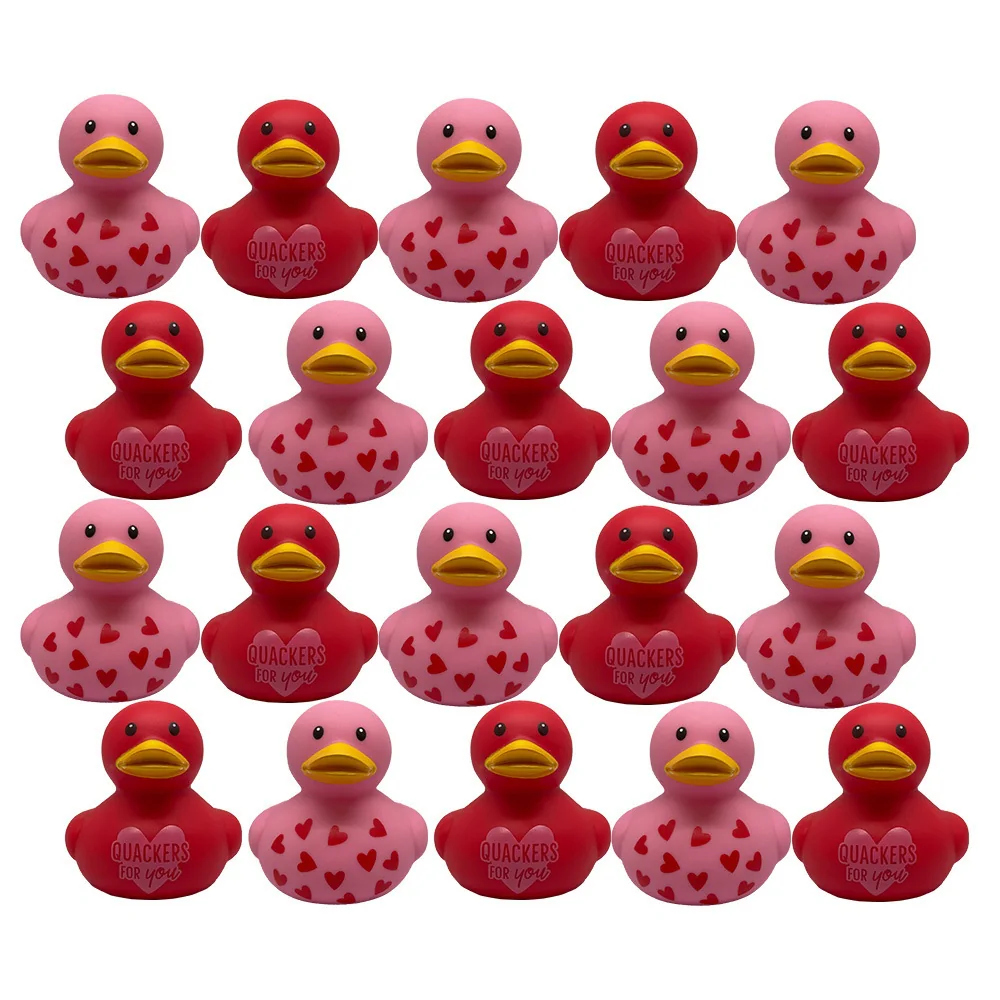
There are three ways a heart gets onto a duck, and they are not grades of the same thing. They differ in how the mark is made, what changes in the tool and the file, and what the buyer has to approve.
| Route | How the heart is made | What it changes in the file | Where it fits |
|---|---|---|---|
| Moulded colour | The heart is part of the body shape or a second material | A tool change, and a second colour to control | A heart that must survive years and stay solid |
| Painted | Paint is applied over the body | One more coating and a drying step | Strong colour on a simple shape |
| Printed | Ink is laid on the body by pad or UV print | A print file and a placement reference | Detail, small text and a mark that may change |
The moulded route is the most permanent and the least flexible, because the heart stops being a graphic and becomes part of the body. The painted route gives a strong saturated colour and adds a coating, which is a separate question in a toy file: a paint or similar surface coating on a children's product is judged on its own lead limit under 16 CFR 1303.1, so the route belongs in the product record and not only in the design file. The printed route carries the finest detail and the fastest change, and the printing process note covers how the ink is laid down and checked.
A buyer who has not chosen a route is asking the factory to choose, and the factory will choose the route that runs most simply, which is not always the one the campaign needed.

The Pack Follows the Handover
A Valentine duck is handed over in one of three ways, and the pack is decided by which one. A duck given across a counter is held in the hand for a moment and needs no pack at all. A duck given as a small gift needs a bag or a box that survives a handbag and a desk. A duck shipped to a distributor needs a carton that survives a pallet and a season in storage.
The pack also decides whether the card is seen. A card loose in a bag slides under the duck and is found later or not at all. A card slotted behind a header, or tied to the duck, is read at the moment of handover. The packaging layout note covers how the bag, the header and the carton sit together, and the colour matching note covers how the red on the pack is agreed with the red on the duck.
Red is the hard part of a Valentine pack. A red printed on board and a red moulded in vinyl will not match, because one is ink on a surface and the other is pigment in the material, and the two reflect light differently. That is normal. The pair should be approved side by side, in the light the campaign will be seen in, and the result recorded so the second pack matches the first.
The Card Carries the Romantic Part
The duck can hold a heart and a logo. The card is where the sentence goes. That division is why a Valentine promo usually pairs the two: the duck is the object that stays on the desk, and the card is the part that is read once and kept or thrown away, and the buyer decides which of those it should be.
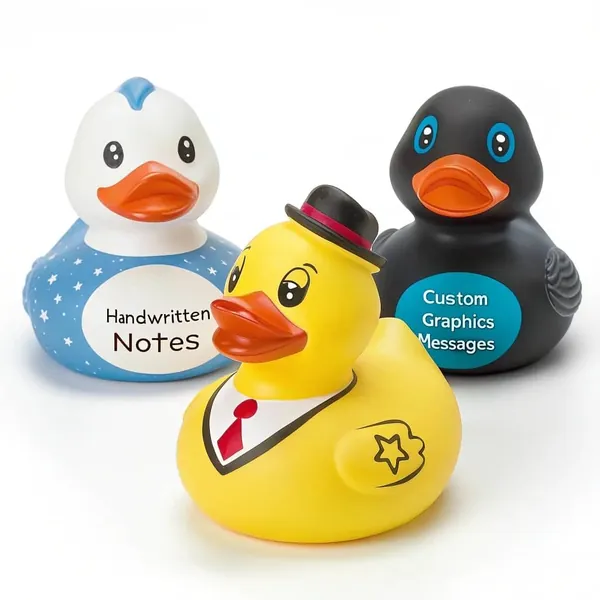
A card also carries what a printed duck cannot change on every unit. A name, a date, a short handwritten line, a table number or a message that differs between recipients is a data job, not a design job, and it belongs on the card rather than on the body. The message print note covers how a line of designs is built around a single message, and the same discipline applies to a single campaign.
One line on the card should not be there: the batch and the producer information. Those belong on the product or the pack, and the CPSC tracking label guidance explains that the permanent marks have to be affixed to the product and its packaging, to the extent practicable, and may use a code the consumer can ask about. A card can repeat that code. It cannot be the only place it exists.
A Pair or a Set Needs Its Parts Approved Together
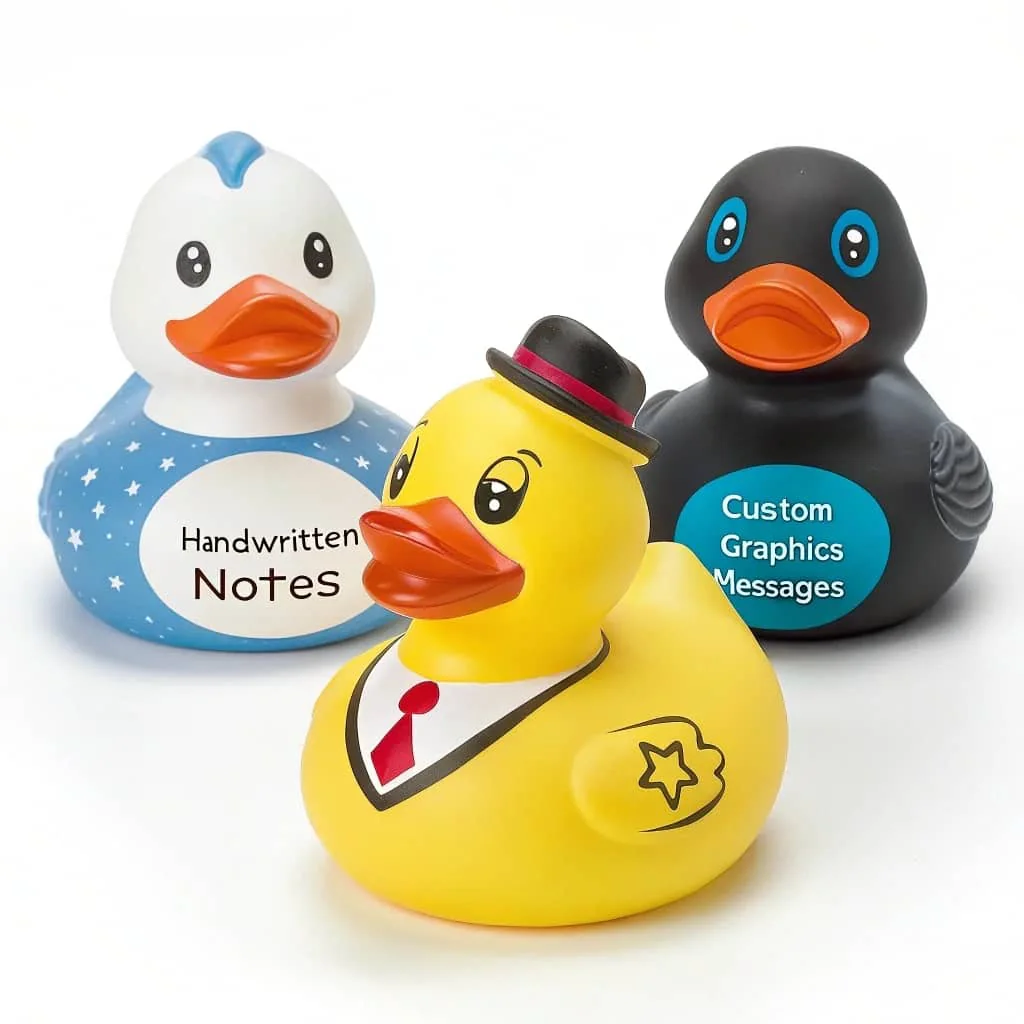
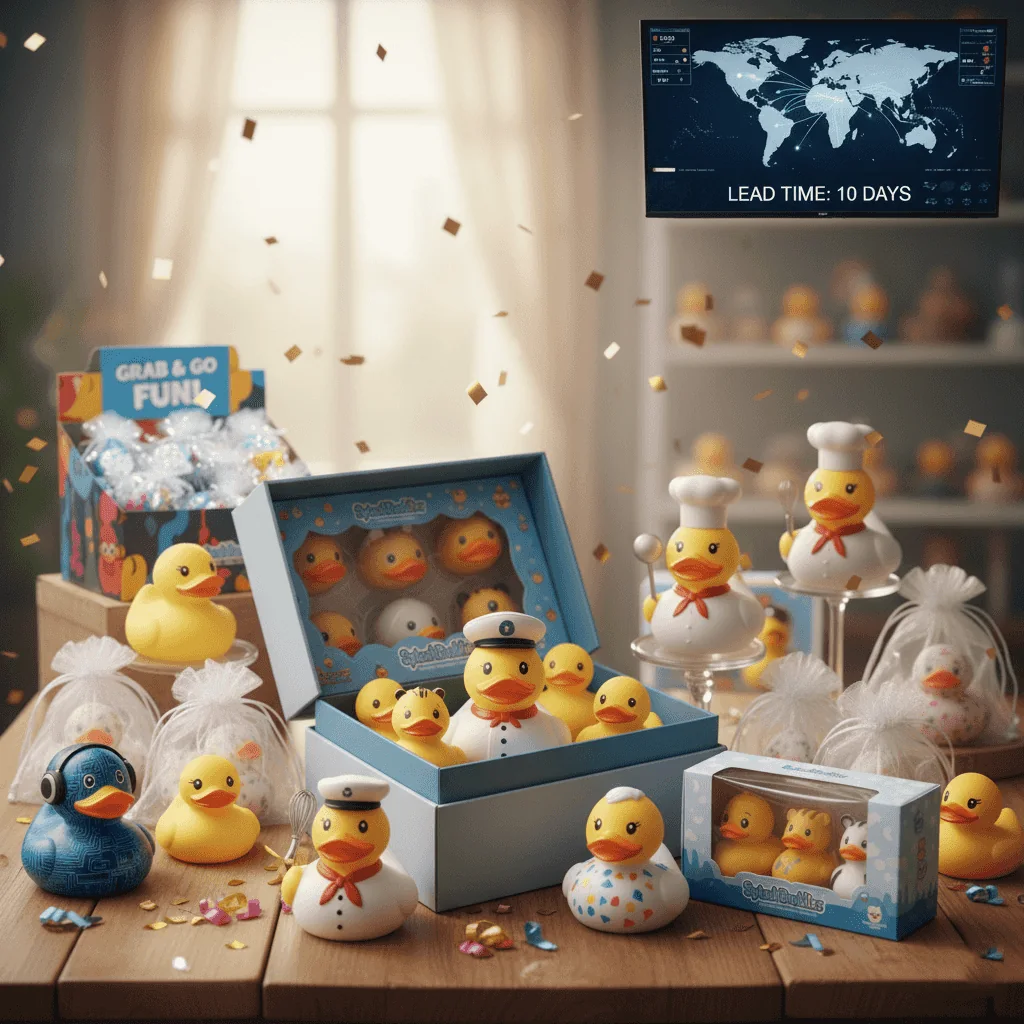
A single duck is one approval. A pair, a set of three or a gift box with a duck and a card is one approval with more parts, and the parts can drift apart. Two bodies from different runs can arrive a shade apart, a card printed for one pair can be packed with another, and a box that was sized for a duck with a hat will not close on a duck without one.
The fix is to approve the set as a set. That means one photograph of the assembled unit, one line per part in the file, and one retained sample of the whole thing rather than one sample per part. The same rule that governs a duck and its card governs a pair and its box: the approval object is the assembled product, not the individual pieces.
There is also a labelling question. A set means more than one item in one pack, and the pack has to state what is inside clearly, which is a different exercise from labelling a single duck. The safety label guide sets out what the pack carries, and the seasonal range post covers how a seasonal line is built around one body shape.
Four questions settle a Valentine line before the artwork closes:
- Which heart survives the two-pace test, and on which part of the body does it sit?
- Which colour route, and does the route add a coating that changes the product record?
- How is the duck handed over, and does the pack match that handover?
- Is the set approved as an assembled unit, with one retained sample?
Frequently Asked Questions
When should a Valentine's duck promo be planned?
As soon as the campaign date is fixed, and before the artwork is closed. The date is the only fixed variable in the whole line, so the body, the colour route and the pack have to be chosen while there is still room to change them. A design closed first and sourced second usually ends with the second-best route.
Should a Valentine duck be boxed or bagged?
It depends on the handover. A counter giveaway needs no pack, a small gift needs a bag or a box that survives a handbag, and a distributor order needs a carton built for storage. The pack should be chosen from the handover, not from a photo of a previous campaign.
Can a Valentine duck be sold the following year?
The duck can, if the heart is a solid shape rather than a dated message and the body colour is not tied to one year's palette. The card usually cannot, because a card carries the year or the campaign name. Keeping the body generic and the card dated is how a line carries over without looking like last season.
What body colour works with a red heart?
A pale body gives the red the strongest contrast, and a red body turns the heart into a tone-on-tone mark that reads only up close. A yellow body with a red heart is the classic pairing because the two colours separate cleanly at a distance. Whatever the pair, approve the body and the heart together rather than on separate screens.
Final Note: Five Decisions Before the Date
- Fix the campaign date and the handover, then let those two set the rest of the line.
- Choose the heart on the two-pace test, and place it on the belly or chest.
- Choose the colour route, and record it if it adds a coating.
- Choose the pack from the handover, and let the card be visible or tied.
- Approve the assembled set, and keep one sample of the whole unit.
A Valentine duck is not a harder product than any other duck. It is a product with one immovable date, and the work is to make every other decision early enough that the date is not the thing that decides them.
Key takeaways
- The date is fixed, so the sourcing order runs backwards from it, covered under the fixed date.
- The heart has to survive the two-pace test on the belly or chest, covered under the heart at promo size.
- Moulded, painted and printed hearts change the tool, the record and the file differently, covered under the three colour routes.
- The pack is chosen from the handover, and the card has to be visible in it, covered under the pack and the handover.
- A pair or a set is approved as an assembled unit with one retained sample, covered under approving a set.