A duck year is planned backwards, from the shelf date to the design, because the forward version always looks comfortable in January and impossible in October. A duck calendar is not twelve ideas. It is a small number of bodies, a colour and print window for each season, and a pack plan that has to be ready before the season rather than during it.
Written as a working note on seasonal planning, with public toy safety and packaging guidance cited where a rule applies.
In short: A year-round duck programme runs best on one or two bodies and a seasonal layer of colour, print and pack. The calendar is built backwards from the dates the goods have to be on a shelf, which means the design decision for a season is made months before the season, and the pack decision is made in the same conversation rather than after it.
The duck year runs backwards
A forward plan starts with an idea and asks when it can be made. A backward plan starts with the date the goods have to be on a shelf and subtracts the work: packing, the run, the sample, the artwork, the colour. The first version feels creative and the second one is honest, because only the backward plan reveals that a season decided in September is already a compromise.
The practical consequence is that a duck calendar is mostly a list of deadlines that have nothing to do with ducks. Artwork approval, colour sign-off, pack artwork, the sample, the booking, the run and the pack each take their own slot, and the season is what is left at the end. The gate note explains the same chain for one quarter.
A twelve month grid a planner can use
| Window | What is being decided | What is being made |
|---|---|---|
| Early year | The body and the colour range for the year | The approved sample and the colour references |
| Spring | Spring and summer event looks | Print artwork and the first seasonal run |
| Mid year | Autumn and back-to-school looks | Colour booking and pack artwork |
| Late year | Winter and gifting looks | The winter run and the gift pack |
| Between seasons | The repeat decision | What carries over and what is retired |
The grid is deliberately coarse. A monthly grid invites monthly changes, and a programme that changes every month has no fixed reference, which is the thing that makes a duck line recognisable. Four windows a year is enough to keep the range fresh and few enough to keep one standard.
Pick one body and dress it for the season
The single biggest calendar decision is how many bodies the year runs on. One body with a seasonal layer of colour and print is the plainest and the most consistent. Two bodies, one plain and one that can carry a hat or a prop, cover most holiday programmes without a new tool every season.
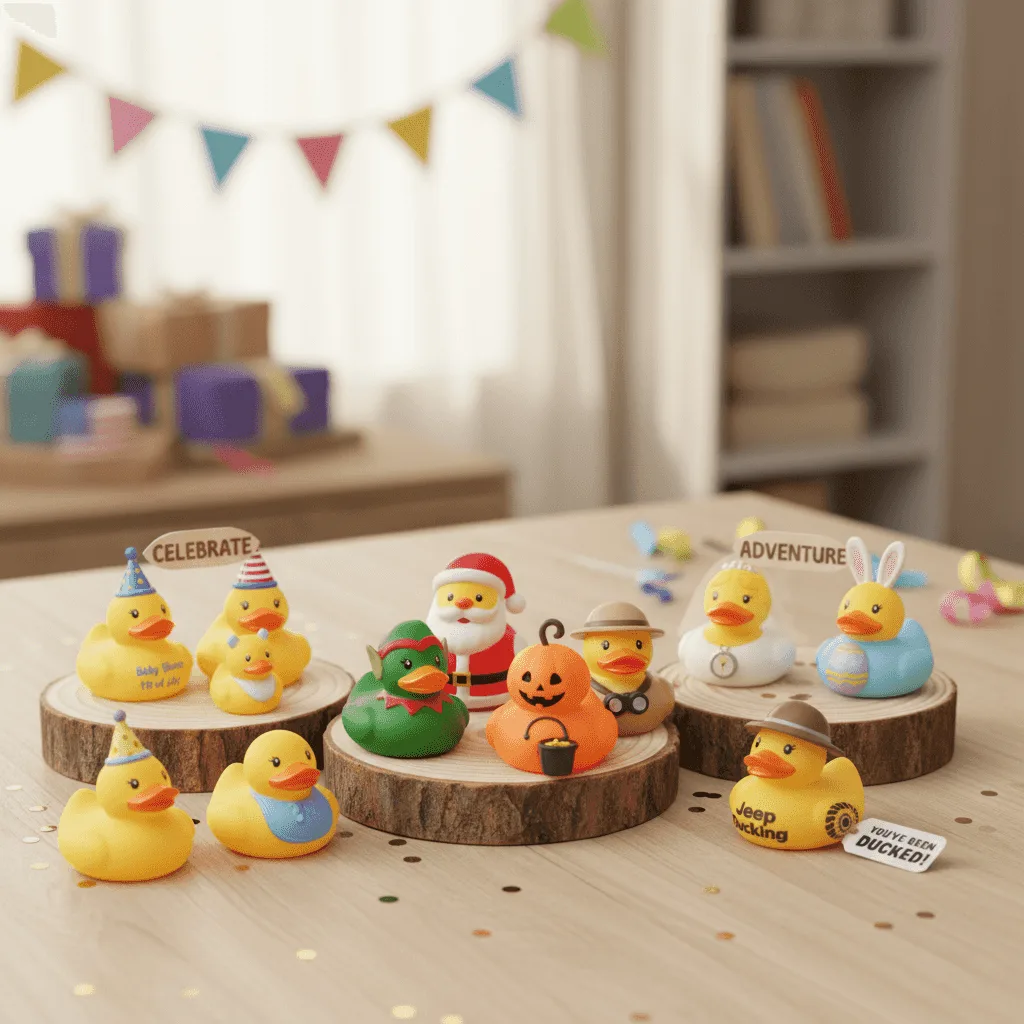
The seasonal layer is where the year feels different. A colour story per season, a print per campaign, a small prop for the winter run. None of that needs a new mould, and all of it needs a decision before the artwork. The base design note covers how much a body can carry, and the print note covers the detail that makes a seasonal duck read as a character.
Colour is fixed before the duck is moulded
Colour is the part of a seasonal programme that looks easy and behaves badly. A season has a colour, the colour has to match across a print run, a paint run and a pack, and the reference has to survive a year of repeats. Approving a colour from a screen is how a spring green arrives as a summer green.
The calendar fix is to sign the colour references for the whole year at the start, in one session, on physical samples. Then each season inherits a reference instead of inventing one. The colour note covers how the reference is specified, and the palette note covers the case where a single colour is the whole programme.
Packing is a calendar decision too
The pack runs on its own schedule. A printed box, a header card or a sleeve is designed, approved and produced before the duck is packed, and the season's pack has to be ready when the season's run is ready. A programme that decides the pack after the run is a programme that either delays the run or ships in the previous season's box.
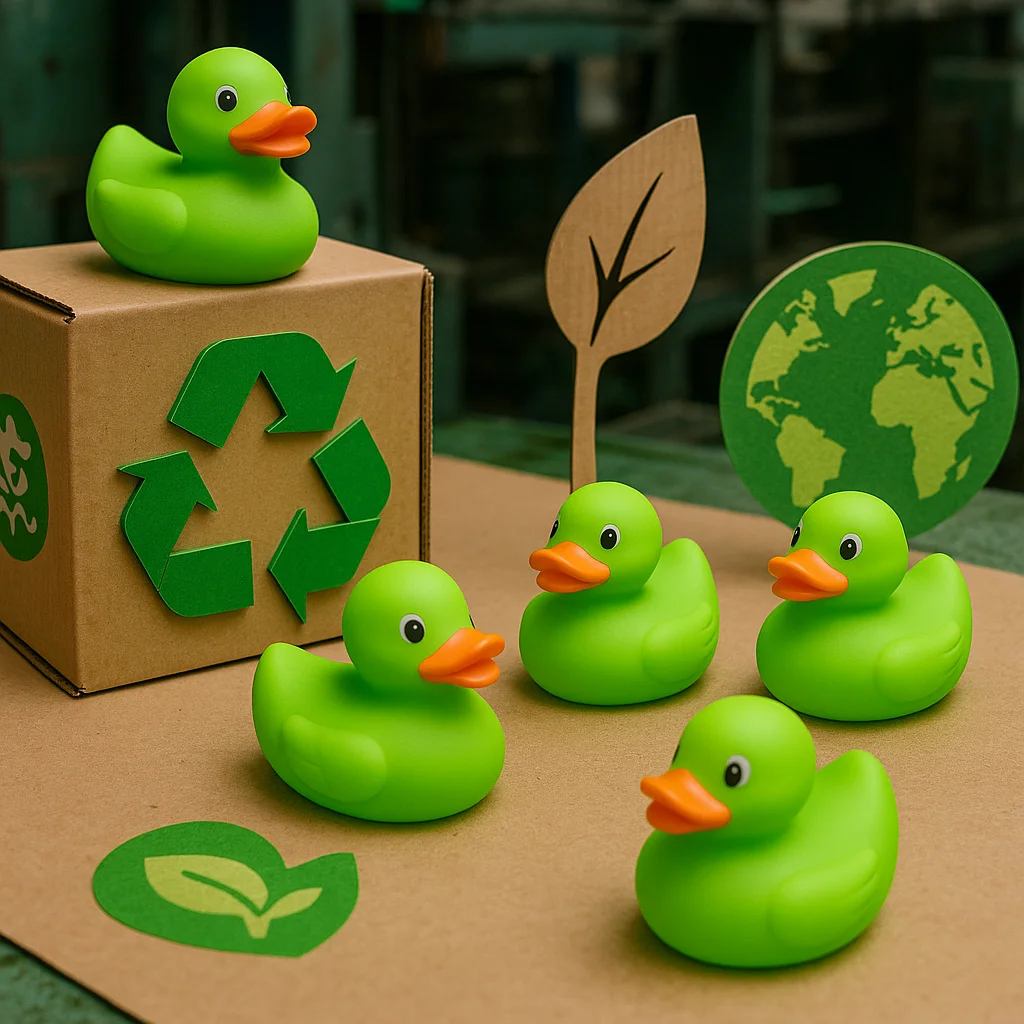
The same logic applies to the material. Packaging placed on the market carries its own design and marking duties, and the European Commission's packaging page sets out the framework those duties sit inside. A seasonal pack that changes every quarter changes that surface every quarter, which is a reason to keep the pack family stable and change only the printed face.
Where a seasonal run goes wrong
Seasonal runs fail in four predictable ways. The design is approved after the sample window, so the sample and the run collide. The colour reference is a screen, so the batch arrives in a different shade. The pack artwork is approved after the run is booked, so the pack becomes the critical path. And the season is treated as a deadline rather than as a shelf date, which means the goods arrive on time and sit in a stockroom through the selling window.
None of those is a factory failure. Each one is a calendar decision taken too late, and each one has a slot in the grid above.
Safety rules do not take a holiday
A seasonal duck given to a child is a children's product whatever the season. The CPSC's toy safety guidance sets out the testing and certification duties that apply, and a seasonal run does not sit outside them because it is short. A new colourway or a new prop is a change to the product, and the file has to account for it.
The calendar consequence is that testing belongs in the early window, not in the seasonal one. A programme that tests once for the body and the year can move fast in each season; one that tests per season builds a queue into its busiest month.
What the factory needs to hold a date
Three things. The shelf date, which is the only date that matters. The body and the colour reference for the season, because a date cannot be held against an open design. And the pack artwork, because the pack is produced in its own run and a late pack delays a finished duck. Everything else can be negotiated around those three.

- Which shelf dates are fixed, and which are flexible?
- Does the year run on one body or two?
- Are the colour references signed for the whole year?
- Is the pack artwork on the calendar, or waiting for the season?
Frequently Asked Questions
When should a seasonal duck design start?
Months before the season, not weeks. The design has to be frozen before the sample, the sample before the run, and the run before the pack. Working backwards from the shelf date is the only way to see how much room is actually left.
Can the same duck body be used for several holidays?
Yes, and that is the usual arrangement. One body with seasonal colour, print and a small prop covers most of the year. A second body is worth it when a recurring season needs a shape the first one cannot carry.
Does a new seasonal design need new safety testing?
A new colourway or a new prop is a change to the product, so it changes what the file has to cover. The simplest arrangement is to test the body and the year once, then keep every seasonal change inside the range that was covered.
Can a seasonal range be packed differently per store?
It can, and often should. A store that wants a shelf-ready box and a store that wants a plain carton are two pack specs, and both have to be on the calendar. The pack is a decision with a lead of its own, not a label applied at the end.
Final Note
A duck year built on four windows and one body beats a year of twelve launches that never look like the same product. The seasons are the visible part. The calendar behind them is the part that decides whether the visible part arrives on time, in the right colour, in a pack that belongs to the month it is sold in.
Key takeaways
- The duck year runs backwards: work back from the shelf date and the calendar becomes honest.
- A twelve month grid a planner can use: four windows, not twelve launches.
- Pick one body and dress it for the season: the seasonal layer is colour, print and pack.
- Packing is a calendar decision too: the pack is produced before the duck is packed.
- What the factory needs to hold a date: shelf date, colour reference and pack artwork.