A buyer side reading order for four documents that are usually checked in the wrong sequence.
A document stack is best read backwards: signer first, then the scope line, then the date, and only then the body. An afternoon spent checking four papers beats a season explaining why one of them did not cover the order. The four documents below look like a set, and they are not a set at all. Each one is issued by a different party, covers a different object, and expires for a different reason, which is why a supplier who sends all four in one email can still leave the buyer with nothing that holds.
In short: BSCI is a social audit of a site, GRS is a recycled content and chain of custody claim about a product, REACH is a regulation that no certificate can prove, and the CPSIA certificate for goods made outside the United States is issued by the importer, not by the factory. Check the signer, the scope line and the date on each one.
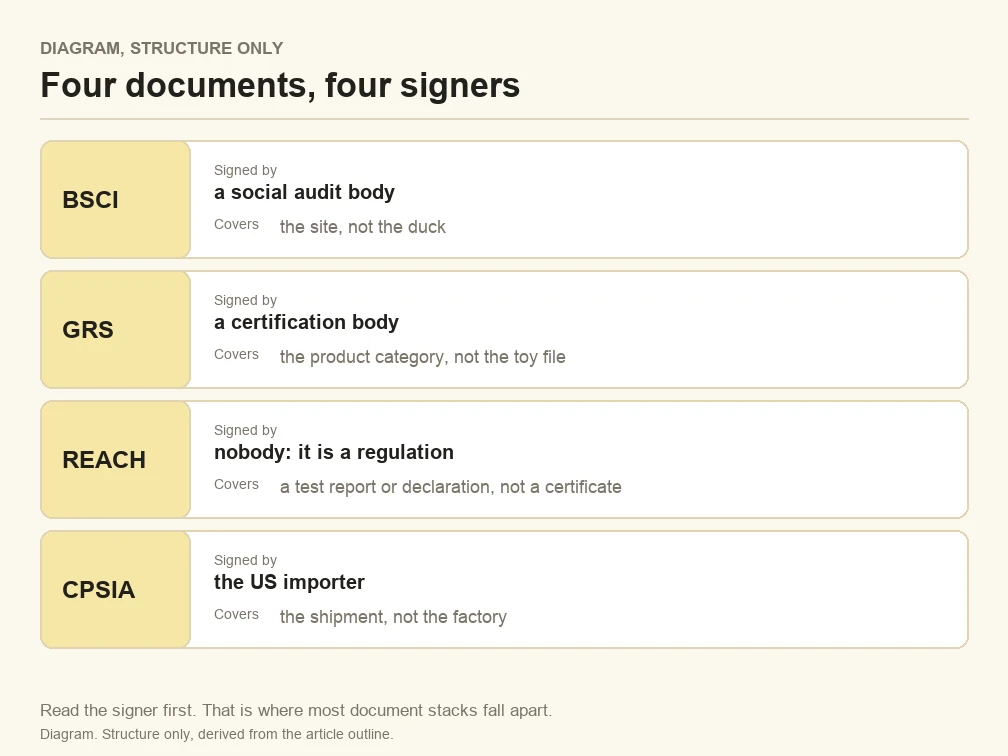
Four documents, four signers
The first question is not what the document says. It is who put their name on it, because that tells you what the document can possibly prove. A factory sends you a stack that includes an audit report, a scope certificate, a test report and a declaration, and the four are signed by four different kinds of party: an audit body, a certification body, a testing laboratory, and in the CPSIA case the importer who brings the goods into the country.
| Document | Signed by | What it covers | What it does not cover |
|---|---|---|---|
| BSCI audit report | An audit body | The site and its management systems on the audit days | The duck, the compound, the paint or the carton |
| GRS scope certificate | A certification body | The product categories and the site cleared to certify | That a named shipment was made inside that scope |
| REACH report or declaration | A laboratory or the supplier | The substances that were tested on a named sample | Any duty that belongs to the importer of record |
| CPSIA certificate of compliance | The US importer | The shipment and the rules it must meet | Anything the factory has not tested or documented |
That matters because a document can only carry the duty of the party that signed it. A factory can give you a test report and a declaration, and it cannot give you a certificate of compliance for the United States that belongs to the importer. A buyer who reads the stack as one bundle ends up asking the supplier to sign something the supplier is not allowed to sign, and the answer usually arrives as a polite version of no.
A BSCI audit describes a building, not a duck
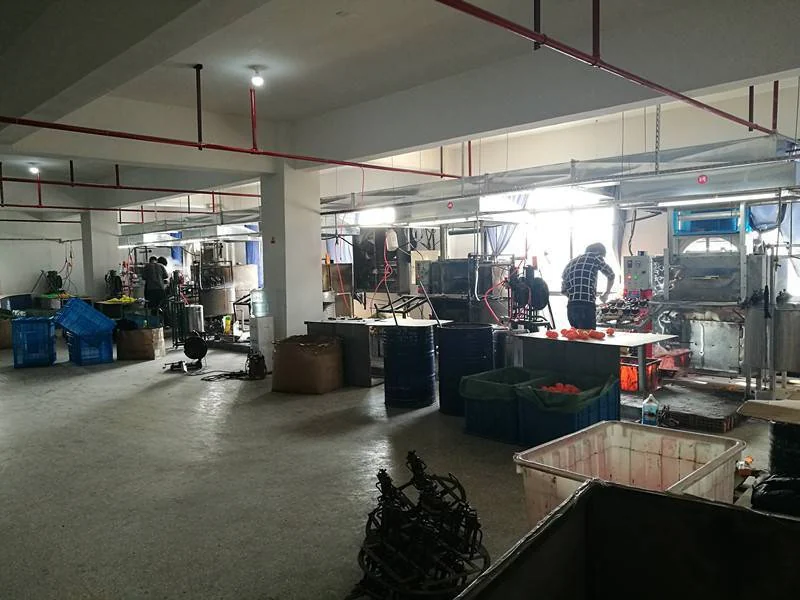
BSCI is a social compliance audit programme, and what an auditor sees is a site: the buildings, the working hours, the records, the people on the floor. The report that comes out of it describes that site on the days of the audit. It says nothing about the duck, the compound, the paint or the carton, and a buyer who treats it as product evidence has mistaken a labour audit for a safety file.
Verification is therefore about identity, not about the conclusions. Check that the site name and address on the report are the site that will make the order, not a trading company office or a sister plant. Check that the audit window is recent enough to be meaningful to your buyer. Check who issued it, because a programme name on a PDF is not the same thing as an accredited audit.
The most useful part of the report is usually the corrective action plan. A site with no findings at all is worth a second look, and a site with findings that were closed on a schedule is telling you how it handles problems. That is the part to read first, and the fifteen questions a supplier audit should answer covers the rest of the file.

A GRS scope certificate is a claim about a product
GRS is different again. It is a standard held and updated by Textile Exchange, and it certifies recycled content together with the traceability of that content through the chain. Certification starts at 20% recycled content and the logo is reserved for 50% or more, as the certification body Ecocert explains in its overview of the GRS label.
Verifying it means reading three things on the same page: the certification body (not the consultant who forwarded it), the product categories the site is certified for, and the site address. A scope certificate that names a site but not your product category is a permission for other goods, and the transaction certificate is the paper that ties a shipment to the certified chain.
The full document set for a recycled duck is set out in what a GRS claim covers, including the line a scope certificate carries about its own limits. Read that line before you accept the certificate as proof of anything. If the duck is going into a market with its own chemical rules, the phthalate and REACH side of the claim is a separate check with a separate report.
REACH is a regulation, and no one issues a certificate for it
This is the one that surprises buyers most. REACH is the EU regulation on the registration, evaluation, authorisation and restriction of chemicals, and it places the responsibility for managing chemical risk on industry rather than on a certifying body. Manufacturers and importers must gather information on the substances they handle and register it with the European Chemicals Agency (European Commission).
There is no central REACH certificate, so a document titled that way is a supplier's own declaration or a laboratory report about a named list of substances. What a buyer actually needs is the report, the substance list it covers, the laboratory that signed it and the sample it was run on. The regulation also gives consumers a right to ask whether an article contains a substance of very high concern, and companies have to answer such a request within 45 days, so the question is answerable by law even when a certificate is not.
If a supplier sends a one page statement that says "REACH compliant" with no test report behind it, you have a sentence rather than evidence. Ask for the report and read the list.
The CPSIA certificate is signed by the importer
The American paper is the clearest example of why the signer matters. Under 16 CFR part 1110, for a product manufactured outside the United States, only the importer must certify that the product complies with the applicable rules, and only the importer provides the certificate (16 CFR 1110.7).
The factory cannot issue the certificate of compliance, because the duty does not sit with the factory. What the factory can do is supply the test reports and the product information that let the importer issue it, which is why the same duck can arrive with a thick test file and no certificate at all, and still be in order.
A buyer who imports directly should therefore plan for that certificate as their own task, not as something to request in a supplier email. A buyer who buys from a local importer should ask to see the certificate that the importer signed, with the product identified on it. Either way, the paper follows the duty, and the duty follows the importer of record. Once the certificate is in hand, the toy safety label guide covers what has to appear on the product itself.

The four dates prove four different things
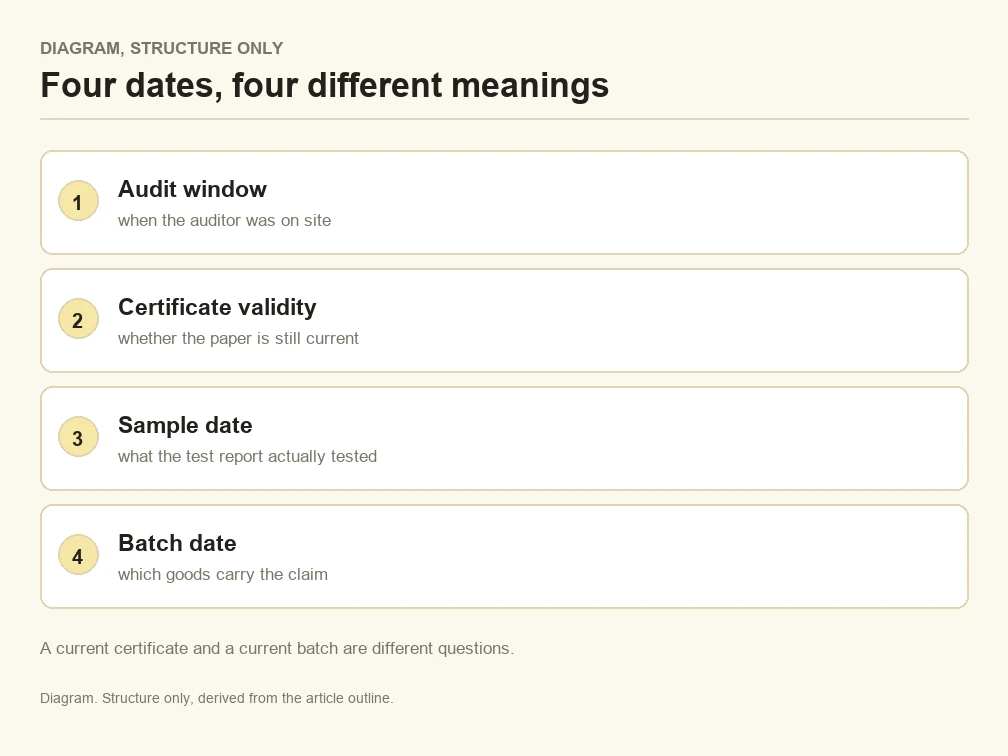
A date on a document is not a freshness badge. Each family carries its own kind of date, and they answer different questions. An audit report has an audit window, which says when someone was on site. A scope certificate has a validity period, which says whether the site may still certify. A test report has a sample date, which says what was tested and when. A carton or batch record has a production date, which says which goods carry the claim.
Mixing them up is the most common verification error. A certificate that is still valid does not prove that the batch in front of you was made inside its scope, and a test report from last season does not prove that this season's compound is the same. Read the date that belongs to the question you are asking, then check that the other three do not contradict it. A test report that is current for one market may still sit behind a standard that has moved, which is why the durability standards behind ASTM and EN 71 are worth a look when the date and the standard disagree.
How to read the four in one sitting
Put the four documents side by side, then ask the same five questions of each one. The answers sort the stack faster than reading any single document end to end:
- Who signed this document, and does that party carry the duty it describes?
- Does the scope line name the product being bought, or only the company it is bought from?
- Which date matters here: the audit window, the validity period, the sample date or the batch date?
- What does this document deliberately not cover, and which of the other three covers it?
- Who signs the replacement for the order, and when is it issued?
A buyer who can answer all five has a file. A buyer who cannot answer the first one is holding a bundle of pages that happen to arrive together. The same logic applies before the documents exist, which is why the supplier RFQ fields should name the documents you expect, not just the duck you want.
Final Note
The uncomfortable conclusion is that document verification is mostly a reading exercise, and reading is the part buyers skip when the file looks thick. The four papers are not equivalent, and the supplier is not the right party to sign all of them. Once you accept that, the questions become simple and slightly boring, which is exactly what a compliance file should be.
Four documents with one understood gap beat forty pages with no signer who can be named. The gap can be closed. A missing signer usually means the duty sits somewhere you have not looked yet.
Frequently Asked Questions
Is BSCI a product certificate?
No. It is a social audit of a site, so it describes working conditions and management systems rather than the duck. Use it to check who makes the goods and how the site is run, and use a test report for the product itself.
Does a GRS certificate cover a rubber duck?
Only if the scope certificate names the product category and the site, and a transaction certificate ties the shipment to the certified chain. A certificate for other product categories does not travel to a duck because the same company forwarded it.
Is a REACH certificate needed?
There is no such certificate. What you need is a test report or a declaration that names the substances checked, the laboratory and the sample, because REACH is a regulation with obligations rather than a scheme that issues paper.
Who signs a CPSIA certificate?
The importer, for goods manufactured outside the United States. The factory can supply the test reports and product data that support it, but the certificate of compliance itself belongs to the party that brings the goods into the country.
Key takeaways
- Four documents, four signers: the signer decides what the page can prove.
- A BSCI audit describes a building, not a duck: check the site identity and the corrective action plan.
- A GRS scope certificate is a claim about a product: read the certification body, the category and the site.
- REACH is a regulation, and no one issues a certificate for it: ask for the report and the substance list.
- The CPSIA certificate is signed by the importer: the duty follows the importer of record, not the factory.