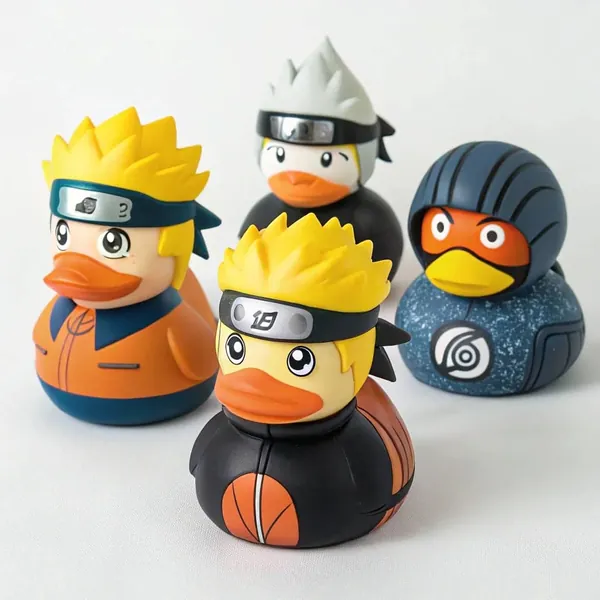
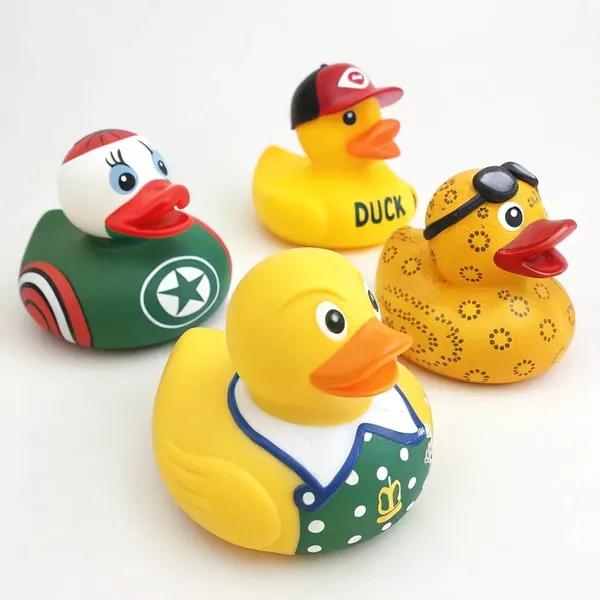
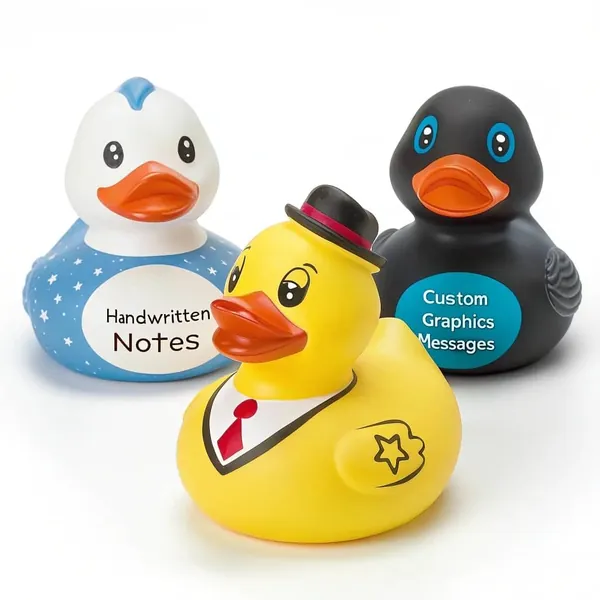
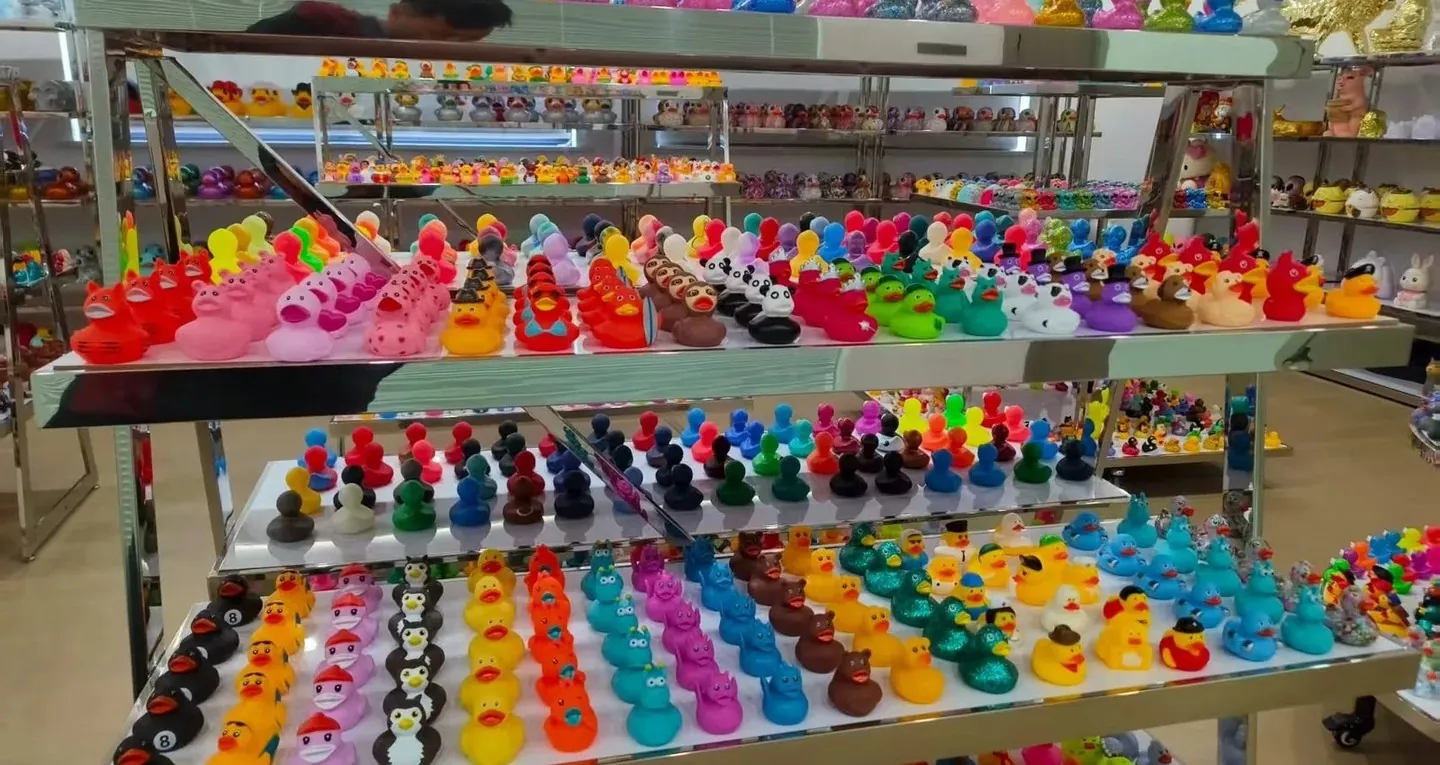
The split is a count of tools and print faces, written down before the batch starts.
Count sculpts, colourways and print faces before discussing quantity, because those three decide what a mixed run can hold. A duck that looks like one object in a catalogue is three separate commitments on the factory side.
In short: A mixed order fits when the number of sculpts is small, the colourways share one tool, and each print face has its own count on the paper. Styles that share a body but differ in colour or print are the least demanding variety. A second sculpt is a second tool, and it starts a separate conversation.
The question is a count of tools, not a count of pieces
A buyer often asks how many designs fit into one order, expecting the answer to be a fraction of the quantity. The better question is how many tools the order touches, because that number decides everything downstream: the setup time, the number of body colours on the line, the number of print passes and the number of marks on the carton.
Two designs that share a body are one tool with two finishes. Two designs with different silhouettes are two tools, and no quantity of ducks changes that. A supplier who answers the quantity question without the tool question is answering the easy half, and the answer will need revising when the artwork arrives.

Three things can vary, and only one needs a new tool
There are three variables in a duck design, and they differ a great deal in what they demand to change. The sculpt is the shape of the body, and a new one needs a tool. The colourway is the body colour, and it needs a clean run with a colour change but no new tool. The print face is the decoration, and it needs an artwork, a plate or a program, and no new tool either.
| What changes | Needs a new tool | What it demands in setup | What it needs on paper |
|---|---|---|---|
| Sculpt (body shape) | Yes | A tool cut and a sample round | A drawing, a tool owner and an approval |
| Colourway (body colour) | No | A colour change and a compound batch | A reference, a tolerance and a count |
| Print face (decoration) | No | An artwork, a plate or a print program | An artwork file, a position and a count |
That table is the whole logic of a mixed run. A buyer who wants many styles should spend the variety on colour and print, and keep the sculpt count as low as the design allows. The same logic explains why stock shapes and custom tooling sit on different sides of the order.

Colour is the variety with the smallest footprint
A colourway change is the least demanding variety in the order and the one most likely to be under-specified. The body colour has to be agreed against a reference, the reference has to survive the difference between a screen and a moulded surface, and the tolerance has to be written down, because two colour batches that both "match Pantone" can still sit visibly apart when the cartons are opened side by side.
The practical rule is one reference per colourway and one count per colourway. A six colour split is six lines on the sheet, six counts and six carton marks, even when all six share one sculpt. Treating the colours as one line is how a mixed run ends with a carton of the wrong ratio and a reorder that cannot repeat the first order.

A print face changes the shelf without touching the steel
The print face is where a small brand gets the most variety for the least tooling. One body, one colour and six print faces gives six products on a shelf, each with its own artwork and its own position on the duck. The sculpt is shared, the tool is paid once, and the difference the customer sees is entirely in the decoration.
Two constraints keep it honest. The position has to be specified, because a logo on the chest and a logo on the belly are different products and one may sit on a curved area that the print cannot hold well. And the print method has to be chosen for the surface, since a pad print and a UV print behave differently on a soft body. That is a printing decision, not a tooling decision, and it should be made per print face rather than per order.

Each style needs its own count on the paper
A mixed order lives or dies on the count sheet. Every style needs its own line with the body, the colour, the print face, the quantity, the inner pack and the carton mark. When two styles share a line, the factory has to guess the ratio, and the guess will be made in the direction that is easiest to run.
The count sheet also fixes the packing. A carton that holds one style can be sealed and labelled as that style; a carton that holds a mix has to be marked as a mix, and the carton specification becomes the document that decides whether the split survives shipping. Buyers who write the count per style get a shipment they can check carton by carton; buyers who write one total get a shipment they have to sort.

Each style needs its own mark in the batch
Once the ducks are painted, two styles that share a body are almost identical in the hand, and the only reliable difference is the mark. That is why every style in a mixed run needs a mark that a worker can read at a glance: a moulded mark in the base, a print on the belly, or a bag label that stays with the group through packing.
For a children's toy the marking question is also a compliance question. The CPSC toy safety guidance records that children's products must carry a tracking label, and that the permanent markings must be on the product as well as its packaging. A mixed run multiplies that requirement by the number of styles, because each style is a separate product for the purposes of the file.
In addition to the above, children's products must also comply with the CPSC tracking label requirement (referenced in section 5.1.2 of ASTM F963) found at 15 U.S.C. § 2063(a)(5).
What the split does to the repeat
A mixed run is easy to place and hard to repeat, because the repeat has to reproduce the ratio as well as the design. The second order needs the same three counts, the same references and the same marks, or the factory will rebuild the split from whatever is left on the shelf and the ratio will drift.
The compound question belongs here too. Every colourway is a separate material batch, and for a duck sold as a children's toy the plasticised part still has to meet the phthalate limit under 16 CFR 1307.3 whatever colour it is. A split that multiplies colourways multiplies the material batches, and each of them deserves the same line in the reorder record as the first order did.
The sheet I would write before a mixed run
The sheet is one page, and it has five columns: style code, sculpt, body colour, print face, quantity. Below the table, four notes: the tool that each sculpt uses, the reference for each colour, the position and method for each print, and the carton mark for each style.
If the sheet cannot be filled in, the order is not ready. If it can be filled in and the number of sculpts is one, the run is simple. If the sculpt count is three or more, the order is really three orders sharing a schedule, and it should be planned that way. Colour options and logo placement are the two pages worth reading next, because they decide most of the sheet.
Four questions belong beside the sheet before it is signed:
- How many sculpts does the order touch, and does each one already have a tool?
- How many body colours are there, and is each one tied to a reference?
- How many print faces are there, and is each position drawn on the duck?
- If one style drops out, does the ratio of the rest still make sense?
Frequently Asked Questions
Can one order carry several different ducks?
Yes, as long as the split is written down. Several styles can share one sculpt and differ in colour and print. Several sculpts can also share one order, but each sculpt is a separate tool and a separate sample round.
Do more colourways mean a higher minimum for each one?
They can, because each colourway is its own material batch and its own line change. The way to keep the split efficient is to hold the sculpt count down and let colour and print carry the variety.
Can the mix change after the order is confirmed?
Only by reopening the count sheet. A change after confirmation moves the ratio, the packing and often the sample, so it should be treated as a new version with a new signature rather than a message.
Does a mixed order take longer than one style?
It usually takes longer, because every style adds setup events even when the tool is shared. The honest planning assumption is that the schedule follows the number of setup events, not the number of ducks.
Final Note
I would keep the sculpt count at one for as long as the design allows, and spend the variety on colour and print where it is simple to repeat. A mixed run that is written on one page, with a line per style and a mark per style, is a run that can be repeated; a mixed run that lives in a message thread is a one time event. The difference between the two is a sheet, and the sheet is the buyer's job. That job is unglamorous and it is the one that decides whether the second order looks like the first. When the sheet is being written, it is also worth naming the one style in the split that would hurt most if it arrived wrong, because that is the style the first carton check should follow through the whole run rather than the style that happens to be on top.
Key takeaways
- The question is a count of tools, not a count of pieces: A buyer often asks how many designs fit into one order, expecting the answer to be a fraction of the quantity.
- Three things can vary, and only one needs a new tool: There are three variables in a duck design, and they differ a great deal in what they demand to change.
- Colour is the variety with the smallest footprint: A colourway change is the least demanding variety in the order and the one most likely to be under-specified.
- A print face changes the shelf without touching the steel: The print face is where a small brand gets the most variety for the least tooling.
- Each style needs its own count on the paper: A mixed order lives or dies on the count sheet.
- Each style needs its own mark in the batch: Once the ducks are painted, two styles that share a body are almost identical in the hand, and the only reliable difference is the mark.
- What the split does to the repeat: A mixed run is easy to place and hard to repeat, because the repeat has to reproduce the ratio as well as the design.
- The sheet I would write before a mixed run: The sheet is one page, and it has five columns: style code, sculpt, body colour, print face, quantity.