Phthalate-free is a phrase that reads like a material grade and behaves like a test result, and the gap between the two is where a duck order quietly acquires a compliance problem. The phrase belongs next to a report line rather than next to a marketing claim, because a report can name the substances, the limit, the part and the sample. That argument is the whole of this page.
Written from LZENGO's material and compliance file work, plus public regulatory guidance from the CPSC and the European Commission.
In short: Phthalate-free is a claim about a test on a named part, not a grade of PVC that exists on a shelf. In the United States the limit sits in section 108 of the CPSIA and is checked against the accessible plasticised component; in the European Union the same chemistry is handled through REACH restrictions and the right to know about substances of very high concern. A claim belongs on the page only when a report names the substances, the limit, the part and the sample.
The phrase is a claim about a test, not a grade of PVC
Phthalates are a family of substances, not one ingredient. Several of them are used as plasticisers, which is why they turn up in soft PVC at all: a rigid PVC shell would not squeeze, and the additive is what gives a duck the feel a buyer associates with the product. The same chemistry that makes the material work is the chemistry the regulation is written around.
That is why the phrase is slippery. A compound can be free of the regulated phthalates and still contain a plasticiser, and a compound can be described as phthalate-free while nobody has tested the part a child can reach. The words describe an outcome, and the outcome depends on which substances are on the list, which limit applies and which piece of the duck was put in the machine.
So the useful move for a buyer is not to argue about the adjective. It is to ask for the report and read the four things a report has to name before it means anything: the substances, the limit, the part and the sample. Everything else on this page is a detail of those four.

What the plasticiser does, and why every duck meets this question
A duck is squeezable because its compound is soft, and softness in PVC comes from a plasticiser rather than from the resin itself. The plasticiser sits between the polymer chains and lets them slide, which is what a hand feels as give. Take it out and the same mould produces a hard shell that would not pass as a bath duck.
That mechanical role is the reason the regulation concentrates on the plasticised part. The question is not whether a duck contains a chemical with a long name; it is whether the accessible plasticised component contains a regulated phthalate above the limit. A painted eye, a printed wing or a moulded beak is not the place the question is usually asked, and a carton is not the product. The part matters as much as the substance.
For a buyer, the practical translation is simple. When a specification says phthalate-free, it is asserting something about the material of the body, and the only way to check that assertion is to see which part of which sample was tested. A duck that passes on a lab bench is a duck whose body was tested, not a duck whose photograph was approved.
What CPSIA actually tests
In the United States the requirement is specific enough to be read out in full. The CPSC phthalates business guidance sets out section 108 of the Consumer Product Safety Improvement Act, codified at 16 C.F.R. part 1307:
Section 108 of the Consumer Product Safety Improvement Act, codified at 15 U.S.C. § 2057c and 16 C.F.R. part 1307, prohibits the manufacture for sale, offer for sale, distribution in commerce, or importation into the United States children's toys and child care articles that contain more than 0.1% (1000 ppm) of the following phthalates in an accessible plasticized component.
Eight substances follow that sentence, and the same page defines the product scope: a children's toy is a consumer product designed or intended by the manufacturer for a child twelve years of age or younger for use when the child plays. That definition is where a duck programme usually discovers it has a decision to make, because a promotional duck and a bath toy can come off the same tool and land in different files.
The guidance also explains what happens after the limit is met. Manufacturers and importers of children's products subject to the regulation have to certify compliance by issuing a Children's Product Certificate, and for the phthalate requirement the citation to use is 16 C.F.R. part 1307. Testing exemptions for certain materials do not remove the underlying requirement, and the commission notes that a firm can still be held responsible if the finished product is found above the limit.
What REACH adds to the same file
The European route does not use the same structure, and a buyer who treats one report as a passport for both markets will be disappointed. The European Commission's REACH guidance describes a framework built on registration, evaluation, authorisation and restriction, and it is the restriction route that decides which substances may be limited or banned in articles placed on the EU market.
REACH also adds a duty that has nothing to do with a lab bench. Under Article 33, consumers have the right to know whether the products they buy contain a substance of very high concern, and the commission states that companies are obliged to reply to such an inquiry within 45 days. For a duck programme that means the file has to be able to answer a question from a customer, not only a question from a laboratory.
The practical difference for a buyer is scope. The US question is written around children's toys and child care articles, with an age definition attached. The EU question runs through a list of restricted and candidate substances and applies to articles more broadly. A duck sold as an adult giveaway can still be an article under REACH, which is why the two files are written separately even when the compound is the same.
What one certificate cannot tell you
A certificate is evidence about a sample, not a description of a material. That single sentence saves a great deal of confusion, because buyers often treat a certificate as a permanent property of the product rather than as a result attached to a date, a part and a method.
Three limits follow from it. A report covers the part it says it covers, so a body report does not automatically cover a newly added cord, a printed tag or an accessory that a child can reach. A report covers the compound that was submitted, so a change of supplier, a change of plasticiser or a new colour concentrate can move the material away from the tested state. And a report covers one market's rule set, so a CPSIA report does not answer a REACH question and a REACH report does not certify a children's product for the United States.
None of that makes certificates less useful. It makes them specific, which is what a buyer needs when a retailer asks a direct question. The label guide covers where the marks that accompany a certificate have to sit, and the durability standards guide covers the physical tests that a chemical report never touches.
How to read a report before you accept it
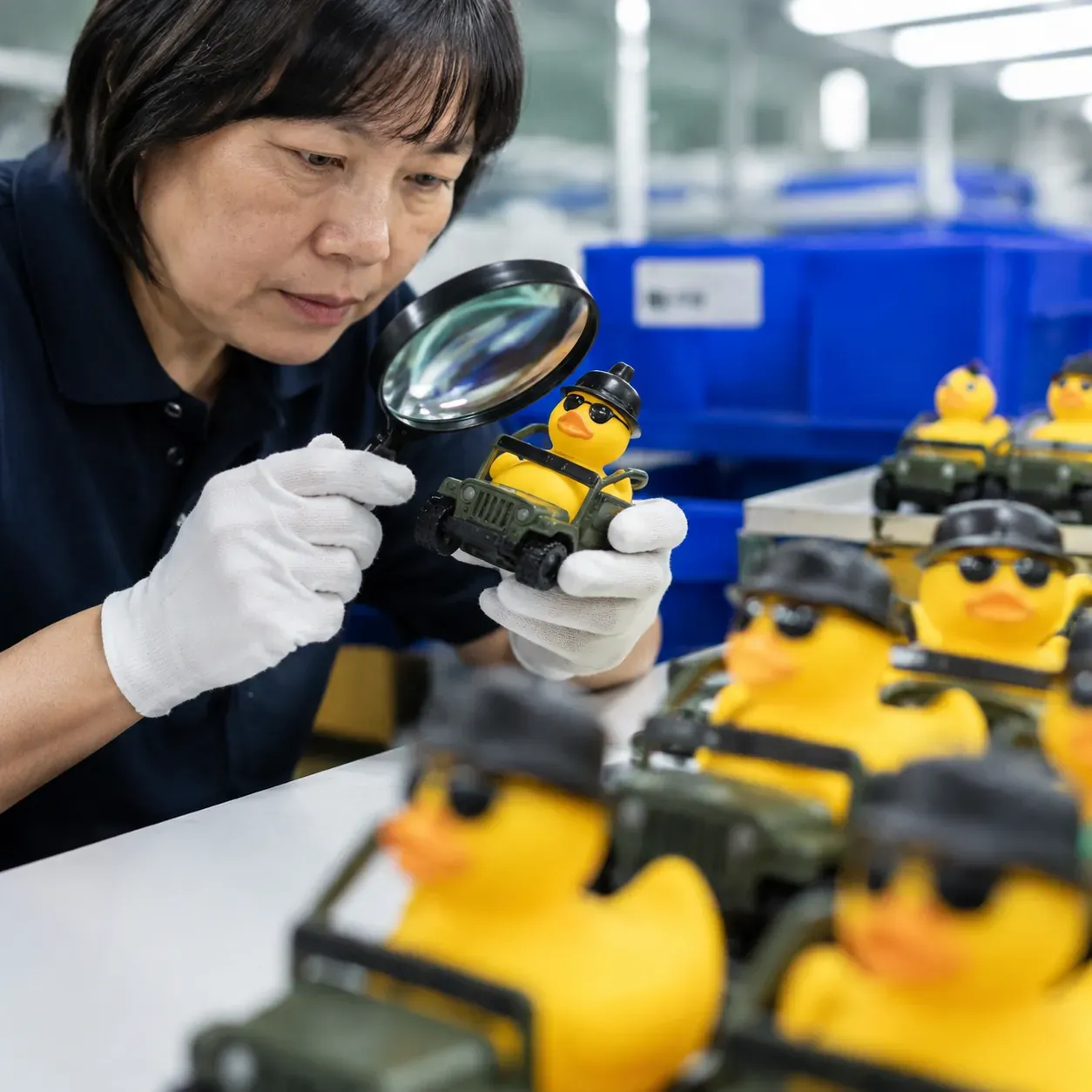
Reading a report takes a few minutes and a fixed order. Start with the sample, because everything else is conditional on it. Then check the substances and the limit against the market you are selling into. Then check the part, because the accessible plasticised component is the thing the rule is written about. Then check the laboratory, the method and the date.
| What the report shows | What it decides | What to check | What it does not cover |
|---|---|---|---|
| Sample identity | Whether this report is about your duck | Style, size, compound and colour as ordered | A later version of the same design |
| Substances and limit | Which rule set the result belongs to | The named phthalates and the limit in the market you sell into | A different market with a different list |
| Part tested | Whether the tested piece is the regulated one | The accessible plasticised component, not the carton or the print | An accessory added after the test |
| Laboratory and method | Whether the result is comparable | An accredited laboratory and a named method | How the compound behaves in sunlight |
| Date and scope | Whether the file is current | The test date against the order date | The next production lot |
The last row is the one that catches repeat orders. A report attached to a compound that has since changed is a historical document, and a report attached to a sample from a different lot is a document about a duck that was not shipped. Neither is dishonest, and both are common, which is why the file should record which lot and which colour the report belongs to.

Where the claim belongs in a brief
A compliance claim belongs on the material line of the brief, next to the colour and the size, rather than in a covering message. Written there, it can be answered with a document. Written in a message, it becomes a sentence that travels from buyer to sourcing office to factory and arrives as a preference rather than a requirement.
The line I would write names the market, the age grading and the rule. Something like: the duck is a children's product for the United States, so the compound has to be certified under 16 C.F.R. part 1307 and the certificate has to travel with the shipment. That one sentence tells a factory which lab result to pull, and it also tells the buyer what to expect in return.
The age answer deserves its own line, because it changes the file. A duck that is marketed as a plaything for a child twelve or younger pulls in the children's product requirements, while a duck sold as a decorative or collectible item sits in a different conversation. That is a marketing decision as much as a material one, and it is much easier to record at the brief stage than to reconstruct after a retailer asks.
The compound and colour notes cover the material side of the same brief, and the California warning file covers a second US route that runs alongside the federal one. A programme that needs the full set usually has a retailer or an institution behind it, which is the situation described in the hospital gift programme notes.
Questions to settle before you accept the file
- Which market is this order actually being sold into, and is there more than one?
- Is the duck a children's product for the destination market, and at what age grading?
- Which part of the duck was tested, and does the current design still match that part?
- Which compound and which lot does the report belong to, and has either changed since?
- Is the claim written on the material line of the brief, or only in a message?
A buyer who can answer those five has turned a phrase into a file, and the file is what a retailer, a hospital or a customs broker will ask for. The answers also make a repeat order much calmer, because the same questions are answered by the same documents instead of being reopened every season.
If the compound itself has an odour question, that is a separate conversation about airing and packing, set out in the smell and airing notes. It is worth keeping separate, because a smell complaint and a phthalate complaint sound similar to a buyer and are answered by completely different evidence.
Frequently Asked Questions
Are all rubber ducks phthalate-free now?
No. The rules restrict a named list of substances in a defined part of a children's product, and compliance depends on the compound and the market rather than on the category of product. A duck made for one market with a compliant compound is not automatically compliant for another, and an adult gift duck is not automatically exempt.
Does a REACH report cover the US market?
No. REACH and CPSIA are separate frameworks with separate lists, limits and paperwork, even where they restrict the same chemistry. A supplier who offers one report for both markets has either misunderstood the question or is hoping the buyer will not ask, and either answer is worth pursuing before an order is placed.
Do adult giveaways need child safety testing?
That depends on how the duck is designed, marketed and packaged. If it is presented as a plaything for a young child, the children's product requirements follow it. If it is clearly a decorative or collectible item for adults, the analysis changes, but the REACH side can still apply because it reaches articles more broadly than the toy rules do.
How often should reports be renewed?
There is no single interval that fits every programme, because the trigger is change rather than time. A new compound, a new colour concentrate, a new supplier or a new part is the moment to check whether the existing report still describes the product. A report that still matches the material is still evidence, and a report that does not is a document about something else.
Final Note
The phrase phthalate-free is not the problem. The problem is that it sounds like a material when it is a result, and a result without a named substance, limit, part and sample cannot be checked by anyone.
Written properly, the claim becomes a line in a brief and a document in a folder, and both survive a change of staff on either side of the order. That is the difference between a duck that passes because it was tested and a duck that passes because nobody asked. The second kind is fine until a retailer, a hospital or a border officer asks the question, and by then the answer has to exist already.
Key takeaways
- The phrase is a claim about a test, not a grade of PVC: ask for the report before the adjective.
- What CPSIA actually tests: section 108, 16 C.F.R. part 1307, an accessible plasticised component and an age definition.
- What REACH adds to the same file: restrictions on substances of very high concern, plus a right to know with a 45 day reply duty.
- What one certificate cannot tell you: a result belongs to one sample, one part and one market.
- Where the claim belongs in a brief: on the material line, with the market and the age grading beside it.